
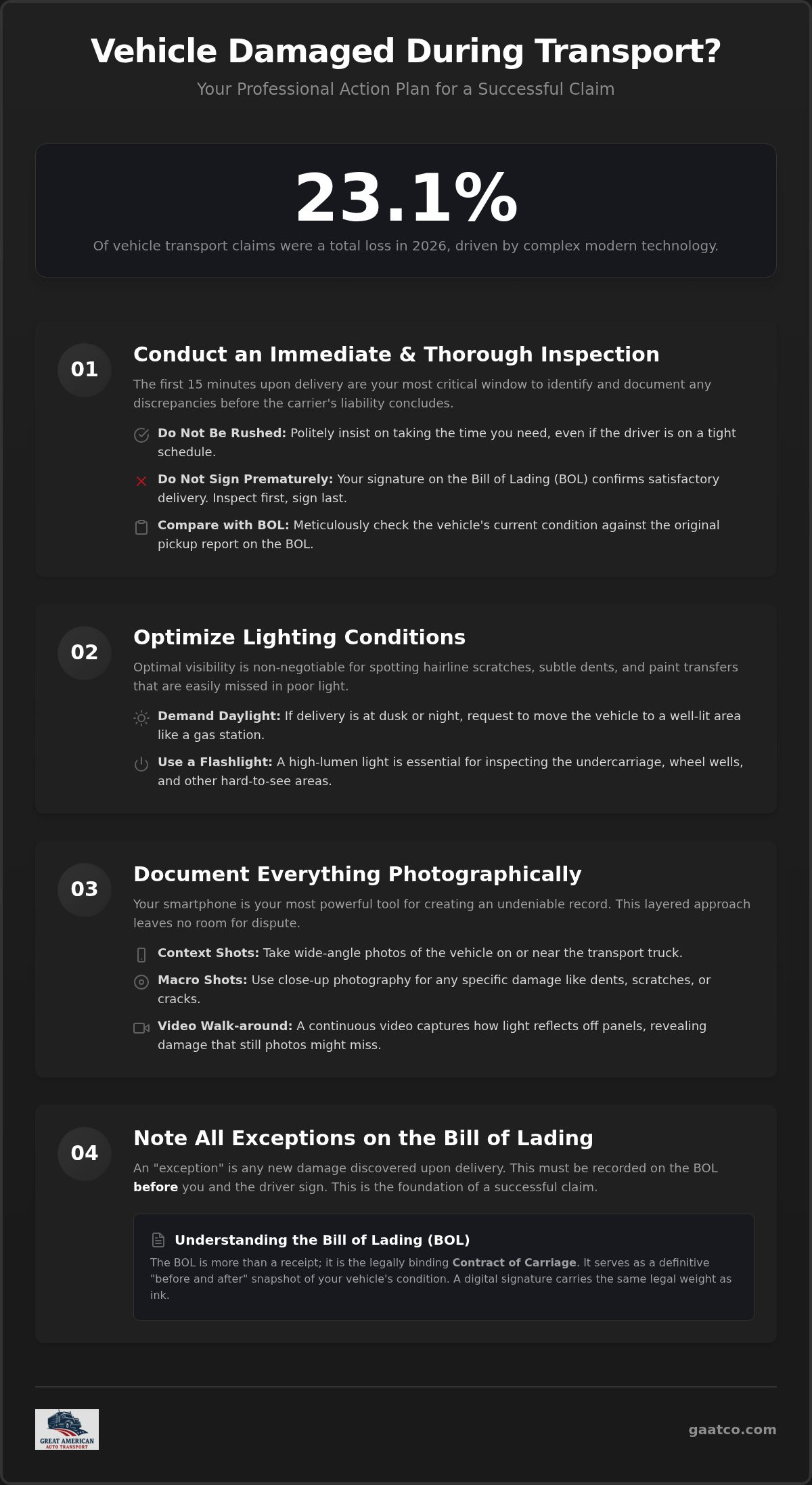
In 2026, industry data revealed that nearly 23.1 percent of vehicle transport claims were classified as a total loss, a record high fueled by the intricate repair requirements and calibration needs of modern automotive technology. Discovering a blemish or mechanical fault upon the delivery of a prized vehicle is a distressing experience that often leaves owners feeling vulnerable to the complexities of logistics insurance. It is natural to worry that a carrier might ignore your claim or that the legal weight of delivery documents will work against your interests. However, mastering what to do if your car is damaged during transport is essential for any discerning owner who values professional poise and financial security.
This article serves as a definitive resource, offering the clarity needed to navigate insurance protocols and protect your automotive assets with absolute confidence. You will gain a sophisticated understanding of how to document damage effectively and hold carriers accountable through established legal frameworks. We will explore the vital role of the Bill of Lading, the federal timelines governing claim resolutions, and the strategic documentation required to achieve a favorable outcome. By following this meticulous roadmap, you can ensure that your vehicle is restored to its proper condition without unnecessary administrative friction.
Key Takeaways
- Master the protocol for a professional-grade delivery inspection to ensure all discrepancies are documented with precision before the carrier departs.
- Gain comprehensive insights into what to do if your car is damaged during transport, focusing on the Bill of Lading as your primary legal instrument for recovery.
- Distinguish between carrier liability and personal insurance to navigate the sophisticated administrative landscape of cargo claims with confidence.
- Assemble a robust evidence dossier that meets the rigorous standards of insurance adjusters, facilitating a more efficient and successful resolution.
- Discover how partnering with an established logistics expert minimizes operational risks through meticulous carrier vetting and door-to-door oversight.
The Delivery Inspection: Immediate Actions for Vehicle Owners
The arrival of your vehicle at its destination marks the conclusion of a complex logistical journey. The initial fifteen minutes following the carrier's arrival are the most critical for any owner. This brief window represents your primary opportunity to establish the vehicle's condition before the carrier's legal liability concludes. Even in high-pressure environments like the congested streets of New York or the busy hubs of Chicago, you must remain composed. Drivers are often on strict schedules, yet a professional inspection cannot be rushed. Understanding exactly what to do if your car is damaged during transport begins with this meticulous scrutiny. You must never sign the delivery receipt until your walk-around is complete, as your signature often serves as a legal acknowledgement that the vehicle arrived in satisfactory condition.
Industry data suggests that while fewer than 5 percent of shipments result in a damage claim, the majority of these issues are minor cosmetic flaws that are easily overlooked without a structured approach. This is where the Bill of Lading becomes your most vital asset. It acts as the definitive record of the vehicle's state from the point of origin to the final destination. By comparing the current state of the car against the notes made during pickup, you can identify discrepancies immediately. Choosing a partner that utilizes licensed and insured carriers ensures that if a discrepancy is found, a professional framework exists to address it.
The Daylight Requirement and Artificial Lighting
Optimal visibility is non-negotiable when searching for hairline scratches or subtle paint transfers. If a delivery occurs during twilight or in a poorly lit urban corridor, you should insist on moving the vehicle to a well-lit area. We recommend using a high-lumen tactical flashlight to inspect the undercarriage and wheel wells, where road debris damage often hides. It is also essential to document environmental factors that could obscure damage, such as the persistent rain common in Seattle or the salt air film found in coastal cities like Miami. These regional nuances can mask surface abrasions that only become visible once the vehicle is cleaned.
Comprehensive Photographic Documentation
Your smartphone is the most powerful tool in your evidence dossier. Begin with wide-angle shots that capture the vehicle's position on or near the trailer to provide context for the insurance adjustor. Transition to macro photography for any specific concerns, such as glass cracks, fresh dents, or compromised trim pieces. A continuous video walk-around serves as a secondary verification tool to capture how light reflects off the panels from multiple angles. This layered approach to documentation leaves little room for dispute during the claims process, especially when dealing with the increased repair complexity of modern vehicles equipped with advanced sensors.
The Legal Significance of the Bill of Lading
The Bill of Lading (BOL) is far more than a simple delivery receipt; it is the official Contract of Carriage and the primary legal instrument for resolving disputes. This document serves as a comprehensive "before and after" snapshot of your vehicle's condition, capturing every detail from the moment of pickup to the final handover. When researching how to ship a car, you'll find that industry experts emphasize the BOL as the foundation of any successful claim. Whether you are presented with a traditional paper copy or a modern digital version, the legal weight remains identical. A digital signature carries the same binding authority as ink, making it imperative that you review every field with a critical eye before finalizing the document.
Understanding the legal nuances of this contract is the first step in mastering what to do if your car is damaged during transport. If a discrepancy is found, the BOL is where that truth must be immortalized. To ensure your logistics experience remains seamless and protected, consider partnering with a firm that prioritizes transparent and professional documentation at every stage of the journey.
Noting Exceptions with Precision
The term "exception" refers to any damage found at delivery that was not present at the time of pickup. To maintain professional clarity, you should use industry-standard codes such as "SC" for scratches, "D" for dents, or "CH" for chips. It's not enough to simply mention these issues to the driver; they must be written clearly on the BOL. You must ensure the carrier's representative acknowledges these notes with their own signature. In the specialized transport industry, silence is often interpreted as acceptance. If you sign a "clean" BOL without noting damage, you are legally admitting the vehicle arrived in perfect condition, which makes subsequent claims nearly impossible to win.
The Role of the Carmack Amendment
Interstate vehicle transport is governed by the Carmack Amendment, a federal law designed to create a uniform standard of liability for carriers. Whether your vehicle is moving from Dallas to Atlanta or across the entire country, this legislation protects you by holding the carrier responsible for damage that occurs while the car is in their care. However, the burden of proof rests entirely on the vehicle owner. You must demonstrate that the vehicle was in better condition at pickup than it was at delivery. By maintaining a meticulous BOL and following the inspection protocols established in the previous section, you provide the undeniable evidence required by federal law to secure a fair settlement.
Understanding Insurance Frameworks and Carrier Liability
Navigating the financial protections of automotive logistics requires a clear distinction between your personal auto policy and the carrier's cargo insurance. Federal law mandates that all interstate motor carriers maintain liability insurance, which serves as the primary coverage for damage occurring during transit. This is why our team at GAATCO prioritizes licensed and insured carriers for every assignment we facilitate. Understanding these insurance layers is a vital part of knowing what to do if your car is damaged during transport. Your personal policy typically acts as secondary coverage, and filing a claim against the carrier's policy shouldn't affect your personal premiums, as the damage occurred while the vehicle was in the care of a third party.
Primary Cargo Insurance vs. Contingent Liability
The carrier's cargo insurance specifically covers the vehicle while it's being loaded, transported, and unloaded. However, these policies often contain exclusions for personal items left inside the cabin or mechanical failures not caused by transport. It's also vital to understand the carrier's deductible. While the carrier is responsible for this cost, a high deductible can sometimes lead to administrative delays if the company lacks the liquidity to cover minor repairs immediately. We mitigate these risks by vetting partners against rigorous financial and operational standards, ensuring they possess the stability to honor their obligations even in complex scenarios.
Climate and Environmental Liability
Environmental factors present a unique challenge in the insurance landscape. Most carrier policies exclude "Acts of God," such as hail in Phoenix or hurricane damage in Miami, as these are considered beyond the carrier's control. Open carriers also expose vehicles to road hazards like pebbles or debris, which some insurance adjusters may classify as wear and tear rather than transport damage. For high-value assets, enclosed car transport provides a critical layer of protection. This service offers significantly higher liability caps and physically shields the vehicle from both road debris and severe weather.
When considering what to do if your car is damaged during transport, verifying the specific limits of the cargo policy before the journey begins is a hallmark of a sophisticated client. With the average property damage liability claim reaching $6,770 in 2024, standard policies may suffice for minor incidents. However, enclosed carriers are tailored for high-stakes logistics, providing the comprehensive coverage required for classic and exotic investments that far exceed average repair costs. Understanding these frameworks ensures you aren't left vulnerable to the road hazard loopholes that can complicate claims in the open transport sector.
A Professional Roadmap to Filing a Damage Claim
Once you've noted discrepancies on the delivery documents, the physical inspection phase transitions into a rigorous administrative process. Understanding the administrative sequence of what to do if your car is damaged during transport transforms a stressful event into a manageable logistics task. You must act as the primary coordinator of your own recovery, maintaining a meticulous communication log that archives every interaction with the broker, carrier, and insurance adjustor. This "Evidence Dossier" should include your time-stamped photographs, the signed Bill of Lading, and a clear record of all verbal agreements. Precision at this stage is the hallmark of a sophisticated owner protecting a high-value investment.
Step 1: Immediate Notification and Documentation
You should initiate formal contact within 24 to 48 hours of delivery, even though federal law provides a broader window for formal filings. Sending a formal "Intent to File a Claim" via tracked email or certified mail ensures there's a legal timestamp on your grievance. Attaching high-resolution images and the annotated Bill of Lading to this initial notice prevents the carrier from claiming the damage occurred after they relinquished custody. For those seeking the highest standards of accountability, partnering with a firm that provides vetted, high-tier logistics solutions can significantly streamline this initial communication phase.
Step 2: Obtaining Professional Repair Estimates
Step 3: Negotiating the Settlement
Federal regulations require a motor carrier to acknowledge receipt of your claim within 30 days and provide a written resolution, such as a payment, offer, or denial, within 120 days. This dossier is your primary leverage when determining what to do if your car is damaged during transport and the carrier's insurance adjuster begins their review. You should be prepared to discuss the difference between "Actual Cash Value" and "Replacement Cost", especially for rare assets. If a carrier becomes unresponsive or refuses to acknowledge documented evidence, involving the Federal Motor Carrier Safety Administration (FMCSA) or the Better Business Bureau can provide the necessary pressure to reach a fair settlement.
Mitigating Risk through Elite Transport Standards
While knowing what to do if your car is damaged during transport is a vital safeguard, the most effective strategy is proactive risk mitigation. Selecting a transport partner that prioritizes safety over high-volume turnover significantly reduces the likelihood of ever needing to initiate a claim. Our commitment to hassle-free logistics is built upon a foundation of rigorous carrier vetting and an uncompromising approach to operational excellence. By focusing on professional door-to-door delivery, we eliminate the structural risks associated with terminal-to-terminal handling. This ensure your vehicle remains in a controlled, professional environment from the moment it's loaded until it reaches its final destination.
The Case for Enclosed Transport
For long-haul routes such as San Diego to Boston, environmental exposure is a significant variable that can't be ignored. Enclosed transport provides a physical barrier against road debris, industrial fallout, and unpredictable weather systems that often cause minor cosmetic damage. This service is particularly essential for luxury vehicles with low ground clearance; specialized carriers utilize hydraulic lift gates to prevent any undercarriage contact during the loading process. Viewing the higher fee for enclosed shipping as a strategic investment in risk management is a hallmark of sophisticated automotive ownership. It's often far more economical than navigating the complexities of a claim for specialized paint or advanced sensor repairs later.
Vetting Your Transport Partner
Our 20 years of expertise in the US logistics market allows us to navigate the specific challenges of major hubs like Houston and New York with ease. We believe that transparent pricing is a direct reflection of a carrier's commitment to safety and operational flow. Rates that appear unusually low often indicate a reliance on underinsured carriers or aging equipment that lacks modern safety features. Before finalizing your booking, we recommend verifying a carrier's safety records through federal databases and ensuring their insurance limits align with your vehicle's current market value. Understanding what to do if your car is damaged during transport starts with choosing a partner that leaves nothing to chance.
To ensure a secure and professional shipping experience, consider this final checklist:
- Confirm the carrier is fully licensed and maintains current insurance credentials.
- Verify the availability of door-to-door logistics to minimize handling risks.
- Inquire about specialized loading equipment for vehicles with low ground clearance.
- Request a clear explanation of the carrier's primary cargo insurance limits and deductibles.
- Ensure the transport broker has a proven track record of handling high-value assets with discretion.
Securing Your Automotive Investment with Confidence
Success in automotive logistics depends on a combination of meticulous preparation and professional oversight. By mastering the delivery inspection and recognizing the legal authority of the Bill of Lading, you transform a potential liability into a controlled administrative process. This proactive approach ensures that your vehicle's value is preserved and your rights are protected under federal law. If your inspection reveals mechanical issues, consulting with a specialized facility like Camco Transmission Auto Care at camcotrans.com can provide the technical expertise needed to restore your vehicle. Understanding exactly what to do if your car is damaged during transport is a fundamental skill for maintaining a sophisticated automotive collection.
Our team at GAATCO brings 20+ years of industry-leading expertise to every shipment, offering A+ rated customer service and specialized handling for luxury and classic vehicles. We prioritize safety and transparent logistics to ensure your vehicle arrives in pristine condition. When you require a partner who understands the nuances of high-stakes transport, we are ready to assist. Request a Professional Transport Quote from GAATCO today and experience the peace of mind that comes from working with seasoned experts. Your investment deserves nothing less than elite protection.
Frequently Asked Questions
What is the first thing I should do if I see a scratch on my car at delivery?
You must immediately document the scratch on the Bill of Lading before the driver departs. This serves as the primary legal evidence that the damage occurred while the vehicle was in the carrier's possession. Take high-resolution photographs of the area from multiple angles to supplement the written note. Ensuring the driver signs the document with these specific exceptions is the most critical step in establishing a valid claim.
Can I refuse to pay the carrier if my car is damaged?
You should not withhold payment for the transport services, as the shipping contract and the insurance claim are separate legal matters. Refusing payment can lead to complications such as the carrier placing a lien on the vehicle or refusing to release it. Instead, pay the agreed amount and immediately initiate the formal claims process through the carrier's insurance provider to seek reimbursement for the documented repair costs.
How long do I have to file a damage claim after delivery?
Federal law stipulates that carriers cannot set a deadline of less than nine months for filing a formal claim, though individual carrier policies often require notification within 24 to 48 hours. Acting quickly is essential to demonstrate that the damage did not happen after delivery. Reviewing your specific contract will clarify the precise window for reporting discrepancies and understanding what to do if your car is damaged during transport to avoid a technical denial.
Does the carrier’s insurance cover personal items left inside the car?
Carrier cargo insurance typically excludes coverage for personal belongings left inside the vehicle during transit. Most transport contracts explicitly prohibit the shipment of household goods or high-value personal items within the cabin or trunk. If items are lost or damaged, the carrier is rarely held liable. It's always recommended to remove all personal property and aftermarket accessories before the vehicle is loaded onto the trailer for its journey.
What happens if the damage is discovered after the driver has left?
Discovering damage after the driver has departed significantly complicates the recovery process because the signed Bill of Lading often acts as a waiver of future claims. You should still contact the carrier and broker immediately with time-stamped photographs and any video evidence captured during the delivery. While these concealed damage claims are difficult to win, professional persistence is key when determining what to do if your car is damaged during transport after a driver leaves.
Is the transport broker or the carrier responsible for the damage claim?
The motor carrier that physically transported the vehicle is legally responsible for the damage claim under the Carmack Amendment. While the transport broker facilitates the logistics and vetting process, their role is typically limited to mediation and administrative support during a dispute. You'll ultimately file the formal claim against the carrier's primary cargo insurance policy, although a reputable broker will often assist you in navigating the communication with the insurance adjustor.
How does enclosed transport reduce the risk of damage compared to open transport?
Enclosed transport utilizes hard-sided or soft-sided trailers to shield the vehicle from road debris, industrial fallout, and adverse weather conditions. This specialized service also employs advanced loading equipment, such as hydraulic lift gates, which are essential for protecting the undercarriages of luxury or low-clearance vehicles. By eliminating exposure to the external environment, enclosed carriers prevent the vast majority of cosmetic and structural issues that can occur on open, multi-car trailers.
Should I use my own insurance company to handle a transport claim?
You should first file the claim through the carrier's primary cargo insurance to avoid paying a personal deductible or risking a premium increase. Your personal auto policy is generally considered secondary coverage for damage occurring during professional transport. However, if the carrier's insurance is insufficient or if the claim is unjustly denied, your own provider may offer assistance in subrogating the claim against the carrier to recover the necessary repair funds.


