

What should you make of a tracking status that hasn’t changed since yesterday? A pause in car shipping tracking doesn’t necessarily mean your vehicle has stopped moving. Many shipments are reported through milestone updates rather than a continuous live map, so it helps to know what each status confirms and what it doesn’t.
When your vehicle is in transit, useful tracking combines shipment milestones, realistic timing, and clear communication. This guide explains how to follow your vehicle’s journey, interpret common updates, and respond when information changes or stops appearing.
You’ll learn what pickup, transit, and delivery updates indicate, why schedules can shift, and what details to have ready when requesting an update. If tracking hasn’t refreshed for more than 24 hours, contacting the shipping company is a sensible next step. Understanding the process can help you follow your shipment from collection through delivery.
Key Takeaways
- Use your booking reference and shipment details to find the latest update and identify your vehicle’s place in the transport process.
- Car shipping tracking may show live location data or milestone updates. Each provides a different level of detail about your vehicle’s progress.
- If updates pause, review the latest confirmed status and estimated dates before deciding what follow-up is needed.
- Keep key booking information ready when requesting an update so the shipment can be identified clearly.
- Use pickup and delivery updates to plan ahead, including choosing an accessible meeting location when access is limited.
What Does Car Shipping Tracking Show During a Vehicle’s Journey?
Car shipping tracking shows a vehicle’s progress through the transport process, usually through shipment milestones rather than a continuous map. It can tell you whether the vehicle has been picked up, dispatched, entered transit, or reached the delivery coordination stage. A status update confirms progress, but it does not necessarily show the vehicle’s precise location at that moment.
Tracking detail depends on the system and communication process used for a shipment. Some provide location data, while others report key stages. In a broker-arranged shipment, an auto transport broker coordinates transport between the customer and carrier, so updates may reflect both operational milestones and movement.
For a visual overview, watch this explanation of how vehicle shipment tracking works:
What information can a car shipment update provide?
Updates may confirm pickup, indicate dispatch or transit, or provide information about delivery coordination. These milestones help you understand the shipment’s operational progress:
- Pickup confirmation: The vehicle has been collected and accepted for transport.
- Dispatch or transit: The shipment has entered the carrier’s route.
- Delivery coordination: The next step is arranging the handoff at the destination.
The detail provided depends on the shipment’s tracking and communication process. For example, an “in transit” status confirms a stage of progress, not a street address or live position.
Is car shipping tracking the same as live GPS tracking?
No. A live GPS feed displays a vehicle’s or carrier’s location as location data becomes available. Milestone-based updates report events in the shipment process, such as dispatch or delivery coordination. Not every shipment provides both formats, and updates may not refresh continuously.
A GPS view might show a carrier moving along a route, while a milestone update might simply confirm that the vehicle has entered transit. Both can help set expectations, but only the location feed offers a map-based position. Read each update for what it actually reports, and use milestone information to follow progress without treating it as precise location data.
How to Track a Car Shipment and Understand Each Milestone
Start with the information from your booking, then compare the latest shipment status with the pickup and delivery plan. This helps you understand what has happened and what comes next without assuming an update provides a live vehicle location.
Which details should you have ready to track a vehicle?
Keep your shipment reference and the contact details associated with the booking together. Have the vehicle’s identifying information, origin, and destination available too. These details help distinguish your shipment from others and make it easier to ask about its status accurately.
Use this sequence to review progress:
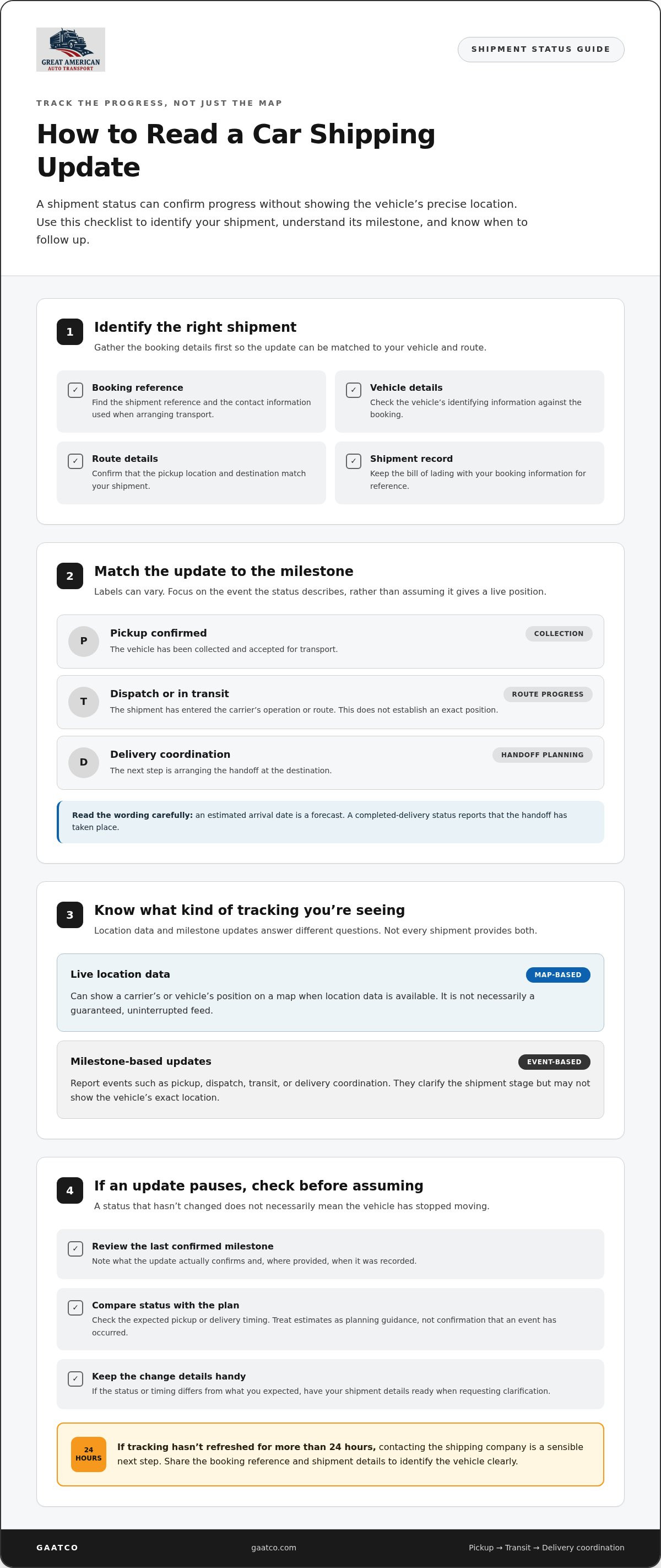
- Step 1: Locate your booking details. Find the shipment reference and the contact information used when arranging transport.
- Step 2: Identify the shipment. Check that the vehicle, pickup location, and destination match your booking.
- Step 3: Review the latest status. Note the milestone it describes and, where provided, when the information was recorded.
- Step 4: Compare it with the plan. Check the update against the expected pickup or delivery timing. Treat estimates as planning guidance, not confirmation that an event has occurred.
- Step 5: Record any change. If the status or timing differs from what you expected, keep the details handy when requesting clarification.
How should you read common car shipping status updates?
Status labels can vary, so focus on the event described rather than assuming every label has a universal meaning. Pickup confirmation generally indicates collection. Dispatch suggests the shipment has been assigned or released into the carrier’s operation. “In transit” signals progress along the route, while delivery coordination concerns arranging the handoff.
An estimated arrival date is a forecast, not confirmation that delivery has occurred. Likewise, a transit update does not establish an exact position. A completed-delivery status is different from an estimate because it reports that the handoff has taken place. If a label is unclear, ask what event it refers to and whether the timing shown is estimated or confirmed.
The bill of lading is another useful shipment record. The bill of lading requirements in the Electronic Code of Federal Regulations provide formal context for this motor-carrier document. Keep it with your booking information so you can refer to the same shipment record when reviewing details.
For an overview of vehicle transport options and coordination, see GAATCO’s vehicle shipping services.
Live GPS Tracking vs. Shipment Updates: What Should You Expect?
Car shipping tracking can refer to location data or progress reported at key stages. The distinction affects what you can learn from an update: a map may show a carrier’s position, while a shipment status may confirm an event without showing where the vehicle is right now.
| Live location data | Milestone-based shipment updates |
|---|---|
| Shows a carrier’s or vehicle’s position on a map when location data is available. It can offer a more immediate view, but should not be treated as a guaranteed, uninterrupted feed. | Reports progress such as pickup, dispatch, transit, or delivery coordination. It helps clarify the shipment stage, but does not necessarily show an exact location. |
| Useful for seeing where the carrier appears to be along a route. A displayed position is a snapshot of location data, not confirmation of arrival or handoff. | Useful for following operational progress and planning around the next milestone. The timing and detail of updates depend on the shipment’s tracking and communication process. |
Neither method should be assumed for every shipment. When available, a location feed answers, “Where is the carrier shown?” A milestone update answers, “What stage has the shipment reached?” Use each type of information for its intended purpose, and avoid interpreting a status as a precise position.
What can change the timing of a car shipment update?
Update timing may reflect route conditions and carrier operations. Traffic, weather, route adjustments, and access at pickup or delivery locations can affect progress or coordination. A multi-vehicle carrier may also make several scheduled stops, so a shipment is part of a broader route rather than a direct trip between two points.
For example, a pickup or delivery in a dense part of Chicago may require coordination around street access and a suitable meeting point. On a longer route across the United States, weather or traffic in one region may influence progress farther along the journey. These are possible factors, not fixed explanations for every delay.
Why can a delivery estimate change while a vehicle is in transit?
An estimate is planning information based on the route and conditions understood at the time. If those conditions change, the projected timing may be revised. A new estimate alone does not establish that a vehicle is missing or damaged. Compare the revised timing with the latest confirmed milestone, such as dispatch or an in-transit update, to understand what has actually changed.
If the new timing is unclear, focus your follow-up on two points: the most recent confirmed shipment event and the current delivery estimate. This keeps the conversation grounded in reported progress rather than assumptions based on a map or a changed date.
What to Do When Car Shipping Tracking Stops Updating
A pause in car shipping tracking can be unsettling, but a quiet interval by itself does not show that a shipment is in trouble. Updates may be tied to specific milestones rather than sent continuously. Check the information you already have, then request clarification if the details conflict or an expected milestone has passed.
- Confirm the shipment reference and contact details match your booking.
- Review the latest confirmed status and when it was recorded.
- Compare the status with the pickup or delivery estimate previously provided.
- Write down what is unclear, such as whether pickup occurred or whether arrival timing has changed.
What should you check before requesting a status update?
First, make sure you are looking at the correct shipment. Check the booking reference and associated contact details, then review the vehicle and route information. Compare the latest confirmed milestone with the estimate you received. If pickup confirmation is missing, or the delivery estimate has passed without a revision, identify that specific gap when you follow up. Clear details make it easier to address the question directly.
A quiet tracking interval can have more than one explanation, and the available status may not show continuous location data. If there has been no update for over 24 hours, contact the shipping company for more information. The same applies when updates contradict one another or an important milestone has passed without clarification. Ask what the latest confirmed event is and whether the timing has changed.
What information makes a shipment update more useful?
Have the booking reference, vehicle details, route, and latest status ready. Then ask a focused question about the next expected milestone, such as pickup confirmation, a transit update, or delivery coordination. This is more useful than requesting an exact vehicle location that a milestone-based update may not provide. Record any revised estimate so the people receiving or handing off the vehicle can plan around the latest information.
Shipment coordination brings together route details, pickup arrangements, and delivery logistics. Explore GAATCO’s vehicle shipping services for an overview of transport options. For help planning a shipment, connect with GAATCO.
Prepare for Delivery and Keep Your Car Shipment on Track
Shipment updates are most useful when they guide practical decisions. As delivery approaches, use the latest estimate to coordinate your availability, keep relevant transport documents accessible, and consider whether the planned handoff location will work for a carrier. A clear plan can make the final stage of vehicle transport easier to manage, even if the estimate changes.
How can you prepare for the vehicle delivery handoff?
Keep your contact details available and plan around the current delivery estimate, allowing for the possibility that timing may be revised. If the destination is on a narrow street, has restricted access, or is in a dense urban area, a large carrier may not be able to reach the exact address. Discuss a suitable nearby meeting point as part of delivery coordination.
At handoff, review the vehicle’s condition and the relevant transport documents. Compare its condition with the shipment record, note any differences, and make sure the delivery paperwork reflects the completed transfer. An organized handoff helps both parties close out the transport clearly.
How does coordinated transport make shipment progress easier to manage?
Tracking information and logistics planning work together. A confirmed milestone can help you prepare for the next step, while the route and pickup or drop-off arrangements shape how delivery is coordinated. Keep your booking details and the latest estimate together so you can refer to the same information if plans need to change.
GAATCO arranges vehicle transport across the United States, with more than 20 years of industry experience and door-to-door delivery. The route and access requirements inform the logistics for each shipment. Car shipping tracking helps you follow shipment progress, but it is not a promise of continuous GPS access. Clear coordination remains central to planning the handoff.
If you are planning a vehicle move, submit a vehicle shipping quote request. Share accurate vehicle, origin, destination, and access details to help establish a transport plan suited to the shipment.
Move Forward With a Clearer Shipping Plan
Car shipping tracking is most useful when you read each update for what it confirms. A milestone can show progress without providing a live vehicle location, and delivery estimates may change as route and access conditions develop. Keep your booking details close, compare new information with the latest confirmed status, and ask for clarification when an expected milestone passes or updates conflict.
Planning also helps you prepare for pickup and delivery, from keeping contact details accessible to choosing an appropriate handoff location. GAATCO brings over 20 years of vehicle transport experience to shipments across the United States, with door-to-door delivery arranged through licensed and insured carriers.
Ready to plan your vehicle’s journey? Request a vehicle shipping quote and take the next step with a clear transport plan. Accurate shipment details and coordination can help you follow the process from pickup through delivery.
Frequently Asked Questions
How can I track my car shipment?
Use the shipment reference and contact details associated with your booking to check the latest status through the communication method provided for that shipment. Compare the update with your pickup and delivery estimates, and note whether it confirms a milestone or gives a location. GAATCO arranges U.S. vehicle transport involving Atlanta, Miami, New York, Houston, Dallas, San Diego, San Francisco, Seattle, Orlando, Boston, Nashville, Denver, Austin, Chicago, Las Vegas, and Phoenix.
Can I track a car shipment in real time?
Sometimes, but real-time tracking is not universal. Some shipment processes provide a live location feed; others share updates at milestones such as pickup, dispatch, or delivery coordination. A status message can show that the shipment has progressed without revealing its current position. Check what kind of information is provided for your booking, and interpret each update accordingly rather than assuming every transport arrangement includes a map or continuous feed.
What does it mean if my car shipping tracking has not updated?
A pause in car shipping tracking does not, by itself, mean the vehicle is missing or that a problem has occurred. Updates may be reported at milestones rather than continuously. Recheck the shipment reference, latest confirmed status, and estimated dates. If there has been no update for more than 24 hours, or an expected milestone has passed, contact the shipping company with those details and ask what event is confirmed and what comes next.
How long does car shipping tracking take to update?
There is no single update interval that applies to every shipment. Timing depends on the tracking and communication process, and on whether updates are tied to events such as pickup, dispatch, or delivery coordination. A milestone-based service may remain unchanged between reported events, while a location feed may show information differently. Review the latest confirmed status and estimate, and ask for clarification if the timing is unclear or a milestone has passed.
Why did my car shipping delivery estimate change?
A delivery estimate may change as route conditions and logistics develop. Traffic, weather, route adjustments, scheduled stops, or access constraints near the destination can affect planning. A revised estimate is not, on its own, evidence that a vehicle is missing or damaged. Compare the new timing with the latest confirmed milestone, such as dispatch or an in-transit update, and use the revised estimate to adjust handoff plans.
What information do I need to track a vehicle shipment?
Keep your booking or shipment reference, the contact details used for the arrangement, and the vehicle and route information available. The origin and destination help identify the correct transport, while the latest status and estimated dates make it easier to ask a focused question. Use the details associated with your booking, and note any specific gap, such as missing pickup confirmation or a delivery estimate that needs clarification.
Does car shipping tracking show the exact location of my vehicle?
Not necessarily. A live location feed may show the carrier’s reported position, but milestone-based updates usually indicate shipment progress rather than an exact address or real-time vehicle location. For example, an “in transit” status confirms a stage of the journey without identifying the vehicle’s precise position. Read each update for what it reports, and ask about the latest confirmed milestone if you need clarification.


