
What does an empty review page tell you about a car shipping company? The risks of shipping a car with a company that has no reviews are real, but a lack of feedback alone does not prove that a business is unsafe. It means you have fewer customer accounts to help assess communication, scheduling, and care.
It is reasonable to worry about damage, a missed pickup, or unclear payment terms after booking. A new or low-profile company may have little public history, but you still need to understand how the shipment is arranged and what each party is responsible for. Reviews are one signal, not a substitute for records and specific written terms.
This article explains what a lack of reviews can and cannot tell you, and how to reduce uncertainty before handing over your vehicle. Learn how to distinguish a broker from a carrier, review relevant FMCSA records and insurance information, and document shipment terms and vehicle condition. These steps help you assess accountability before transport.
Key Takeaways
- The risks of shipping a car with a company that has no reviews stem mainly from limited independent insight, not proof of misconduct.
- Separate the company arranging transport from the carrier moving the vehicle so you know which records and responsibilities apply.
- Write down pickup expectations and pricing terms, and keep vehicle-condition records to make key parts of the shipment easier to track.
- Check the appropriate FMCSA records for the business’s role, and review the carrier’s insurance details for coverage relevant to your vehicle.
- GAATCO brings more than 20 years of industry experience and works with licensed and insured carriers, with transparent pricing.
What Are the Risks of Shipping a Car with a Company That Has No Reviews?
Handing over a vehicle without being able to read other customers’ experiences can feel like a significant unknown. The main risk is limited independent information: you have less public feedback to help assess communication, scheduling, and customer service. That gap is a reason to look for other evidence, not proof that a company has acted improperly.
No reviews means there is little or no public customer feedback to assess. It does not, by itself, mean negative reviews or verified misconduct. Reviews are one trust signal among several. Written shipment terms, applicable business credentials, and your transport records can give you a clearer picture of how the arrangement is structured.
For context, this video discusses reviews and evaluating car-shipping companies:
What a lack of reviews can make harder to judge
Customer feedback can show how a company sets expectations, responds to questions, and handles changes. Without those accounts, it is harder to anticipate how promptly you will receive updates if a pickup time shifts, whether communication will remain clear during transit, or how a concern about vehicle condition will be addressed.
These are uncertainties, not predictions. A shipment may proceed smoothly even when a company has no visible review history. The Auto transport broker entry explains the intermediary role in vehicle shipping: a broker arranges transport, while a carrier physically moves the vehicle. Feedback about one may not describe the other, so identify which business you are evaluating.
Does having no reviews mean a car shipping company is a scam?
No. A newer online profile, limited review collection, or a business-name change could explain a sparse review history. None of these possibilities establishes fraud or poor performance. The risks of shipping a car with a company that has no reviews come from having less customer feedback to consult, so look for additional details you can verify.
Pay attention to inconsistencies. If the company name or role differs across the quote and shipment paperwork, key terms remain unclear in writing, or its business details do not align with relevant records, pause and resolve the discrepancy before proceeding. A clear pickup window, stated payment terms, and documented vehicle-condition inspection give you concrete reference points that reviews alone cannot provide.
Why a Legitimate Auto Transport Company May Have Few or No Reviews
A sparse review profile can have ordinary explanations. A business may be relatively new, serve a small customer base, or receive feedback through channels that are not visible on major review platforms. A company may also have changed its name or online profile, leaving earlier comments harder to find. These are possibilities, not proof of a company’s history or reliability.
Review absence signals an information gap, not a verdict. Weigh any explanation alongside independently verifiable records and clear shipment details. The Protect Your Move resource offers FMCSA consumer guidance for household-goods moves. Do not mistake it for auto-transport-specific records.
New businesses, low review volume, and changing profiles
A newer business may not yet have a substantial public review history, while a smaller customer base may generate fewer comments. A name or profile change can also divide feedback across multiple listings. If you find reviews under a different name, look for consistent business details before assuming they refer to the same operation. A plausible explanation helps frame your search, but it does not establish reliability on its own.
Why reviews may not reflect the specific shipment
Check what each comment is about, not only its rating. Feedback about a broker may describe booking, coordination, or updates, while comments about a carrier may focus on the driver’s pickup and delivery. Even detailed reviews may concern a different route, vehicle, or communication needs than yours.
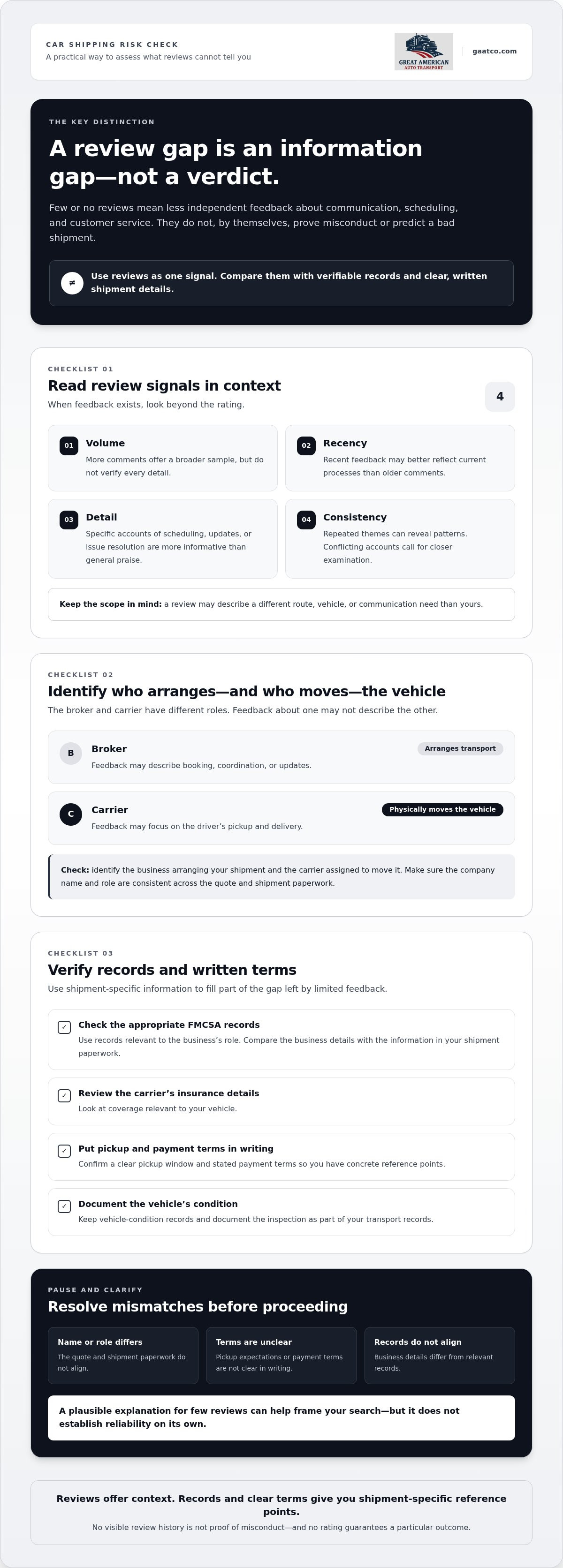
Review signals offer different kinds of context:
- Volume: More comments offer a broader sample, but do not verify every detail.
- Recency: Recent feedback may better reflect current processes than older comments.
- Detail: Specific accounts of scheduling, updates, or issue resolution are more informative than general praise.
- Consistency: Repeated themes can reveal patterns, while conflicting accounts call for closer examination.
A strong rating cannot guarantee the same outcome on another shipment, just as a thin profile cannot predict a poor one. The risks of shipping a car with a company that has no reviews are best understood as uncertainty about past customer experience. Compare available feedback with the company’s records, written terms, and the identity of the carrier assigned to your shipment.
Documented experience is another useful point of context, but it does not replace shipment-specific details. GAATCO’s vehicle transport experience spans more than 20 years. Consider that alongside clear documentation when evaluating your transport arrangement.
How Missing Reviews Can Affect Price, Pickup, Damage, and Accountability
A lack of customer feedback does not itself cause a price change, delay, or damage. It does leave you with fewer firsthand accounts to help anticipate how a company handles those situations. Clear, shipment-specific records can fill part of that information gap by establishing expectations and showing who is responsible for each stage.
Start by identifying the parties. A broker arranges transport, while a carrier physically moves the vehicle. Neither role is inherently unsafe, but knowing which business is coordinating and which is transporting helps direct questions and keep the paperwork aligned. The FMCSA’s consumer advisory explains how to verify their federal registration.
| Uncertainty | Useful record or detail |
|---|---|
| Price changes | Written quote and written explanation of any revision |
| Pickup or delivery changes | Agreed pickup window, delivery expectations, and dated updates |
| Communication gaps | Named points of contact and saved messages or notices |
| Vehicle damage | Condition notes and photos at pickup and delivery, plus the Bill of Lading |
| Responsibility or claims | Broker and carrier identities, applicable insurance terms, and claims instructions |
Pickup, delivery, and payment expectations
Before the vehicle is collected, review the written pickup window, anticipated delivery expectations, payment schedule, and any conditions that could change the quoted amount. A defined window helps you plan access to the vehicle. Unclear timing can make it harder to distinguish a change from a missed commitment. Vague payment terms can also create disagreement about what is due and when. Keep revised terms in writing rather than relying on a verbal update.
Vehicle condition, cargo insurance, and the Bill of Lading
At pickup, note existing marks and visible damage, and take clear, dated photos from several angles. Review the Bill of Lading, the shipment document that records vehicle details and condition, and check that it reflects what you observed. Repeat the inspection at delivery and document any new concern before completing the handoff.
Cargo insurance is governed by the applicable policy, including its terms, limits, and claims process. A general statement about insurance does not explain how a particular loss would be handled. Review the carrier’s applicable coverage information and written claims instructions, and retain copies of the shipment documents. These steps cannot predict the outcome, but they create a more reliable record if questions arise. The risks of shipping a car with a company that has no reviews are easier to manage when expectations, condition, and accountability are documented from the outset.
A Practical Checklist for Reducing Risk Before Your Car Is Picked Up
A review history is only one part of assessing a shipment. Use this checklist to replace missing customer feedback with consistent records and clear expectations. For official guidance, use the FMCSA’s current lookup tools and confirm which records apply to the business’s role. Broker and carrier records are not interchangeable.
- Identify the business and its role. A broker coordinates the shipment; a carrier transports the vehicle. Note the business name and any USDOT or MC number provided, then compare them with the relevant FMCSA record. Lookup terminology and systems can change, so follow the agency’s current instructions rather than relying on an old screenshot or search result.
- Match names across documents. Check that the company name and identifiers are consistent across the quote, written agreement, shipment updates, and carrier information. If the arrangement involves both a broker and carrier, keep each role clear in your records.
- Review the written shipment terms. Confirm that the agreement identifies your vehicle, origin and destination, transport type, payment expectations, and pickup window. Keep any revisions in writing so the agreed terms are easy to distinguish from an estimate or informal update.
- Clarify local pickup logistics. For the specific city and route, consider access restrictions, vehicle access, and a suitable handoff location. Have the pickup window and any location adjustments documented, especially if a large transport vehicle may have difficulty reaching the address.
- Understand the insurance and claims information. Review the applicable policy details, limits, and claims instructions for the carrier and shipment. Keep this information with the agreement, quote, and shipment communications so you can find the relevant terms if a concern arises.
- Document condition at both handoffs. Photograph the vehicle before pickup, note existing damage, and review the Bill of Lading with the driver. Repeat the inspection at delivery and retain the completed condition records.
Keep the quote, agreement, messages, insurance information, and condition report together. A complete file gives you a practical reference if pickup timing changes, a charge needs clarification, or the vehicle’s condition is questioned. These steps do not guarantee a particular outcome, but they make the arrangement more transparent and accountable.
GAATCO offers open and enclosed transport and serves shipments involving cities such as Atlanta, Miami, New York, Houston, Dallas, San Diego, San Francisco, Seattle, Orlando, Boston, Nashville, Denver, Austin, Chicago, Las Vegas, and Phoenix. Review GAATCO’s auto transport services to compare options. The GAATCO website is a starting point for arranging your shipment with clear details.
How GAATCO Makes Vehicle Shipping More Accountable
Customer reviews can offer useful perspective, but they are not the only way to assess a shipment arrangement. Clear terms, coordinated communication, and relevant documentation also help establish expectations. GAATCO brings more than 20 years of industry experience to vehicle transport and works with licensed and insured carriers. That experience is a trust signal, not a guarantee of a flawless shipment or a substitute for reviewing the details of your transport.
Experience, carrier coordination, and transparent pricing
GAATCO arranges vehicle shipping with licensed and insured carriers, helping clarify the roles involved in arranging and physically transporting your vehicle. Transparent pricing supports a clear understanding of the shipment’s stated terms. Review the quote alongside details such as the vehicle, route, transport type, and payment expectations so you understand the written price and service arrangement.
Professional coordination matters because shipment details need to stay consistent as arrangements progress. Written terms and shipment records give you a reference for pickup expectations, updates, and the vehicle handoff. These practical safeguards help address some of the uncertainty behind the risks of shipping a car with a company that has no reviews, without suggesting that reviews are unimportant or that any shipment is risk-free.
Choose a transport arrangement that fits the vehicle
The right transport option depends on the vehicle and your preferences. Open transport carries vehicles on an open carrier, while enclosed transport uses a covered arrangement that may suit vehicles for which additional protection from exposure is a priority. Door-to-door delivery is another option, with pickup and delivery locations shaped by access and route logistics.
Explore GAATCO’s vehicle transport services to review available arrangements. When you are ready, share your shipment details to receive a quote tailored to your vehicle and route. A clear, shipment-specific quote gives you a practical basis for reviewing the proposed terms and planning next steps.
Request an auto transport quote and take the next step with your vehicle’s transport details in view.
Move Forward With Clearer Shipment Expectations
The risks of shipping a car with a company that has no reviews come from limited independent feedback, not from the absence of reviews alone proving misconduct. Reduce uncertainty by checking the business’s applicable credentials, clarifying who arranges and who transports the vehicle, and keeping shipment terms and condition records in writing.
GAATCO brings more than 20 years of industry experience and works with licensed and insured carriers. Transparent pricing and door-to-door delivery help establish clear expectations, while the written details remain essential to understanding your specific arrangement.
Whether you are arranging open or enclosed transport, an informed decision starts with details that fit your vehicle, route, and preferences. Review the terms at your own pace, then request an auto transport quote to begin planning your shipment. Clear information is a practical foundation for a more assured handoff.
Frequently Asked Questions
Is it safe to ship a car with a company that has no reviews?
It may be, but an empty review profile does not establish that a company is safe or unsafe. Treat it as limited public feedback and look for other evidence before booking, including the applicable FMCSA records, consistent business details, written shipment terms, and carrier insurance information. Confirm pickup expectations and payment terms in writing, then retain the vehicle-condition records created at handoff.
Does a car shipping company with no reviews mean it is a scam?
No. A newer online profile, a small customer base, limited review collection, or a change in business name could explain the absence of public feedback. These possibilities are context, not proof of reliability. Look for verifiable inconsistencies, such as mismatched company names across documents or business details that do not align with applicable records. Resolve discrepancies before agreeing to shipment terms.
What are the biggest risks of shipping a car with an unreviewed company?
The main risks of shipping a car with a company that has no reviews are uncertainty about its communication practices, scheduling, and handling of customer concerns. Without customer accounts, it is harder to understand how changes or disputes have been managed in the past. That does not mean a delay or damage is likely. A clear agreement, documented pickup expectations, and condition records can help clarify the arrangement.
How can I check an auto transport company's credentials?
First identify whether the business is a broker arranging transport or a carrier moving the vehicle, since relevant records differ by role. Use the current FMCSA lookup guidance to review applicable registration and operating information. Compare the business name and any USDOT or MC number provided with the written agreement and shipment communications. Also review the carrier’s insurance information and keep copies with your booking documents.
Can a car shipping company change the price after booking?
A quoted amount may need review if shipment details change, such as the vehicle information, route, or agreed service. The written quote and terms should explain what the amount covers and how changes are handled. If you receive a revised figure, compare it with the original agreement and request the reason in writing before accepting the change. Do not rely on an informal verbal update as the only record.
What happens if my car is damaged during transport?
Document the concern at delivery with clear photos and accurate notes, and compare the vehicle’s condition with the pickup record and Bill of Lading. Notify the appropriate company contact and follow the claims instructions for the applicable carrier policy. Coverage, limits, and claim procedures depend on the policy and shipment, so review those details rather than assuming all damage is handled the same way. Retain copies of all records and communications.
Should I avoid a car shipping company with only a few reviews?
Not automatically. Read the available comments for detail, recency, and recurring themes, while remembering that reviews may describe a different carrier, route, or vehicle. Weigh them alongside credentials and written shipment terms. GAATCO has more than 20 years of industry experience and works with licensed and insured carriers, with transparent pricing and door-to-door delivery. GAATCO serves shipments involving Atlanta, Miami, New York, Houston, Dallas, San Diego, San Francisco, Seattle, Orlando, Boston, Nashville, Denver, Austin, Chicago, Las Vegas, and Phoenix.


