
What matters when you’re asked to pay a large auto transport deposit is not only the amount, but also who will receive it and what the payment covers. If you’re wondering, “is it safe to pay a large deposit for auto transport,” the answer depends on whether you can verify the business, understand the written terms, and confirm how the rest of the payment will be handled.
A deposit is not automatically a warning sign. But unclear cancellation terms, pressure to pay quickly, or uncertainty about whether you’re dealing with a broker or a carrier deserve careful attention. Before sending money, find out whether the deposit is refundable, when the balance is due, and how the company and payment recipient can be checked.
This guide explains how to assess a deposit request, verify who is arranging or providing your vehicle’s transport, and review payment and cancellation terms before you commit. It also covers warning signs to investigate and the records to keep so you can make an informed decision.
Key Takeaways
- A large deposit does not prove a company is fraudulent. Assess it alongside the written terms, payment recipient, and business details.
- If you’re asking “is it safe to pay a large deposit for auto transport,” verify the company and check applicable registration details through official FMCSA resources.
- Before paying, confirm whether the deposit is refundable, what cancellation rules apply, when the balance is due, and what could change it.
- Compare the agreement with the payment instructions. Pause if the recipient or terms are unclear, inconsistent, or difficult to verify.
- Choose open or enclosed transport based on your vehicle’s needs, then get the service expectations and payment arrangement in writing.
Is a Large Auto Transport Deposit a Warning Sign?
A large auto transport deposit is not, by itself, proof of a scam. Look at whether the amount is explained in writing, whether you can verify the recipient, and whether the payment schedule makes sense from booking through delivery. If you’re asking, “is it safe to pay a large deposit for auto transport,” check those details before authorizing payment instead of judging the request by size alone.
A deposit may be only part of the transport charge. Depending on the provider and shipment, it could be collected when you book, with the remaining balance due later. Ask for a written breakdown that identifies what the deposit covers, who collects each payment, and when the balance is due.
For additional context on transport paperwork and vehicle records, watch this brief overview of auto transport payment options:
What does an auto transport deposit usually cover?
Payment arrangements vary by provider and shipment, so don’t assume every company uses the same deposit structure. A broker may arrange transport with a carrier, while the carrier physically moves the vehicle. Those roles can affect who collects the deposit and who receives the remaining payment. Confirm the name of each payment recipient and what each payment covers.
Ask which documents define your booking and payment obligations. The Bill of Lading is commonly associated with shipment receipt and transport details, but it may not set out your booking, deposit, or cancellation terms. Review the relevant paperwork before paying, and do not treat one document as a substitute for the others.
When should a deposit request prompt caution?
An unusually large request calls for an explanation, not an automatic accusation. Ask the provider to put the amount and payment schedule in writing. Be cautious if you’re pressured to pay immediately, given vague or contradictory terms, or sent new payment instructions without a clear explanation. If the provider will not document the arrangement, pause.
Before paying, check that the amount is explained, the terms are documented, and the recipient is verifiable. Confirm the business identity and payment recipient independently. If you cannot establish who will receive your money or why, wait until the details are clear.
How to Verify the Auto Transport Company and Deposit Recipient
First, establish which business is arranging your shipment and which business will physically transport the vehicle. A broker and a carrier may be separate companies, so the name on a quote may differ from the name on the carrier’s truck. Check the entity named in your agreement, then ask how the payment recipient is connected to it.
Use this checklist before sending money:
- 1. Compare the documents. Match the legal business name and contact details on the quote, booking agreement, and payment instructions. Ask the provider to explain any differences.
- 2. Check official records. Use the Federal Motor Carrier Safety Administration’s SAFER Company Snapshot and other applicable FMCSA search tools to review available registration and operating information. Compare the results with the business details you received.
- 3. Confirm the transport role. Ask whether the company is acting as a broker or carrier. If it is arranging transport as a broker, request the assigned carrier’s legal name and check its available information separately once assigned.
- 4. Verify the payment recipient. Ask for the recipient’s legal name and its relationship to the broker or carrier. Confirm that the recipient and payment method match the written booking terms.
How can you check a broker or carrier?
Search using identifying details from your agreement, such as the legal business name or applicable USDOT or MC number. Check that the record belongs to the same entity. A broker’s record does not verify the carrier assigned to your shipment. If a broker is arranging the transport, ask for the carrier’s details and review them separately. If information is missing or inconsistent, request clarification before proceeding.
Compare the company’s claims with official records and the written agreement. An online listing can help you check business details, but it does not replace reviewing the payment terms or confirming who will receive your money.
Who should receive the deposit?
The recipient may be the broker or another named party, depending on the documented arrangement. Ask what the deposit pays for, whether another payment will go to the carrier, and how the balance will be collected. The agreement and payment instructions should be consistent. If the details change unexpectedly, contact the provider using a trusted phone number or email already on file, rather than relying only on new instructions in a message.
If you are comparing providers, review GAATCO’s vehicle transport services alongside the written terms and payment details for your shipment.
How to Judge Deposit Terms, Payment Methods, and Red Flags
A deposit request is easier to assess when the written agreement explains how money will move through the shipment. Before accepting the booking, check the initial amount and the conditions that could affect a refund, cancellation, pickup, or final balance. If you’re still asking, “is it safe to pay a large deposit for auto transport,” clear written terms are central to your decision.
Which deposit terms should appear in writing?
Look for the deposit amount, the recipient’s legal name, the payment due date, and an explanation of how the remaining balance will be collected. The agreement should also set out cancellation and refund rules, pickup arrangements, and what happens if shipment details change. Ask how the deposit will be handled if no carrier is assigned or the original arrangement cannot proceed.
Compare the terms before paying so you can spot missing details:
- Clear terms: The agreement names the recipient, explains what the deposit covers, states how the balance will be paid, and outlines cancellation, refund, and shipment-change conditions.
- Terms needing clarification: The recipient is unnamed, refund language is missing, the balance is unexplained, or verbal assurances conflict with the written agreement.
If a term is unclear, request a written explanation or an amended agreement. Do not rely on an informal promise to resolve a detail that could affect your payment later.
Which payment requests deserve extra scrutiny?
Slow down if you’re pressured to pay immediately, the recipient differs from the one named in the agreement, or payment instructions change unexpectedly. Contact the provider through a previously verified channel to confirm any change. A different recipient may have a valid explanation, but the relationship and reason should be documented before you authorize payment.
Payment protections vary by method, provider, and financial institution. Credit cards, bank transfers, digital wallets, and other options may have different dispute processes, limits, and eligibility rules. Confirm the applicable protections with your card issuer or payment provider. Do not assume any method guarantees recovery or is universally safe. Ask the transport company which forms of payment it accepts and how each payment will be recorded.
Keep the quote, signed agreement, payment instructions, receipt or confirmation, and messages about any changes together. These records help you check what was agreed and support a prompt inquiry if a discrepancy arises. If the company will not document the terms or you cannot confirm the recipient, pause rather than paying under pressure.
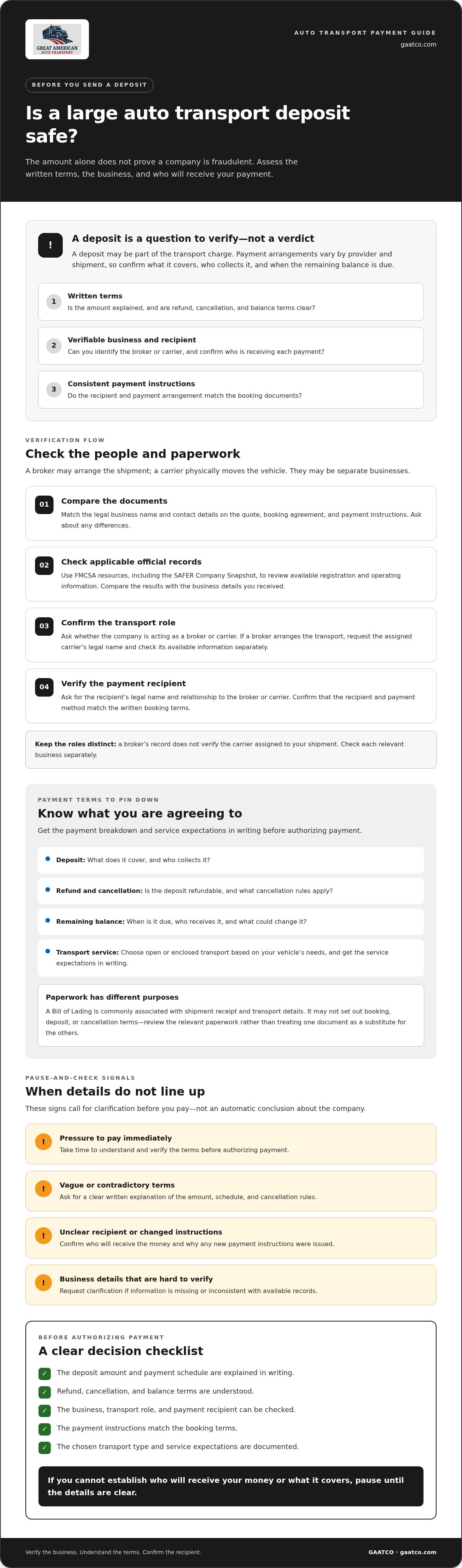
What to Do Before Paying an Auto Transport Deposit
Before paying, check that the booking details, transport plan, and payment instructions match. Keeping a complete written record can also help if plans change or questions come up later.
- Confirm the provider’s role. Ask whether the company is arranging transport as a broker or moving the vehicle as a carrier.
- Identify the payment recipient. Confirm the recipient’s legal name, what the deposit covers, and when and to whom the remaining balance is due.
- Review cancellation and refund terms. Get the rules in writing before deciding, including what happens if transport arrangements change.
- Clarify pickup and delivery expectations. Confirm the locations, anticipated timing or windows, and how updates will be provided. Treat these as expectations, not guaranteed dates or outcomes.
- Keep one complete record. Save the quote, agreement, company contact details, payment instructions, and receipt together.
Check the route description carefully. Whether your shipment involves Atlanta, Miami, New York, Houston, Dallas, San Diego, San Francisco, Seattle, Orlando, Boston, Nashville, Denver, Austin, Chicago, Las Vegas, or Phoenix, make sure the agreement names the correct pickup and delivery cities and reflects the arrangement you discussed. If a location, vehicle detail, or timing expectation is inaccurate, ask for a written correction before authorizing payment.
What should you ask the provider before paying?
Ask direct questions and keep the answers with your booking records: “Are you the broker or the carrier?” “Who receives the deposit, and what does it cover?” “When is the balance due, and what could change it?” Request written cancellation and refund terms. If an answer is unclear or conflicts with the agreement, resolve the discrepancy before paying.
What if you have already paid or feel pressured?
Stay calm, but act promptly. Save messages, the quote, the signed agreement, payment instructions, and transaction records. If you suspect an unauthorized or misrepresented charge, contact your bank, card issuer, or payment provider promptly to ask about its dispute process. Use independently verified company contact details to request clarification, and keep the response in writing.
If you’re evaluating a shipment, you can request an auto transport quote and review the proposed route, payment recipient, and written terms before deciding whether to proceed.
Choose a Transparent Auto Transport Arrangement and Take the Next Step
A sound decision rests on three points: verify the business, understand the written terms, and confirm who receives each payment. Do not choose a provider based on the deposit alone. Compare the full arrangement and how well it fits your vehicle and shipment.
How to compare a quote without focusing only on the deposit
Review the written total, the service included, pickup expectations, and payment schedule. Compare similar services. Open and enclosed transport, for example, may suit different vehicle needs, so consider the protection and service you require rather than treating deposit size as a measure of value.
Check whether the provider is acting as a broker or carrier, what carrier arrangements are described, and what insurance information is available for the carrier assigned to your shipment. Verify relevant details independently. Ask follow-up questions if the quote does not make clear who is responsible for arranging transport, moving the vehicle, or collecting payment.
GAATCO describes more than 20 years of industry experience and a transparent-pricing approach. Review its auto transport services as one option while comparing service details and written terms. Confirm the proposed payment, cancellation, and refund terms directly with any provider before booking.
When to request a tailored transport quote
Prepare your vehicle’s make, model, and condition, along with the origin, destination, preferred timing, and any special handling needs. These details help the provider explain which transport option may fit and what to expect for pickup and delivery. Ask for payment timing and applicable terms in writing before you decide.
If you’re still considering, “is it safe to pay a large deposit for auto transport,” use the quote process to clarify the arrangement, not to skip verification. Share your shipment details, review the proposed terms, and take time to resolve questions before authorizing payment.
For a tailored discussion of your shipment, request an auto transport quote from GAATCO. Discuss your vehicle, route, service needs, and payment terms, then decide whether the arrangement works for you.
Make Your Next Transport Decision with Confidence
A large deposit alone cannot tell you whether a transport arrangement is safe. A more reliable test is whether you can verify the business and recipient, understand the written payment and cancellation terms, and confirm how the balance will be handled. If you’re asking, “is it safe to pay a large deposit for auto transport,” check those details before authorizing payment.
Compare the full quote, not just the upfront amount. Make sure the service suits your vehicle and that pickup and delivery expectations, the payment schedule, and provider responsibilities are clear. GAATCO reports more than 20 years of industry experience, states that it offers transparent pricing, and works with licensed and insured carriers. Confirm current details and applicable terms directly before booking.
When you are ready to discuss your shipment, prepare your vehicle and route information, then request a clear auto transport quote. Reviewing the details first can help you move forward with a better understanding of the arrangement.
Frequently Asked Questions
Is it normal to pay a deposit for auto transport?
Deposit arrangements vary by provider and shipment, so an upfront payment is not automatically unusual or unsafe. Some providers collect a deposit when a booking is made, while others structure payment differently. Before paying, check what the deposit covers, who receives it, when the remaining balance is due, and what happens if you cancel or the transport plan changes. Get these details in writing.
How much of an auto transport quote should I pay as a deposit?
There is no single deposit amount that suits every shipment or provider. Compare the requested amount with the written quote and payment schedule, and ask the provider to explain how it is calculated and applied. Confirm whether the deposit could change if the vehicle, route, or transport arrangement changes. Do not rely on a verbal explanation alone, especially if the amount seems out of step with the documented terms.
Can I get an auto transport deposit back if I cancel?
Whether a deposit is refundable depends on the provider’s written cancellation terms and the circumstances of the cancellation. Before booking, check the agreement for deadlines, fees, or other refund conditions. Ask what happens if a carrier has already been assigned or the transport plan changes. If the policy is unclear, request a written explanation before paying.
How can I verify an auto transport broker or carrier before paying?
Compare the legal business name and contact details on the quote, agreement, and payment instructions. Use official Federal Motor Carrier Safety Administration resources, including SAFER Company Snapshot, to check applicable company and operating information. A broker arranges transport, while a carrier moves the vehicle, so verify the assigned carrier separately if one is named. Pause if the records and booking details do not align.
Is it safe to pay an auto transport deposit by credit card?
A credit card may provide a way to dispute eligible charges, but protections depend on the card issuer and transaction. Confirm the applicable terms directly with your issuer, and make sure the payment recipient matches the written agreement. Keep the receipt and booking records. No payment method makes an unclear transaction safe, so verify the company, amount, and terms before authorizing payment.
What should I do if an auto transport company asks for a large deposit immediately?
Pause and ask for the amount, recipient, payment schedule, and cancellation terms in writing. Verify the company independently and contact it through details you have already confirmed, especially if payment instructions have changed. A large request or urgent deadline deserves careful review, but neither alone proves fraud. If you cannot verify the business or recipient, do not authorize payment until you resolve the discrepancy.
Should I pay the broker or the carrier for auto transport?
Follow the payment arrangement in the written agreement, and confirm who receives each payment before sending funds. A broker may collect a deposit for arranging the shipment, while the carrier may collect a remaining balance, but arrangements differ. Ask the provider to explain the roles and payment timing. Do not send money to a different recipient without independently confirming the change through a trusted contact channel.
What documents should I get before paying an auto transport deposit?
Before paying, obtain the written quote and booking agreement, including the total charge, service, route, payment schedule, and cancellation and refund terms. Keep the recipient’s details, payment instructions, and receipt with those records. For routes such as Atlanta to Miami or New York to Houston, or shipments involving Denver, Seattle, and other cities, check that the pickup and delivery locations are correct. Review the Bill of Lading at pickup as a shipment record, not as a substitute for clear booking terms.


