

Your vehicle has arrived, but the final payment still raises an important question: who should receive it, and when? If you’re unsure when to pay the final balance for your car shipment, it is commonly due at delivery and paid directly to the carrier driver, according to the written shipment terms. The distinction matters: a broker may collect an initial fee, while the carrier receives the remaining balance.
Before delivery day, make sure you know the amount due, who receives it, and which payment methods are accepted. Clear expectations help avoid last-minute surprises and make the handoff easier to manage. GAATCO provides transparent pricing and coordinates vehicle transport with licensed and insured carriers.
This guide explains how broker and carrier payments typically differ, when the final balance may be due, and how to confirm payment instructions. You’ll also learn how to compare your vehicle’s condition with the Bill of Lading, record any visible changes before signing, and keep proof of payment. Use your written shipment terms as the reference for your specific arrangement.
Key Takeaways
- Use your written payment terms to determine when to pay the final balance for your car shipment.
- Follow the payment schedule from booking through delivery, and distinguish broker charges from carrier charges when they are itemized separately.
- Before delivery day, confirm the balance, recipient, accepted payment method, and how the payment will be documented.
- Compare the vehicle’s delivered condition with its pickup condition report and record visible differences on the delivery paperwork before completing the handoff.
- Transparent pricing and coordination with licensed, insured carriers help make a shipment’s payment expectations clearer.
When Is the Final Balance for a Car Shipment Due?
In a common car-shipping arrangement, the final balance is due when the vehicle is delivered, and the carrier may collect its portion directly from you. The answer to when to pay the final balance for your car shipment depends on the written payment schedule for your shipment. Treat delivery as a common milestone, not a rule that applies to every booking.
The final balance is the unpaid amount remaining under your agreement after any separately arranged initial payment. Some shipments divide payment between a booking or broker charge and a carrier charge; others use a different arrangement. Check the written terms for the amount, recipient, and due date. Do not assume every shipment follows the same payment split.
For a helpful overview of the vehicle-shipping process, watch this video:
What does final balance mean in car shipping?
The total transport charge is the full amount set out for the shipment. If the agreement includes an initial payment, that payment may cover a broker or booking portion, with the remaining amount due under separate instructions. The balance is not a standard deposit amount or fixed percentage. It is the unpaid portion specified in your agreement. Some shipments do not require an initial payment.
A broker arranges transportation, while the motor carrier physically transports the vehicle. Because their roles differ, payment may go to different parties. For background on the auto transport broker role, see Wikipedia. For your own shipment, follow its billing instructions to identify each recipient.
Is the balance usually paid before or at delivery?
Delivery is a common time to pay the carrier’s remaining charge, but your agreement may set another schedule. Check the payment terms for the exact due milestone and compare them with the instructions provided as pickup and delivery are arranged. If the paperwork separates broker and carrier charges, keep the amounts distinct so payment to one party is not mistaken for payment to the other.
In brief: the common arrangement places the carrier balance at delivery, while the written shipment terms determine the actual amount, recipient, payment timing, and any initial charge.
How Car-Shipment Payments Typically Move from Booking to Delivery
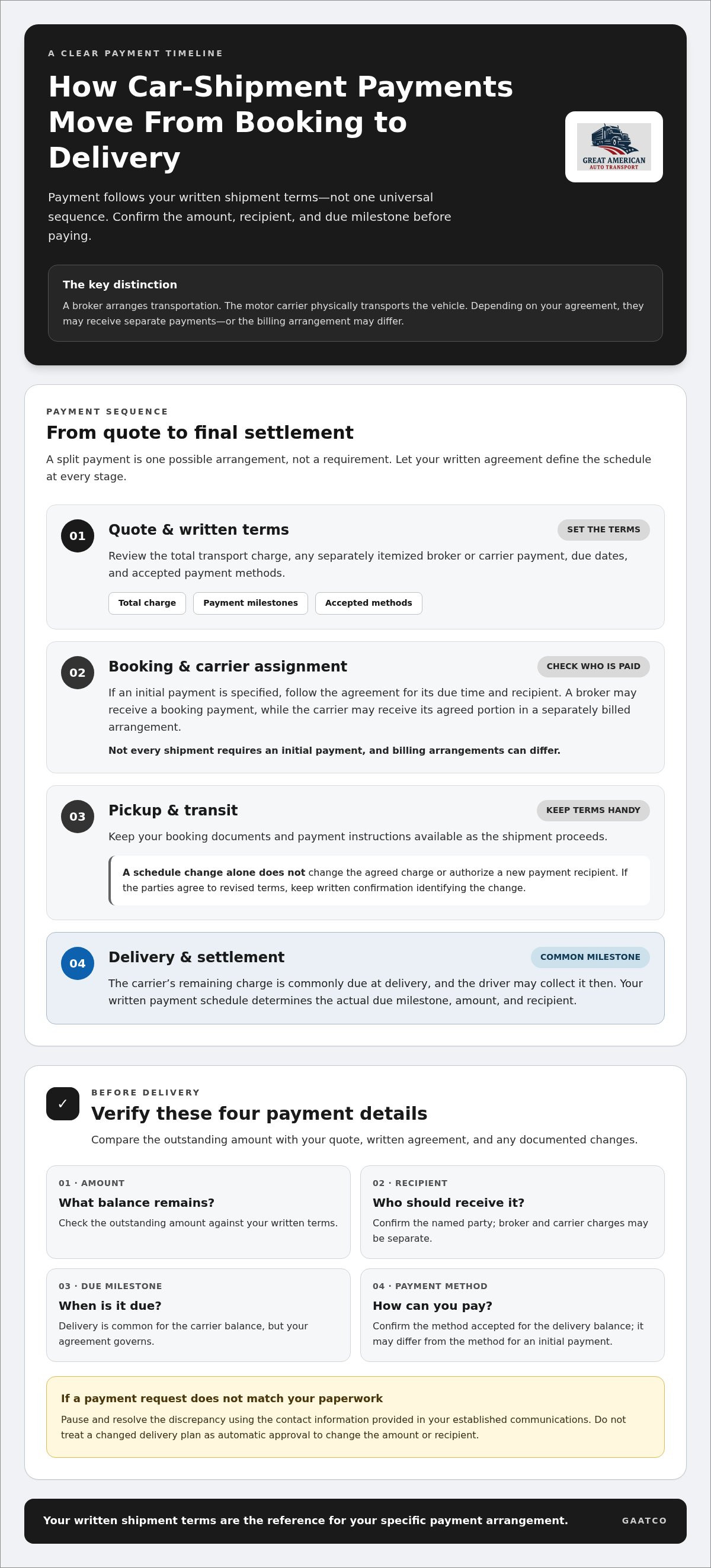
Payment follows the agreed terms, not one universal industry sequence. A quote should clarify the total charge and any payment milestones. Later requests should match the named recipient and due milestone in the written agreement. The steps below describe how arrangements may progress, but your shipment agreement governs your specific payment schedule.
- Quote and written terms: Review the total transport charge, any separately itemized broker or carrier payment, due dates, and accepted payment methods. A split payment is one possible arrangement, not a requirement.
- Booking and carrier assignment: If an initial payment is specified, follow the agreement for when it is due and who receives it. A broker arranges transportation, while the motor carrier moves the vehicle. The parties may receive separate payments when the documents specify that structure, but billing arrangements can differ.
- Pickup and transit: Keep the booking documents and payment instructions available as the shipment proceeds. A change to the pickup or delivery schedule may affect coordination, but it does not by itself change the agreed charge or authorize a new payment recipient.
- Delivery and settlement: If the agreement assigns the remaining amount to the carrier at delivery, the driver may collect it then. Before paying, use the written terms to confirm the amount and recipient.
Who receives the booking payment and the delivery balance?
In a separately billed arrangement, the broker may receive a booking payment for arranging the shipment, while the carrier receives its agreed portion for transporting the vehicle. Other arrangements may handle payment differently. Compare the recipient and payment instructions on each request with your booking documents. The FMCSA provides guidance to verify your shipper with the FMCSA, which can help you assess the parties involved before making payment.
What can change the payment timeline?
Your written payment schedule and carrier arrangement determine the applicable milestones. A delay or revised delivery plan can change when payment coordination happens, but it should not be treated as automatic approval to change the amount or recipient. If the parties agree to a change, keep written confirmation that identifies the revised terms before following new payment instructions.
For an overview of how transport is arranged, explore GAATCO’s vehicle transport services. Clear terms make it easier to understand when to pay the final balance for your car shipment and which party is due at each stage.
How to Confirm the Balance, Payment Method, and Recipient
Before delivery, compare the outstanding amount with your quote, written shipment agreement, and any documented changes. Then confirm who should receive that amount and which payment methods the terms accept. Do not assume a method accepted for an initial payment is also accepted for the delivery balance.
Which payment details should you verify before delivery?
Use your shipment documents and established communications to verify the details. If a payment request differs from the paperwork, pause and resolve the discrepancy through the contact information provided in your booking documents. Keep the agreement, written changes, and payment confirmation together so the transaction can be matched to the shipment.
| Payment recipient | Due milestone | Accepted method | Receipt or confirmation |
|---|---|---|---|
| Broker, if separately billed | As stated in the agreement | Only the method identified in the payment instructions | Retain the booking or payment confirmation |
| Carrier, if a balance is assigned to it | As stated in the agreement, often at delivery | Only the method identified for the carrier payment | Keep the carrier’s receipt or written payment confirmation |
This is a reference framework, not a universal payment schedule. Your shipment documents determine whether payments are separate, who receives each payment, and which methods are accepted.
What payment requests should prompt a pause?
Pause before paying if the requested amount does not match the quote or an approved written change, if the recipient has changed without explanation, or if the requested method conflicts with the agreed instructions. Pressure to use an unfamiliar payment method is also a reason to verify the request. These signs call for caution, but do not by themselves prove that a request is fraudulent.
- Compare the amount with the written agreement and documented changes.
- Match the recipient to the party named for that payment milestone.
- Use only a payment method identified as accepted for that transaction.
- Save the receipt or confirmation with the shipment paperwork.
A short review before payment can prevent confusion at handoff. Knowing when to pay the final balance for your car shipment also means knowing which terms apply, who should receive payment, and how to document it. For an overview of GAATCO’s transport options, see our vehicle transport services.
What to Do Before Paying Car-Shipping Balance at Delivery
A careful handoff brings together three things: the vehicle’s arrival, its documented condition, and the payment terms for your shipment. If your agreement makes a balance due at delivery, follow its payment timing and inspection procedures. Do not assume a condition concern automatically allows payment to be withheld. Any steps for resolving a dispute depend on the signed terms.
How should you handle vehicle inspection and payment together?
Before completing the handoff, compare the delivered vehicle with the pickup condition report. Review the exterior and other areas described in the original paperwork, and note visible differences clearly on the applicable delivery inspection document, such as the Bill of Lading (BOL). Complete the paperwork accurately and keep a copy. If you see a concern, document it and raise it through the communication channel specified in your shipment documents.
Use this sequence as a practical checklist, while following the signed agreement if its process differs:
- Confirm arrival: Verify that the delivered vehicle is the one identified in your shipment paperwork.
- Inspect and compare: Check its visible condition against the pickup report before completing delivery documentation.
- Record differences: Describe any visible changes on the applicable inspection paperwork and keep a copy.
- Confirm payment: Match the amount, recipient, due milestone, and accepted method to the written terms.
- Complete the handoff: Follow the agreed payment process and keep the receipt or other confirmation.
If the inspection or payment request raises a concern, document the issue and use the agreed communication channel for clarification. The paperwork creates a record of the vehicle’s condition and the handoff, but it does not replace the payment or dispute procedures in your agreement.
What records should you keep after paying?
Keep the quote, signed shipment agreement, pickup and delivery condition reports, written changes, relevant messages, and payment receipt together. Note the payment date, recipient, method, and amount. An organized file makes it easier to refer to the agreed terms if a billing or condition question comes up after delivery.
Knowing when to pay the final balance for your car shipment is only part of a smooth handoff. Accurate inspection notes and clear payment records provide useful documentation afterward. To arrange a vehicle shipment with clear expectations, request your vehicle transport quote.
How GAATCO Helps Make Car-Shipment Payment Expectations Clear
A well-managed shipment begins with clear expectations. GAATCO emphasizes transparent pricing and works with licensed and insured carriers, helping customers understand the transport arrangement and the parties involved. Payment details are specific to each shipment’s written agreement, so do not assume there is one balance due date or payment method for every booking.
What should a clear shipment payment plan explain?
Your written terms should make it easy to identify the agreed total, any separately arranged payment, the remaining balance, and the party receiving each amount. They should also state the due milestone and accepted method for each transaction. Review those details before transport begins, and keep the agreement and payment confirmations together through delivery.
The broker’s role in arranging transport and the carrier’s role in moving the vehicle can affect how payment is allocated. If separate charges apply, the documents should distinguish them. If payment is handled another way, follow the stated instructions instead of assuming a familiar arrangement applies.
GAATCO’s transparent-pricing approach gives customers a clear basis for understanding their shipment. Review the specific amount and payment schedule in your agreement rather than relying on a general statement about when car-shipping balances are usually due. Clear documentation helps keep payment coordination aligned with the transport plan.
How can you arrange your vehicle shipment with confidence?
Start with your vehicle, route, and preferred transport arrangement, then review the written quote and payment terms before booking. GAATCO offers open and enclosed transport, along with door-to-door auto shipping. Explore the company’s vehicle transport services to compare these options. GAATCO brings more than 20 years of industry experience to vehicle transport, with attention to transparent pricing and shipment coordination.
As you review your agreement, make sure you can find the total charge, any separate payment, the remaining balance, who receives each amount, and the applicable due milestone. These details provide a practical answer to when to pay the final balance for your car shipment under your own terms, without relying on assumptions that may not fit your booking.
Ready to discuss your vehicle transport needs? Request a car-shipping quote to start planning a shipment around your requirements.
Plan Your Shipment with Clear Payment Expectations
The most reliable answer to when to pay the final balance for your car shipment comes from your written shipment terms. Delivery is a common payment milestone, but the agreement specifies the actual due date, recipient, amount, and accepted method. Before handoff, compare the vehicle with its pickup condition report, record visible differences on the delivery paperwork, and keep your payment confirmation.
GAATCO provides transparent pricing and door-to-door delivery solutions, supported by more than 20 years of industry experience and coordination with licensed and insured carriers. Review your shipment details and payment terms so each step is clear before transport begins.
Ready to arrange your vehicle shipment? Request a car-shipping quote and take the next step.
Frequently Asked Questions
When do you pay the final balance for a car shipment?
In many auto-transport arrangements, the carrier balance is due at delivery, but your written shipment agreement sets the actual timing. To understand when to pay the final balance for your car shipment, check the due date, amount, recipient, and accepted payment method before pickup. Keep the terms available during transport. If a payment request differs from the agreement, pause and verify it through established shipment communications before sending payment.
Do you pay the car carrier before pickup or on delivery?
Payment timing depends on the terms for your shipment. Some arrangements specify a separate broker payment and a carrier balance due at delivery; others set different milestones or payment arrangements. Do not assume the same schedule applies to every booking or route. Before the carrier arrives, review the written instructions for the due date, amount, recipient, and accepted method. If anything has changed, look for documented confirmation.
Who receives the final balance for car shipping?
The carrier may receive the delivery balance when your booking terms assign that portion to the carrier. In other arrangements, a different party may collect some or all of the payment. Your written agreement should identify the recipient for each amount and list the accepted payment methods. Match payment instructions to those documents, and keep a receipt or other confirmation showing the amount, recipient, date, and method.
Can you pay the final balance by credit card?
Credit card acceptance depends on the shipment’s payment terms and the party collecting the balance. A broker and a carrier may have different payment instructions, so do not assume a card accepted for one payment will be accepted at delivery. Before handoff, check the written instructions for the approved method and recipient. Keep proof of the completed transaction with your shipment paperwork.
Should you pay the full car-shipping balance before pickup?
Whether full payment is due before pickup depends on the written terms for your shipment. Some arrangements divide payment across milestones, while others use a different schedule. Compare any request for full prepayment with the agreed amount, due date, and named recipient before sending funds. If the request conflicts with the documents, pause and verify the instructions through an established communication channel instead of relying on an unexplained change.
What should you do if the final balance differs from your quote?
Compare the requested balance with your written quote, shipment agreement, and any documented changes. If the amount differs, ask for the reason and supporting details through the established communication channel, and keep the explanation in writing. Do not rely only on a verbal explanation for a new charge. Follow the agreement’s process for addressing billing questions, and retain copies of the quote, correspondence, and payment records.
Do you inspect the car before paying the delivery balance?
Follow the inspection and payment sequence in your shipment agreement. At delivery, compare the vehicle with its pickup condition report and record visible differences on the applicable paperwork, such as the Bill of Lading. Complete the inspection documentation accurately and keep a copy. The agreement determines how concerns and payment are handled, so do not assume you can withhold payment. GAATCO arranges vehicle transport in Atlanta, Miami, New York, Houston, Dallas, San Diego, San Francisco, Seattle, Orlando, Boston, Nashville, Denver, Austin, Chicago, Las Vegas, and Phoenix.


