
What if the insurance certificate for your vehicle’s shipment is accurate, but no longer current? A certificate offers a snapshot of reported policy information, but it does not prove that coverage remains active. Verifying a car carrier's insurance coverage is active means checking the policy for the actual carrier assigned to your vehicle, not relying on a document that may be outdated or belong to another company.
It’s reasonable to expect that the company arranging transport and the carrier handling your vehicle are properly covered. They may be separate businesses, however, and a broker’s insurance is not a substitute for the hauling carrier’s policy. Before pickup, confirm the carrier’s identity and current insurance status, then check that the policy’s limits and terms are relevant to your shipment.
This guide explains how to review FMCSA records, seek confirmation from the carrier’s insurance agent, and clarify policy limits, exclusions, and claims procedures. You’ll also learn what details to document and whom to contact if information is incomplete or inconsistent, so you can make a well-informed decision before your vehicle is loaded.
Key Takeaways
- Identify the hauling carrier assigned to your shipment before relying on insurance information from the company that arranged transport.
- Use FMCSA records to review carrier details, then seek confirmation through the carrier’s insurance agent for a clearer picture of coverage.
- When verifying a car carrier's insurance coverage is active, check that the policy dates, limits, and terms align with your vehicle and shipment.
- Keep a pre-pickup record of the carrier’s identity, insurance confirmation, and answers about claims procedures.
- If documents or explanations are unclear, request clarification before the vehicle is loaded.
Why verifying a car carrier’s active insurance matters before pickup
“Active carrier insurance” means a policy is in force for the motor carrier at the relevant time, with terms that may apply to the vehicle and transport in question. Verifying a car carrier's insurance coverage is active before loading helps you assess the actual carrier’s coverage, rather than relying on a general assurance made before the carrier was assigned.
The company arranging a shipment may not be the company that takes possession of and transports the vehicle. That distinction matters: information about one business does not automatically confirm the other’s policy. The Federal Motor Carrier Safety Administration (FMCSA) is the U.S. agency associated with motor-carrier oversight, and its records can help you identify and review carrier information.
For an overview of carrier-vetting practices, watch this demonstration:
Who is the motor carrier, and who arranged the shipment?
A broker arranges the transport; a motor carrier is the business responsible for moving the vehicle. These roles may belong to separate companies, so ask for the assigned carrier’s legal business name and USDOT number. The carrier may not be known when you first book, but you can confirm its identity after assignment and before pickup. If the carrier changes, request the replacement carrier’s details and review them before loading.
What insurance verification can and cannot establish
A certificate of insurance documents reported policy information, but it does not by itself establish that the policy remains active today. Direct confirmation from the insurer or agent, alongside relevant official records, can help clarify current status. Ask whether the coverage applies to the carrier’s vehicle-transport operation and what limits and terms are relevant to your shipment.
Even an active policy is not a promise that every loss will be covered. Coverage depends on the policy’s scope, conditions, and exclusions, and a claim may still involve questions or disputes. Verification helps you make a more informed decision before loading, but it does not eliminate deductibles or exclusions, or remove the need to understand the claims process.
How to check a car carrier’s insurance status using official records
Use a three-step sequence: identify the assigned carrier, review its federal records, then confirm current policy details directly with the insurer or agent. This layered approach helps you avoid confusing the company arranging transport with the business responsible for moving your vehicle. Verifying a car carrier's insurance coverage is active requires matching the records to the carrier assigned to your shipment, not merely finding a company with a similar name.
Look up the carrier through FMCSA resources
Begin with the carrier’s legal business name and USDOT number. Ask for its MC number as well if one is provided, and compare the identifiers with the carrier information on your shipping documents. Matching identifiers helps confirm that the records you review belong to the carrier assigned to your shipment.
Search for the carrier in FMCSA SAFER using its USDOT number or legal name. Review the returned company details and authority information, and make sure the business identity matches the information you received. Then consult the FMCSA Licensing and Insurance resource for available insurance filing and status information. Federal record labels and page layouts can change, so follow the current instructions on FMCSA’s websites rather than relying on outdated screenshots or menu names.
Look for discrepancies such as a different legal name, identifier, or carrier address. A search result that appears close is not enough if its details do not align with the assigned carrier.
Confirm that the policy is current with the insurer
Federal records are an important reference, but direct confirmation can help resolve questions about the policy itself. Request the carrier’s current certificate of insurance and the name and contact information of its insurer or insurance agent. Where feasible, verify those contact details independently, then contact the insurer or agent rather than relying only on a forwarded document.
Ask whether the policy is active for the planned pickup and transport dates, and whether the coverage is relevant to the carrier’s vehicle-hauling operation and your shipment. The insurer may limit what it can disclose, so have the carrier or its agent authorize confirmation if needed. Record the response, including the date, the person or office contacted, and any information provided.
If the certificate, federal records, and insurer’s response do not agree, pause and request clarification before pickup. If you are arranging transport, reviewing vehicle shipping services can help you prepare questions about what carrier details will be available after assignment.
What a certificate of insurance does not prove about carrier coverage
A certificate of insurance (COI) is a summary of reported policy information, not the insurance contract itself. It can help you identify the named insured, policy dates, and listed coverage, but it does not alone confirm that the policy remains active or that a particular vehicle loss would be covered. Verifying a car carrier's insurance coverage is active means looking beyond the certificate and clarifying how the actual policy applies to the assigned carrier and shipment.
Use each source for a different purpose. A record or document that appears consistent is a reason to continue checking, not a guarantee of payment.
| Source | What it can help establish | What it does not establish by itself |
|---|---|---|
| Certificate of insurance | Named insured, listed coverage, policy dates, and stated limits | That coverage is still active, or that every shipment, vehicle, or type of loss is covered |
| Official records | Carrier identity and insurance filing information available in the records | All policy conditions, exclusions, deductibles, or claim outcomes |
| Insurer or agent confirmation | Current policy status and answers the insurer or agent is able to disclose | A guarantee that a future claim will be accepted or paid |
Which details should you compare on the certificate?
Start with the named insured and compare it with the assigned motor carrier’s legal name and identifying details. Check the effective and expiration dates against the planned pickup date. Then ask for clarification about cargo coverage, applicable limits, deductibles, and exclusions. Do not assume that a familiar-looking certificate or a stated limit reflects the terms that apply to your vehicle.
A limit is not necessarily the amount payable for every loss. Policy conditions, valuation rules, exclusions, and the circumstances of an incident can affect how a claim is assessed. Ask the carrier or its insurance representative to explain relevant terms, and request written clarification if the answer could affect your decision.
How carrier liability and cargo coverage differ
Liability coverage and cargo coverage address different categories of risk, and one should not be treated as a substitute for the other. Ask which coverage may apply if damage occurs during loading, transit, or unloading, and whether any conditions or exclusions affect that stage. A clear written explanation tied to your specific vehicle and shipment can help you understand what the documents do, and do not, say.
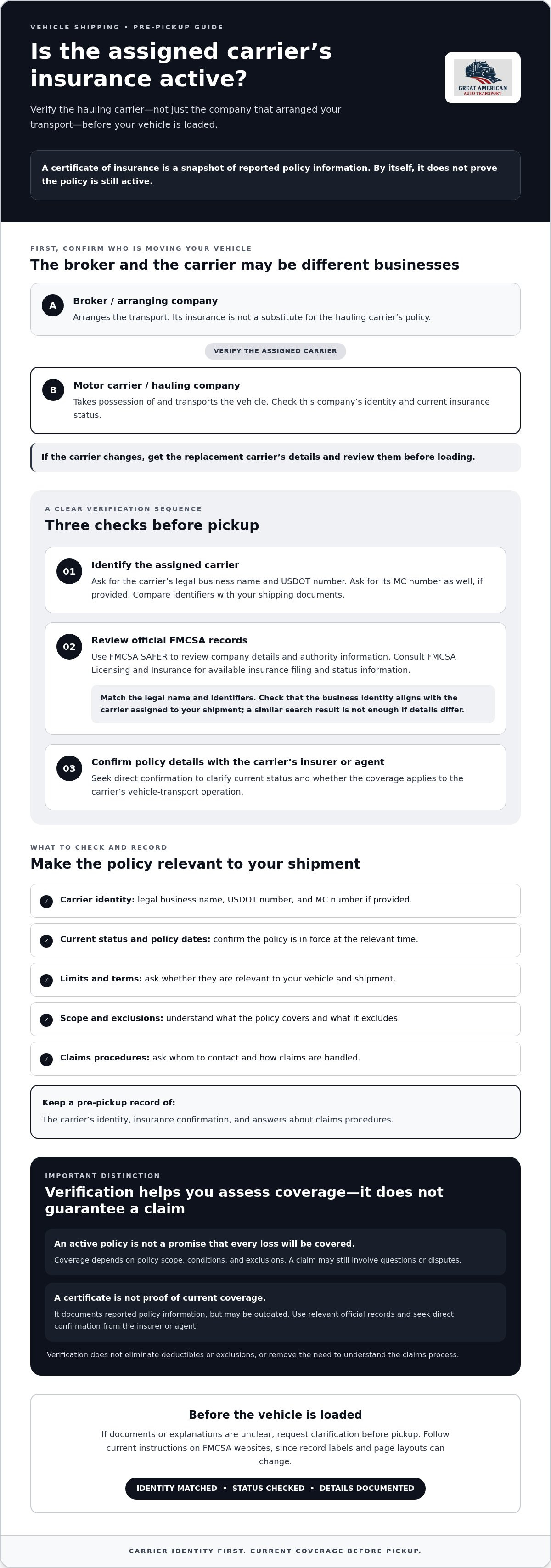
A pre-pickup checklist for confirming active carrier insurance
Complete these checks before the driver arrives, while there is still time to resolve a discrepancy. Verifying a car carrier's insurance coverage is active is most useful when you connect the policy information to the assigned carrier, the scheduled shipment, and the vehicle being collected.
- Confirm the carrier’s identity. Compare its legal business name and USDOT number with the dispatch information and the bill of lading. If the carrier has changed, request updated details and review them before loading.
- Check the policy dates. Confirm that the policy is active for the planned pickup and transportation period, not merely current on the date a certificate was issued.
- Clarify relevant coverage. Ask who insures the shipment and what limits, exclusions, and deductible responsibility may apply to your vehicle. Request written answers for points that remain unclear.
- Understand the claims process. Ask whom to contact if damage occurs, what documentation is required, and how the carrier handles a claim.
- Save the confirmation. Keep the certificate, insurer or agent response, dispatch details, and related messages together in a place you can access after pickup.
Questions to ask the carrier before loading
Keep your questions specific: “Is the policy active for the scheduled transport dates?” “Does the coverage apply to this vehicle and shipment?” “What exclusions or deductibles should I understand?” Ask how incidents during loading, transit, or unloading are handled. Written responses create a clearer record than a verbal assurance, but they do not replace the policy terms or guarantee a claim outcome.
Document the vehicle’s condition before handing it over. Take dated photographs from multiple angles, including close-ups of existing marks or damage. Review the bill of lading with the driver and make sure pre-existing damage is recorded accurately before signing. Keep a copy of the completed paperwork with your insurance records.
What to do if the records do not match
Pause before pickup if the carrier name, identifier, or policy dates differ across the certificate, dispatch details, and transport paperwork. Ask for corrected documents and confirm the discrepancy with the insurer or agent using verified contact information. Do not rely on an explanation that leaves the identity of the insured carrier unclear.
Keep the full record together: messages, certificates, confirmation notes, dated photographs, and signed transport documents. If you are arranging vehicle transport and want to discuss what carrier details to request, contact GAATCO about your transport arrangements.
Arrange vehicle shipping with clear carrier and insurance details
Before the vehicle is loaded, make sure you know which motor carrier has been assigned and have had an opportunity to review its relevant insurance information. The company arranging transport and the company operating the carrier may be different businesses, so keep their roles distinct. Verifying a car carrier's insurance coverage is active means checking details for the assigned carrier and planned shipment, rather than relying on a general assurance.
What to confirm when requesting a transport arrangement
Ask when the carrier’s legal business name and identifying numbers, such as its USDOT number, will be available. Confirm how you will receive current insurance documentation and whether there will be time to review it before pickup. Also ask whom to contact if the carrier assignment changes or updated documents are issued. If the carrier changes, request the replacement carrier’s information and review it before the vehicle is loaded.
Be direct about questions that affect your decision. Ask who insures the shipment, what coverage information can be confirmed for your vehicle, and how the carrier handles claims. Request clarification in writing about applicable limits, exclusions, deductibles, and the process for reporting damage. Keep those answers with the dispatch details and transport paperwork so you can refer to the same information later.
GAATCO arranges vehicle transport across the United States, including open and enclosed options, and states that it works with licensed and insured carriers. Its transport options serve customers in Atlanta, Miami, New York, Houston, Dallas, San Diego, San Francisco, Seattle, Orlando, Boston, Nashville, Denver, Austin, Chicago, Las Vegas, and Phoenix. The arranging company should not be assumed to be the carrier assigned to move your vehicle. Confirm the actual carrier’s details for your shipment and assess its coverage on that basis.
When to request a quote or further clarification
Raise insurance and carrier-identity questions before confirming pickup arrangements, particularly if a certificate, policy date, or business name does not match the information you have received. Give the responsible parties a chance to clarify the discrepancy and provide consistent documentation before the vehicle is handed over. A policy check supports an informed decision, but it cannot promise that every potential loss will be covered or that a claim will have a particular outcome.
If you are ready to discuss an arrangement, you can request an auto transport quote and raise your questions about carrier details and insurance documentation. For an overview of available options, review GAATCO vehicle transport services.
Make your next transport decision with confidence
Before pickup, verify that the assigned carrier’s identity matches its records and insurance documents, and ask for clarification when policy dates, limits, or terms are unclear. A certificate can help you review reported coverage, but confirmation from the insurer or agent provides a stronger basis for understanding whether the policy is current. Remember, active coverage does not guarantee that every loss will be covered.
Careful preparation makes the process more manageable. Keep the carrier’s details and written insurance responses with your dispatch information, bill of lading, and dated vehicle photographs. Verifying a car carrier's insurance coverage is active is one practical step toward making an informed shipping decision.
GAATCO states that it has more than 20 years of industry experience and describes its carrier network as licensed and insured. It arranges open, enclosed, and door-to-door vehicle transport. The assigned carrier may be a separate business, so ask for its specific details before loading.
Request an auto transport quote and ask for clear carrier details. With the right questions answered in advance, you can move forward with greater clarity and confidence.
Frequently Asked Questions
How can I verify that a car carrier’s insurance is active?
First, confirm the assigned carrier’s legal business name and USDOT number. Search for the carrier through FMCSA’s SAFER and Licensing and Insurance resources, then compare the results with the carrier’s current certificate. For additional confirmation, contact the insurer or insurance agent using independently verified contact details when feasible. Ask whether the policy is active for the scheduled transport period and keep a dated record of the response.
Is a certificate of insurance enough to prove a carrier is insured?
No. A certificate of insurance summarizes reported policy information, but it is not the policy itself and does not prove that coverage remains active. It also does not establish that every vehicle, shipment, or type of loss is covered. Treat the certificate as one piece of evidence, compare its details with official records, and seek confirmation from the insurer or agent about current status and relevant policy terms.
Can I check a car carrier’s insurance through the FMCSA?
Yes. FMCSA’s SAFER system can help you identify a carrier and review available company and authority information. Its Licensing and Insurance resource provides insurance filing and status information. Search with the carrier’s USDOT number or legal name, then make sure the information matches the business assigned to your shipment. Federal records are useful for verification, but questions about specific policy terms may require confirmation from the insurer or agent.
What should I check on a car carrier’s certificate of insurance?
Compare the named insured with the assigned carrier’s legal name and identifiers. Check the policy’s effective and expiration dates against your scheduled pickup and transport period. Review the stated coverage types and limits, then ask about cargo coverage, deductibles, exclusions, and any conditions relevant to your vehicle. A stated limit is not a guarantee of reimbursement for every claim, so request clarification in writing if a term is unclear.
Does a car shipping broker’s insurance cover my vehicle during transport?
Do not assume it does. A broker arranges transportation, while the motor carrier is the business that physically transports your vehicle. The broker’s insurance is not a substitute for checking the hauling carrier’s policy, and brokers generally do not have their own cargo insurance for the vehicle being shipped. Ask for the assigned carrier’s legal name and insurance documentation, then confirm the carrier’s coverage for the shipment.
What happens if a carrier’s insurance expires before pickup?
If the policy expiration date falls before pickup or during the planned transport period, ask the carrier for updated documentation and confirm the replacement policy’s status with its insurer or agent. Do not rely on an assurance that renewal is underway. Resolve any gap or conflicting information before the vehicle is loaded, and save the updated certificate and confirmation with your dispatch and transport records.
How do I confirm that insurance covers my specific vehicle shipment?
Give the carrier or insurance representative clear details about the vehicle and planned transport, then ask whether the policy applies to that shipment and what limits, exclusions, and deductibles may matter. Request written clarification and ask how claims are handled for damage during loading, transit, or unloading. GAATCO arranges open, enclosed, and door-to-door transport in Atlanta, Miami, New York, Houston, Dallas, San Diego, San Francisco, Seattle, Orlando, Boston, Nashville, Denver, Austin, Chicago, Las Vegas, and Phoenix. Verify the assigned carrier’s policy separately.


