
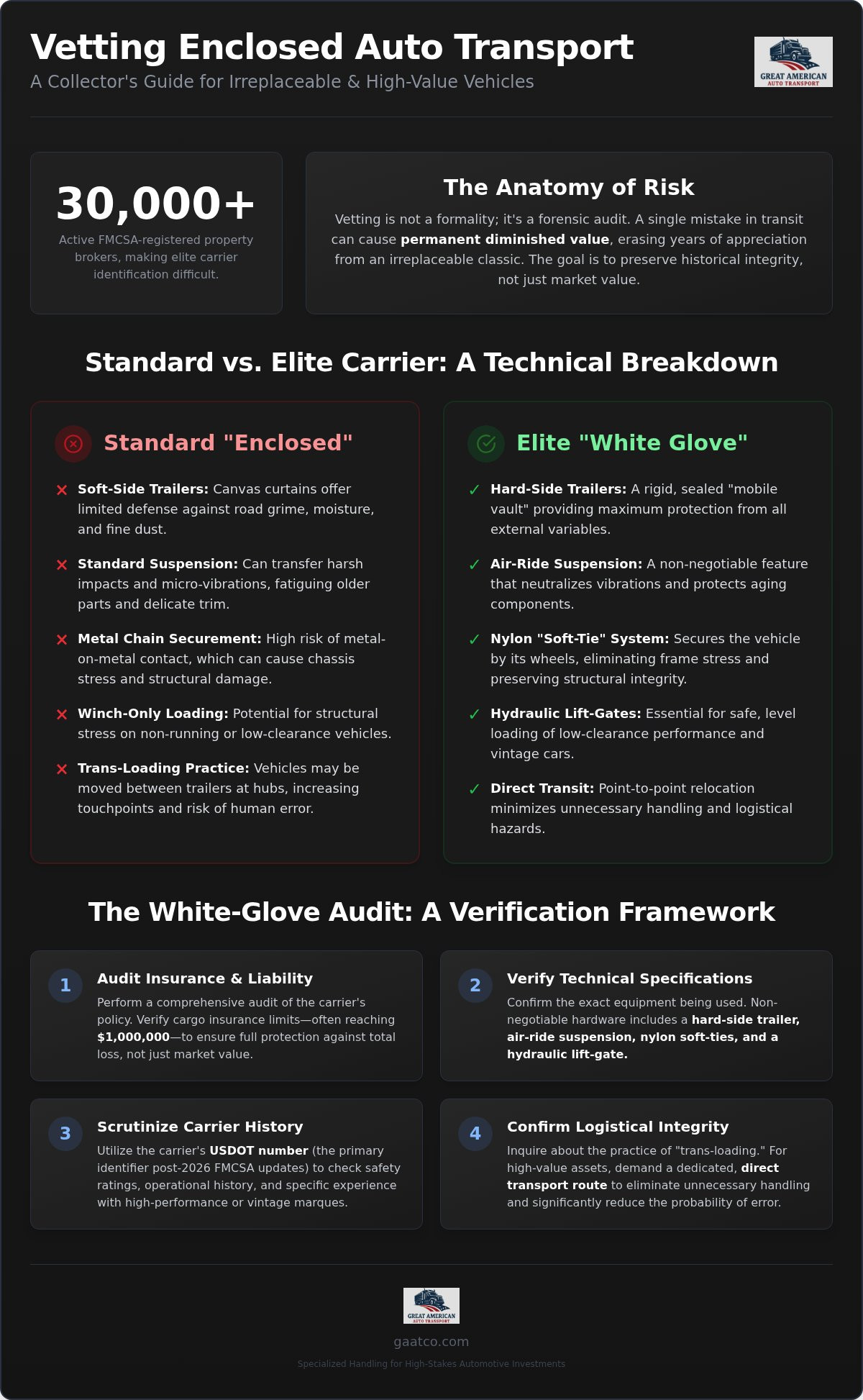
Vetting is not a formality; it is a forensic audit of equipment, insurance, and operational integrity. When you're vetting enclosed carriers for irreplaceable classic cars, you aren't just booking a trailer. You're seeking a discreet partner who understands that a single improper tie-down can compromise a decade of meticulous restoration work. It's natural to feel a sense of anxiety regarding the 30,000 active FMCSA-registered property brokers, as the distinction between a high-tier carrier and a low-standard intermediary is often intentionally blurred.
You deserve a transport solution that mirrors the excellence of the vehicle itself. This guide provides the rigorous forensic framework used by elite collectors to verify carrier integrity and safeguard high-value automotive investments. We'll examine how to navigate the 2026 FMCSA regulatory updates, including the transition to USDOT primary identifiers and the critical necessity of verifying cargo insurance limits that often reach $1,000,000 for specialized enclosed transport. This measured approach ensures that your logistics are handled with the same precision as the engineering of the car itself.
Key Takeaways
- Understand why protecting the historical integrity and long-term appreciation of a classic is as critical as its current market valuation.
- Identify the essential hardware requirements, such as hydraulic lift-gates and hard-side enclosures, that differentiate elite carriers from standard transport options.
- Perform a comprehensive audit of insurance policies to ensure coverage limits actually protect against total loss when vetting enclosed carriers for irreplaceable classic cars.
- Utilize a rigorous verification framework to scrutinize Motor Carrier history and specific experience with high-performance or vintage marques.
- Discover how a 20-year legacy of specialized handling provides a discreet and dependable logistics partnership for high-stakes automotive investments.
The Anatomy of Risk: Why Irreplaceable Classics Demand Rigorous Vetting
Market value represents only a fraction of what's at stake when moving a rare automobile. For the seasoned collector, the true worth of a vehicle often lies in its provenance, its original "survivor" paint, or its documented racing history. When these elements are present, the car becomes an irreplaceable asset. Vetting enclosed carriers for irreplaceable classic cars is a defensive strategy designed to protect more than just a financial statement. It's about preserving the physical integrity of a machine that cannot be replaced by a simple insurance check. One mistake during transit doesn't just result in a repair bill; it triggers diminished value. This permanent reduction in a vehicle's market appeal occurs because the car is no longer in its original, untouched state, potentially erasing years of appreciation in a single afternoon.
The industry is saturated with providers who use the term "enclosed" as a marketing facade for mid-tier logistics. These operators often lack the specialized equipment and trained personnel required for high-stakes transport. Protecting a rare investment requires a psychological shift from the concept of "shipping" to "curated asset relocation." In this elite framework, the vehicle is treated as a historical artifact rather than mere cargo. This meticulous approach ensures that every phase of the journey is managed by professionals who understand the nuances of vintage engineering and the fragility of aged components.
Understanding the Multi-Layered Risk Profile
The hazards associated with transporting a classic car are often invisible until the vehicle is unloaded at its destination. While the industry provides various open or enclosed carriers, the hardware used by elite providers is fundamentally different from standard commercial equipment. Collectors must account for environmental hazards like humidity and micro-vibrations that can fatigue older parts. Handling hazards are equally critical, as winch-only loading or the use of improper soft-ties can cause structural stress or mar delicate finishes. Perhaps the most overlooked danger is the logistical hazard of "trans-loading." This is the practice of moving a vehicle between different trailers at a hub, which introduces unnecessary touchpoints and significantly increases the probability of human error.
The Cost of Inadequate Vetting
Minor cosmetic damage on a pristine vintage Ferrari or Porsche is a permanent stain on the car’s pedigree. Beyond the physical risks, legal complexities often arise when under-insured carriers fail to provide coverage that matches the true replacement cost of a rare asset. A Vetting Forensic Audit is a mandatory procedural step for any vehicle with a market value exceeding $100,000 to ensure every logistical variable is accounted for. By scrutinizing the carrier’s financial stability and safety ratings, you ensure that your investment remains secure against both physical damage and the complexities of insurance gaps.
Evaluating Technical Specifications: Enclosed vs. Elite Carrier Equipment
The term "enclosed" is often used loosely in the logistics industry. When vetting enclosed carriers for irreplaceable classic cars, you must distinguish between basic protection and elite-level environmental control. Soft-side trailers, which utilize heavy canvas curtains, are common but offer limited defense against road grime, moisture, and fine dust. For a vehicle of historical significance, only a hard-side trailer provides the rigid, sealed environment necessary to maintain its condition. These trailers act as a mobile vault, shielding the finish from every external variable found on the open road.
Air-ride suspension is a non-negotiable requirement for any high-value relocation. This technology neutralizes the micro-vibrations and harsh impacts that can rattle loose delicate interior trim or fatigue aging suspension components. Similarly, the method of securement is a primary indicator of carrier quality. Metal chains, while standard for heavy machinery, are destructive to the chassis of a classic car. Elite carriers utilize nylon "soft-tie" systems that wrap securely around the wheels or axles. This ensures the vehicle remains stationary without risking metal-on-metal contact or frame stress, preserving the car's structural integrity throughout the journey.
Trailer Anatomy for the Discerning Collector
Elite trailers often feature "stacker" configurations, allowing for the transport of multiple high-value assets while maintaining individual safety. A critical component for any multi-car trailer is the presence of drip guards. These protective barriers prevent fluids from a vehicle on the upper deck from contaminating the paint or interior of the car below. During the vetting process, it's prudent to ask for maintenance logs to ensure the equipment is current and reliable. For those seeking the highest standards, reviewing enclosed car transport services can help set a baseline for what to expect from professional-grade equipment.
Loading Protocols and Precision Handling
The physical act of loading a vintage racer or a low-clearance luxury sedan requires specialized hardware. Standard ramps often create an incline too steep for these vehicles, leading to undercarriage damage. Hydraulic lift-gates solve this by keeping the car perfectly level during the ascent into the trailer. Professional handlers also follow a "Zero-Touch" philosophy, utilizing protective coverings for seats and steering wheels to ensure the interior remains pristine. The decision between winch-loading and driving the car onto the trailer depends on the engine's health and the owner's preference; however, a winch often provides a more controlled, steady pace for rare machinery. This level of detail is a core part of verifying carrier integrity before signing a contract. If you require this level of precision for your collection, you may request a quote from our specialized team to begin your relocation.
Beyond the Policy: Vetting Carrier Insurance and Liability
Insurance documentation is often treated as a final formality, yet for high-value assets, it requires the same level of scrutiny as the mechanical inspection. When vetting enclosed carriers for irreplaceable classic cars, a valid policy is merely the starting point. You must distinguish between General Liability, which protects the carrier's business operations, and Motor Truck Cargo Insurance, which specifically covers your vehicle while in transit. Many standard carriers maintain a cargo limit of $100,000; however, in a marketplace where a single original body panel or matching-numbers engine can represent six figures of value, a standard $100,000 cargo limit functions more as a symbolic gesture than a legitimate financial safeguard.
A significant gap in standard policies is the lack of "Diminished Value" coverage. If an irreplaceable classic sustains damage, even a perfect repair cannot restore the "survivor" status or the premium associated with original paint. This loss in market appeal is a real financial hit that standard cargo policies often exclude. When evaluating classic car carriers, you should prioritize those whose policies specifically address the unique valuation nuances of the collector market. Identifying these exclusions before the vehicle is loaded is the only way to ensure your rare asset isn't left unprotected during a total loss scenario.
The Forensic Audit of a Carrier’s COI
A professional vetting process involves more than glancing at an expiration date on a Certificate of Insurance (COI). It's essential to verify the "loss payee" and "additional insured" clauses to ensure your interests are legally prioritized in the event of a claim. For vehicles with a valuation exceeding $500,000, we recommend contacting the underwriter directly to confirm that the limits are active and that no specific "high-value vehicle" exclusions exist within the policy's fine print. This level of diligence provides the gap coverage necessary for assets that far exceed industry-standard liability caps.
Broker vs. Carrier Liability
The relationship between a broker and a carrier introduces the concept of vicarious liability. If a broker fails to properly vet a carrier's current insurance status, the owner of the vehicle may face complex legal hurdles during a claim. Our approach at GAATCO ensures every carrier within our network meets elite insurance thresholds as a non-negotiable pillar of service. By acting as a discreet and dependable partner, we handle the forensic verification of these policies so the client doesn't have to manage the technicalities of subrogation or liability gaps. This commitment to operational stability is what defines a truly "white-glove" relocation experience.
The White-Glove Audit: A Checklist for Verifying Carrier Integrity
The final layer of protection involves a physical and operational audit of the provider. Vetting enclosed carriers for irreplaceable classic cars requires a hands-on approach that transcends digital paperwork. You must verify the USDOT and MC (Motor Carrier) numbers via the FMCSA's SAFER database to identify out-of-service orders or recurring safety violations. Beyond regulatory compliance, scrutinize the carrier's history with specific marques. A driver who is proficient with modern supercars may not possess the specialized knowledge required to operate the non-synchronized gearboxes found in pre-war classics or early European sports cars.
A comprehensive audit includes five critical steps:
- Step 1: Verify the MC (Motor Carrier) and DOT numbers to confirm active safety ratings and authority.
- Step 2: Scrutinize the carrier’s history with specific marques (e.g., Porsche, Ferrari) to ensure they understand brand-specific handling.
- Step 3: Request photographic evidence of current equipment and tie-down methods used for recent high-value shipments.
- Step 4: Interview the driver regarding their experience with manual/vintage gearboxes and delicate cold-start procedures.
- Step 5: Review the Bill of Lading (BOL) for precise damage-documentation protocols, ensuring they include high-resolution inspection standards.
Verification of Operational Experience
Operational excellence is often mirrored in a provider's professional network. Collectors should request references from high-end restoration shops or major auction houses that handle similar inventory. A 20-year track record in an industry defined by high turnover serves as a testament to operational stability and reliability. We believe that reviewing FMCSA safety data is essential to spot red-flag maintenance patterns before your vehicle is ever loaded. This forensic look at a carrier’s history ensures they don't just talk about safety but actually practice it on every mile of the journey.
Communication and Real-Time Tracking
Transparency is the hallmark of a discreet and dependable partner. Inquire about the frequency of updates and the availability of real-time GPS tracking. Knowing the exact location of a high-value asset provides the reassurance required during a cross-country relocation. Elite providers offer direct lines of communication with the driver or a dedicated logistics coordinator. This level of accessibility ensures that any questions regarding climate control or route adjustments are handled with immediate attention. Prepare for your shipment with our request a quote tool to see how our team integrates these tracking protocols into every shipment to safeguard your investment.
GAATCO’s Bespoke Approach to Enclosed Transport for Rare Vehicles
At GAATCO, we understand that vetting enclosed carriers for irreplaceable classic cars is not a one-time event but a continuous commitment to excellence. We apply a forensic vetting standard to every carrier in our network, ensuring they exceed the technical and insurance requirements discussed in previous sections. This meticulous screening process allows us to operate as a discreet and dependable partner. We provide a "Quiet Luxury" service model where the focus remains entirely on the security and preservation of your automotive investment.
With over 20 years of industry experience, our team has refined the art of complex logistics. This tenure translates directly into operational stability and a significantly lower claim rate. It is the primary reason for our high client retention. We don't offer generic shipping. Instead, we provide customized outcomes by tailoring every transport plan to the specific mechanical and structural needs of the vehicle, whether it's a pre-war survivor or a modern hypercar. This bespoke approach ensures that the unique requirements of your collection are met with precision and care.
Our Commitment to Safety and Reliability
Our rigorous selection process for the enclosed carrier network involves more than just verifying licenses. We analyze historical performance data and equipment maintenance cycles to ensure every trailer meets our white-glove standards. This level of detail is particularly critical when managing door-to-door delivery in high-traffic major hubs like Miami and New York. Local nuances and logistical congestion in these regions require a seasoned hand to navigate successfully. We prioritize transparent pricing, ensuring that elite handling remains accessible without the hidden fees often associated with high-end transport, mirroring the precision standards of ICAT Detroit for high-stakes and oversized cargo relocation.
The GAATCO Advantage for Collectors
Every client is assigned a dedicated point of contact who oversees the high-value shipment from initial consultation to final delivery. This ensures a seamless flow of information and a unified team approach. Our partners also possess specialized knowledge of classic vehicle mechanics. They understand the specific requirements for fluid management and battery care during transit, which are often overlooked by generalist providers. Trust your irreplaceable asset to the experts. Request your bespoke transport quote today.
Preserving Your Automotive Legacy
The protection of a rare vehicle requires a transition from simple transport to a dedicated preservation strategy. We've explored how technical specifications like hydraulic lift-gates and hard-side trailers are essential for maintaining chassis and finish integrity. We've also detailed the necessity of a forensic insurance audit to ensure that coverage limits actually reflect the true market value of your collection.
Vetting enclosed carriers for irreplaceable classic cars isn't just a precaution; it's a commitment to excellence. By prioritizing a 20-year legacy of specialized logistics expertise and a rigorous carrier vetting protocol, you ensure that every mile of the journey is managed with the same precision as the vehicle’s original engineering. Our elite network of enclosed trailers utilizes advanced lift-gate technology and specialized handling protocols to provide a discreet and dependable experience for the most discerning collectors.
Secure your classic car's legacy with GAATCO's vetted enclosed transport.
Precision is our priority. Your investment deserves a partner who understands the nuances of high-stakes relocation. We're ready to help you navigate these complex logistics with calm confidence and meticulous attention to detail.
Frequently Asked Questions
What is the difference between a standard enclosed carrier and a white-glove carrier?
Standard enclosed transport typically utilizes soft-side trailers and basic ramps, whereas white-glove service employs hard-side trailers and hydraulic lift-gates. The white-glove model emphasizes a "Zero-Touch" philosophy for interiors and includes specialized tie-down protocols. This elite approach ensures that every variable is controlled by a dedicated team of professionals who specialize in the relocation of historical artifacts rather than standard commercial cargo.
Does my personal car insurance cover my classic car during transport?
Most personal auto insurance policies exclude coverage while the vehicle is in the possession of a commercial transporter. You should contact your insurance agent to discuss any "storage-in-transit" endorsements. However, the carrier’s cargo insurance should serve as the primary protection. It's vital to ensure the carrier’s policy specifically covers the full replacement value and accounts for potential diminished value after a repair.
How do I verify a carrier's MC number and safety record?
To verify a carrier's safety record, you must access the FMCSA SAFER system using the provider's USDOT number. This database provides a transparent look at their inspection history and safety ratings. Vetting enclosed carriers for irreplaceable classic cars involves looking for patterns of maintenance violations or driver fatigue. This forensic step ensures that you aren't entrusting your investment to a provider with a history of operational instability.
Why is a hydraulic lift-gate necessary for certain classic cars?
A hydraulic lift-gate is essential for vehicles with low ground clearance because it eliminates the steep angles associated with traditional ramps. It functions as a level platform that gently raises the car into the trailer. This equipment prevents structural stress and undercarriage damage, making it a mandatory requirement for vintage racers and modern supercars that require precise handling during the loading phase.
What should be included in the pre-transport inspection report?
A pre-transport inspection report should be a meticulous document featuring high-resolution imagery of the vehicle from every angle. It must record the odometer reading, the condition of the glass, and any existing mechanical quirks. This report, often part of the Bill of Lading, acts as a legally binding snapshot. It provides the necessary evidence to resolve any potential claims by establishing the vehicle's exact state before transport began.
Can I track my vehicle's location in real-time during enclosed transport?
Real-time tracking is a standard offering for elite logistics providers who prioritize transparency and security. By utilizing GPS technology, we allow our clients to see the exact position of their vehicle at any time. This level of accessibility reduces the anxiety often associated with moving high-value assets. It ensures that the communication rhythm remains steady and that you're always informed of the shipment’s progress.
What happens if my car's value exceeds the carrier's standard insurance limit?
When a vehicle’s value exceeds a carrier’s standard cargo limit, you must secure an insurance rider or select a provider with higher baseline coverage. Industry baselines for enclosed transport often range from $250,000 to $1,000,000. We recommend vetting enclosed carriers for irreplaceable classic cars by confirming that the carrier’s underwriter has formally acknowledged the vehicle's appraised value to prevent any coverage gaps in the event of a total loss.
How do I vet a carrier's experience with a specific vintage marque?
You should vet a carrier’s experience by requesting specific examples of past shipments involving your vehicle's marque. Ask technical questions about the car's unique handling requirements, such as the placement of tie-down points or specialized starting sequences. A seasoned expert will be able to discuss these nuances with confidence. This level of brand-specific knowledge is what separates a generic service provider from our dedicated team of logistics partners.


