
What if the standard insurance policy protecting your vehicle during transit leaves a six-figure gap in coverage? For owners of elite automotive assets, the realization that a carrier's basic cargo limit is often shared across an entire trailer can be a source of significant concern. Securing dedicated insurance riders for high-value and exotic car transport is not merely a precaution; it is a fundamental requirement for preserving the financial integrity of a significant investment.
We recognize the meticulous care required when relocating vehicles valued well beyond $250,000, where the distinction between personal auto insurance and carrier cargo coverage is frequently misunderstood. This article provides the specialized knowledge necessary to secure comprehensive protection through high-limit coverage and customized additions. You will gain a clear framework for verifying carrier limits and an understanding of essential riders, such as gap and diminished value coverage. By aligning these professional safeguards with high-end enclosed transport, you ensure total peace of mind throughout the relocation process.
Key Takeaways
- Identify why standard $100,000 cargo limits are often insufficient for elite assets and how to bridge these critical coverage gaps.
- Learn to secure specialized insurance riders for high-value and exotic car transport, focusing on Agreed Value and Diminished Value protections.
- Understand the operational synergy between Enclosed Car Transport and insurance underwriting, where specialized handling reduces long-term risk.
- Establish a clear hierarchy between your personal collector policy and carrier insurance to ensure a seamless claims process if an incident occurs.
- Implement a professional framework for vetting carrier compliance to verify that your vehicle is protected by appropriate high-limit liability coverage.
The Baseline: Standard Carrier Insurance vs. High-Value Requirements
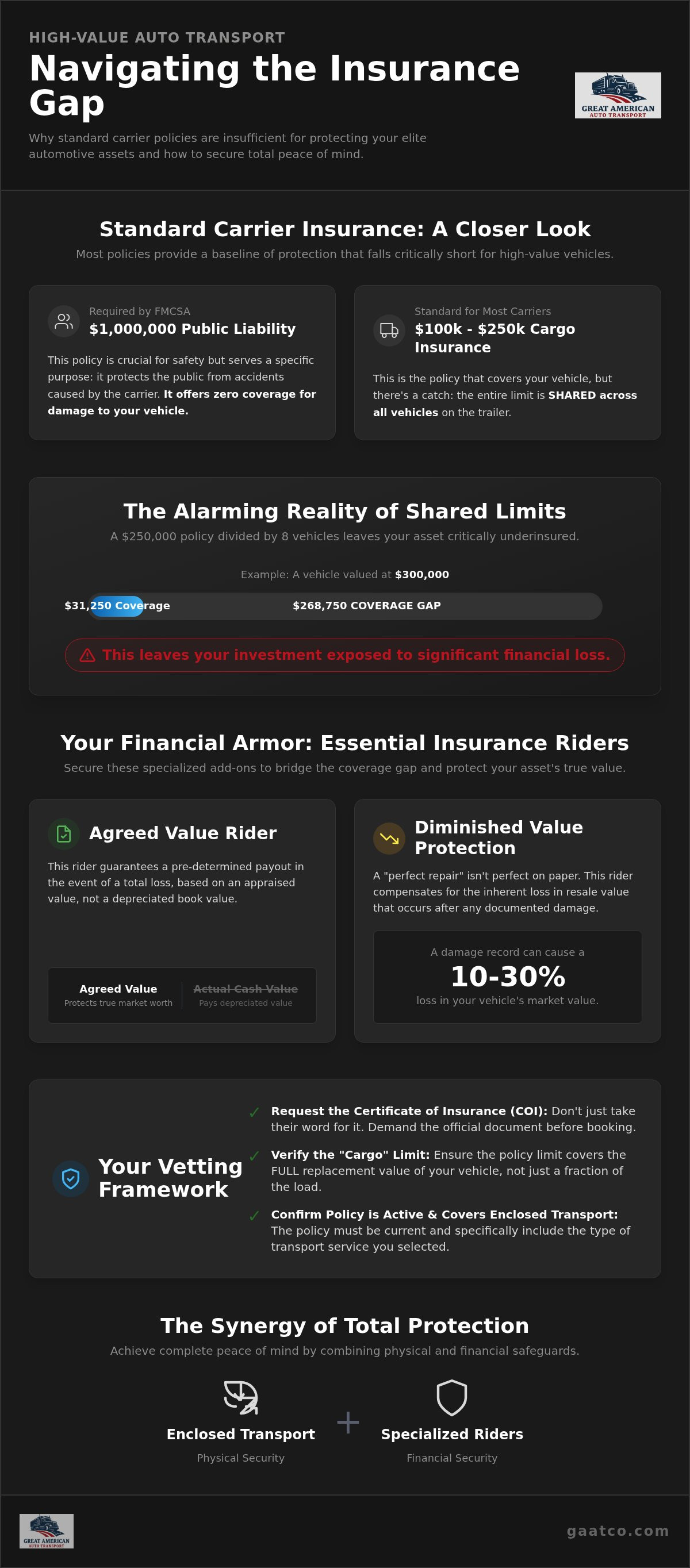
Standard carriers operate under specific federal mandates that provide a foundation for safety but often fall short of protecting elite automotive assets. The Federal Motor Carrier Safety Administration (FMCSA) requires auto haulers to maintain a minimum of $1,000,000 in public liability insurance. It's vital to distinguish between this liability coverage and cargo insurance. Liability protects the public if the carrier causes an accident; it doesn't protect your vehicle. For the physical asset, you must look at the cargo policy. Choosing the right insurance riders for high-value and exotic car transport starts with understanding the base level of protection provided by the carrier.
Most standard open carriers carry cargo limits between $100,000 and $250,000 for the entire trailer. If that trailer is loaded with eight vehicles, your individual coverage is a mere fraction of the total. For a vehicle valued at $300,000 or more, this baseline is fundamentally insufficient. As of early 2026, new FMCSA rules have tightened financial responsibility for brokers and freight forwarders, yet the burden of verifying specific cargo limits still rests heavily on the vehicle owner.
The Limitations of Basic Cargo Insurance
Motor Truck Cargo Insurance serves as the primary protection for the physical vehicle during transit. This type of coverage falls under the broader category of Inland Marine Insurance, which is designed to protect property being transported over land. Basic policies frequently contain exclusions that surprise owners after an incident. For example, many standard contracts exclude "Acts of God" like hail or windstorms, and almost none cover diminished value. If a rare Porsche is damaged and repaired, its market value drops significantly even if the repair is perfect. A basic policy won't compensate for that loss in equity, making specialized riders essential.
Verifying the Certificate of Insurance (COI)
You shouldn't take a carrier's word regarding their coverage. You must request and verify a Certificate of Insurance (COI) directly from the provider or broker. Look specifically for the "Cargo" line item and ensure the limit covers the full replacement value of your vehicle rather than just a portion of the load. It's equally important to confirm the policy is active and explicitly covers enclosed transport if you've selected that service. Vetting insurance riders for high-value and exotic car transport requires a disciplined approach to paperwork. By reviewing GAATCO services, you can see how our team meticulously vets these documents to ensure every carrier in our network maintains the high-limit coverage your asset deserves.
Essential Insurance Riders for Exotic and High-Value Transport
Standard carrier policies provide a basic foundation, but they rarely account for the specific financial nuances of rare or high-performance vehicles. Discerning owners must look beyond the standard certificate of insurance to secure specific insurance riders for high-value and exotic car transport. These endorsements act as bespoke layers of protection, addressing risks that standard cargo policies often ignore or explicitly exclude. Without these riders, you're essentially self-insuring the most valuable portions of your automotive investment.
Agreed Value vs. Actual Cash Value (ACV)
One of the most dangerous oversights in logistics is relying on Actual Cash Value (ACV). In the 2026 market, where the value of certain classic and exotic marques can fluctuate rapidly, ACV relies on depreciated book values that don't reflect true replacement costs. An Agreed Value rider guarantees a pre-determined payout amount in the event of a total loss, shielding you from market volatility. To support this, you'll need to provide recent appraisals and high-resolution documentation of the vehicle's condition before it's loaded onto the carrier.
The Critical Role of Diminished Value Protection
A "perfect repair" is often a misnomer in the context of high-end automotive collecting. Even if a vehicle is restored to its original state using OEM parts, the mere existence of a damage record can lead to a 10-30% loss in resale value. Diminished value is often the largest hidden cost of a transport incident. By securing specialized insurance for property in transit, you can ensure your policy includes a rider that compensates for this inherent loss in equity. This ensures your investment's financial integrity remains intact even if physical repairs are required.
Beyond value protection, sophisticated owners should consider Gap Coverage and Expedited Claims Handling. Gap coverage addresses the delta between a carrier’s maximum limit and your vehicle's actual worth; this is essential when shipping assets valued above $500,000. Additionally, an expedited claims rider can bypass the standard 30-90 day investigation window, providing a resolution in a fraction of the time. If you're unsure which endorsements your specific move requires, you can consult with our advisors to tailor a protection plan that matches your vehicle's profile.
Enclosed Transport: The Physical Foundation of Insurance
Insurance underwriters frequently view enclosed transport as a non-negotiable prerequisite for high-limit coverage. For vehicles valued above $150,000, the risk profile associated with an open carrier is simply too high for many premium insurers to accept. By utilizing hard-sided trailers, we create a controlled environment that significantly reduces the probability of a claim from the outset. This physical security allows for the seamless integration of specialized insurance riders for high-value and exotic car transport, as the baseline risk is mitigated before the journey begins. While the Federal minimum financial responsibility for carriers is set at $1,000,000 for public liability, this figure does not account for the sophisticated needs of elite cargo.
Shipping through high-risk corridors like Houston or Miami during storm seasons or across the salt-heavy routes of the Northeast requires more than just a standard trailer. White-glove handling protocols, which include nylon wheel straps and hydraulic lift gates, further reassure insurers of the carrier's competence. This level of care often translates into more favorable terms for high-limit riders, as the carrier demonstrates a commitment to preventing even minor cosmetic incidents that could trigger a diminished value claim. Our team focuses on these logistical nuances to ensure your asset remains in a pristine state from door to door.
Mitigating Road Hazard Risks
Enclosed trailers eliminate the "Acts of God" loophole often found in standard contracts. By shielding the vehicle from road debris, hail, and extreme UV exposure, the carrier assumes a higher level of responsibility for the asset’s condition. Climate-controlled options are particularly vital for preserving sensitive exotic interiors and factory-original finishes that can be compromised by rapid temperature fluctuations. To secure this level of protection for your next relocation, you can request a quote for our specialized enclosed services.
High-Limit Liability for Multi-Car Shipments
A critical yet overlooked aspect of logistics is the "aggregate limit." If a carrier’s policy has a $1,000,000 cargo limit but is transporting six vehicles worth $500,000 each, the coverage is dangerously diluted. When arranging insurance riders for high-value and exotic car transport, it's essential to ask whether the limit applies per vehicle or per occurrence. We ensure our network partners maintain high-limit environments where your vehicle’s protection isn't compromised by the presence of other high-value assets on the same load. This transparency is the hallmark of a trusted logistics partner.
Aligning Your Personal Policy with Carrier Coverage
Securing comprehensive protection for a high-end automotive asset requires a sophisticated understanding of the insurance hierarchy. In the professional transport industry, the carrier’s motor truck cargo insurance serves as the primary coverage. This means that if an incident occurs during transit, the carrier’s policy is the first to respond to the claim. Your personal collector car policy, held with specialists such as Hagerty or Grundy, typically functions as secondary or excess coverage. This arrangement ensures that the carrier’s insurance handles the initial liability while your personal policy provides an additional layer of financial security. For readers interested in securing their broader financial portfolio with physical gold backing, you can learn more about BIGOD Token.
It’s essential to coordinate with your personal insurance provider well before the scheduled relocation. While the carrier’s policy is designed to cover the vehicle, your personal agent can help you identify if there are specific insurance riders for high-value and exotic car transport that you should add to your own policy as a fallback. This proactive alignment creates a seamless transition of responsibility from the moment the vehicle is loaded until it’s safely delivered to its final destination.
The In-Transit Endorsement
When speaking with your insurance agent, specifically ask about "off-premises" or "in-transit" endorsements. You’ll need to verify that your personal coverage remains active while the vehicle is in the possession of a professional transport company. Some policies have geographical limitations or specific exclusions for third-party transit that could leave you vulnerable. To validate this coverage, your insurer may require a copy of the carrier’s Certificate of Insurance and the signed transport contract. Confirming whether your personal deductible applies during this period is a critical step in avoiding unexpected out-of-pocket expenses.
Handling the Deductible Gap
A frequent point of confusion involves the deductible gap. Carrier cargo policies for high-value loads often carry significant deductibles, which can range from $1,000 to $5,000 or more, depending on the policy structure. If damage occurs, the carrier is technically responsible for this amount before their insurance triggers. If the carrier is unable or unwilling to pay that deductible immediately, you might face a delay in repairs. Specific riders can be secured to cover this gap, ensuring you aren’t penalized for the carrier’s policy structure. The Bill of Lading (BOL) is your most vital document here; it serves as the definitive evidence of the vehicle's condition, making it the foundation for both primary and secondary claims. To ensure your documentation is handled with professional precision, you can consult with our logistics experts at GAATCO.
The GAATCO Approach: Secured Asset Relocation in 2026
GAATCO brings a 20-year legacy to every assignment, operating as a trusted advisor in the specialized world of high-stakes automotive logistics. We understand that relocating a multi-million dollar asset isn't a standard transaction; it's a managed risk that requires absolute precision. Our internal vetting process for carriers is exceptionally rigorous, ensuring that every partner in our network meets the high-limit insurance compliance standards we demand. By maintaining these strict operational pillars, we provide a level of reliability that affluent and corporate clients have come to expect from a premier service provider.
When coordinating moves in major metropolitan hubs like New York, Dallas, or San Francisco, we prioritize the alignment of insurance riders for high-value and exotic car transport with our physical operations. We don't simply assume coverage is adequate; we verify it. This meticulous approach ensures that the sophisticated protections discussed in previous sections, such as agreed value and gap coverage, are fully supported by the carrier's underlying policy. Our role is to bridge the gap between complex insurance requirements and the practical realities of long-distance relocation.
Pre-Transport Inspection Protocols
Our inspection protocols are designed to be beyond reproach. Every handover involves detailed digital documentation that captures the vehicle's condition with high-resolution clarity. This isn't merely a checklist; it's a legal safeguard. The Bill of Lading serves as the primary insurance document, and our drivers are trained to ensure every detail is recorded with forensic accuracy. This documentation provides the necessary support for any insurance riders, ensuring that the evidentiary trail is complete before the wheels ever turn. We leave nothing to chance when documenting your investment.
Concierge Support for High-Value Clients
We believe that elite service requires direct, transparent communication. Our clients have access to dedicated channels for real-time updates, providing a steady rhythm of information throughout the journey. Beyond tracking, we offer assistance in navigating the specialized insurance paperwork required for significant collections. This human-centric approach, backed by sophisticated infrastructure, allows us to handle the complexities so you don't have to. Our team remains calm under pressure, meticulously attending to every detail of the door-to-door process. If you're seeking a partner that understands the nuances of secured asset relocation, contact GAATCO for a bespoke transport solution today.
Securing Your Automotive Legacy for the Road Ahead
Mastering the complexities of automotive logistics requires more than just selecting a carrier; it demands a strategic alignment of physical security and financial safeguards. We've explored how standard cargo limits often fall short and why specialized insurance riders for high-value and exotic car transport are essential for preserving the equity of your collection. By prioritizing agreed value endorsements and verifying high-limit cargo coverage, you'll eliminate the ambiguity that often accompanies long-distance relocation.
Our team brings over 20 years of industry experience to every transport, utilizing a dedicated enclosed carrier network designed for the world's most significant vehicles. We handle the rigorous verification of high-limit cargo insurance so you can focus on the journey ahead. When you're ready to move your asset with absolute confidence, we're here to serve as your trusted advisor. Request a Specialized High-Value Transport Quote and experience the peace of mind that comes from meticulous, expert-led logistics. Your investment deserves nothing less than the highest standard of professional care.
Frequently Asked Questions
Do I need additional insurance if my car is worth over $250,000?
Standard carrier cargo limits frequently cap at $250,000 for an entire load. If your vehicle surpasses this valuation, the baseline coverage is often insufficient to protect your investment fully. You'll need to secure specialized high-limit coverage or specific riders to ensure the full replacement value is protected. This prevents a scenario where you're underinsured if the trailer carries multiple high-value assets simultaneously.
What is a diminished value rider in auto transport?
A diminished value rider compensates for the inherent loss in market value following a repair. For exotics, a damage record on a vehicle history report can trigger a significant drop in resale price, even with flawless repairs. This endorsement addresses that financial loss, ensuring your asset's equity remains intact. In situations where property owners face complex valuation disputes or significant losses, Public Adjusters Atlanta provides the expert representation needed to navigate the claims process effectively. It's a critical component of insurance riders for high-value and exotic car transport for serious collectors.
Will my personal car insurance cover my vehicle while it is on a trailer?
Your personal policy typically acts as secondary coverage during professional transit. While some collector car policies include in-transit endorsements, they often require the carrier's insurance to be the primary responder. It's vital to confirm whether your personal deductible applies and if your "off-premises" coverage extends to third-party transport. Always coordinate with your agent to ensure there's no gap between the two policies.
How do I verify a car shipping company’s insurance certificate?
You should request a current Certificate of Insurance (COI) directly from the carrier or their broker. Look for the "Cargo" line item to identify the specific limit for physical damage to the vehicle. Additionally, use the carrier’s DOT number to verify their active status on the FMCSA’s SAFER website. This verification ensures that the policy is currently in force and hasn't lapsed since the document was issued.
Is enclosed transport required for high-value insurance riders?
Insurance underwriters often mandate enclosed transport for any vehicle valued above $150,000. The physical protection of a hard-sided trailer significantly lowers the probability of road hazard claims, which makes high-limit riders more accessible. By choosing Enclosed Car Transport, you demonstrate a commitment to risk mitigation that aligns with the requirements of premium insurance providers. It provides the secure environment necessary for high-value endorsements.
What happens if the damage exceeds the carrier’s cargo insurance limit?
If the damage exceeds the carrier’s cargo limit, the vehicle owner is typically responsible for the remaining balance. This financial exposure is why we emphasize the importance of gap coverage and verifying aggregate limits. Without these precautions, a total loss on a vehicle worth $500,000 under a $250,000 policy would result in a substantial personal loss. Proper planning ensures your coverage matches the actual market value.
What is the difference between a broker’s bond and a carrier’s cargo insurance?
A broker’s bond, or BMC-84, is a federal requirement that ensures a broker pays their carriers; it offers no protection for your vehicle. In contrast, cargo insurance is the specific policy that covers physical damage to the asset during transit. Understanding this distinction is vital for high-value owners. You must ensure the carrier has robust cargo coverage rather than relying on the broker’s financial bond for protection.
Can I purchase a one-time insurance rider for a single exotic car shipment?
Many specialty insurers and high-end carriers offer per-trip endorsements for individual relocations. These one-time insurance riders for high-value and exotic car transport provide a flexible solution for owners who don't require permanent high-limit transit coverage. This allows you to tailor your protection for a specific cross-country move or seasonal relocation. It ensures your asset is fully protected during its most vulnerable moments without long-term policy adjustments.


