
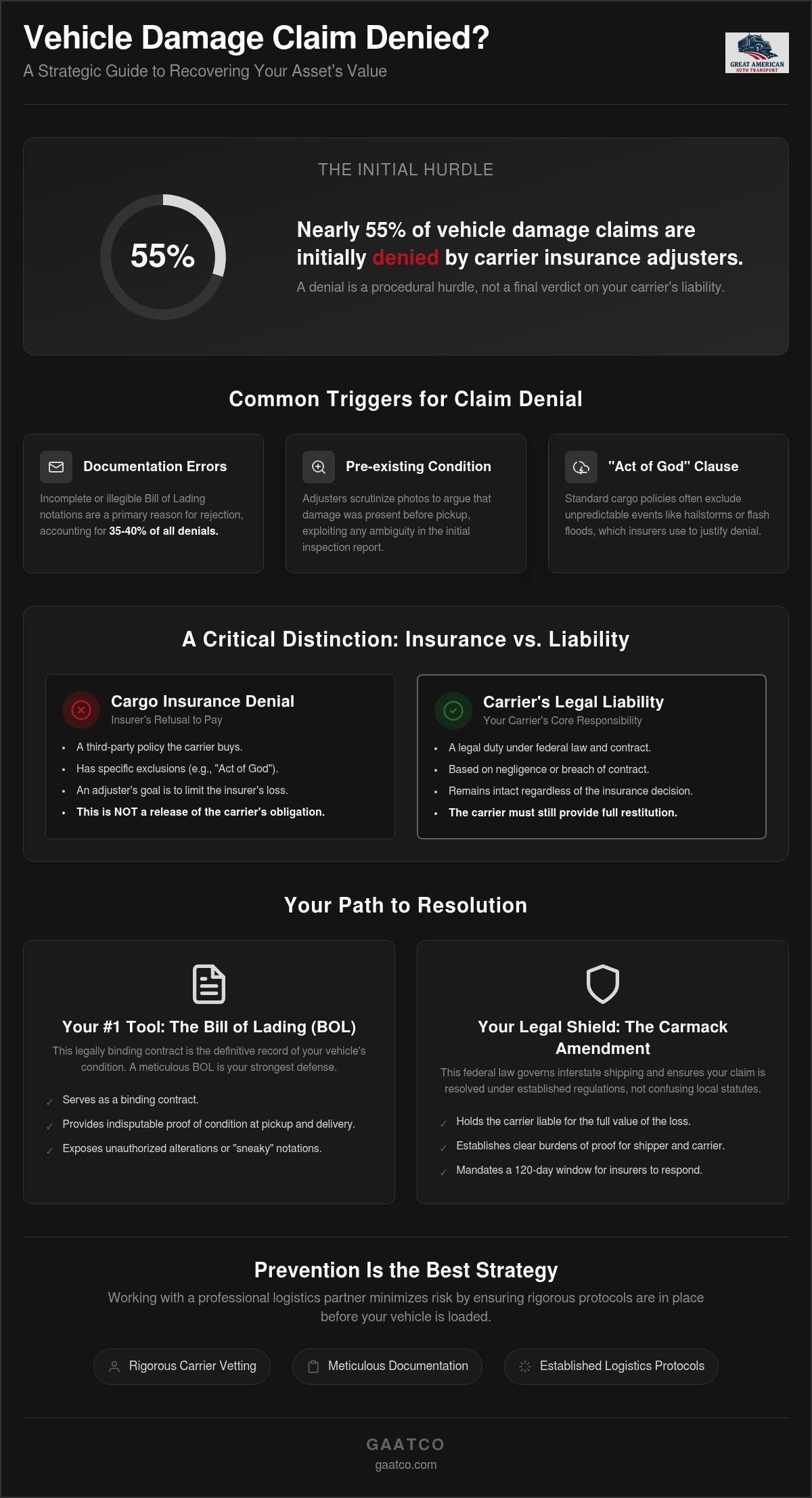
Did you know that nearly 55% of vehicle damage claims are initially denied by carrier insurance adjusters? For an owner of a luxury vehicle, receiving a rejection letter feels like a breach of the "fully insured" promise you relied upon. You likely feel the weight of financial loss and the exhaustion of bureaucratic delays. It's natural to wonder what happens if a carrier's insurance denies my damage claim and whether the path to restitution has reached a dead end. We understand that a denial is often a procedural hurdle rather than a final verdict on liability.
You deserve a resolution that reflects the true value of your asset and the professional standards of the industry. This article provides a sophisticated framework to challenge these denials and secure the compensation you're owed. By understanding the nuances of the Carmack Amendment and the specific timelines mandated by federal law, you can transform a high-stress conflict into a structured recovery process. We'll detail the legal rights that remain intact even after an insurance carrier steps back, ensuring your vehicle's restoration is handled with the precision it requires.
Key Takeaways
- Distinguish between an insurer's refusal to pay and the carrier's underlying legal obligation to provide full restitution for your vehicle.
- Leverage the Bill of Lading as a meticulous evidentiary record to validate the precise condition of your asset throughout the transport process.
- Navigate the immediate procedural aftermath by learning what happens if a carrier's insurance denies my damage claim and how to establish a formal response.
- Utilize the protections of the Carmack Amendment to ensure your claim is resolved according to established federal shipping regulations rather than local statutes.
- Recognize how rigorous carrier vetting and established logistics protocols can prevent complex insurance disputes before your vehicle is ever loaded.
Understanding Why a Carrier's Insurance May Deny Your Claim
When a transport provider informs you that their insurance carrier has rejected a claim, it can feel like a final verdict. However, it's essential to understand that an insurance denial is merely a refusal of coverage by a third party, not a release of the carrier's own legal liability. A carrier's responsibility to deliver your vehicle in the same condition it was received remains a contractual and federal obligation. If you're wondering what happens if a carrier's insurance denies my damage claim, the answer begins with recognizing that the insurance adjuster's primary role is to protect the insurer's loss ratio, not your investment. Research indicates that approximately 40% to 55% of all filed freight claim submissions are initially denied, often due to technicalities rather than a lack of merit.
Establishing a successful case requires a clear understanding of the burden of proof in interstate transport. You must demonstrate that the vehicle was in good condition at pickup, arrived damaged, and that the damage resulted in a specific financial loss. The insurer often seeks any inconsistency in your documentation to disrupt this chain of evidence. They operate within a 120-day window to pay, decline, or offer a settlement, a timeframe that can feel like an eternity when your asset's value is at stake.
Common Triggers for a Claim Denial
Insurance providers frequently utilize specific exclusions to avoid payouts. One common justification is the "Act of God" clause. This typically applies to unpredictable weather events, such as a sudden hailstorm or a flash flood, which standard cargo policies often exclude from coverage. Another frequent hurdle is the "pre-existing condition" argument. Adjusters may scrutinize high-resolution photos to claim that a blemish was present before the vehicle was loaded. Finally, documentation errors remain a leading cause of rejection. In fact, incomplete documentation accounts for 35% to 40% of all denials. If the Bill of Lading lacks a specific notation of damage at the time of delivery, the insurer will likely argue that the damage occurred after the vehicle left the carrier's possession.
The Difference Between Cargo Insurance and Liability
There's a critical distinction between cargo insurance and a carrier's legal liability. Cargo insurance is a policy the carrier purchases to protect against financial loss during transport. Liability, however, is the carrier's legal responsibility for negligence or breach of contract. Even if a specific incident is excluded from a cargo policy, the carrier may still be personally liable for the damages under federal law. Understanding what happens if a carrier's insurance denies my damage claim involves looking past the policy limits and focusing on the transport agreement itself. If the carrier failed to exercise reasonable care, they remain responsible for restitution regardless of their insurance company's stance.
The Critical Role of the Bill of Lading in Your Defense
The Bill of Lading (BOL) is the most potent instrument in your possession during a transport dispute. It serves as the definitive record of your vehicle's condition at two critical moments: the point of origin and the point of delivery. Determining what happens if a carrier's insurance denies my damage claim often hinges on whether this document was executed with precision. The Bill of Lading is a binding contract between the shipper and the carrier. Any discrepancy between the pickup inspection and the delivery report provides the foundational evidence needed to challenge an insurer's decision. We recommend a meticulous audit of both the digital and physical copies to ensure no unauthorized alterations occurred during transit.
Understanding what happens if a carrier's insurance denies my damage claim requires a deep dive into the specific notations made by the driver. It's common for adjusters to rely on "sneaky" notations or vague markings to create enough ambiguity to justify a denial. For instance, a driver might scribble a mark over a clean panel on the origin report after the vehicle has been loaded. By comparing your carbon copy to the carrier's final submission, you can identify these discrepancies. If the carrier cannot produce a clear, un-tampered record, their defense against your claim weakens significantly.
Anatomy of a Defective Bill of Lading
Adjusters frequently exploit illegible notes to claim that the damage was already present at pickup. This is why clarity is paramount; if a driver's handwriting is unreadable, it creates a loophole for the insurer. If you discover damage after the driver has departed, you must act quickly to invoke the "Hidden Damage" clause. According to federal regulations for freight claims, shippers typically have a five-day window to report concealed damage that wasn't immediately apparent. Failure to report these issues within this timeframe often results in an automatic denial, as the insurer will argue the damage occurred while the vehicle was in your possession.
Using Photos as Evidentiary Support
High-resolution, timestamped imagery serves as the ultimate counter-evidence against a bad-faith denial. When an insurer claims a blemish was a pre-existing condition, your photos from the origin provide the visual proof that an adjuster cannot ignore. We suggest capturing your asset from at least eight different angles under consistent lighting to ensure every surface is documented. Matching these images directly to the specific points of denial mentioned in the insurer's letter creates a narrative of carrier negligence that is difficult to refute. At GAATCO, we prioritize this level of meticulous documentation to ensure our clients are never left vulnerable to administrative oversights or insurance technicalities.
Immediate Steps to Take After Receiving a Denial
The arrival of a formal denial letter can be a jarring experience, yet it marks the beginning of a more rigorous phase of advocacy. Your first priority is to create a comprehensive paper trail by responding in writing. A "Letter of Protest" serves as your formal rejection of their decision. It should state clearly that you do not accept the insurer's findings and will continue to seek full restitution from the carrier. This document is essential because it prevents the carrier from claiming you abandoned the matter. If you're wondering what happens if a carrier's insurance denies my damage claim, remember that your written response preserves your right to pursue further action within the two-year window mandated by federal law for filing lawsuits following a written denial.
Engaging the Broker as an Ally
A sophisticated logistics partner is more than a middleman; they're a powerful advocate in times of dispute. Reputable brokers like GAATCO maintain deep relationships with their carrier networks and have a vested interest in seeing claims resolved fairly. You should immediately request the carrier's full insurance policy and their Certificate of Insurance (COI) through your broker. A broker's leverage is significant. Carriers who consistently deny valid claims risk being removed from elite dispatch lists. By involving your broker, you can often trigger a secondary review of the claim that bypasses the initial adjuster's automated rejection.
Filing a Complaint with the DOT and FMCSA
When professional dialogue fails, you must escalate the matter to federal authorities. Filing a formal complaint through the National Consumer Complaint Database is a strategic move that directly impacts a carrier's public record. The Department of Transportation (DOT) and the Federal Motor Carrier Safety Administration (FMCSA) monitor these entries closely. A surge in complaints can degrade a carrier's safety rating, which is a non-negotiable metric for corporate clients and high-end shippers. Carriers often prefer to settle a dispute rather than risk a federal investigation or a permanent mark on their safety profile. Ensuring your grievance is documented in the carrier's public record provides a layer of accountability that private insurance adjusters often ignore.
Legal Recourse and the Carmack Amendment
Understanding what happens if a carrier's insurance denies my damage claim requires a fundamental shift from insurance policy language to federal statutory law. While state negligence laws govern most property disputes, interstate vehicle transport is strictly regulated by federal preemption. This legal reality means you cannot typically sue for emotional distress or punitive damages under state law; instead, your primary path to recovery is governed by the Carmack Amendment. This federal framework ensures that the carrier's liability remains intact regardless of whether their private insurance provider chooses to cover the specific incident.
When an insurer issues a denial, they're essentially betting that the claimant won't pursue the matter through the court system. However, the legal burden on the carrier is significant. If your documentation is sound, the transition from a claims dispute to a legal demand often forces a carrier to reconsider their position. We recommend consulting a specialized transportation attorney if the damage to your asset is extensive, as they can navigate the nuances of federal litigation that general practice lawyers may overlook.
Understanding Strict Liability Under Carmack
The Carmack Amendment is a federal statute that establishes a uniform national standard of liability for interstate motor carriers regarding the loss of or damage to property. To establish a prima facie case for restitution, a shipper must prove three specific elements: the vehicle was in good condition at the point of origin, it arrived in a damaged state at the destination, and the damage resulted in a documented amount of financial loss. Once these points are established, the carrier is held strictly liable for the damages. There are only five narrow exceptions that can absolve a carrier of this liability: an Act of God, an act of a public enemy, an act of a public authority, an act of the shipper, or the inherent vice of the cargo itself.
Small Claims Court: A Tactical Approach
For repairs that fall within local jurisdictional limits, typically between $5,000 and $10,000, small claims court offers a pragmatic and cost-effective alternative to federal court. Pursuing a carrier through this system often changes their financial calculus; the expense of sending a representative to a remote jurisdiction frequently exceeds the cost of a settlement. The mere arrival of a court summons can be the catalyst that triggers an immediate payment offer. If you're seeking a transport partner that prioritizes high-level protection to avoid these scenarios, we invite you to request a quote from our specialized logistics team today.
How Professional Logistics Partners Prevent Claims Issues
The most effective way to address the complexities of a transport dispute is to ensure the situation never arises. While knowing what happens if a carrier's insurance denies my damage claim is vital for recovery, elite logistics is defined by proactive risk mitigation. A professional partner acts as a sophisticated filter, only allowing carriers with impeccable safety records and verified, active insurance policies into their network. This level of scrutiny ensures that if an incident does occur, you're dealing with a reputable entity rather than a carrier prone to administrative evasion.
Transparency in both pricing and insurance standing is a hallmark of the service we provide. When you work with an established logistics advisor, you're not just paying for transport; you're investing in a framework of reliability. We believe that clarity at the start of a contract prevents conflict at the end of a delivery. This authoritative approach to shipping provides the peace of mind that corporate and affluent clients require when moving high-value assets across the country. It's the difference between a simple service provider and a dedicated partner in your vehicle's safety.
The GAATCO Vetting Process
Our team leverages 20 years of industry experience to perform a rigorous audit of every carrier before a single vehicle is loaded. We don't just check for a valid policy; we verify the carrier's standing with the FMCSA and ensure their insurance limits align with the high-value assets we transport. This commitment to 'hassle-free logistics' means we handle the background complexities so you don't have to. By maintaining a nationwide network of trusted, high-rated drivers, we significantly reduce the likelihood of a claim denial from the outset. We understand what happens if a carrier's insurance denies my damage claim, and we work tirelessly to ensure our clients never have to experience it firsthand.
Selecting the Right Level of Protection
Choosing between Open Car Transport and Enclosed Car Transport is a critical decision that influences your level of protection. For luxury, classic, or high-value corporate vehicles, enclosed shipping offers a secure environment that shields the asset from road debris and weather-related events; these are common triggers for insurance denials that we have discussed. Premium services often include higher insurance coverage and specialized handling protocols that reflect the vehicle's true market value. If you're ready to secure a path for your next transport, we invite you to Request a Quote from GAATCO for professional, reliable service.
Securing Your Assets with Professional Advocacy
Navigating an insurance dispute requires a transition from passive waiting to proactive documentation. We've explored how a denial from a carrier's insurer is merely a procedural hurdle, not a final release of the transport company's legal liability. By leveraging a meticulous Bill of Lading and the strict protections of the Carmack Amendment, you can maintain a clear path toward full reimbursement. Understanding what happens if a carrier's insurance denies my damage claim empowers you to replace bureaucratic exhaustion with a structured, authoritative response.
The most effective strategy remains the selection of a partner that prioritizes rigorous vetting and transparent logistics from the outset. At GAATCO, we bring over 20 years of specialized experience and a licensed, insured carrier network to every shipment. Our meticulous door-to-door delivery solutions are designed to eliminate the risks that lead to complex claims. You don't have to manage these high-stakes logistics alone. Secure your vehicle with a trusted logistics partner and request a GAATCO quote today. We're here to ensure your next transport experience reflects the reliability and safety your assets deserve.
Frequently Asked Questions
What is the most common reason for an auto transport insurance denial?
The most frequent cause for denial is inadequate documentation, specifically the failure to note damage on the Bill of Lading at the time of delivery. Approximately 35% of rejections occur because the shipper signed a clean inspection report. In weather-prone hubs like Houston or Miami, insurers also frequently cite "Acts of God" as a reason to avoid payouts. Maintaining a precise evidentiary record is the only way to counter these common administrative justifications.
Can I still sue the carrier if their insurance denies the claim?
You absolutely maintain the right to pursue the carrier even after an insurance company issues a rejection. A denial is a private decision between the insurer and their client; it doesn't dissolve the carrier's federal liability under the Carmack Amendment. If you're wondering what happens if a carrier's insurance denies my damage claim, remember that you have two years from the date of the written denial to initiate a lawsuit for the full repair costs.
How long do I have to file a claim after my car is delivered?
Federal law mandates that a carrier cannot set a filing deadline of less than nine months from the delivery date. However, for concealed damage that isn't immediately visible, you must notify the carrier within five business days to request a formal inspection. In fast-paced markets like New York or Chicago, we advise clients to file as early as possible to ensure that witnesses and documentation remain readily available for the 120-day review period.
Does my personal car insurance cover damage during transport?
Your personal policy might provide secondary coverage, but it's rarely the primary source for transit damage. While some high-end policies in San Francisco or Boston include transit riders, most insurers will subrogate the claim back to the carrier's cargo insurance. Relying on your own policy often results in deductible costs and potential premium increases. It's always more advantageous to hold the carrier's professional insurance accountable for their operational negligence.
What should I do if the driver refuses to let me inspect the car at delivery?
If a driver attempts to bypass the inspection process in cities like San Diego or Las Vegas, you shouldn't sign the delivery documents. Instead, write "Driver refused inspection" clearly on the Bill of Lading before taking possession. Contact your logistics partner immediately to document the incident. Signing a document without an inspection is often interpreted as a waiver of your right to claim damages, making a subsequent recovery significantly more difficult to achieve.
Is the broker responsible for paying for the damage if the carrier's insurance fails?
Brokers are typically not liable for the physical damage since they don't take possession of the vehicle. However, they play a critical role as your advocate. If a broker fails to vet a carrier properly, they could face negligence claims. At GAATCO, we utilize our 20 years of experience to ensure every carrier in our network is fully licensed and insured, providing a layer of protection that prevents these complex liability gaps from occurring.
What happens if the carrier's insurance has expired without my knowledge?
If a carrier's policy has lapsed, they remain legally responsible for the loss, though recovering funds becomes a matter of pursuing the company's corporate assets. This scenario highlights why rigorous vetting is non-negotiable. Professional logistics firms verify insurance standing before every load to protect clients in cities like Atlanta or Phoenix. If you're wondering what happens if a carrier's insurance denies my damage claim due to expiration, you may need to involve a specialized attorney.
Can I withhold payment to the carrier if the car is damaged?
You shouldn't withhold the freight payment as a leverage tactic for a damage claim. Federal regulations generally view freight charges and damage claims as two independent transactions. Withholding payment can lead to a carrier placing a legal lien on your vehicle or refusing to release it at the destination. It's better to pay the invoice in full, note the damage on the receipt, and then pursue the formal claim process for the total repair value.


