
Could a signature on a vehicle’s bill of lading confirm more than you intended? If you are arranging auto transport, understanding the bill of lading (BOL) as a legal contract starts with knowing what the document records and what your signature acknowledges. A BOL documents the shipment and the vehicle’s condition at pickup and delivery. Review any incomplete or inaccurate entry before signing.
It is reasonable to be cautious: the BOL is not the vehicle’s title or a payment invoice, and signing it does not mean you should accept details you believe are incorrect. The document can provide important evidence of the transport arrangement and the vehicle’s recorded condition, particularly if damage is later disputed.
This guide explains the BOL’s role in an auto transport transaction, the pickup and delivery details to review, and how to record your vehicle’s condition with clear notes and photos. You will also learn how it differs from other shipping and ownership documents. When you arrange a shipment through GAATCO, real-time tracking helps you follow its progress, while the BOL remains an important written record of the vehicle and its transport.
Key Takeaways
- Understanding the bill of lading (BOL) as a legal contract means recognizing it as evidence of the transport terms, not as a substitute for legal advice.
- Before signing, compare the vehicle identifiers, route, dates, and parties on the BOL with your booking information.
- An auto transport BOL, vehicle title, bill of sale, and freight bill serve different purposes.
- If a detail or condition entry is inaccurate, identify the specific discrepancy and keep relevant records rather than relying on memory.
- Follow the same review steps at pickup and delivery, and retain the completed documents for your records.
What Does a Bill of Lading Mean as a Legal Contract in Auto Transport?
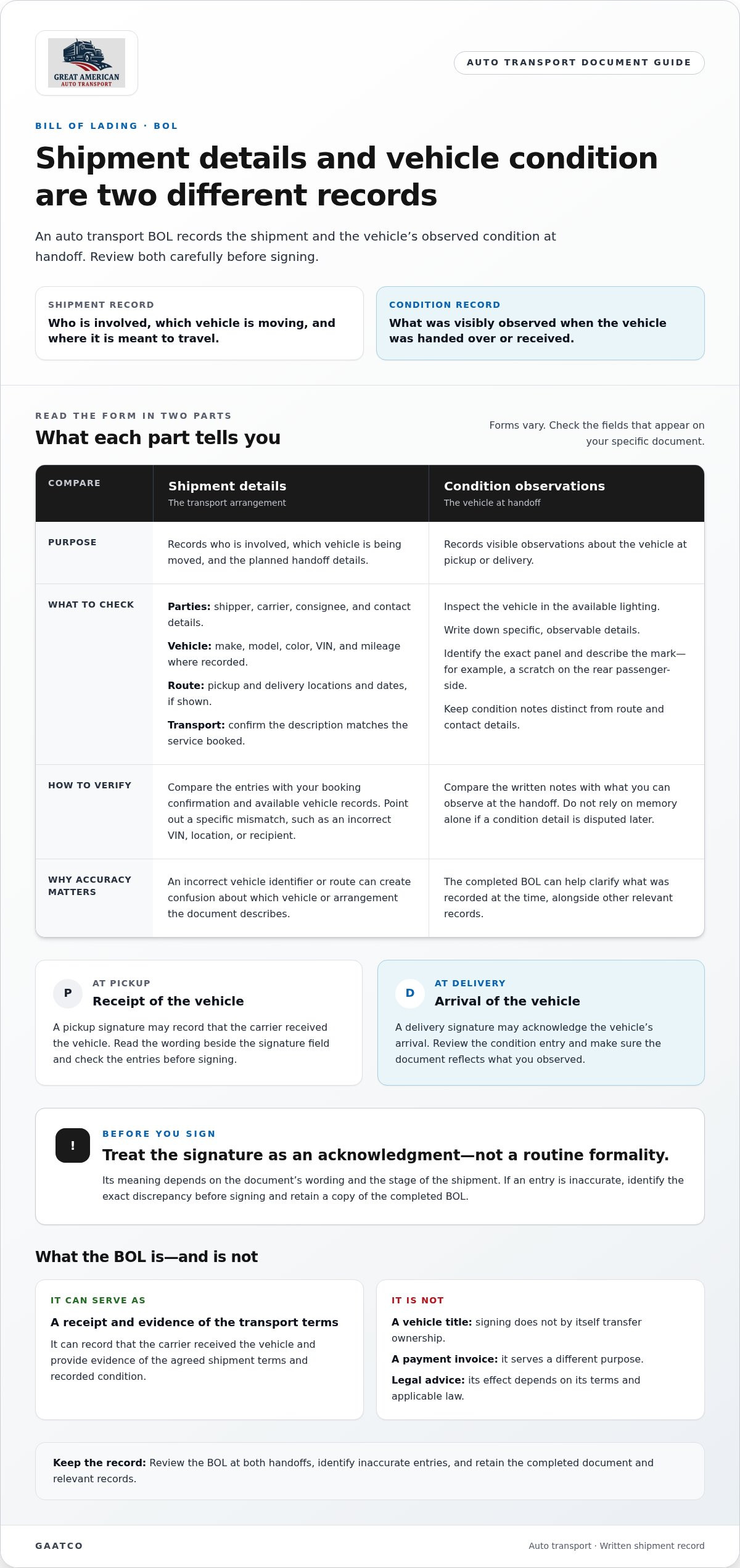
An auto transport bill of lading (BOL) records information about a vehicle and its journey, including the parties, pickup and delivery locations, and the vehicle’s condition at handoff. It can serve two related purposes: acknowledging that the carrier received the vehicle and providing evidence of the agreed transport terms. A receipt records a transfer of possession; contract evidence helps show what the parties agreed to for the transport.
Understanding the bill of lading (BOL) as a legal contract means reading the specific document rather than assuming every BOL has identical wording or effect. A general overview of the Bill of Lading describes its traditional functions, but an auto transport BOL should be understood in the context of vehicle shipping. It is not the vehicle’s title, and signing it does not by itself transfer ownership. It is also not a substitute for legal advice about a particular dispute.
Who are the shipper, carrier, and consignee?
The names on the document identify the parties’ roles in the shipment. The shipper is the party arranging or tendering the vehicle for transport. This may be the owner or someone authorized to arrange shipment on the owner’s behalf. The carrier is responsible for physically moving the vehicle under the shipment arrangement. The consignee is the designated recipient at delivery, who may be the owner or another person authorized to receive the vehicle.
For a shipment arranged through GAATCO, the BOL relates to the vehicle’s carriage by the carrier. Check the party names and contact details carefully. The person who books the transport, the carrier handling the vehicle, and the person receiving it may be different people.
What makes an auto transport BOL legally significant?
The BOL’s terms can help establish which vehicle was tendered, where it was meant to travel, and who was involved. Its entries may also document the vehicle’s observed condition at handoff. If a disagreement arises, the completed document can help clarify what was recorded at the time, alongside other relevant records. Accuracy matters: an incorrect vehicle identifier, route, or condition entry can create confusion about what the document describes.
A signature may acknowledge a specific event or set of details, depending on the wording and the stage of the shipment. A pickup signature may record that the carrier received the vehicle; a delivery signature may acknowledge its arrival. Treat neither as a routine formality. Read the text beside the signature field and make sure it reflects what you observed or intend to acknowledge. If an entry is incorrect, identify the discrepancy before signing and retain a copy of the completed document.
What Information Should an Auto Transport BOL Record?
An auto transport BOL should give a clear account of the shipment: who is involved, which vehicle is being moved, and the planned handoff details. Forms vary, so a particular document may not include every field. Check that the information shown accurately reflects the vehicle and the transport arrangement. A general industry reference such as the National Motor Freight Traffic Association (NMFTA) can provide context on bills of lading, but the specific form used for your vehicle shipment is the one to review.
Separate shipment details from condition observations. The route and parties describe the arrangement; condition notes record what was visible when the vehicle was handed over or received. They answer different questions, and both deserve careful attention when understanding the bill of lading (BOL) as a legal contract and practical transport record.
Which vehicle and route details should you compare?
Compare the BOL with your booking confirmation and available vehicle records. Check the details that appear on the form, including:
- Parties and contacts: Confirm that the shipper, carrier, consignee, and listed contact details are accurate for the intended handoff.
- Vehicle identification: Match the make, model, color, VIN, and mileage, where recorded, against the vehicle and your records. A mismatch can make it unclear which vehicle the document covers.
- Pickup and delivery: Compare the stated locations and dates, if shown, with the planned arrangement. Confirm that the listed delivery recipient is the person intended to accept the vehicle.
- Transport details: Read any description of the transport arrangement and confirm it matches the service you booked.
Look for specific discrepancies rather than assuming a prefilled field is correct. For example, a similar model description is not enough if the VIN identifies a different vehicle. If a location or recipient is wrong, point to the exact entry so the document can reflect the intended handoff.
How does the BOL document vehicle condition?
Condition notes record visible observations at pickup or delivery. They are different from shipment details such as route or contact information. Review the vehicle in the available lighting and write down specific, observable details. Instead of writing “damage,” identify the panel and describe the mark, such as a scratch on the rear passenger-side door. Specific notes are less likely to be confused with other areas or conditions.
At delivery, compare the vehicle with the pickup record and note any newly observed discrepancy before acknowledging the condition shown. Clear photographs can provide useful context. Take images of relevant areas and keep them with the completed BOL and booking records. Keep copies of the documents and written corrections together.
Clear documentation supports a more transparent transport process. For nationwide auto transport arrangements, GAATCO customers also receive real-time tracking. It complements the written shipment record but does not replace it.
Auto Transport BOL vs. Vehicle Title, Bill of Sale, and Freight BOL
Several documents may be involved in a vehicle purchase or shipment, but they serve different purposes. An auto transport BOL records the vehicle’s carriage and handoff details. A title relates to ownership, while a bill of sale records a transaction between buyer and seller. A freight BOL may document other kinds of cargo. Understanding the bill of lading (BOL) as a legal contract means considering the document’s specific purpose and wording, not just its name.
| Document | Primary role | What it generally records |
|---|---|---|
| Auto transport BOL | Documents vehicle carriage and handoff | Vehicle identification, shipment details, and condition observations at pickup or delivery |
| Vehicle title | Records ownership information | Ownership details maintained under the relevant state process |
| Bill of sale | Documents a sale | Information about the transaction between buyer and seller |
| Freight BOL | Documents carriage of cargo | Cargo descriptions and shipment details, which vary by shipment and form |
This comparison is a practical guide, not a legal determination. The meaning and effect of any document depend on its terms and applicable law. A completed form may be relevant evidence, but it does not automatically decide a dispute or establish ownership by itself.
Is a bill of lading the same as a vehicle title?
No. A vehicle title and a transport BOL serve different purposes. The title is associated with ownership records; the BOL documents the vehicle’s movement and handoff under a shipping arrangement. A carrier receiving a vehicle for transport does not become its owner simply by receiving it or recording it on a BOL. Similarly, a BOL should not be treated as proof that the person presenting or signing it owns the vehicle. Keep ownership paperwork separate from shipment records.
How is an auto transport BOL different from a freight BOL?
Both documents can record carriage information, but their fields should suit the shipment. A vehicle-specific BOL may identify an individual car by details such as its VIN, make, and model, and include a condition record. A general freight BOL may instead describe cargo by type or quantity. For an auto shipment, check that the form clearly identifies the particular vehicle rather than relying on a cargo description that does not capture its individual identity or observed condition.
BOL formats and legal functions can vary with the transport context. Some discussions of ocean shipping describe negotiable bills of lading or title-related functions. Do not assume those examples apply to domestic car shipping. Read the actual auto transport document and distinguish what it says about carriage from what separate ownership or sale records show.
How to Review and Sign an Auto Transport BOL
A careful review at pickup and delivery helps ensure the BOL reflects the vehicle and handoff accurately. Treat each signature as an acknowledgment of the information shown beside it, not as a routine step. Understanding the bill of lading (BOL) as a legal contract means checking both shipment details and condition entries before signing or otherwise acknowledging receipt.
Use this sequence at each handoff:
- Identify the vehicle. Compare the make, model, color, and VIN shown on the BOL with the vehicle and your records.
- Verify the arrangement. Check the listed pickup or delivery location, date where shown, and named parties against the planned shipment.
- Inspect the vehicle. Look over visible areas in suitable lighting, including existing marks or damage.
- Record observations. Make sure condition notes describe what you can see, and identify any discrepancy in the document.
- Retain the record. Keep a copy of the completed BOL and relevant photographs with your shipment correspondence.
Review every field, including any statement beside the signature line. If wording or a prefilled entry does not match what you observed or agreed to, point out the specific issue and request a correction before signing. If the discrepancy remains unresolved, avoid signing language you believe is inaccurate. Document the concern and seek guidance about the next step.
What should you check at pickup?
Before the carrier takes possession, match the vehicle identifiers and pickup details with your booking information. Walk around the vehicle and note visible marks with precise descriptions, such as a dent on the front driver-side fender, rather than a general phrase like “body damage.” Take photographs of the overall vehicle and close views of noted areas. Keep them with a copy of the signed pickup record.
What should you check at delivery?
Inspect the vehicle before acknowledging delivery. Compare its visible condition with the pickup notes and photographs, including areas already documented and any new or differing observations. If you notice a discrepancy, describe its location and appearance clearly on the delivery documentation before signing, where the form allows. Keep the completed record, photos, and related shipment messages together.
Accurate entries and organized records make it easier to refer back to what was observed at each handoff. For a shipment arranged through GAATCO, real-time tracking helps you follow progress, while the BOL and your condition records document the handoffs. Arrange your auto transport with GAATCO and include the paperwork review in your shipment preparations.
Handling Inaccurate BOLs or Condition Disputes
A paperwork error and a disagreement about vehicle condition are different issues. A clerical error might be a misspelled name, an incorrect VIN, or a pickup location that does not match the arrangement. A condition dispute concerns what was visible at handoff, such as whether a mark was already present or appeared during transport. Understanding the bill of lading (BOL) as a legal contract means treating its entries as an important factual record, not as a guarantee of a particular legal outcome.
If you find a discrepancy, keep your response specific and measured:
- Identify the entry. State the exact field or condition note that appears inaccurate.
- Describe the difference. Explain what the document says and what you believe it should reflect.
- Request a correction or notation. Where practical, address the issue before signing and avoid endorsing wording you believe is inaccurate.
- Keep each version. Retain copies of the original and any corrected or annotated documents, along with related records.
A correction should make the record clearer, not create a second ambiguity. For example, if a vehicle identifier is transposed, identify the incorrect entry and the accurate identifier rather than simply writing “wrong.” If the disagreement concerns condition, describe the specific location and visible feature. A BOL may help establish what was recorded, but its entries alone do not decide responsibility or settle a claim.
How should you handle a missing or incorrect detail?
Point out the precise omission or error and explain the correction plainly. If a condition note is incomplete, request wording that identifies the area and observation rather than relying on a broad phrase. Where practical, have the correction or an explanatory notation included on the document before signing. Keep a copy of each version and note who provided or acknowledged the correction, without altering the record in a way that obscures its original wording.
What records help explain a condition disagreement?
Keep pickup and delivery BOLs together with dated photographs, condition notes, and relevant shipment communications. Organize records by handoff, and preserve original files where possible so the sequence remains clear. Photos can illustrate visible details, while written notes explain what the images show. Together, these materials may help clarify the timeline, but they cannot guarantee how a dispute will be resolved.
If a disagreement raises questions about your rights, obligations, or next steps, seek advice from qualified legal counsel. The effect of a document depends on its language and the circumstances, so do not rely on a general explanation as a legal conclusion.
Clear documentation begins with a well-managed shipment. If you are planning a vehicle move, explore GAATCO’s auto transport services and keep the BOL and handoff records with your shipment paperwork.
Prepare for Your Next Vehicle Shipment
Understanding the bill of lading (BOL) as a legal contract is a practical step toward managing your vehicle shipment with clarity. Keep your transport documents and vehicle records organized so you can review the details carefully at each handoff. Preparation makes it easier to stay informed and address questions as they arise.
GAATCO arranges nationwide auto transport through a network of licensed and insured carriers. Vehicles are fully insured during transport, and real-time shipment tracking helps customers follow progress. These features support a considered shipping experience, while clear documentation remains an important part of your own records.
Whether you are arranging open or enclosed car transport, choose a shipment plan that suits your needs. Request an auto transport quote from GAATCO and take the next step. Careful preparation can make the process more manageable from pickup through delivery.
Frequently Asked Questions
Is a bill of lading a legally binding contract for auto transport?
An auto transport BOL can serve as evidence of the carriage agreement, but its legal effect depends on the document’s wording, the parties’ actions, and applicable law. Understanding the bill of lading (BOL) as a legal contract means reviewing the actual terms rather than assuming every form has the same effect. If a provision could affect your rights or obligations, consult qualified legal counsel about your specific circumstances.
Does signing a vehicle BOL mean I accept the car’s condition?
Not necessarily. The meaning of a signature depends on the wording beside it and what the signer is acknowledging. A signature may confirm receipt or acknowledge the entries on the form, so read that language before signing. If it appears to state that the vehicle is damage-free when you observe otherwise, clearly identify the condition discrepancy on the record and retain a copy of the completed document.
Can a bill of lading transfer ownership of a vehicle?
An auto transport BOL ordinarily documents carriage, not a sale or transfer of vehicle ownership. It should not replace the title or sale paperwork used for an ownership transaction. For example, a person receiving a car at the delivery location is not necessarily its owner simply because they are named on the transport document. Ownership questions can depend on the relevant records and law, so seek legal advice if they are disputed.
What happens if the BOL has incorrect vehicle or delivery information?
Identify the exact field and explain the correction clearly before signing, where practical. For example, correct a transposed character in a VIN rather than leaving uncertainty about which vehicle the document describes. If you discover an error after signing, preserve the version you have, record the discrepancy in writing, and keep related communications. A correction may clarify the record, but it does not by itself determine a dispute.
Should I take photos before signing an auto transport BOL?
Yes. Photographs can create a useful visual record of the vehicle around the time of handoff. Capture the vehicle from several sides, then take closer images of visible marks or areas noted on the form. Keep the original image files with the relevant pickup or delivery document, and avoid editing them in ways that could obscure what they show. Photos support written observations but do not replace accurate BOL entries.
Can an electronic bill of lading be used for vehicle transport?
Electronic BOLs and signatures can be used for domestic transport in the United States. Their legal validity depends on applicable requirements and the particular signing process, including whether the signer intended to sign electronically and consented to electronic transactions. Before completing an e-signature, review the document as you would a paper form and save the completed copy and any confirmation records for your files.
Who keeps a copy of the signed bill of lading?
Keep a copy for your shipment records, and ensure the carrier has the completed document for its records. If someone else is named to receive the vehicle, provide them with the delivery details and documentation they need for the handoff. Whether arranging transport in Atlanta, Miami, New York, Houston, Dallas, San Diego, San Francisco, Seattle, Orlando, Boston, Nashville, Denver, Austin, Chicago, Las Vegas, or Phoenix, keep the BOL with related correspondence.


