
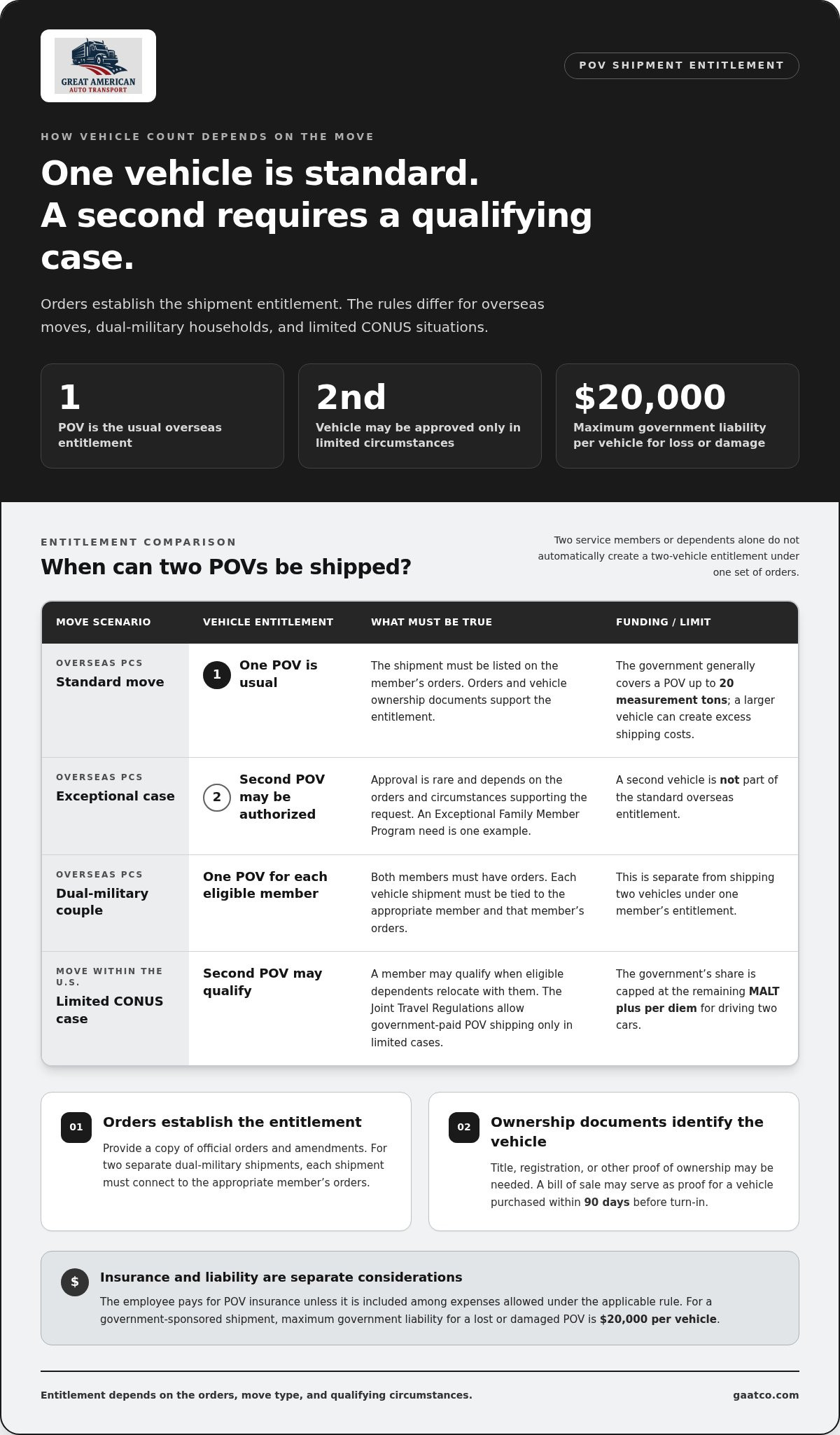
One government-funded privately owned vehicle (POV) is the usual entitlement for an authorized overseas move; a second vehicle may be approved only in exceptional circumstances. The requirements for shipping a privately owned vehicle (POV) to a base depend on whether the vehicle qualifies as a personal-use POV, meets operating and safety conditions, and has the required orders and ownership documents. Having two service members or dependents does not automatically mean two vehicles can ship under one set of orders.
That distinction matters: military shipping rules define both the vehicle and the member’s entitlement, while overseas transport adds processing, pickup, and delivery arrangements. This guide explains who may qualify to ship one vehicle or, in limited cases, two; what can make a vehicle ineligible; and how government-sponsored overseas shipping typically works, from vehicle turn-in to pickup at the destination. It also explains how a POV differs from a commercial or non-running vehicle, so you can understand the requirements before planning a move.
Key Takeaways
- Prepare the orders, proof of ownership, and registration for the Personal Property Office’s counseling process; leased or liened vehicles may also need written authorization.
- Before turn-in, make sure the vehicle is clean, safe to operate, and has no more than one-quarter tank of fuel. A damp-cleaned interior must dry for at least 14 days before overseas shipment.
- Vehicle size and configuration affect eligibility and potential excess costs. An overseas POV above 20 measurement tons exceeds the government shipping limit.
- At pickup, inspect the vehicle with the representative and record any discrepancies on DD-788 to document damage for a potential claim.
- Understand who can deliver or collect the vehicle on your behalf: the required authorization depends on the representative and how they are identified in the shipping paperwork.
Operational, safety, cleanliness, and documentation conditions
For overseas shipment, the government generally covers a POV up to 20 measurement tons; larger vehicles can create excess shipping costs for the member. The vehicle must be safe, clean, operational, and documented, while any delivery inside a base follows that installation’s driver-identification and vehicle-access procedures.
At a Vehicle Processing Center (VPC), an inspection records the vehicle’s condition before shipment. The documents and preparation details below explain what to expect at turn-in.
For a practical look at the turn-in process, watch this video:
Ownership and Authorization Documents
Ownership and authorization documents establish the member’s entitlement and show that the vehicle may be shipped. The Personal Property Office needs to review the orders, ownership proof, and registration during counseling. Bring one copy of the service member’s official orders and amendments as proof of entitlement, alongside the vehicle title or registration. For a purchase made within 90 days before turn-in, a bill of sale may serve as proof of ownership.
A leased or liened vehicle also needs written export approval from the leasing company or lienholder. If another person acts for the service member, that person generally needs a certified power of attorney or authorization; a spouse identified on official orders is an exception. A pickup agent must have a power of attorney or be named in block 38 of the vehicle shipping document.
Vehicle Inspection and Condition Records
The VPC inspection documents the vehicle’s condition and identifies issues before it enters shipment. The member or designated representative should record every discrepancy on DD-788 during the joint inspection. An omitted mark can complicate a later damage claim, so note existing dents, scratches, and other visible concerns before signing.
Size is assessed through measurement tons: multiply length, height, and width in feet, then divide by 40. Extensive lift kits, oversized tyres, excessive weight, or commercial configurations can take a vehicle outside standard POV treatment. It must also be operable enough to drive on and off the ship.
Prepare the vehicle before appointment day. It should be clean inside and out, in safe operating condition, and have no more than ¼ tank of fuel. An interior cleaned or shampooed while wet or damp must dry for at least 14 days before overseas shipment. Address recalls before turn-in, and remember that VPCs do not issue temporary plates or registrations.
Transporters entering a base must follow the installation’s access controls, including driver identification and vehicle screening. An agent delivering the POV to the port should arrive at least one hour before closing. According to the Office of the Federal Register, insurance remains the employee’s expense unless it is included in expenses allowed under the applicable rule.
Can families ever get authorized to ship two vehicles?
Yes, but a second vehicle is not part of the standard overseas entitlement. For an authorized overseas PCS, the government generally ships one POV per service member or household, and the shipment must be listed on the member’s orders. A second vehicle may be authorized in rare situations, such as an Exceptional Family Member Program (EFMP) need. Eligibility depends on the orders and the circumstances supporting the request.
Dual-military couples are generally each entitled to ship one POV when both members have orders. That differs from shipping two vehicles under one member’s entitlement: each shipment must be tied to the appropriate member and orders. For a move within the United States, the Joint Travel Regulations allow government-paid POV shipping in limited cases. A CONUS member whose eligible dependents relocate with them may qualify for a second POV, with the government’s share capped at the remaining monetary allowance in lieu of transportation (MALT) plus per diem for driving two cars.
Insurance and liability are separate considerations. The employee pays for POV insurance unless it is included among expenses allowed under the rule, according to the Office of the Federal Register. For a government-sponsored shipment, the government’s maximum liability for a lost or damaged POV is $20,000 per vehicle.
Orders establish the shipment entitlement; ownership documents establish whose vehicle is moving. A member should provide one copy of official orders and amendments. The paperwork may also include the title, registration, lease agreement, or other proof of ownership. A vehicle bought within 90 days before turn-in may use its bill of sale as ownership proof.
Lease and lien status can affect whether an overseas shipment proceeds. A long-term lease for shipping purposes means a lease of 12 months or longer, and the leasing company must provide written authorization. A vehicle with a lien being exported outside its country of origin needs a lienholder authorization letter. These permissions are distinct from the member’s military orders.
If another person handles delivery, pickup, or shipment, their authority must be documented. A certified power of attorney or letter of authorization is generally required when someone acts for the member. A spouse identified on the official travel orders is an exception. For pickup, a representative may also be named in block 38 of the vehicle shipping document when it is prepared.
Families arranging a separately paid shipment should distinguish that transport from government authorization: private arrangements do not change the military entitlement or add a vehicle to the orders. For a domestic move, vehicle transport arrangements can be considered separately from the government-sponsored process.
How Does Government-Sponsored POV Shipping Work Overseas?
Government-sponsored overseas shipping follows military entitlement and VPC procedures; private transport is arranged separately. This distinction affects who arranges transportation, which costs are covered, and how the vehicle reaches its destination.
Government-Sponsored Shipping Through VPCs
A government-sponsored shipment typically moves through the Vehicle Processing Center (VPC) network, where the government books a contracted carrier. The member turns in the vehicle at the designated VPC, rather than arranging the overseas carrier independently. That route matters because the VPC handles the military shipment process, while private transport follows a separate arrangement. At destination, the member has 21 days to collect the vehicle once it is ready.
Eligibility and Government-Paid Shipping Limits
For an authorized overseas PCS, the government generally ships one POV, up to 20 measurement tons. A vehicle above that size limit can incur excess shipping costs for the owner. The member’s orders must authorize the entitlement, and the POV must be in the service member’s name for government-paid shipping. A long-term leased vehicle needs written authorization from the leasing company; a lienholder’s letter is required when exporting a vehicle with a lien.
Domestic and Overseas Shipment Differences
Yes. Overseas shipments generally use VPCs and require the appropriate PCS entitlement, while CONUS shipments are government-paid only in limited circumstances. The Joint Travel Regulations address CONUS POV shipment in paragraph 0529 and OCONUS shipment in paragraph 0530. Overseas moves also involve destination import requirements, which may affect whether a vehicle can be accepted there. The member should distinguish military authorization from registration and other obligations at the destination.
Shipping Costs and Payment Responsibility
For an authorized overseas shipment, the government generally pays to ship one POV within the 20-measurement-ton limit; the owner is responsible for excess costs above that limit. For a CONUS PCS, the member usually pays to ship a vehicle, while the military may reimburse mileage and some travel costs when the member drives. The exact cost of a privately arranged shipment depends on the route, vehicle, and transport arrangement.
Private transport does not replace military authorization or change the entitlement shown on orders. It is a separate arrangement for a vehicle move organized independently by the member. For CONUS travel, the Joint Travel Regulations allow government-paid POV shipping only in limited cases, including when a member cannot drive or lacks time to drive and report as ordered.
A privately arranged overseas shipment may also involve import and export responsibilities, depending on the arrangement. Keep the orders, vehicle registration, and any required leasing-company or lienholder letter together to clarify entitlement and ownership throughout transportation. The transportation office can explain how the authorized shipment fits into the member’s PCS paperwork.
Pickup and delivery at a base or vehicle processing center
Military vehicle pickup and delivery typically follow the appointment and location details provided for the shipment. A Vehicle Processing Center (VPC) is a designated handoff point, not necessarily the service member’s duty station or base. For an OCONUS move, note the destination VPC and collection window, then arrange pickup after receiving notice that the vehicle is ready.
All vehicle processing at VPCs requires an appointment. The live virtual briefing is a 30-minute session covering vehicle turn-in for shipment or storage. Allow time to complete the appointment, bring the required paperwork, and ensure the vehicle is prepared for inspection. A POV should arrive with no more than a quarter tank of fuel.
At turn-in, the VPC contractor must process the vehicle within 1 hour of sign-in. The member or authorized representative should take part in the joint inspection and ensure visible discrepancies are recorded on DD-788. This condition record is important at collection: compare the vehicle with the recorded inspection before accepting it, and document any new discrepancy through the applicable process.
Pickup also requires an appointment, and the VPC contractor must process the vehicle within 1 hour of sign-in. A service member may authorize another person to collect it through a power of attorney or by naming that person as the designated agent in block 38 of the vehicle shipping document. The designation must be made when the form is prepared. A spouse identified on the member’s official travel orders is an exception to the general authorization requirement.
For an overseas government-sponsored shipment, the member has 21 days to collect the POV once it is ready at the destination. If the vehicle is in storage, delivery to a VPC for pickup may take up to 21 calendar days; international transportation can take longer. Those timelines make it useful to arrange an authorized pickup person before departure, rather than relying on the member’s arrival date alone.
An agent delivering a POV to the port should arrive at least one hour before closing. This port instruction is separate from a VPC appointment, so the agent should follow the time and location specified for that handoff. A base or installation may also have its own entry procedures for commercial transporters, including driver identification and vehicle screening. These access arrangements are separate from the VPC processing appointment.
Before the appointment, keep the orders, vehicle documents, and representative authorization together. If a spouse’s vehicle is not titled in the service member’s name, the move counselor may require a power of attorney before drop-off. Ownership can affect who is allowed to release the vehicle, even when the shipment is authorized.
Military definition of a privately owned vehicle
In military shipping, a privately owned vehicle (POV) is generally a self-propelled, wheeled motor vehicle licensed for public highways and used for personal transportation. It may carry passengers or household goods, but it cannot be shipped as a POV for commercial use. A vehicle’s everyday name does not determine whether it fits the government’s shipping category.
Common examples include a passenger car, family-use SUV, van, qualifying pickup, or registered road-use motorcycle. A vehicle is typically titled or registered to the service member, spouse, or dependent listed on the orders. A leased vehicle may qualify when the member or dependent holds a long-term lease of 12 months or longer. Ownership, registration, and the orders must align with the shipment entitlement.
Motorcycles have a specific relationship to the four-wheel rule. A motorcycle or moped may count as a POV if the member is not shipping a vehicle with four or more wheels on the same orders. A motorcycle or dirt bike may instead move with household goods when the personal property office authorizes that arrangement. Classification and shipping method are separate decisions.
Vehicle size and use also matter. A standard family SUV is different from a commercial vehicle, even if both can travel on roads. Cargo or commercial configurations, extensive lift kits, oversized tyres, and excessive weight can place a vehicle outside standard POV treatment. For overseas shipping, the government limit is 20 measurement tons, with the owner responsible for excess costs above that threshold.
Some vehicles require closer attention to their intended use and design. An RV may fall within the POV category, while a boat is treated as household goods because it is not a wheeled vehicle. A track-only car that is not registered for road use does not fit the ordinary definition of a licensed highway vehicle. Likewise, a non-running project car may not meet standard government-sponsored shipping conditions.
The practical takeaway is to identify the vehicle by its title, registration, use, and configuration before shipment planning. Chapter 5 of the Joint Travel Regulations governs POV shipment eligibility, while a vehicle processing center handles government-sponsored vehicle turn-in. If your vehicle is privately owned but needs separate transportation, review the available military vehicle transport options for a suitable arrangement.
GAATCO: Open Car Transport
GAATCO offers Open Car Transport for privately arranged vehicle moves, separate from government-sponsored POV entitlements. If your orders do not authorize a shipment or you need to transport an additional vehicle, private auto shipping provides a separate arrangement without changing your military eligibility.
For domestic moves, GAATCO also offers Door-to-Door Auto Shipping and Military Vehicle Shipping. Open transport can suit a standard daily-use vehicle, while Enclosed Car Transport is an alternative for owners seeking a covered transport method. Choose based on the vehicle and your move requirements.
For a privately arranged vehicle move, contact GAATCO to discuss your transport needs.
Plan Your Next Vehicle Move with Clarity
Once you understand the requirements for shipping a privately owned vehicle (POV) to a base, decide how any separately arranged transport fits with your orders and destination plans. Keep military authorization separate from private shipping, then choose an arrangement suited to the vehicle and handoff location.
GAATCO offers Open Car Transport, Enclosed Car Transport, and Door-to-Door Auto Shipping for privately arranged vehicle moves. These options address different transport preferences without changing government eligibility rules or shipment entitlements. Share your route, vehicle details, and preferred transport approach to focus the discussion on the logistics of your move.
Contact GAATCO about POV shipping to discuss a transport arrangement for your vehicle. With a clear distinction between military authorization and private transport, you can move forward with a considered plan for the transition ahead.
Frequently Asked Questions
How long does POV shipping take?
For domestic transport, transit time depends chiefly on route length and starts after loading. Routes under 500 miles often take 1 to 3 days, mid-length trips 3 to 7 days, and coast-to-coast trips about 7 to 10 days. Overseas government shipments follow a different schedule: the destination pickup window begins once the vehicle is ready. For most domestic routes, booking two to four weeks before pickup is recommended.
Can you deliver to an on-base address?
An on-base address is not automatically an approved delivery point. Government-sponsored shipments are processed through the designated Vehicle Processing Center (VPC). A privately arranged carrier needs a delivery location it can access under the installation’s entry procedures. If access is unavailable, plan to meet the carrier outside the gate, and distinguish that handoff from delivery to a VPC or port.
What documents are required to ship a privately owned vehicle to a U.S. military base?
For government-authorized shipment, the requirements for shipping a privately owned vehicle (POV) to a base include orders authorizing the entitlement, vehicle ownership proof, and registration. A purchase made within 90 days before turn-in can be documented with a bill of sale. A leased or liened vehicle needs written export approval from the leasing company or lienholder. If a representative handles the vehicle, include the applicable power of attorney or authorization.
Does the vehicle owner need military orders or base sponsorship to ship a POV to a base?
Orders authorizing the POV entitlement are required for government-funded military shipping; base sponsorship alone does not establish eligibility. A privately arranged domestic shipment is separate from the military program and does not depend on government payment authorization. Installation access and the delivery location are separate considerations, so keep private arrangements distinct from the orders authorizing government transportation.
Can a POV be shipped directly through a base gate, or must it be delivered to an off-base location?
A carrier cannot assume that a base gate grants permission to enter or deliver. Government-sponsored POV shipments use their assigned VPC or port, while private transport requires an agreed, accessible handoff location. Installation procedures determine whether a transporter can proceed beyond the gate. If entry is unavailable, arrange to meet the carrier at an accessible location outside the installation.
How do I arrange POV shipment to a military base, and what are the required steps?
For a government move, start with the transportation or personal property office to address your orders and entitlement. Then follow the assigned shipment process and VPC appointment instructions. For a separate domestic move, GAATCO provides auto transport serving Atlanta, Miami, New York, Houston, Dallas, San Diego, San Francisco, Seattle, Orlando, Boston, Nashville, Denver, Austin, Chicago, Las Vegas, and Phoenix. Keep private arrangements separate from government authorization.
How long does POV shipping to a base take, and how is delivery scheduled?
Delivery scheduling depends on the shipment route and whether the move uses a VPC or private carrier. VPC processing requires an appointment, and overseas pickup timing begins when the destination confirms the POV is ready. A service member has 21 days to collect a government-sponsored overseas shipment after readiness notice. This is a pickup period, not a transit estimate. Designate an authorized representative in advance if the member cannot attend.
What restrictions apply to personal items, fuel, and vehicle modifications during POV shipment?
Personal items shipped in a POV are subject to Chapter 8 of the PPTMR; hand tools inside the vehicle cannot exceed $200 in value. The vehicle should arrive with no more than one-quarter tank of fuel. Extensive lift kits, oversized tyres, excessive weight, and commercial configurations can affect standard POV eligibility. Measure the vehicle’s dimensions and consider its modifications before planning an overseas shipment.


