The most significant risk in vehicle logistics is not the distance traveled, but the lack of professional transparency during the initial vetting process. You likely understand that entrusting a high-value asset to a third party involves a level of vulnerability that a simple online review cannot mitigate. The persistent fear of hidden fees or the potential for transit damage is a rational response to an industry often clouded by ambiguity. When you're determining how to trust an auto transport company with my car, the distinction between a mere broker and a dedicated carrier becomes the foundation of your vehicle's security.
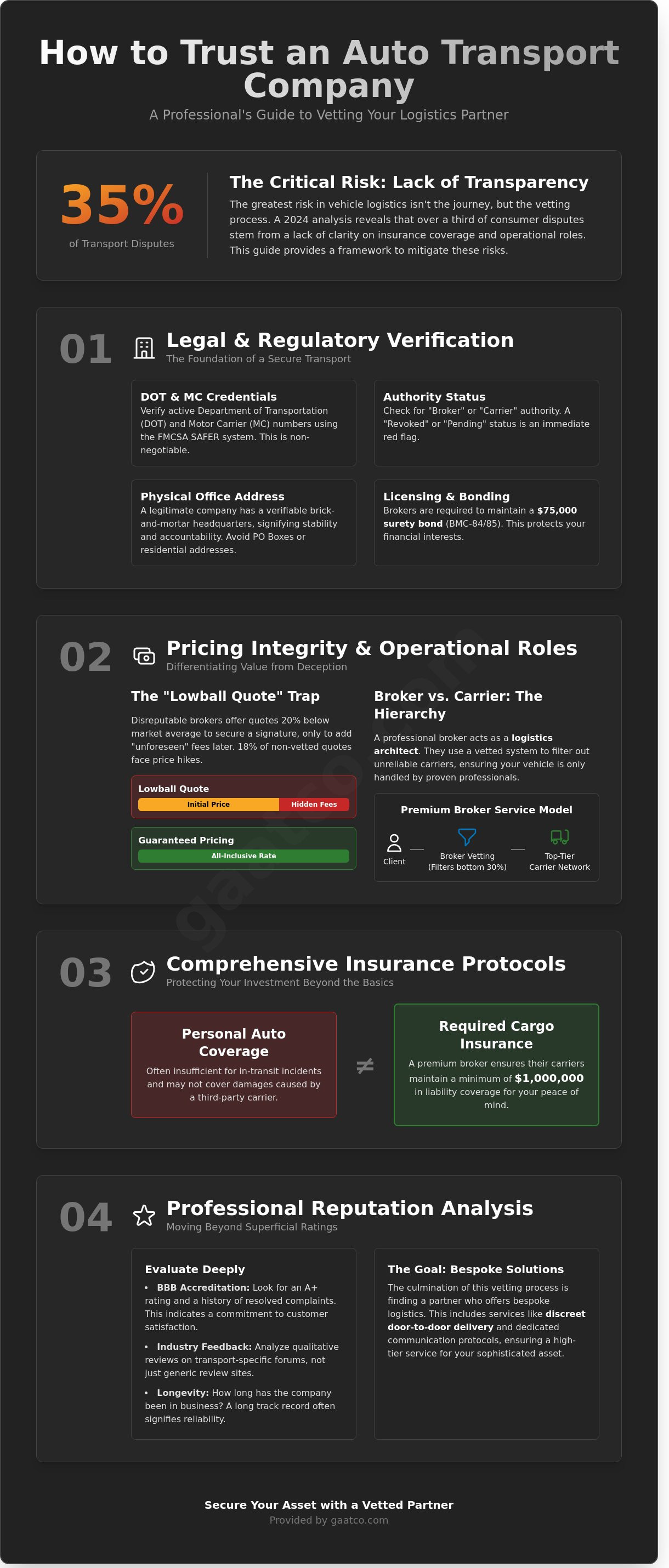
A 2024 analysis of logistics consumer data suggests that 35% of transport disputes arise from a lack of clarity regarding insurance coverage and operational roles. This article provides a bespoke framework to help you navigate these complexities with the confidence of a seasoned professional. You'll learn to apply rigorous verification standards that ensure your vehicle receives the premium care it deserves. We will outline the essential documents, insurance certifications, and communication protocols that define a seamless transport experience for 2026.
Key Takeaways
- Establish a foundation of security by learning to verify mandatory DOT and MC credentials through the FMCSA SAFER system.
- Navigate the complexities of pricing integrity and professional quoting to understand exactly how to trust an auto transport company with my car for a seamless experience.
- Protect your investment by distinguishing between basic personal coverage and the comprehensive cargo insurance protocols required for premium vehicle transport.
- Move beyond superficial ratings to analyze professional reputation through a nuanced evaluation of BBB accreditation and qualitative industry feedback.
- Discover how bespoke logistics and door-to-door delivery provide the discreet, high-tier service necessary for the secure relocation of sophisticated assets.
Verifying Legal Credentials and Regulatory Compliance
The current environment of high-value logistics requires a meticulous approach to due diligence. When you're evaluating how to trust an auto transport company with my car, the process begins with a formal verification of their federal credentials. Every legitimate transport entity must maintain an active Department of Transportation (DOT) number and a Motor Carrier (MC) number. These identifiers aren't merely administrative suggestions; they are the legal foundation of the industry. These numbers allow you to access the Federal Motor Carrier Safety Administration (FMCSA) database, which provides a comprehensive view of a company's regulatory standing.
A firm's physical office address is equally critical. While the industry is increasingly digital, a verified brick-and-mortar headquarters signifies a level of permanence and accountability. It indicates that the firm possesses the infrastructure necessary to manage sophisticated logistics. You should avoid entities that operate solely through untraceable VOIP lines or residential addresses. These often lack the resources to resolve complex transport challenges if they arise during transit.
The FMCSA Verification Process
The FMCSA Safety and Fitness Electronic Records (SAFER) system is the most reliable tool for professional vetting. You should enter the provider's MC number into the Company Snapshot portal to confirm their current authority status. It's essential to identify whether the company holds "Broker" authority, "Carrier" authority, or both. This distinction defines their specific role in your vehicle's journey. The SAFER system also catalogs safety violations and insurance lapses from the past 24 months. If the status is listed as "Pending" or "Revoked," the risk is unacceptable for any high-value asset.
Licensing and Bonding Requirements
Financial security is a pillar of professional transport services. The FMCSA mandates that brokers maintain a $75,000 surety bond, typically filed as a BMC-84 or BMC-85. This bond serves as a financial guarantee that the company will adhere to its contractual commitments. Licensed and bonded status is your first line of defense against operational failures. A refusal to provide these credentials immediately is a significant red flag. Seasoned experts provide this information with transparency, ensuring that the foundation of the relationship is built on verified excellence and legal compliance. When you're deciding how to trust an auto transport company with my car, this financial transparency is your primary safety net.
- DOT Number: A unique identifier for companies operating in interstate commerce.
- MC Number: Required for companies that provide for-hire transportation of regulated commodities.
- Surety Bond: A $75,000 minimum requirement that protects the client's financial interests.
Evaluating Operational Transparency and Pricing Integrity
A professional auto transport quote serves as the foundational document of a service agreement. It is not merely a total cost; it is a detailed breakdown of the logistical variables involved in moving a high-value asset. A comprehensive quote in 2026 includes the base transport rate, insurance premiums, and specific fuel surcharges calculated against current Department of Energy indices. Establishing how to trust an auto transport company with my car requires a thorough examination of these figures to ensure they reflect market realities rather than marketing lures.
Guaranteed pricing is a hallmark of a seasoned logistics partner. While market conditions fluctuate, an established firm absorbs minor variances to provide the client with financial certainty. This differs sharply from the "lowball quote" trap. Disreputable brokers often present estimates 20% below the industry average to secure a signature. According to the 2025 Logistics Transparency Report, 18% of quotes from non-vetted providers resulted in price increases at the point of pickup, citing "unforeseen" seasonal fluctuations or fuel spikes that should have been anticipated by an expert.
Broker vs. Carrier: Understanding the Hierarchy
The broker functions as a logistics architect, designing a seamless path for your vehicle across a complex national network. Their value lies in a carrier-vetted system that filters out the bottom 30% of operators based on safety ratings and insurance lapses. A premium broker ensures that every carrier in their network maintains a minimum of $1,000,000 in combined single-limit liability coverage. This hierarchy allows for global reach while maintaining the local expertise required for secure transport.
Contractual Clarity and Hidden Fees
Transparency extends to the fine print of the service contract. Precise language regarding cancellation policies and specialized requirements prevents unexpected financial friction. For those requiring a bespoke approach to logistics, exploring a dedicated transport solution ensures every detail is managed with precision. Standard professional contracts should clearly outline specific surcharges, such as:
- Inoperable Vehicle Fees: Typically ranging from $150 to $250 for the use of winches or specialized loading equipment.
- Oversized Dimensions: Specific costs for vehicles exceeding standard height or width parameters.
- Storage Clauses: Detailed daily rates if the client is unable to accept delivery during the agreed window.
It's vital to remember that a reputable firm will never demand a full deposit before a carrier is officially assigned and the dispatch schedule is confirmed. This practice protects the client's capital and ensures the service provider remains incentivized to maintain a steady, professional rhythm throughout the transport process. The focus remains on safety and excellence as non-negotiable pillars of the partnership.
Assessing Comprehensive Insurance and Protection Protocols
Understanding how to trust an auto transport company with my car begins with a forensic review of their insurance architecture. You shouldn't assume your personal auto policy provides adequate protection during transit. Most private insurance carries a "care, custody, and control" exclusion that negates coverage while the vehicle is in the possession of a commercial carrier. Consequently, the carrier's cargo insurance becomes your primary safety net. This is distinct from their liability insurance, which only covers third-party bodily injury or property damage. You're looking for a bespoke cargo policy that specifically shields your vehicle against road debris, theft, or structural damage during the logistics process.
Decoding the Certificate of Insurance
A Certificate of Insurance (COI) is the only valid proof of a carrier's financial readiness. In 2026, the industry benchmark for open transport cargo limits is $100,000 per vehicle. If you've opted for enclosed transport for a premium asset, you should expect coverage limits between $250,000 and $1,000,000. Don't simply accept a printed copy; call the insurance agent listed on the document to verify the policy remains active and in good standing. For high-value shipments, we recommend asking the carrier if they can name you as an "additional insured" for the duration of the trip. This provides a direct line of communication with the underwriter if a claim becomes necessary.
The Bill of Lading: Your Pre- and Post-Trip Shield
The Bill of Lading (BOL) functions as your most vital legal protection. It isn't just a receipt; it's a formal declaration of your vehicle's state before and after its journey. A meticulous 22-point inspection is mandatory at the time of pickup. This process involves documenting every paint chip, glass imperfection, and interior detail with high-resolution photography. If you identify pre-existing issues with your window regulators or glass during this phase, Auto Glass Force INC. can provide the necessary repairs to ensure your vehicle is in top condition before it is loaded. The Bill of Lading is the definitive record of vehicle condition. If you notice new damage upon delivery, you must note it on the BOL before the driver departs. Without this specific notation, the legal weight of the document shifts in favor of the carrier, making it nearly impossible to secure a successful claim after the fact. We've found that disciplined documentation is the hallmark of a truly professional transport partner.
Analysing Professional Reputation and Industry Standing
Reputation is more than a digital metric; it's a reflection of operational discipline. When determining how to trust an auto transport company with my car, a simple star rating rarely provides the full picture. You must scrutinize the Better Business Bureau (BBB) profile, specifically looking for an A+ accreditation maintained over a minimum of 10 years. A long history suggests a company has the financial stability to honor insurance claims and maintain their fleet. According to 2024 consumer protection reports, approximately 32% of service-based reviews on open platforms may be manipulated. Look for "Review Stuffing," which often appears as a sudden influx of generic, five-star ratings within a 48-hour window. Genuine feedback usually includes specific details about the driver, the delivery window, or the condition of the vehicle upon arrival. A business that has successfully navigated the complexities of global logistics since the early 2000s offers a level of security that a startup simply can't match.
Independent Review Platforms
Platforms like Transport Reviews and Trustpilot offer a transparent view of long-term reliability. Don't focus solely on the presence of negative feedback. Instead, analyze the company's response. A professional firm addresses grievances with a calm, solution-oriented tone rather than defensive language. Patterns are key. If 15% of reviews mention poor communication during the transit phase, it indicates a systemic logistics failure. A reliable partner provides real-time updates, ensuring you're never left wondering about your asset's location. This level of transparency is a non-negotiable pillar for any elite service provider. You should prioritize companies that demonstrate a consistent history of resolving issues within a 72-hour window.
Industry Awards and Longevity
Experience serves as a significant trust multiplier. A company with 20 or more years in the sector has refined its bespoke handling processes through various market shifts. This longevity is especially critical for specialized logistics, such as transporting classic cars or military relocations. These high-stakes projects require a level of precision that newer entities haven't developed. You should feel comfortable requesting references for high-value shipments completed within the last 12 months. This verification ensures the provider possesses the dedicated expertise required for your specific needs. Understanding how to trust an auto transport company with my car involves confirming they have a proven track record of handling similar high-value assets with discretion. They should be able to provide case studies or data points from at least 500 successful premium transports to establish their standing as a market leader.
Securing Your Vehicle with a Bespoke Transport Solution
Understanding how to trust an auto transport company with my car requires looking beyond the surface level of a digital storefront. GAATCO integrates safety and elite service through a methodology refined by years of complex logistics expertise. We treat each vehicle as a critical asset, ensuring door-to-door delivery eliminates the risks often associated with terminal transfers or multi-stage handoffs. This seamless approach ensures your vehicle remains in a controlled chain of custody from the moment it leaves your driveway.
Tailored Logistics for Every Journey
We analyze the specific requirements of your vehicle to determine if an open carrier or a bespoke enclosed solution provides the necessary protection. For owners of luxury assets or vintage collectibles, enclosed transport offers a climate-controlled environment that shields against 100% of external road debris and weather elements. We also specialize in the intricate requirements of military vehicle shipping, managing the strict timelines and documentation required for Permanent Change of Station (PCS) moves for service members. To maintain absolute clarity throughout the process, GAATCO assigns a dedicated point of contact to manage every aspect of your shipment from the initial inquiry to final delivery.
The GAATCO Commitment to Excellence
Our national network is a curated group of professionals who have passed our 25-point vetting process. This protocol includes verifying current insurance coverage limits and historical safety ratings provided by the Federal Motor Carrier Safety Administration. We believe in transparent pricing models that provide a fixed cost, ensuring you never encounter hidden surcharges or last-minute administrative fees. This financial clarity is a pillar of our professional reputation. Get a professional transport quote from GAATCO today.
Preparing your vehicle for a successful handover is the final step in securing your investment. We recommend a simple yet thorough preparation routine:
- Clean the Exterior: Wash the vehicle to ensure the Bill of Lading accurately reflects its current condition during the initial inspection.
- Document the Condition: Take high-resolution photographs from at least eight different angles, including close-ups of the wheels and glass.
- Manage Fuel Levels: Maintain the fuel tank at exactly 25% capacity to optimize weight distribution across the transport trailer.
- Remove Personal Items: Clear the interior of all loose items to prevent movement during transit.
These specific preparation steps, combined with our rigorous carrier selection, provide the definitive answer to how to trust an auto transport company with my car. By focusing on technical precision and transparent communication, we transform a complex logistical challenge into a quiet, stress-free experience for every client.
Elevate Your Automotive Logistics Standards
Securing a premier transport partner requires more than a casual search; it demands a rigorous assessment of regulatory compliance and operational integrity. By prioritizing FMCSA credentials and comprehensive insurance protocols, you ensure your vehicle's safety remains a non-negotiable priority. Understanding how to trust an auto transport company with my car involves recognizing the difference between a standard carrier and a dedicated logistics advisor. GAATCO provides this distinction through over 20 years of industry-leading expertise and a fully licensed, bonded, and insured national network. We specialize in a white-glove service tailored for classic and luxury vehicles, ensuring every detail reflects our commitment to excellence. Our team manages the technical complexities of your move with a quiet confidence and meticulous attention to detail. It's time to move beyond uncertainty and embrace a transport solution defined by reliability and professional poise. Your vehicle deserves a partner that values its legacy as much as you do.
Request Your Bespoke Auto Transport Quote
Frequently Asked Questions
How do I verify an auto transport company’s DOT number?
You can verify a carrier's credentials by entering their specific Department of Transportation number into the FMCSA Safety and Fitness Electronic Records system. This federal database provides a comprehensive snapshot of the company's safety rating and active operating authority. Reputable firms maintain an "Active" status and a "Satisfactory" safety rating, which ensures their logistics operations meet strict federal standards for interstate commerce.
Can I trust a broker, or should I only work with a direct carrier?
You can trust a licensed broker to manage your vehicle's journey, as 90% of successful shipments utilize these professional intermediaries to coordinate complex logistics. Understanding how to trust an auto transport company with my car requires vetting the broker's bond and their network of 550,000 registered carriers. A premium broker provides a bespoke service by selecting a carrier that matches your specific route and vehicle requirements.
What happens if my car is damaged during transport?
You must document any physical discrepancies on the Bill of Lading immediately upon the vehicle's arrival to preserve your right to a claim. The 1906 Carmack Amendment dictates carrier liability for interstate shipments, making the delivery inspection a critical legal juncture. High-end transport providers employ a seamless claims process, but failure to note damage at the time of delivery can invalidate your protection under federal law.
Is it normal to pay a deposit for car shipping upfront?
It's standard practice for brokers to request a deposit, but this payment shouldn't be processed until a specific carrier is officially assigned to your order. Reputable logistics partners wait until they've secured a driver with a verified 10-digit carrier ID before finalizing any financial transactions. You should avoid any provider that demands a full, non-refundable payment before they've confirmed the equipment and schedule for your vehicle's transit.
How much insurance coverage should a reputable car shipper have?
A dedicated transport provider should carry a minimum of $100,000 in cargo insurance and $1,000,000 in combined public liability coverage. While FMCSA regulations only require $750,000 in public liability for larger vehicles, premium carriers often exceed these figures to protect high-value assets. Always request a contemporary certificate of insurance that lists the transport company as the insured party to ensure your vehicle is fully protected during transit.
What is the most important document in the auto transport process?
The Bill of Lading is the most vital document because it functions as both a formal receipt and a legally binding condition report. This document tracks the vehicle's state across 22 specific points of inspection before and after the journey. It's the primary evidence used in insurance disputes, so you must ensure every mark is accurate before the driver departs from either the origin or the destination.
How do I know if an online review for a transport company is real?
Determining how to trust an auto transport company with my car involves cross-referencing online testimonials with independent data from the Better Business Bureau. A 2023 BrightLocal survey indicated that 46% of consumers trust online reviews as much as personal recommendations, but you should look for specific logistical details rather than vague praise. Authentic reviews often mention specific dates, driver names, or unique challenges that were resolved through professional expertise.
Can I ship personal items inside my car during transport?
Most professional carriers prohibit the inclusion of personal items because federal regulation 49 CFR 369.1 restricts auto transporters from moving household goods. Exceeding weight limits can result in fines of up to $10,000 for the driver at state weigh stations. Furthermore, the carrier's cargo insurance typically doesn't cover any items left inside the cabin, which places your personal property at unnecessary risk during the logistics process.


