
The traditional assumption that a cross-country drive is the most economical choice often collapses when subjected to rigorous financial scrutiny. While the odometer might suggest a simple journey, the reality of 2026 logistics reveals that the hidden depreciation and physical toll of long-distance travel can be surprisingly high. You likely recognize that your time is your most valuable asset, yet the logistical burden of a 2,500-mile journey often masks significant hidden expenses. Evaluating the cost of shipping a car vs driving it requires a lens that looks beyond the fuel pump to include maintenance intervals and luxury depreciation.
We provide a comprehensive analysis of the financial and personal costs associated with vehicle relocation to help you make a data-driven decision. This evaluation moves beyond surface-level expenses to protect your vehicle's resale value and your own professional focus. You will find a detailed ROI comparison and a strategic framework designed to ensure your next relocation is as seamless as a private charter. Our goal is to replace the uncertainty of the open road with a bespoke plan that prioritizes safety and elite efficiency.
Key Takeaways
- Evaluate the true Total Cost of Ownership by contrasting immediate expenditures with the invisible maintenance costs inherent in cross-country travel.
- Perform a data-driven comparison of the cost of shipping a car vs driving it to identify the most efficient allocation of your financial resources.
- Quantify the opportunity cost of your time and the psychological impact of travel fatigue to safeguard your personal productivity and well-being.
- Protect your vehicle’s long-term resale value by understanding how professional transport mitigates the detrimental effects of mileage-induced depreciation.
- Discover how to execute a seamless relocation strategy through bespoke logistics that offer the same reliability and safety expected in private aviation.
The Financial Architecture of Vehicle Relocation: Beyond the Fuel Pump
When evaluating the cost of shipping a car vs driving it, many clients focus solely on the immediate outlay at the fuel pump. A sophisticated logistical approach requires a broader perspective. We view vehicle relocation through the lens of Total Cost of Ownership (TCO). This framework accounts for both the obvious expenditures and the subtle, eroding costs that accumulate over a transcontinental journey. As we move into 2026, regional price volatility and rising service costs make a precise calculation essential for informed decision-making. Selecting between various transportation options demands an understanding of how distance impacts a vehicle's long-term value and your personal resources.
Our role as a trusted advisor is to illuminate the invisible expenses that often escape a cursory glance. While a road trip may offer a sense of autonomy, it introduces variables that can complicate a seamless transition. By analyzing the financial architecture of a move, we ensure that our clients make choices that align with their standards of efficiency and excellence. The 2026 economic landscape suggests that convenience and asset protection are increasingly intertwined with fiscal prudence.
Calculating the Direct Expenses of a Road Trip
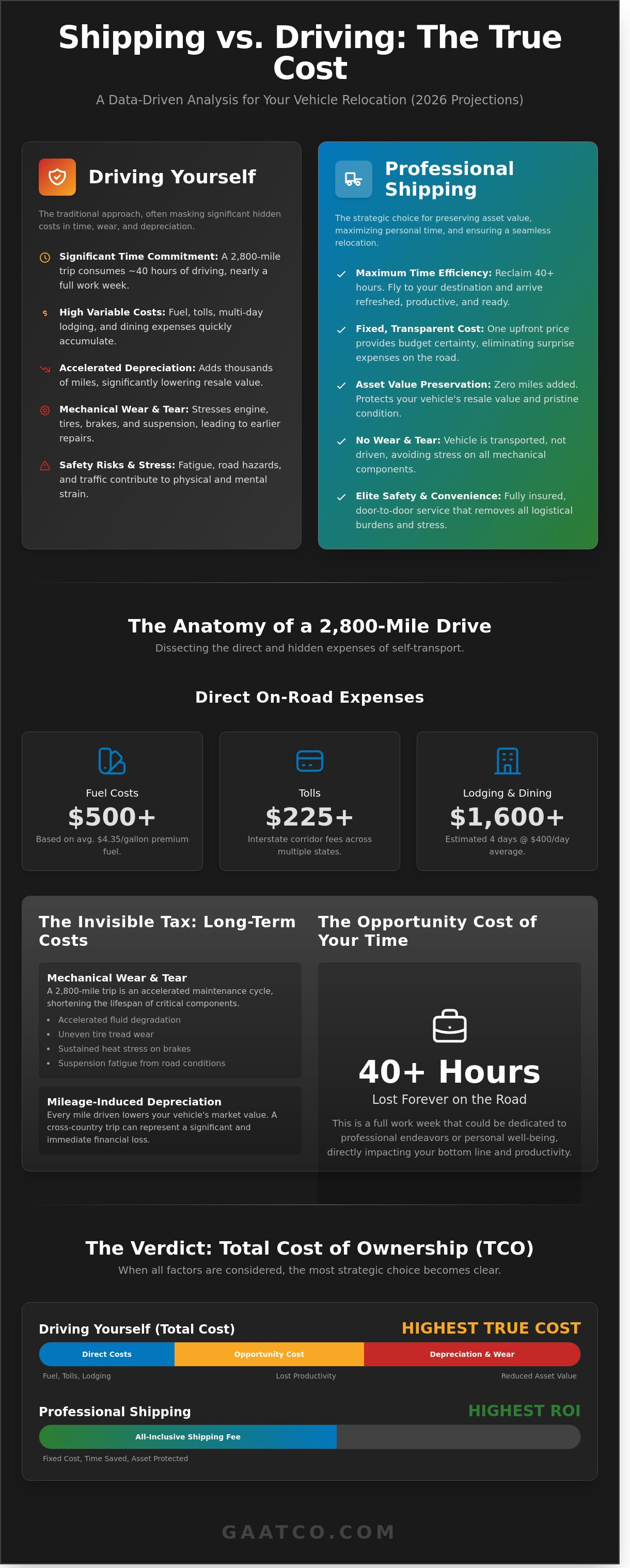
Direct expenses are the most visible line items in a relocation budget. By 2026, national averages for premium unleaded fuel are projected to fluctuate around $4.35 per gallon. For a 2,800-mile journey, fuel costs alone can exceed $500 for a standard sedan. Tolls across major interstate corridors add another layer of expense, often reaching $150 to $225 depending on the route. Beyond the vehicle, one must account for the human element of the journey. High-quality lodging and dining for a multi-day trip typically range from $300 to $500 per day. These cumulative figures often narrow the perceived gap in the cost of shipping a car vs driving it when viewed as a total package.
The Maintenance Premium: Wear and Tear
A 1,000-mile journey isn't merely a trip; it's an accelerated maintenance cycle for sophisticated machinery. This distance often triggers the need for immediate oil changes and tire rotations, services that carry a premium in 2026 due to rising labor rates. High-speed highway travel places sustained heat stress on brake systems and suspension components, potentially shortening their functional lifespan. Mechanical depreciation is the cost of future repairs brought forward. We've observed that owners who ignore these invisible factors often underestimate the true price of self-transport by as much as 25%.
- Fluid Degradation: Extended high-temperature operation accelerates the breakdown of synthetic lubricants.
- Tire Integrity: Sustained friction over 2,000+ miles can lead to uneven tread wear, necessitating early replacement.
- Brake Fatigue: Heavy traffic in metropolitan transit zones puts significant strain on rotors and pads.
The Invisible Tax of the Open Road: Time, Safety, and Stress
The decision involves more than a simple calculation of fuel and tolls. When evaluating the cost of shipping a car vs driving it, one must account for the 30 to 40 hours typically required for a cross-country journey. For a high-net-worth individual or a busy executive, these hours represent a significant loss of potential. Instead of enduring the monotony of the interstate, you could dedicate that time to professional endeavors or personal rest. Choosing a professional carrier ensures a seamless transition to your new destination. It's a bespoke approach that prioritizes your presence where it matters most.
Valuing Your Time as a Strategic Asset
A 2,800-mile trip from New York to Los Angeles requires approximately 40 hours of active driving time, excluding necessary rest stops. This is nearly a full work week lost to the windshield. Analysis from sources like Forbes indicates the cost to ship a car often balances out when you factor in the price of premium lodging, meals, and the immediate depreciation of your vehicle. Arriving at a destination refreshed rather than exhausted is a luxury that's essential for maintaining a high-performance schedule. Shipping your vehicle allows you to maintain a professional rhythm, ensuring that your transition between cities is handled with the same precision as a private flight.
Risk Mitigation and Safety Standards
Safety remains a non-negotiable pillar of any logistics operation. National highways present unpredictable variables, from fluctuating weather patterns to the risk of driver fatigue. According to the National Highway Traffic Safety Administration, there were 42,795 traffic fatalities in 2022, a statistic that highlights the inherent risks of long-haul personal driving. In 2023, weather-related delays accounted for nearly 23 percent of all roadway delays, a variable that professional carriers are equipped to manage through advanced routing software. Professional transport utilizes licensed and insured carriers who specialize in risk mitigation. These experts handle the complexities of the road so you don't have to.
Highway hypnosis and travel fatigue are genuine psychological concerns. Long hours behind the wheel lead to diminished reaction times and increased stress levels. By 2026, the density of traffic on major corridors has only increased the mental load of long-distance travel. By outsourcing this task, you eliminate the mental burden of the move. Our dedicated logistics team ensures that every detail is managed with precision. This strategic choice allows you to maintain your focus on your global interests while your assets are moved with the care they deserve. When you compare the cost of shipping a car vs driving it, the peace of mind offered by professional transit is often the most valuable return on investment.
A Comparative Framework: Direct Expenses vs. Long-Term Value
Evaluating the financial architecture of a 1,500-mile journey requires a perspective that extends beyond the fuel pump. While the immediate expense of a road trip might appear lower than a transport quote, a granular analysis often reveals hidden liabilities. A journey of this magnitude typically necessitates three days of travel, involving lodging expenses, meals, and the physical toll on the driver. When utilizing AAA's Your Driving Costs calculator, it becomes evident that the comprehensive expense of vehicle operation includes maintenance, insurance, and finance charges that accumulate with every mile. For many professionals, the cost of shipping a car vs driving it reaches a break-even point at approximately 1,000 miles, where the value of one's time and the preservation of the asset outweigh the perceived savings of a self-driven trip.
- Direct Costs: Fuel, overnight accommodations, and high-protein sustenance for the duration of the transit.
- Indirect Costs: Immediate oil life reduction, tire tread depletion, and the risk of road debris damage.
- Opportunity Costs: The loss of three productive business days or personal leisure time.
The Depreciation Equation
In the 2026 resale market, vehicle valuation is increasingly sensitive to mileage thresholds, particularly for high-performance and electric models. A single cross-country excursion can push a vehicle into a higher maintenance tier or diminish its trade-in value by a specific margin. For clients managing leased vehicles, these miles represent a direct financial penalty, as overage fees often reach $0.25 per mile or higher. Professional transport effectively freezes a vehicle's odometer and preserves its market value during relocation. By avoiding the mechanical stress of a 1,500-mile trek, owners maintain the integrity of the vehicle's powertrain and interior finishes.
Logistical Efficiency: Shipping as a Solution
The simplicity of door-to-door auto shipping offers a level of sophistication that traditional road trips cannot match. Rather than coordinating a complex itinerary involving chase vehicles or return flights, clients can rely on a streamlined process that fits into a busy schedule. We recognize that our clients require reliability above all else. GAATCO handles the complexities of logistics so the client doesn't have to, managing everything from route optimization to final delivery. This bespoke approach ensures that the vehicle arrives in pristine condition without the owner ever needing to step behind the wheel. The cost of shipping a car vs driving it is not merely a line item; it's an investment in a seamless lifestyle transition.
Preserving Asset Integrity: When Professional Transport is Essential
Choosing between professional transport and a DIY road trip involves more than a simple calculation of fuel and lodging. It's a decision regarding the preservation of a sophisticated mechanical asset. For high-value vehicles, the cost of shipping a car vs driving it often favors transport when you account for accelerated depreciation. Data from 2024 automotive market analyses suggests that adding 2,000 miles to a late-model luxury SUV can impact its resale value by as much as 2.5%. Professional logistics eliminate this loss, ensuring the odometer remains unchanged during transit.
Driving isn't always a viable option, particularly for inoperable vehicles or those with specialized mechanical needs. If a vehicle can't be safely operated, attempting a long-distance tow with consumer-grade equipment risks significant structural damage. Professional carriers utilize winches and specialized tie-down points to secure non-running vehicles without stressing the suspension. This level of precision is a hallmark of our commitment to safety and excellence.
Luxury, Classic, and Exotic Vehicle Protection
Collector cars require a sanctuary, not a highway. Open carriers expose vehicles to road salt, gravel, and unpredictable weather, which can lead to micro-pitting in the paintwork. Enclosed transport provides a bespoke environment, shielding the asset from the elements entirely. This is essential for vehicles with low ground clearance. We utilize hydraulic lift gates rather than traditional ramps to prevent undercarriage scraping. Driving a vintage 1965 Shelby Mustang across three time zones is a strategic error; it introduces unnecessary wear on components that are often difficult to replace. Professional transport isn't just a service; it's an insurance policy for your investment.
Military and Corporate Relocation Standards
Precision is the foundation of every successful relocation. For military personnel during a 2026 PCS move, timelines are non-negotiable. Professional logistics providers coordinate these transitions to ensure the vehicle arrives exactly when the member reports for duty. Corporate standards for executive relocation are equally stringent. We understand that a seamless transition for a key leader requires their personal vehicle to be ready upon arrival. This removes the logistical burden from the individual, allowing them to focus on mission-critical objectives. Our global network ensures that whether the move is regional or international, the standard of care remains elite and consistent.
The choice to ship is often the most fiscally responsible path for those who value their time and the long-term integrity of their vehicle. By choosing a dedicated partner, you bridge the gap between complex operational realities and a stress-free arrival.
Secure your vehicle’s future with our elite transport services. Request a bespoke logistics consultation today.
Executing a Seamless Relocation Strategy with GAATCO
GAATCO approaches vehicle logistics with the same meticulous attention to detail found in private aviation. When you evaluate the cost of shipping a car vs driving it, the final calculation extends beyond fuel and mileage. It encompasses the preservation of your time and the mitigation of risk. Our philosophy centers on reliability and an understated elegance that ensures your assets are handled with the highest standards of safety. We treat every transport as a mission-critical operation, where the goal is a flawless arrival.
A professional transport consultation begins with a comprehensive assessment of your specific requirements. We don't just provide a price; we architect a solution. Our logistics specialists coordinate every detail of the door-to-door delivery process, providing a seamless experience from the initial pickup to the final handover. You can expect a dedicated point of contact who manages the complexities of interstate transport, allowing you to focus on the broader aspects of your relocation. This bespoke approach eliminates the uncertainty often associated with moving vehicles across the country.
The GAATCO Difference: 20 Years of Expertise
For over two decades, we've served as a trusted advisor for national vehicle moves. Our network consists exclusively of licensed, insured, and rigorously vetted carriers. We maintain a strict vetting process that exceeds Department of Transportation (DOT) minimums; this ensures that only the top 5% of carriers handle our clients' vehicles. Our pricing model remains transparent, eliminating the hidden surcharges that often plague the industry. This commitment to honesty provides a clear understanding of the cost of shipping a car vs driving it, allowing for a decision based on genuine value rather than just the lowest bid.
- Rigorous vetting of all logistics partners to ensure 100% compliance with safety regulations.
- Fixed pricing structures that reflect the actual market conditions and fuel costs of 2026.
- Comprehensive insurance coverage that provides peace of mind for every mile of the journey.
Your Next Steps: Securing a Bespoke Quote
Preparing your vehicle for professional transit is a straightforward process. We recommend removing personal items and ensuring the fuel tank is at approximately one-quarter capacity to optimize weight for the carrier. Scheduling a pickup is equally efficient. Our team works within your timeline to ensure a precise departure that aligns with your 2026 relocation schedule. This level of coordination is essential for high-net-worth individuals and corporate clients who require absolute punctuality. The decision to ship your vehicle is an investment in your peace of mind. By choosing a partner with a global perspective and local expertise, you ensure that your vehicle arrives in the same condition it left.
Elevating Your Relocation Strategy for 2026
Choosing between personal transit and professional transport involves more than a simple fuel calculation. The 2024 IRS standard mileage rate of 67 cents per mile serves as a vital benchmark for understanding the true wear and tear on your vehicle. When you analyze the cost of shipping a car vs driving it, you must account for the 15 percent average annual depreciation that high mileage accelerates. GAATCO provides a sophisticated alternative that prioritizes asset integrity and personal time. Our team leverages over 20 years of industry leading logistics expertise to manage every detail of your vehicle's journey. We maintain a fully licensed and insured national carrier network specifically designed for luxury, classic, and military transport. This dedicated support ensures that your most valued assets remain in pristine condition throughout the transition. Relocating a vehicle shouldn't be a source of stress but a seamless part of your broader strategy. We're here to provide the reliability and quiet excellence your lifestyle demands.
Experience a seamless vehicle relocation with a bespoke GAATCO quote.
Frequently Asked Questions
Is it actually cheaper to ship a car than to drive it?
Shipping a car is often more cost-effective when the journey exceeds 1,000 miles. According to 2023 AAA data, the average cost to own and operate a new vehicle is 60.8 cents per mile. When you calculate the cost of shipping a car vs driving it, you must include fuel, lodging, and meals. A three day cross-country trip can easily exceed $1,200 in direct expenses, whereas professional transport provides a fixed, predictable fee.
How does shipping a car affect my insurance coverage?
Professional transport companies are required by the FMCSA to carry minimum levels of cargo insurance, typically ranging from $100,000 to $250,000 for open carriers. Your personal auto insurance usually acts as secondary coverage during transit. We recommend verifying your policy's off-road or in-transit clauses before booking. To further safeguard your assets, you can discover AMCO.NET LLC and their professional insurance services. This structured approach ensures your asset remains protected without risking your personal premiums or claims history in the event of a transit incident.
What is the 'hidden cost' of depreciation when driving long distances?
Depreciation represents a tangible financial loss, as every mile added to the odometer reduces a vehicle's resale value. Industry data from Kelley Blue Book suggests that high mileage can decrease a car's value by approximately $0.10 to $0.15 per mile. A 3,000 mile cross-country drive could result in a $450 reduction in equity. Choosing professional transport preserves the vehicle's mechanical integrity and maintains its market valuation for future transactions.
Can I ship personal belongings inside my vehicle during transport?
Federal Department of Transportation regulations generally prohibit carriers from transporting household goods inside vehicles. However, many logistics providers allow a maximum of 100 pounds of personal items if they're secured below the window line. These items aren't covered by the carrier's insurance policy. We advise clients to remove all valuables to ensure a seamless transit process and to comply with weight restrictions that affect the transport vessel's balance.
How long does it typically take to ship a car across the country?
A standard transcontinental shipment typically requires a window of 7 to 10 days for completion. Drivers are restricted by FMCSA Hours of Service regulations to 11 hours of driving within a 14 hour period. This ensures that every delivery is handled with the highest safety standards. While weather or road conditions can influence the timeline, our logistics team provides consistent updates to ensure you're informed at every stage of the journey.
What is the price difference between open and enclosed car transport?
Enclosed transport options generally command a premium of 33% to 50% over standard open-air carriers. This investment provides a bespoke environment that protects the vehicle from road debris, precipitation, and ultraviolet exposure. When evaluating the cost of shipping a car vs driving it, high-value or vintage assets benefit significantly from this added layer of security. The choice reflects a commitment to maintaining the pristine condition of a sophisticated automotive investment.
What happens if my vehicle is damaged during professional shipping?
While industry statistics show that over 99% of professional shipments arrive without incident, a formal protocol exists for discrepancies. You must note any new damage on the Bill of Lading during the final inspection at delivery. This document serves as the primary evidence for insurance claims. Taking high-resolution photographs before and after transit provides the necessary documentation to ensure a swift and professional resolution through the carrier's dedicated insurance provider.
Is professional car shipping worth it for an older vehicle?
Shipping is often the safer choice for vehicles over 10 years old, as long-distance travel puts extreme stress on aging cooling systems and drivetrains. With the average age of cars on U.S. roads reaching 12.5 years in 2023, the risk of a mid-journey mechanical failure is statistically higher. Professional transport eliminates the potential for a costly roadside emergency. It allows you to relocate your vehicle with the same level of care afforded to a premium luxury asset.


