
A rooftop tent can turn a straightforward vehicle shipment into a clearance question. Shipping a car with a rooftop tent attached depends on the full vehicle-and-tent dimensions, the carrier’s clearance limits, and how the tent is secured. Compare the practical benefits of leaving it mounted with the effort of removing and transporting it separately.
Plan around the complete setup, not the vehicle alone. This guide covers the measurements and equipment details that affect fit, how attached and removed configurations compare, and how to prepare for pickup. Measure and photograph the vehicle as it will travel, then share those details when planning your shipment. That gives you a practical basis for choosing whether the tent should stay on the roof or travel separately.
Key Takeaways
- Shipping a car with a rooftop tent attached depends on the complete setup’s dimensions and the carrier’s operating limits, not a universal rule.
- Assess height, width, weight, and attachment security separately to understand how the tent may affect loading and transit planning.
- Compare attached and removed tent arrangements alongside open and enclosed transport to identify the most suitable configuration.
- Measure and photograph the vehicle and tent, document their condition, and share accurate dimensions in your transport request.
- Use your vehicle’s configuration to guide the transport choice and prepare for a more straightforward carrier handoff.
Can You Ship a Car With a Rooftop Tent Attached?
Yes, in some cases. Shipping a car with a rooftop tent attached depends on the complete vehicle-and-tent dimensions and the carrier’s operating limits. A setup that fits one loading configuration may not suit another, so treat attached transport as a fit and loading assessment rather than an automatic yes or no.
The shipment’s profile includes the vehicle’s height, width, and length, plus any mounted equipment that changes its shape or clearance. Measure the vehicle with the tent in the exact position it will travel. Even folded and latched, the tent adds height and remains part of the shipment’s configuration. Include it in your transport request instead of relying on the vehicle’s standard model dimensions.
Accurate loaded dimensions help determine whether the complete setup can fit the assigned carrier space.
Measure on level ground and record the fullest points, including anything that extends beyond the roofline or sides. Use the same configuration for measuring and pickup. If the tent will be removed before transport, make that clear: measurements for a bare-roof vehicle describe a different shipment.
Which rooftop-tent details affect transport?
Record the tent’s make, style, folded position, and mounting location. Include the full setup: an attached ladder, awning, crossbars, or other protruding accessories can affect the vehicle’s overall dimensions. Note which items are firmly mounted and which can be removed. The vehicle model alone does not describe a modified setup accurately.
For example, two vehicles of the same model may have different overall heights if one carries a low-profile folded tent and the other has additional roof-mounted equipment. Share measurements rather than relying on a visual description. Specific figures make it easier to assess the actual configuration.
Why is there no universal answer for every shipment?
Carrier equipment, clearance limits, and loading arrangements vary. Height may be the most obvious concern, but width, length, and the position of mounted equipment also matter. The assessment needs to reflect the actual vehicle and tent, not a general assumption about rooftop tents.
Share complete dimensions early so they can inform the transport plan. If the attached tent creates a fit constraint, compare those measurements with a tent-removed configuration to decide whether removal is worthwhile.
How a Rooftop Tent Changes Vehicle Fit, Clearance, and Securement
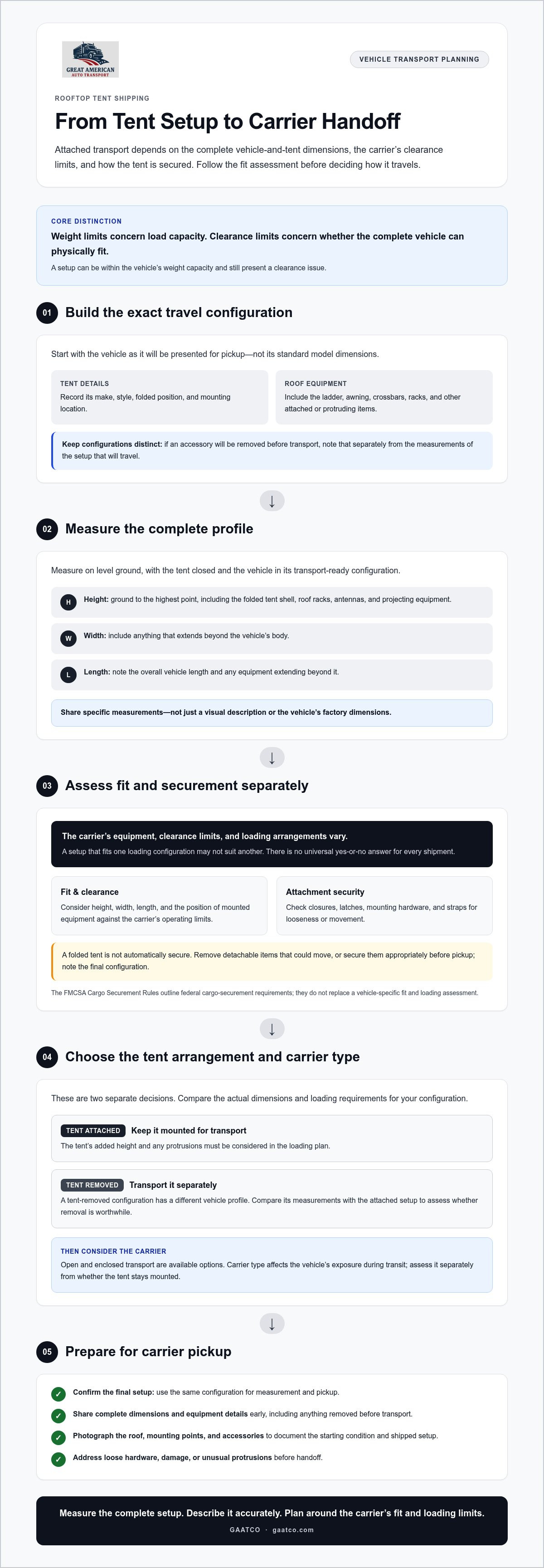
A closed rooftop tent still adds height and may change how the vehicle fits in its assigned carrier space. The shell, mounting hardware, and attached accessories all contribute to the transport-ready profile. Height is often the most noticeable concern, but width, weight, and attachment security are separate considerations. A setup can be within the vehicle’s weight capacity and still present a clearance issue.
Weight limits concern load capacity; clearance limits concern whether the complete vehicle can physically fit. One does not establish the other. For shipping a car with a rooftop tent attached, provide an accurate description of the full configuration. The carrier determines how the vehicle is positioned and secured for transport.
How should you measure the vehicle with the tent mounted?
On level ground, measure from the ground to the highest point with the vehicle in its transport-ready configuration. Include roof racks, the folded tent shell, antennas, and other permanent or projecting equipment. Measure overall width and length too, noting anything that extends beyond the vehicle’s body. Manufacturer dimensions describe the standard vehicle, not necessarily the modified setup you intend to ship.
Keep the tent closed as it will be for transport. If a removable accessory will be taken off before pickup, record that separately rather than including it in the measurements for the configuration that will travel.
What should be secured or assessed before loading?
Check the tent’s closures, latches, mounting hardware, and straps for movement or looseness. A folded tent is not automatically secure: exposed straps, handles, or other components may still protrude or shift. Remove detachable items that could move in transit, or secure them appropriately before pickup. Describe the final configuration, including anything removed.
Vehicle securement and tent attachment are related but distinct. The vehicle must be secured for transport, while the tent and its mounting system should be assessed as equipment attached to the vehicle. The FMCSA Cargo Securement Rules outline federal cargo-securement requirements. They provide useful context, but do not replace a vehicle-specific fit and loading assessment.
Photograph the roof, mounting points, and accessories before handoff. These images document the starting condition and help show the setup being shipped. Address any loose hardware, damage, or unusual protrusions before pickup rather than assuming they will remain unchanged in transit.
Accurate measurements and a clear description help ensure the plan reflects the vehicle as configured, not as it left the factory. GAATCO provides U.S. vehicle transport planning with open and enclosed transport options.
Attached or Removed: Compare Rooftop-Tent Shipping Options
There are two separate decisions: whether the tent travels on the vehicle, and whether the vehicle moves on an open or enclosed carrier. Removing the tent may simplify the vehicle’s profile. Carrier type affects the vehicle’s exposure during transit. In either case, plan around the actual dimensions and loading requirements.
| Configuration | Clearance and planning | Equipment exposure | Removal effort |
|---|---|---|---|
| Tent attached, open transport | Mounted height and protrusions must be considered in loading plans. | Vehicle and tent are exposed to outdoor conditions during transit. | No tent disassembly, but securement and dimensions need clear documentation. |
| Tent attached, enclosed transport | Overall dimensions still matter; an enclosed carrier is not automatically a fit. | Enclosure limits direct exposure to outdoor conditions. | No tent disassembly, but the complete setup still needs assessment. |
| Tent removed, open transport | A lower vehicle profile may simplify clearance planning. | Vehicle is exposed; the tent needs separate handling. | Removal and separate arrangements for the tent are required. |
| Tent removed, enclosed transport | Removing the tent may reduce fit complexity, though vehicle dimensions still apply. | Vehicle is enclosed; the tent still travels separately. | Removal and separate handling remain part of preparation. |
GAATCO offers open and enclosed vehicle transport. Compare the options according to your priorities and the vehicle’s configuration, rather than assuming one carrier type suits every rooftop tent.
When might leaving the tent attached be practical?
Keeping the tent mounted can be convenient if the setup fits the carrier’s requirements and the tent and hardware are secure. It avoids disassembly and separate arrangements for the tent. However, convenience alone does not establish that a particular carrier can accommodate the setup. Share dimensions and configuration details early so they can inform shipment planning.
When might removing the tent be the clearer option?
Removal may be worth considering if the mounted setup raises a clearance concern. A lower vehicle profile can simplify the fit assessment, but taking the tent off requires time, careful handling, and a plan to transport it separately. Weigh that effort against the benefit of shipping a less bulky vehicle. Removing the tent may reduce fit complexity, but does not guarantee a particular carrier or transport outcome.
For shipping a car with a rooftop tent attached, compare both configurations using measurements. If the tent stays mounted, provide its dimensions and describe how it is secured. If you remove it, plan its separate handling before pickup. Plan your vehicle shipment around the configuration that best suits your needs.
Prepare Your Car and Rooftop Tent Before Carrier Pickup
A well-prepared handoff starts with clear shipment details. For shipping a car with a rooftop tent attached, describe the vehicle’s actual configuration, not just its year and model. Use this checklist to record the setup, reduce uncertainty, and prepare the pickup location.
- Document the vehicle and tent. Provide the vehicle’s year, make, and model, plus the tent’s make and style if known. Describe its folded travel position and whether it will remain mounted.
- Measure the complete setup. Record the vehicle’s height, width, and length in its transport-ready configuration. Include the tent, roof racks, antennas, and accessories that extend beyond the roofline or body. Share the measurements in your transport request.
- Secure the equipment. Close and latch the tent according to its manufacturer instructions. Check mounting hardware, straps, and detachable accessories for looseness. Remove loose gear and secure or remove parts that could shift.
- Photograph the condition. Take clear photos of the tent, mounting points, roof, and vehicle exterior before handoff. Capture existing marks or damage, and keep the images with your shipment records.
- Prepare pickup access. Consider whether narrow streets, low structures, or limited maneuvering space could affect where a carrier can approach or load the vehicle. Share access constraints in advance.
What information should you provide before pickup?
Provide the full vehicle and tent dimensions and describe the folded configuration that will travel. Note accessories extending above or beyond the vehicle, such as crossbars or an attached ladder. State whether the tent will stay mounted. These details help align the shipment plan with the setup presented at pickup.
How can you prepare the setup for handoff?
Follow the tent manufacturer’s instructions for closing and latching it, then check the mount and accessories for movement. Remove personal belongings and loose equipment from the vehicle and tent. Photograph the roof setup and overall vehicle condition before pickup so your records reflect the vehicle as prepared for transport.
Keep measurements and photos accessible on pickup day. If the planned configuration changes, such as removing the tent or an accessory, update the shipment details to match what the carrier will receive. Clear access notes and accurate information help avoid a mismatch between the planned load and the vehicle at pickup.
Ready to plan around your vehicle’s actual dimensions? Plan your vehicle transport with GAATCO using the configuration details you have prepared.
Plan Rooftop-Tent Car Shipping With GAATCO
Start with the complete vehicle, not the factory specification. Measure the car with the tent and accessories in their transport-ready positions, compare attached and removed configurations, then submit details that describe the setup accurately. This gives the shipment plan a useful foundation and helps align the carrier arrangement with the vehicle presented for pickup.
GAATCO brings over 20 years of industry experience to U.S. vehicle transport and works with licensed and insured carriers. Open and enclosed transport are both options to consider, with the vehicle’s dimensions and configuration informing the arrangement. Door-to-door delivery can also be part of the plan, with pickup and delivery details considered alongside access at each location.
What should a rooftop-tent shipping request include?
Provide the origin and destination, vehicle year, make, and model, and the tent’s transport configuration. Include the overall height and, where available, the vehicle’s width and length with mounted equipment. Note whether the tent will remain attached and identify accessories that extend beyond the roofline or vehicle body.
Describe unusual dimensions or access constraints, such as a narrow approach or a low structure near the pickup point. If you plan to remove the tent before loading, state that clearly so the shipment details describe the configuration that will travel. Complete information supports a plan based on the actual vehicle rather than standard-model dimensions.
What happens after you submit shipment details?
Your details inform the quote and planning conversation. The vehicle’s full dimensions, tent configuration, route, and pickup and delivery access help shape the shipment arrangement. Open or enclosed transport can then be considered in relation to the setup. Choosing an enclosed carrier does not eliminate the need to account for height and other dimensions.
For shipping a car with a rooftop tent attached, clear measurements are especially useful because they describe the actual load. If a detail changes before pickup, such as removing an accessory or changing the tent’s position, update the shipment information so planning reflects the revised configuration. This helps keep the handoff orderly without assuming that every setup will fit every carrier.
Have your route, vehicle details, tent configuration, and measurements ready? Request a vehicle shipping quote with complete setup information.
Set Your Shipment Up for a Confident Start
Turn your vehicle’s real-world configuration into a clear shipment plan. Before booking, decide whether the tent will stay mounted, note equipment that changes the vehicle’s profile, and gather measurements for the setup you intend to transport. This gives planning a practical starting point and helps align the arrangement with your priorities.
For shipping a car with a rooftop tent attached, rely on measurements rather than assumptions based on the vehicle model. Share the tent’s position and any access considerations at pickup or delivery. GAATCO can help you consider open or enclosed transport and door-to-door delivery in light of your vehicle’s configuration.
When you are ready, request a vehicle shipping quote with your setup details. A thoughtful plan begins with accurate information.
Frequently Asked Questions
Does a rooftop tent affect the quote to ship a car?
It can, because the tent changes the vehicle’s transport configuration and may affect carrier fit or loading arrangements. For a useful quote, include the tent’s folded dimensions and the vehicle’s overall measurements rather than relying only on standard model specifications. A low-profile tent and one with a projecting ladder present different profiles. State whether the tent will stay mounted so the shipment can be assessed using the setup you intend to transport.
Are rooftop tents covered by auto transport insurance?
Don’t assume the tent is covered in the same way as the vehicle. A carrier’s cargo coverage may apply to the vehicle while treating mounted accessories or personal property differently. The tent’s status depends on the applicable coverage terms. Photograph the tent and its mounting points before pickup, and review the shipment documents for how accessories are handled. If the tent has substantial value, consider whether separate coverage is appropriate for your circumstances.
Can I leave camping equipment inside a rooftop tent during car shipping?
It’s best to remove camping equipment from the tent before transport. Bedding, cooking gear, and other loose belongings can shift or add unaccounted weight, and personal items left with a vehicle may not be covered by carrier insurance. Empty the tent, vehicle cabin, and storage compartments, then secure the tent in its specified travel position. Arrange separate transport for camping equipment rather than treating the vehicle shipment as a way to move household or personal goods.
Will a rooftop tent change where a car carrier can pick up my vehicle?
It may affect pickup arrangements if the location has restricted access, low overhead clearance, or little room for a carrier to maneuver. This can matter in dense areas such as Boston, New York, San Francisco, and Chicago, as well as at properties with tight entrances in Atlanta, Miami, Houston, Dallas, San Diego, Seattle, Orlando, Nashville, Denver, Austin, Las Vegas, or Phoenix. Describe gates, overhead obstructions, and street access in advance so pickup planning reflects the location.
Should I remove an awning or ladder before shipping my car?
Remove an awning or ladder if it is loose, can move, or protrudes in a way that changes the vehicle’s transport profile. A securely stowed item may remain part of the setup, but include its dimensions and position in the shipment details. Follow the accessory manufacturer’s instructions for stowing or detaching it. If you remove it, keep the hardware together and arrange separate handling rather than leaving loose parts in the vehicle.
Does enclosed transport protect a rooftop tent from weather?
Enclosed transport places the vehicle inside a covered carrier, reducing direct exposure to outdoor weather compared with open transport. It does not remove the need to assess the tent’s height, width, mounting, and fit within the carrier. Nor is it a guarantee against every possible source of damage. Consider the vehicle’s configuration and your exposure concerns together when comparing open and enclosed shipping options.
Can a hard-shell and soft-shell rooftop tent be shipped the same way?
Not automatically. Tent style alone does not determine how it can travel. The folded profile, mounted height, exposed components, and attachment security all matter. A hard shell may have a different closed shape from a folded soft-shell tent, while covers, straps, or accessories can alter either setup. Provide measurements and photographs of the exact transport-ready configuration so planning reflects the tent on the vehicle, not a general assumption about its style.


