
What if the parts that make your vehicle distinctive are not clearly valued in its transport coverage? Insuring aftermarket modifications during vehicle transport means checking the applicable coverage terms instead of assuming they account for every upgrade. Without clear records of the modifications and the vehicle’s condition, it can be harder to support a claim.
Before handing over a modified vehicle, gather its parts records, review the shipment documents, and understand what each policy says. This guide explains what to review before pickup, how to document modifications with receipts and photographs, and why the bill of lading deserves careful attention at both ends of the journey.
You’ll also learn how to compare transport options based on your vehicle and priorities. Clear coverage information and organized documentation can help you make a more informed shipping decision, whether you choose open or enclosed transport.
Key Takeaways
- Learn what counts as an aftermarket modification and why transport coverage documents matter when assessing what may be covered.
- Use a simple recordkeeping sequence: inventory modifications, take dated photos, gather receipts, disclose details, and retain copies.
- Understand how carrier cargo coverage, your personal auto policy, and open or enclosed transport serve different purposes.
- Before pickup, review relevant policy documents and shipment paperwork, inspect the vehicle, and record condition discrepancies as instructed.
- Insuring aftermarket modifications during vehicle transport starts with clear records and coverage terms, helping you prepare for a more informed shipping arrangement.
What Does Insuring Aftermarket Modifications During Vehicle Transport Mean?
Aftermarket modifications are changes made beyond a vehicle’s original factory configuration, whether installed by the owner or a professional. Custom wheels, a lift kit, a body kit, a spoiler, and upgraded audio equipment can all affect a vehicle’s configuration and value. For owners investing in bespoke styling or vehicle protection packages—such as those highlighted by Vanguard Motors Dubai—insuring aftermarket modifications during vehicle transport means understanding how the relevant coverage documents treat those changes if a qualifying loss occurs in transit.
There is no single rule for how every part will be treated. Carrier cargo coverage applies to qualifying transit losses under its own terms, while the owner’s personal auto policy is separate and has its own provisions. A carrier’s insured status alone does not establish whether a particular modification is covered, how it is valued, or what conditions apply. The policy documents and any written explanation of coverage are the useful reference points.
For a general overview of how auto policies are structured, Car insurance offers background. Transport coverage should still be considered on its own terms, rather than inferred from general descriptions of auto insurance.
This distinction matters when a vehicle has components that differ from its standard configuration or items that are not permanently attached. Records and policy documents can help establish what was present before transport and provide a clearer basis for understanding how coverage may apply.
For a related overview of aftermarket parts and auto insurance, watch this video:
Which aftermarket parts may need special attention?
Start by distinguishing installed components from loose accessories. Custom wheels, lift kits, body kits, spoilers, and upgraded audio equipment may be attached to or integrated with the vehicle. A detached spoiler, removable audio component, or other accessory placed inside the car may be treated differently from an installed part. Do not assume both fall under the same coverage terms.
Pay particular attention to items that are unique, costly, or difficult to replace, such as specialized towing systems from ProPride, Inc. or custom suspension components. Record identifying details, such as make or model where available, how each item is installed, and whether it will travel attached to the vehicle or separately. This creates a specific record of what was present at pickup.
What is the difference between carrier coverage and personal auto insurance?
Carrier cargo coverage concerns qualifying losses during transport, subject to its terms, covered-property definitions, exclusions, and claim conditions. Personal auto insurance is a separate contract, and its provisions for vehicle transport and modified parts must be reviewed independently. Neither should be assumed to cover every modification or automatically pay its full replacement value.
Before shipment, identify the relevant documents and look for their treatment of modified components, loose property, valuation, and the steps to follow if damage is discovered. If wording is unclear, request a written explanation from the party responsible for the policy. The documents, not assumptions based on a carrier being insured or a vehicle having an auto policy, establish what may apply.
How to Document Vehicle Modifications Before Transport
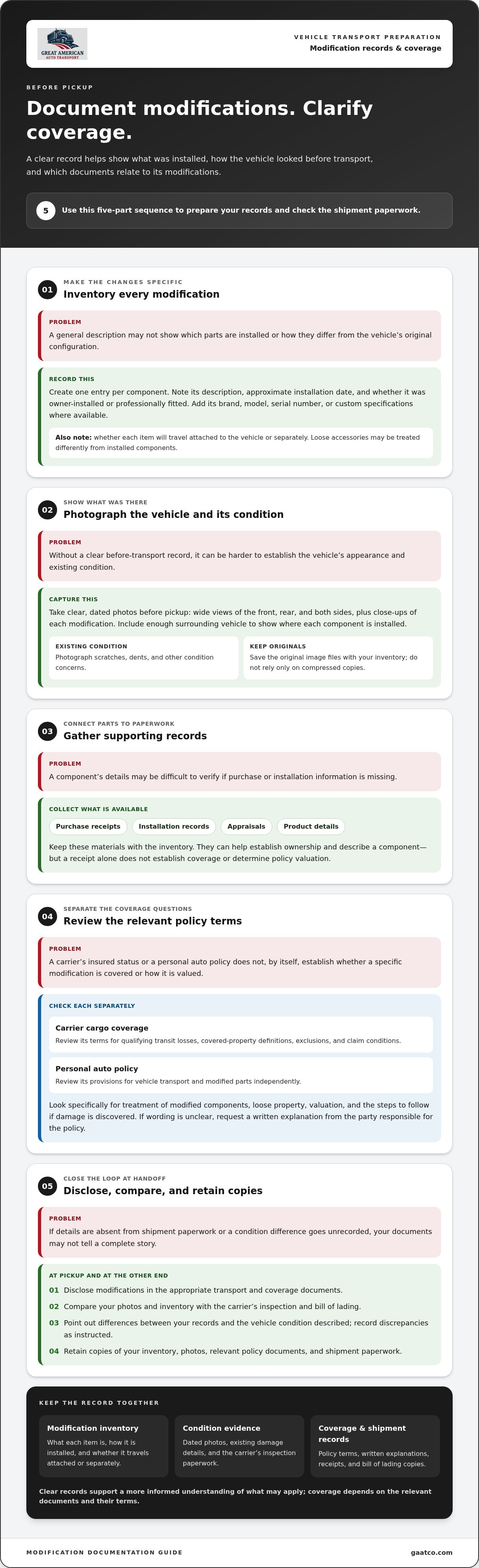
A well-organized record helps establish what was installed, how the vehicle looked before pickup, and which documents relate to its modifications. For insuring aftermarket modifications during vehicle transport, preparation is most useful when it creates a clear timeline and keeps vehicle details with shipment records. Complete these steps before pickup:
- Inventory each modification and note whether it will travel installed or separately.
- Photograph the vehicle, modified components, and any existing damage.
- Collect records such as purchase receipts, installation documents, appraisals, and product details.
- Disclose the modifications in the appropriate transport and coverage documents.
- Retain copies of your records, relevant policy documents, and shipment paperwork.
Build a useful modification inventory
Create one entry for each component. Record its description, approximate installation date, and whether it was owner-installed or professionally fitted. Add the brand, model, serial number, or custom specifications where available. For example, an entry for custom wheels can include their make and model and when they were installed. Keep these details with the vehicle’s original records so the standard configuration and later changes are easy to distinguish.
Attach supporting documents where available, including purchase receipts, installation records, an appraisal, or product information. These materials can help establish ownership and describe the component, but a receipt alone does not establish coverage or determine a policy’s valuation. Keep original documents safe and store digital copies somewhere accessible during pickup.
Photograph the vehicle and record its condition
Take clear, dated photographs before pickup. Begin with wide views of the front, rear, and both sides, then take close-ups of each modification. Include enough of the surrounding vehicle to show where a component is installed, and use consistent lighting so details remain visible. Photograph existing scratches, dents, and other condition concerns. Keep the original image files with your inventory rather than relying only on compressed copies sent through messaging apps.
At pickup, compare your photographs and inventory with the carrier’s inspection and bill of lading. Point out differences between your records and the condition described on the paperwork, then follow its instructions for recording them before signing. Keep a copy of the completed paperwork with your pre-shipment records.
Keep copies of relevant coverage documents, written disclosures about the modifications, your inventory, photographs, and shipment paperwork together. This makes it easier to refer to the same details if a question arises. When you are ready to plan the shipment, GAATCO vehicle transport options include open and enclosed carrier arrangements.
How Carrier Coverage, Personal Insurance, and Transport Type Compare
Each part of a vehicle shipment serves a different purpose. The transport method should not be confused with the insurance terms: carrier cargo coverage and your personal auto policy are separate arrangements, while open and enclosed transport describe how the vehicle is moved. Neither transport method automatically changes what a policy covers. For insuring aftermarket modifications during vehicle transport, compare the applicable documents alongside the transport option before booking.
| Option | Purpose | Documents to review | Questions to resolve |
|---|---|---|---|
| Carrier cargo coverage | May apply to qualifying losses during transit under its terms. | Written coverage terms and shipment documents. | How are installed modifications and accessories treated? What exclusions, limits, and claim conditions apply? |
| Owner’s auto policy | Provides coverage according to the personal policy, which is separate from carrier coverage. | Policy declarations, applicable endorsements, and policy wording. | Do transit-related losses and modified components fall within the policy’s provisions? Are any conditions relevant to this shipment? |
| Open transport | Moves the vehicle on an open carrier. | Transport order and shipment paperwork, plus applicable coverage documents. | Does this arrangement suit the vehicle and your priorities? Do the documents describe the vehicle and modifications accurately? |
| Enclosed transport | Moves the vehicle in an enclosed carrier environment. | Transport order and shipment paperwork, plus applicable coverage documents. | Does the enclosed arrangement better fit your protection priorities, and do the coverage terms remain clear? |
What to understand about a carrier’s cargo coverage
Coverage scope, limits, exclusions, and claim conditions can vary by policy and shipment. Review the written terms for how they address installed aftermarket components, detached accessories, valuation, and the steps required if damage is discovered. Do not infer a particular outcome from the phrase “insured carrier.” That status alone does not explain how an individual modification will be treated.
Review how your personal policy applies during vehicle transport, including its provisions for modifications. Compare those provisions with the carrier’s written terms and shipment documents before booking. Keep the relevant documents together so the distinctions are easy to see.
When might open or enclosed transport be worth comparing?
GAATCO arranges open car transport for vehicle relocation, as well as enclosed car transport for owners whose priorities call for an enclosed shipping environment. The right comparison depends on the vehicle, its modifications, and your preferences. Enclosure changes the transport environment, not automatically the insurance arrangement.
Before selecting either option, make sure the shipment paperwork accurately identifies the vehicle and review the applicable coverage provisions for both the transport method and modified parts. A different carrier type is not a substitute for clear policy terms. The governing documents establish how coverage applies, and no transport choice by itself guarantees a payout.
What to Clarify Before Pickup and Handling Damage
A careful review before loading can prevent avoidable uncertainty later. Gather the coverage documents, modification records, and shipment paperwork in one place. Read the documents that govern the shipment and applicable policies rather than relying on general descriptions of coverage.
Questions to resolve before the vehicle is loaded
Use the written terms to understand how installed modifications and accessories traveling with the vehicle are treated. Review applicable limits, exclusions, deductibles, notice requirements, and claim deadlines in the governing documents. If wording is unclear, request a written explanation from the responsible insurer or carrier and keep it with your records. The answer may depend on the specific policy and shipment.
At pickup, compare the vehicle’s condition with the inspection record and bill of lading. Check that the paperwork accurately reflects the vehicle and visible condition concerns. If you see a discrepancy, ask for it to be recorded before signing, where the form and its instructions allow. Keep a copy of the completed document with your dated photographs and modification inventory.
- Coverage: Have the applicable written terms available, including relevant declarations or endorsements.
- Modifications: Ensure your inventory and any required disclosures accurately describe installed parts and separately transported accessories.
- Condition: Compare the pickup inspection with your own records and note discrepancies on the shipment paperwork as instructed.
- Process: Locate applicable reporting instructions and deadlines before the vehicle leaves.
If a modification is damaged or missing after delivery
Inspect the vehicle at delivery and compare its condition with your pickup records. If a component appears damaged or missing, promptly photograph the affected area and the surrounding vehicle. Preserve relevant receipts, inventory details, pickup images, and shipment paperwork. Avoid making changes that could obscure the condition before documenting it, unless immediate action is needed to address a safety concern.
Record the issue on the delivery paperwork when possible and consistent with its instructions. Then follow the stated reporting process and notify the appropriate carrier or insurer promptly. Retain dated copies of messages, forms, photographs, and responses. Timely notice and organized evidence can support a claim review, but do not determine its outcome. The applicable terms and claim assessment remain controlling.
For insuring aftermarket modifications during vehicle transport, maintain a consistent record from pickup through delivery: what was disclosed, what condition was observed, and when any concern was reported. Keep communications factual and specific by identifying the component and where the issue appears. Follow the relevant policy and carrier instructions, including any required submission method or supporting documents.
Once your records and pickup questions are organized, arrange vehicle transport with GAATCO and carry those details into your shipment preparation.
Arrange Vehicle Transport with Clear Expectations
Once you understand the relevant coverage documents and have organized your records, carry accurate information into the transport arrangement. A clear preparation sequence keeps vehicle details, condition records, coverage terms, and shipment paperwork aligned. It also helps distinguish arranging transportation from determining how an insurance policy may respond.
- Inventory the modifications and identify which components are installed and which, if any, will travel separately.
- Document the vehicle’s condition with dated photographs and a written record before pickup.
- Review applicable coverage terms with the relevant insurer or carrier, and retain any written explanation.
- Prepare the shipment paperwork with accurate vehicle and condition details, and keep copies for your records.
Prepare a clear transport request
Provide an accurate description of the vehicle, its route, whether it is operable, and its notable installed modifications. Mention changes that may affect the vehicle’s configuration, along with any handling considerations relevant to transport. Clear details help shape suitable logistics and reduce the chance that important vehicle information is missed during planning.
GAATCO arranges open-car transport as well as enclosed options. Reviewing the available vehicle transport services can help you consider an arrangement that fits the vehicle and your priorities. A quote addresses the transport request. It does not confirm insurance coverage or establish claim eligibility for any modification.
Set expectations for the shipment
Keep written coverage details, your modification inventory, condition records, and shipment documents together. Before pickup, review the paperwork for accurate vehicle information and note condition discrepancies according to its instructions. Retain copies of completed records and relevant communications so you can refer to the same information through delivery.
GAATCO brings more than 20 years of industry experience arranging U.S. vehicle transport and works with licensed and insured carriers. Coverage remains governed by the applicable policy and shipment documents. Clear records help establish what was disclosed and how the vehicle was documented, without assuming that a particular part or loss will be covered.
For insuring aftermarket modifications during vehicle transport, pair complete vehicle details with a clear understanding of the applicable written terms. Have your route, operability, modification information, and condition records ready when planning the shipment. Request a vehicle transport quote and share relevant details about your vehicle so the transport arrangement can be planned with your needs in view.
Move Forward with a Well-Planned Shipment
A modified vehicle deserves a transport plan that reflects its configuration and your priorities. Treat insuring aftermarket modifications during vehicle transport as one part of preparation, alongside deciding how the vehicle should travel and ensuring its details are accurately represented in the shipment arrangements.
GAATCO brings more than 20 years of industry experience to U.S. vehicle transport, arranging open and enclosed options with licensed and insured carriers. Share the vehicle information that will help shape the transport plan, including its route, operability, and notable modifications. A transport quote addresses logistics, while coverage remains governed by the applicable policy and shipment documents.
With expectations clearly established, you can move ahead with a considered approach to the journey. Request a vehicle transport quote and take the next step toward arranging your shipment.
Frequently Asked Questions
Will carrier insurance cover aftermarket modifications during vehicle transport?
Not necessarily. The carrier’s applicable cargo policy determines how a loss involving a modification may be treated, including the covered-property definition, exclusions, and claim conditions. A custom component’s documented value is separate from whether the policy covers it. For insuring aftermarket modifications during vehicle transport, review the written terms and how they address a specific part, such as an upgraded suspension. Keep pre-pickup records to help establish what was installed and its condition.
Should I tell the auto transport company about modifications before shipping?
Yes. Disclose material modifications while arranging transport so the vehicle description is accurate and relevant handling questions can be addressed before pickup. Details such as unusually wide wheels, a lowered chassis, or a fixed roof attachment may help with planning, though not every modification affects transport eligibility. Disclosure does not itself establish insurance coverage. For shipments involving Atlanta, Miami, New York, Houston, Dallas, San Diego, San Francisco, Seattle, Orlando, Boston, Nashville, Denver, Austin, Chicago, Las Vegas, or Phoenix, include the route and vehicle details in your request.
Does personal auto insurance cover aftermarket parts while a car is being shipped?
It depends on the personal policy’s wording, which may treat transit, aftermarket equipment, and exclusions differently. Review the relevant provisions for the shipment and specific modification, such as a professionally installed audio system. Personal auto coverage and carrier cargo coverage are separate considerations. Do not assume one replaces the other or applies in every circumstance. Keep any written explanation with your policy documents for reference if questions arise.
How do I prove the value of aftermarket parts if they are damaged in transit?
Gather itemized receipts, installation invoices, product specifications, and any available appraisal or valuation records. For a custom-built component without a standard retail listing, a detailed installer invoice may help describe what was fitted and the work involved. Pair those records with dated images showing the component on the vehicle before pickup. This evidence may support a review, but it does not establish coverage or guarantee reimbursement. The responsible insurer or carrier assesses it under the applicable terms.
Does enclosed transport provide better insurance for modified vehicles?
No transport method alone establishes broader insurance coverage. Enclosed transport changes the shipping environment, while the applicable policy and shipment documents determine coverage scope and conditions. An owner moving a restored vehicle may prefer to compare enclosed transport with open transport based on the vehicle’s needs and priorities. Review the written insurance provisions separately, including how they address modified parts. A particular transport choice does not guarantee that a claim will be accepted or paid.
What should I do if an aftermarket part is damaged during vehicle delivery?
Photograph the affected component and surrounding area, then record the concern on delivery paperwork when possible and consistent with its instructions. Preserve pre-shipment images, receipts, and modification records. Follow the carrier’s stated notice and claim process promptly, and notify the relevant insurer when applicable. Reporting deadlines and documentation requirements can differ, so use the governing documents rather than relying on a general timeframe. Keep dated copies of submissions and related communications.
Are aftermarket accessories left inside the car covered during transport?
Do not assume loose accessories or personal property inside the vehicle receive the same treatment as installed parts. For example, a removable speaker or spare components placed in the cabin may be addressed differently from equipment fitted to the car. Review the carrier’s instructions and applicable policy language before pickup, and remove loose valuables where practical. If an item must travel with the vehicle, document it and retain any written guidance about how it is treated.


