
While consumer prices for vehicle transport rose by 14.6 percent in the first half of 2026, the most significant risk to your investment remains the presence of predatory operators. Entrusting a high-value asset to a third party requires more than a cursory glance at a digital storefront. Recognizing common car shipping red flags is the first step in distinguishing a seasoned logistical partner from a high-risk intermediary. You likely feel a justifiable sense of caution regarding the safety of your vehicle and the transparency of the final invoice.
We understand that the transition of a vehicle between major hubs like Houston or San Diego demands absolute precision and clear communication. This guide provides the definitive criteria for vetting auto transporters to ensure your vehicle receives the professionalism and security it deserves. We will examine the new 2026 FMCSA financial responsibility requirements, the nuances of cargo insurance limits, and the operational markers that define a reputable carrier. By the conclusion of this analysis, you will possess the expertise required to secure a damage-free delivery at a firm, guaranteed price.
Key Takeaways
- Learn how to authenticate a transporter’s operating authority using the FMCSA’s 2026 Motus platform to verify essential DOT and MC credentials.
- Protect your investment by identifying critical car shipping red flags, such as demands for non-refundable deposits or the use of unregistered "phantom" company names.
- Understand the current standards for cargo insurance and public liability to ensure your vehicle is protected by a minimum of $1,000,000 in coverage.
- Discover the logistical advantages of partnering with a seasoned expert who manages the complex vetting process between brokers and physical carriers.
- Gain peace of mind by prioritizing transporters with a multi-decade record of regional expertise in major hubs like Houston, Dallas, and San Diego.
What Defines a Reputable Car Shipping Company in 2026?
Reputable vehicle transport is built upon a foundation of strict regulatory compliance and fiscal resilience. In 2026, the Federal Motor Carrier Safety Administration (FMCSA) maintains rigorous standards for operating authority, including the requirement for brokers to hold a $75,000 bond to protect clients and carriers alike. A company's legitimacy isn't merely a marketing claim. It's a verifiable status within the FMCSA's Motus platform that confirms a provider's commitment to federal safety mandates and professional accountability.
Discerning clients must distinguish between high-volume providers and those who prioritize vehicle integrity. While some entities focus on moving maximum units with minimal oversight, a premium service provider treats every vehicle as a unique logistical project. This commitment to quality ensures that technical specifications and safety protocols aren't sacrificed for speed or volume. Identifying car shipping red flags early in the consultation process allows you to bypass companies that view your vehicle as just another line item on a ledger.
To better understand the warning signs of a subpar provider, watch this helpful video:
The Core Pillars of Professional Auto Logistics
Operational longevity serves as a reliable proxy for financial stability. With over 20 years of industry experience, GAATCO has refined the processes necessary to manage complex transport requirements across major American hubs. Professionalism in this field involves utilizing specialized equipment, such as enclosed carriers for classic automobiles, to mitigate environmental risks. We maintain a standard of Door-to-Door Auto Shipping to ensure a seamless experience that respects the client's time and convenience. This level of service requires a unified team that understands the nuances of high-end care.
Why "Cheap" Often Costs More in the Long Run
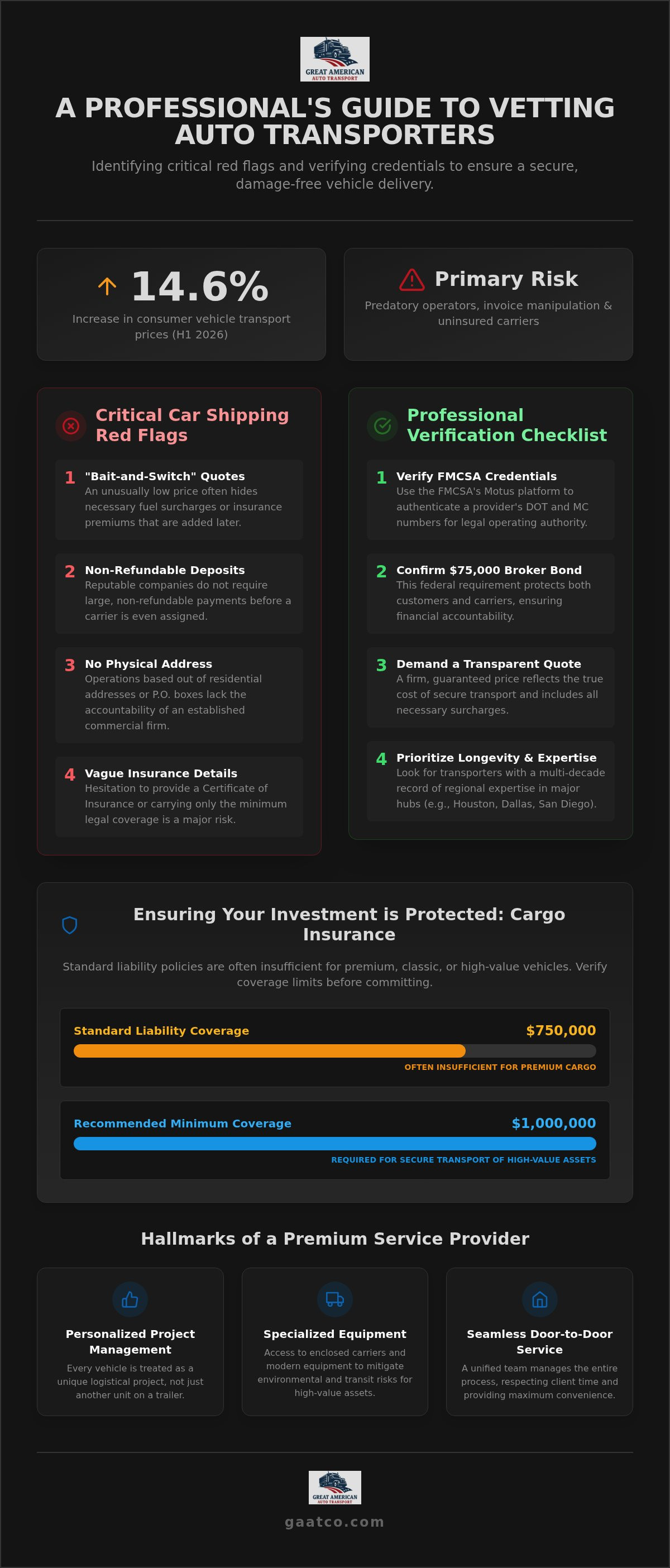
Identifying car shipping red flags often begins with an analysis of the quote itself. Low-tier providers frequently employ "bait-and-switch" tactics, offering an initial estimate that lacks necessary fuel surcharges or insurance premiums. These companies may function as a high-volume Auto transport broker without vetting the carriers they hire. Under-insured carriers jeopardize high-value assets, as the standard $750,000 liability policy is often insufficient for premium cargo. A firm, transparent quote reflects the true cost of secure transport and the expertise of a seasoned team that prioritizes safety over razor-thin margins.
The Professional Verification Checklist: Vetting Your Carrier
Objective verification serves as the only definitive safeguard against the sophisticated tactics of bad actors in the logistics space. While online reviews offer a subjective window into customer experiences, they can be manipulated or lack technical context. Identifying car shipping red flags requires a meticulous examination of a provider's federal credentials. Every legitimate transporter must possess a valid Department of Transportation (DOT) number and a Motor Carrier (MC) number. These identifiers are the foundation of legal operation, and any hesitation from a provider to share them should be viewed as an immediate disqualification.
Beyond licensing, confirm the entity's physical business address. Reputable firms operate from established commercial locations rather than residential settings or virtual mailboxes. This physical presence, combined with the professionalism of their logistics coordinators, reflects the company's operational maturity. A seasoned expert will provide clear, technical answers regarding transport routes and equipment specifications without resorting to high-pressure sales tactics. If you're seeking a partner that prioritizes this level of transparency, you may wish to request a consultation to see these standards in practice.
Mastering the FMCSA SAFER Database
In 2026, the Federal Motor Carrier Safety Administration (FMCSA) transitioned to the Motus platform, which serves as the primary system for authority verification. When you input a carrier's MC number, ensure their status is listed as "Authorized" for property transport. Pay close attention to the "Out of Service" (OOS) percentages. If a carrier’s vehicle or driver OOS rates significantly exceed the national average, it indicates a pattern of deferred maintenance or safety violations. A truly professional partner maintains an impeccable safety record, viewing these metrics as non-negotiable pillars of their service offering.
Insurance Coverage: Beyond the Basics
While the legal minimum for public liability insurance remains $750,000, industry leaders maintain at least $1,000,000 in coverage to protect against high-stakes incidents. Distinguish between this general liability and cargo insurance, which specifically covers damage to your vehicle. For Enclosed Car Transport, cargo limits should ideally reach $1,000,000 to reflect the value of the high-end assets being moved. Always request a Certificate of Insurance (COI) and verify that the policy is currently in good standing by contacting the listed underwriter directly. This step ensures that your investment is protected by more than just a paper promise.
Broker vs. Carrier: Navigating the Industry Infrastructure
The architecture of the auto transport industry relies on two distinct entities: brokers and carriers. A broker serves as the logistical architect, designing the route and identifying the optimal transport solution. Conversely, a carrier owns the physical assets and manages the actual movement of the vehicle. Understanding this distinction is vital because failing to recognize the specific responsibilities of each party is one of the most common car shipping red flags. When these roles are blurred, accountability often vanishes, leaving the client caught between two uncooperative parties.
A seasoned partner like GAATCO acts as a bridge between these two worlds. By leveraging over two decades of refined expertise, we provide the strategic oversight of a professional broker while maintaining the rigorous standards expected of a high-end carrier network. This dual-layered approach ensures that every vehicle, whether it requires Classic Car Transport or standard open shipping, is handled by a vetted professional. We don't just find a truck; we select a partner that meets our non-negotiable safety pillars, ensuring the physical transporter is as committed to your vehicle's safety as we are.
The Logistics Manager Advantage
Professional logistics managers offer a level of route efficiency that individual carriers simply cannot match. By maintaining an expansive network, a broker can identify the most direct paths between major hubs, which significantly reduces transit times. This management style provides several key benefits for the discerning client:
- Advocacy during insurance claims to ensure a swift and fair resolution.
- Access to specialized equipment for Military Vehicle Shipping or low-clearance exotic cars.
- Optimized scheduling that leverages real-time data from multiple transport lanes across the country.
This advocacy is especially critical when dealing with specialized cargo, where the nuances of coverage require expert interpretation. A diverse network allows for deeper customization, ensuring the equipment matches the specific requirements of your vehicle class perfectly.
Ensuring Accountability in a Multi-Party System
Maintaining a "white-glove" standard across a vast carrier network requires meticulous attention to detail and constant oversight. We believe that a single point of contact is essential for your peace of mind throughout the journey. This dedicated logistics advisor manages the operational flow, providing clear updates and ensuring that communication never falters. Our regional expertise in hubs like Houston, Miami, and San Diego allows us to navigate local logistical challenges with precision. By coordinating directly with the physical transporter, we eliminate the car shipping red flags associated with poor communication and scheduling delays. This centralized accountability ensures your vehicle arrives exactly as expected, without the frustration of hidden surcharges or logistical gaps.
Identifying Critical Red Flags: Protecting Your Investment
Protecting a high-value vehicle requires vigilance against sophisticated fraudulent practices. One of the most prominent car shipping red flags is a demand for a non-refundable deposit before a carrier is even assigned to your route. Reputable firms typically process payments once a logistics plan is solidified. Additionally, be aware of "phantom" companies that operate using stolen Department of Transportation (DOT) numbers. These entities often lack a physical presence and disappear once a deposit is paid. Verifying the company’s history through the FMCSA Motus platform, as discussed previously, remains your primary defense against such predatory actors.
Professionalism is also reflected in the quality of documentation provided. We maintain that a formal Bill of Lading is a non-negotiable requirement for any legitimate transport. This document serves as the official receipt and a record of the vehicle's condition at both pickup and delivery. If a provider suggests bypassing this step or offers only verbal agreements, it's a clear sign of operational negligence. To ensure your vehicle is handled with this level of meticulous detail, you should contact our seasoned logistics experts for a comprehensive consultation.
The "Bait-and-Switch" Pricing Trap
Unscrupulous brokers often use low initial quotes to attract clients who are focused solely on cost. These "lowball" estimates frequently exclude mandatory fuel surcharges or insurance premiums, leading to a sudden price increase on the day of pickup. In 2026, fuel surcharges are structured specifically based on diesel prices, with rates reaching 18 to 25 percent when fuel exceeds $4.50 per gallon. We provide a firm, transparent quote that accounts for these variables upfront. Identifying these car shipping red flags within the pricing structure prevents financial frustration and ensures your budget remains intact.
Communication Red Flags
The sophistication of a provider's communication infrastructure often mirrors their operational reliability. A lack of a professional business email or a centralized phone system suggests a transient operation rather than an established firm. Additionally, a total absence of status updates or tracking capabilities is a significant indicator of poor logistics management. While automated "bot" responses may offer immediate replies, they cannot replace the nuanced problem-solving of a human expert. Our seasoned advisors provide personalized support, ensuring you remain informed throughout the transit process without the frustration of generic, pre-programmed interactions.
Why Discerning Clients Entrust Their Vehicles to GAATCO
Established circa 2004, GAATCO has spent over two decades refining the nuances of specialized vehicle transport. We operate with a quiet confidence that only comes from navigating thousands of complex logistical scenarios across the United States. While the 2026 market has seen an influx of intermediaries struggling to meet new FMCSA financial standards, our team maintains a steadfast commitment to operational excellence. We position ourselves as a discreet advisor rather than a mere service provider, ensuring that your high-stakes transport requirements are met with meticulous attention to detail. By choosing a partner with a twenty-year track record, you effectively eliminate the car shipping red flags associated with inexperienced or under-capitalized brokers.
Regional Expertise in Major US Metros
Our deep understanding of regional logistics allows us to manage the specific challenges found in congested metropolitan environments. Navigating the restrictive corridors of New York or the steep terrain of San Francisco requires more than just a truck; it requires a sophisticated plan. We maintain a strategic presence in southern hubs like Atlanta, Dallas, and Austin to ensure efficient routing through the most active transport lanes in the country. This local knowledge is the engine behind our seamless door-to-door delivery solutions. We handle the complex realities of urban pickup and delivery so you don't have to, providing a level of convenience that reflects our commitment to high-end service.
Customized Solutions for Every Vehicle Class
Every vehicle requires a tailored approach based on its value, dimensions, and mechanical status. We offer a diverse suite of services designed to meet these specific needs without compromise. For daily-use vehicles, our Open Car Transport provides a standard of reliability that has been honed over twenty years of service. When protecting high-value assets or vintage collections, our Enclosed Car Transport utilizes premium protection protocols to shield vehicles from environmental variables. We also take immense pride in supporting military personnel during PCS transitions, providing dedicated logistical support that respects the critical urgency of their relocations.
The GAATCO Guarantee of Integrity
Integrity in auto transport is defined by transparency and a human-centric approach to logistics. We don't believe in the "bait-and-switch" pricing models that characterize many car shipping red flags. Instead, we provide a firm, comprehensive quote that accounts for all operational variables from the outset. Our team of seasoned experts remains calm under pressure, providing a steady rhythm of communication that keeps you informed without feeling rushed. This elite level of service is designed for those who demand reliability and safety above all else. We invite you to experience the GAATCO difference and request your professional shipping quote today.
Securing Your Vehicle’s Future with Professional Oversight
Navigating the complexities of vehicle transport requires a commitment to rigorous verification and a keen eye for car shipping red flags. You now possess the analytical tools to distinguish between established logistical partners and the transient intermediaries that often compromise vehicle integrity for volume. By prioritizing transparent insurance thresholds and valid FMCSA credentials, you ensure your investment is protected by more than just words. The distinction between a standard shipment and a secure transit lies in the details of the vetting process.
Our team at GAATCO brings 20+ years of industry leadership to every shipment, providing the peace of mind that comes from working with licensed and fully insured carriers. We manage every detail through our specialized door-to-door logistics experts so you don't have to handle the complex realities of transit yourself. It's our privilege to serve as your trusted advisor, ensuring your vehicle is treated with the understated elegance and security it deserves. We maintain a focus on reliability that has been the cornerstone of our operations since 2004.
If you're ready to experience a service defined by precision and quiet luxury, we invite you to Request a Transparent Auto Transport Quote today. Your vehicle deserves the highest standard of care, and we're here to provide it. Safe travels begin with a partner you can trust.
Frequently Asked Questions
How do I check if an auto transport company is legitimate?
You can verify a company’s legitimacy by searching their Department of Transportation (DOT) and Motor Carrier (MC) numbers on the FMCSA’s Motus platform. Every reputable provider must maintain an active operating authority and a $75,000 bond. Confirming a physical business address in major hubs like Houston or San Diego helps you avoid car shipping red flags associated with "phantom" brokers. Legitimate firms also provide a Certificate of Insurance upon request to prove their current standing.
What is the difference between a car shipping broker and a carrier?
A broker serves as a logistical architect, managing the coordination and vetting of carriers, while a carrier owns the physical trucks and performs the transit. Working with a seasoned partner like GAATCO offers the advantage of a vast, pre-vetted network. We ensure that every carrier assigned to routes in cities like Atlanta or Seattle meets our non-negotiable safety pillars. This professional oversight provides a layer of accountability that individual carriers often cannot maintain independently.
Is my car insured during transport by the shipping company?
Yes, every vehicle is covered by the carrier’s cargo and liability insurance during transit. While the federal minimum for public liability is $750,000, reputable carriers in our network typically maintain $1,000,000 in coverage. It's essential to request a Certificate of Insurance (COI) to verify that the policy is active. We ensure that our door-to-door solutions across hubs like Miami or Chicago are supported by licensed and fully insured professionals for your peace of mind.
Should I choose open or enclosed transport for my vehicle?
Open transport is the industry standard for everyday reliability, offering a cost-effective solution for most sedans and SUVs. Enclosed transport provides premium protection for classic cars or high-value assets, shielding them from environmental variables. Whether you're shipping a vehicle to Nashville or Phoenix, both options include our signature door-to-door service. We recommend enclosed shipping for any vehicle where preserving a pristine exterior finish is a primary concern, as it offers the highest level of security.
What documents should I receive when shipping my car?
The most critical document is the Bill of Lading, which serves as both a receipt and a record of your vehicle's condition. You should also receive a formal quote, a written contract, and a Certificate of Insurance if requested. At pickup and delivery in cities like Denver or Boston, ensure that every existing mark is noted on the Bill of Lading. A lack of formal documentation is one of the most significant car shipping red flags to watch for.
How much should I expect to pay for a reputable car shipping service?
Reputable shipping costs are determined by total mileage, vehicle dimensions, and current fuel surcharges. In 2026, fuel surcharges are structured based on diesel prices to ensure transparent pricing for routes between hubs like Austin or Las Vegas. While lowball quotes may seem attractive, they often lead to hidden fees or poor service. We provide firm, transparent estimates that reflect the true cost of professional handling and the expertise required to manage complex American logistics.
Can I ship personal items inside my vehicle during transport?
Auto transport carriers are not licensed to transport household goods, so you should not ship personal items inside your vehicle. Most carriers permit up to 100 pounds of items in the trunk, but these are not covered by the carrier’s insurance policy. For security reasons during transit to major metros like San Francisco or Orlando, we recommend removing all valuables. This ensures that the focus remains entirely on the safe and secure relocation of your vehicle.
What happens if my car is damaged during the shipping process?
If damage occurs, it must be documented immediately on the Bill of Lading at the time of delivery. Take high-resolution photographs of the affected areas and contact your logistics coordinator to initiate the claim process. We act as your advocate, ensuring that the carrier’s insurance provider handles the resolution with the professionalism you deserve. Maintaining clear communication during this phase is essential for a swift and fair outcome for shipments arriving in hubs like Dallas or New York.


