
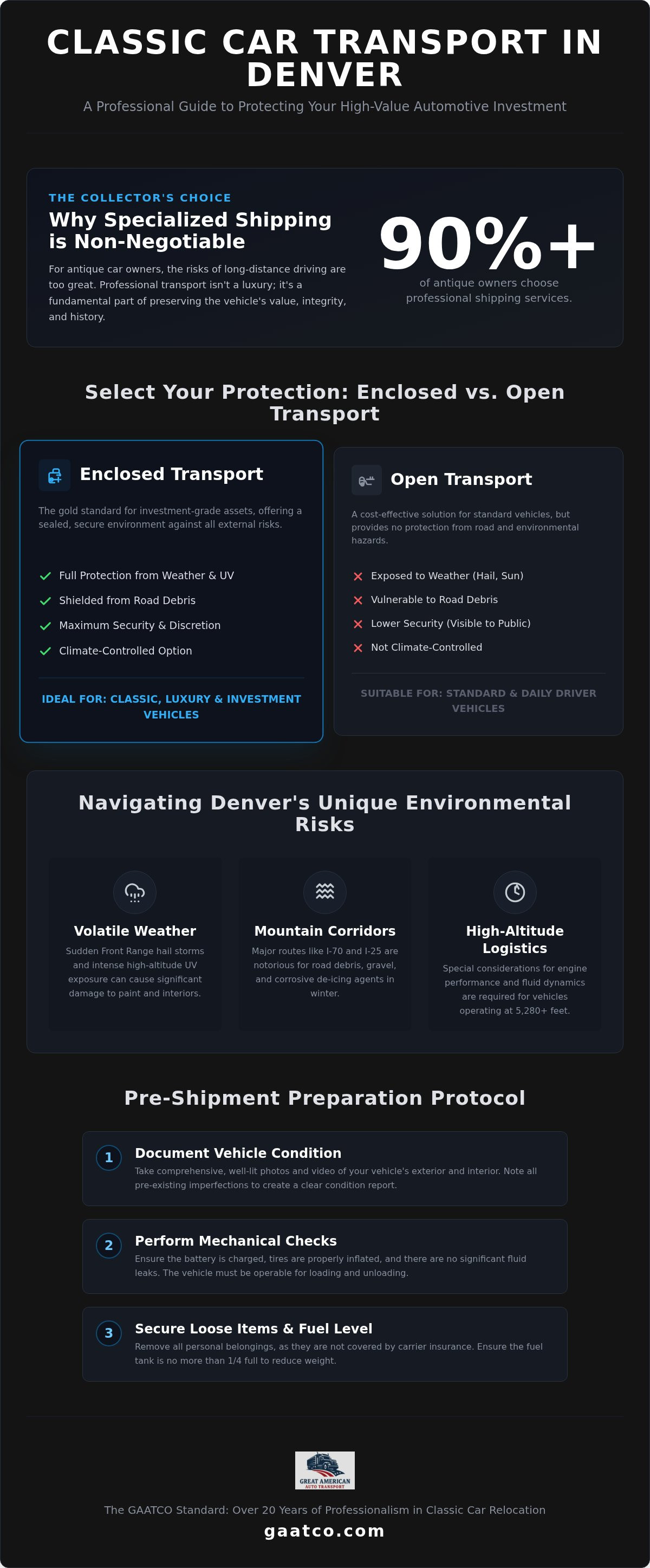
Over 90 percent of antique car owners choose professional shipping rather than driving their vehicles long distances. This choice underscores the high stakes of vintage automotive preservation. The high standards for classic car transport denver collectors require are born from the necessity of protecting assets against the volatile Rocky Mountain environment. A sudden afternoon hail storm or the debris of a steep mountain pass can transform a routine delivery into a significant financial and emotional liability.
You recognize that a high-value collector vehicle requires more than a standard logistics solution; it demands a partner who treats mechanical integrity and aesthetic perfection as non-negotiable pillars. This article explores the professional standards and logistical precision required to safely transport high-value vintage vehicles to or from the Mile High City. We provide a detailed overview of the specialized equipment, high insurance limits, and discreet communication channels that define premium auto shipping in 2026, ensuring your vehicle arrives in pristine condition regardless of the Colorado terrain.
Key Takeaways
- Identify the essential standards of white-glove service that prioritize vehicle preservation over delivery speed to protect your automotive investment.
- Compare the protection levels of enclosed versus open carriers to effectively shield your vintage assets from Colorado's unique road hazards and debris.
- Master the logistical nuances of classic car transport denver requires, specifically regarding high-altitude engine considerations and major transit corridors like I-70 and I-25.
- Implement a strategic preparation protocol, including condition documentation and mechanical checks, to facilitate a seamless door-to-door delivery process.
- Gain peace of mind by understanding the rigorous insurance requirements and specialized protocols that define professional transport for elite collectors.
Why Specialized Classic Car Transport is Essential for Denver Collectors
Preserving a vintage automobile requires a logistical strategy that transcends basic shipping. For the local collector community, classic car transport denver services represent a white-glove discipline where preservation is the primary objective rather than speed. The financial and emotional stakes are exceptionally high. A single error during the loading process can diminish a vehicle's provenance and market value. This specialized approach ensures that every vehicle is treated as a unique historical artifact rather than just another unit in a cargo manifest.
There's a fundamental distinction between high-volume auto hauling and professional vehicle relocation. Standard carriers prioritize capacity and rapid turnaround. In contrast, specialized relocation focuses on the meticulous security of the asset. As Denver's collector community expands, the need for local logistical expertise becomes critical. To appreciate the caliber of vehicles requiring such care, consider the heritage found in local collections.
To better understand the level of detail required for these historic assets, watch this helpful video:
The Value of Professional Expertise
Experience is the most critical component when handling non-standard vehicle dimensions. Pre-war classics or low-clearance sports cars don't fit the standard templates of commercial trailers. With over 20 years of industry experience, our team has developed specialized protocols to manage these unique requirements. We utilize licensed and insured carriers who understand the complexities of classic car valuations. A professional partner acts as a discreet advisor, ensuring that every detail of the classic car transport process is handled with a sense of quiet luxury and absolute precision.
Door-to-Door vs. Terminal Shipping
Terminal shipping is often unsuitable for delicate classic vehicles. These facilities are high-traffic environments where cars are moved frequently to accommodate other loads. Each touch increases the risk of mechanical or cosmetic damage. Door-to-door service provides a more controlled environment. This is particularly beneficial in Denver's residential neighborhoods, where narrow streets require precise navigation. By choosing a door-to-door solution for classic car transport denver, you minimize handling risks and ensure the vehicle remains on the same carrier from the initial pickup to the final delivery. Most collectors choose between open or enclosed carriers based on the specific needs of their vehicle, but the goal remains the same: a seamless, safe arrival at your private residence or gallery.
Enclosed vs. Open Transport: Selecting the Right Protection Level
Selecting the appropriate carrier method is the most critical decision a collector makes when arranging classic car transport denver services. While the industry provides two primary options, the choice between open and enclosed trailers depends entirely on the vehicle's valuation and the owner's tolerance for risk. Colorado's highways are notorious for road debris; gravel and magnesium chloride are common on the I-25 corridor. Open transport leaves a vehicle exposed to these physical hazards, which can lead to costly paint chips or glass damage before the car even reaches its destination.
Technical Advantages of Enclosed Carriers
Enclosed carriers represent the gold standard for investment-grade assets. These trailers provide a climate-controlled, sealed environment that shields the vehicle from Denver’s volatile weather patterns, including sudden summer hail storms and intense UV exposure at high altitudes. Beyond environmental protection, enclosed units offer a level of security that open trailers cannot match. Your vehicle remains hidden from prying eyes during overnight stops, maintaining the discretion required for high-value acquisitions. For owners of low-clearance vintage sports cars, we utilize hydraulic lift gates. This technology ensures the vehicle remains perfectly level during the loading process, eliminating the risk of undercarriage damage associated with traditional ramps.
When to Consider Open Transport
Open transport remains a viable and professional option for certain scenarios. If you are relocating a "driver-quality" classic or a vehicle currently undergoing restoration, the exposure to the elements may be a secondary concern compared to logistical efficiency. Even when utilizing open-air trailers, our team maintains rigorous safety standards. We employ specialized tie-down techniques that secure the vehicle by its tires rather than the chassis, preserving the suspension's integrity. It's also vital to review the insurance coverage limits between these service tiers, as enclosed transport typically carries higher liability caps to match the valuation of the cargo.
The return on investment for enclosed shipping is often realized in the absence of detailing or paint correction costs upon arrival. Preparing your classic car for transport by selecting the right protection level ensures that its condition remains exactly as it was when it left the showroom or gallery. Investing in the correct classic car transport denver solution provides the peace of mind that your asset is protected from the first mile to the last. If you are unsure which method suits your specific itinerary, you can request a customized quote to compare the technical specifications of each service.
Navigating Denver’s Logistics: Climate, Routes, and Seasonal Considerations
Successful classic car transport denver requires an intimate understanding of Colorado's unique geographical challenges. Logistics aren't just about the route; they're about the timing. We observe a significant shift in demand during the "Snowbird" seasons as collectors relocate assets between Denver and warmer climates. This seasonal migration typically peaks in late autumn and early spring, requiring advanced planning to secure a position on a specialized carrier during these high-volume windows.
Between May and August, the Front Range enters its peak hail season. For a high-value vintage asset, the risk of cosmetic damage from a sudden afternoon storm makes enclosed car transport a non-negotiable standard. While open trailers are efficient for standard daily drivers, they offer no defense against the rapid weather shifts characteristic of the region. Our logistical team prioritizes enclosed solutions during these months to maintain the pristine condition of your investment.
The I-70 Corridor and Mountain Logistics
The I-70 corridor serves as a primary artery but presents significant hurdles for heavy carriers. Navigating the steep grades of the Rocky Mountains requires drivers with specialized mountain training. From September 1st to May 31st, Colorado's chain law is strictly enforced for commercial vehicles over 16,000 pounds. We monitor these regulatory requirements and mountain pass closures in real-time to avoid delays. Experienced drivers manage these routes with a measured pace, ensuring that the mechanical stresses of high-altitude climbing don't compromise the safety of the vehicle.
Denver’s Microclimates and Vehicle Preservation
Denver's high altitude and low humidity can be harsh on vintage materials. When a vehicle transitions from a humid coastal region to the dry air of the Mile High City, wood dashboards and leather interiors often face risks from rapid desiccation. Enclosed trailers act as a climate-stabilized buffer during this transition. This controlled environment also helps manage temperature swings that affect fluid expansion in older engines. We suggest collectors review their vehicle's cooling system before arrival, as the pressure changes at 5,280 feet can reveal minor leaks that remained hidden at sea level. Our team acts as a bridge, handling these complex environmental realities so you don't have to.
Preparation Checklist: Readying Your Vintage Vehicle for Denver Shipping
Meticulous preparation is the foundation of a successful relocation. For those utilizing classic car transport denver, this phase ensures the asset remains protected during the physical transition. A detailed pre-shipment condition report serves as the definitive record of the vehicle's state. We recommend taking high-resolution photographs from multiple angles, focusing on the undercarriage and interior trim. If you're shipping an inoperable vehicle transport, please notify our logistics team in advance. These units require specialized winching equipment to navigate the loading ramps safely without compromising the chassis.
Remove all personal belongings and loose aftermarket parts before the carrier arrives. Items left inside the cabin can shift during transit through steep mountain passes, potentially damaging delicate upholstery. Additionally, ensure that convertible tops are securely latched and any specialized covers are properly fastened. This proactive approach minimizes the number of variables our team must manage during the journey.
Mechanical and Fluid Inspections
Older engines are prone to minor leaks that can become problematic on a multi-car carrier. Inspect the vehicle for any active fluid drips. Fluids from an upper-deck car can damage the finish of a vehicle positioned below. Setting tire pressure to the manufacturer’s specification provides the necessary cushion for the journey. Secure the battery to prevent movement and ensure the terminals are insulated. The industry standard for fuel is a 1/4 tank. This level provides enough weight for stability while minimizing the total load for safety and regulatory compliance.
Documentation and Keys
Organize your title, registration, and insurance documents so they're readily accessible for the carrier's inspection. Vintage ignitions often have specific starting sequences that may be unfamiliar to modern drivers. We suggest providing a brief, written set of instructions for temperamental starters or manual chokes. This small detail prevents unnecessary wear on the battery during the loading and unloading process. The final step involves the formal handover of keys and the signing of the Bill of Lading. This document is your primary protection and should be reviewed with meticulous attention to detail.
If your vehicle is ready for its journey, request a quote from our specialists today to begin the logistical planning for your classic car transport denver itinerary.
The GAATCO Standard: Professionalism in Denver Classic Car Relocation
GAATCO stands as the definitive partner for collectors who prioritize the security of their automotive heritage over the convenience of a mass-market broker. Our 20-year legacy in the industry allows us to navigate the complexities of classic car transport denver with a sense of quiet luxury and operational precision. We don't merely move vehicles; we manage high-value assets through a meticulously controlled professional environment. This commitment to excellence ensures that every relocation is handled by a unified team of specialists dedicated to maintaining the integrity of your collection.
Our role as a discreet and dependable partner is built on a foundation of reliability and safety. We provide a reassuring experience for affluent and corporate audiences by ensuring that technical details regarding logistics are clear and accessible. By positioning ourselves as a bridge between your needs and complex operational realities, we allow you to focus on the expansion of your collection while we handle the high-stakes details of specialized transport.
Customized Logistics for Every Client
We recognize that every acquisition has a unique set of requirements. Whether you are an individual owner, a representative for a high-end dealership, or a participant in a national auction, our logistics plans are entirely bespoke. We utilize specialized handling protocols that go beyond standard industry practices to preserve the mechanical and cosmetic state of each vehicle. Our communication rhythm is steady and formal, providing you with a discreet and dependable advisory experience from the initial consultation to the final delivery. By choosing a partner that understands the nuances of high-end service, you eliminate the stress often associated with complex transport itineraries.
Securing Your Denver Transport Quote
Accuracy is the cornerstone of our transparent pricing model. To receive a precise and professional quote, we request detailed specifications regarding your vehicle’s dimensions, current mechanical status, and any specific handling requirements. In the 2026 market, several factors influence premium transport fees, including the move toward digitalized commercial permitting in Colorado and the ongoing demand for climate-stabilized enclosed carriers. We provide a clear, hierarchical breakdown of these operational realities so you can make an informed decision without the pressure of aggressive marketing tactics.
Our reputation as a trusted advisor is built on a commitment to core operational values as non-negotiable pillars. We invite you to experience a relocation process where every detail is managed with meticulous attention to detail. When you are ready to secure your vehicle’s journey, request your customized Denver classic car transport quote to begin a partnership defined by stability and long-term expertise.
Securing Your Automotive Legacy in the Mile High City
Protecting a vintage asset during relocation requires more than just a carrier; it demands a strategic partnership built on over 20 years of specialized auto transport expertise. By prioritizing enclosed shipping and meticulous mechanical preparation, you effectively shield your investment from Colorado's volatile microclimates and steep mountain corridors. The professional standard for classic car transport denver collectors expect is one of logistical precision and absolute discretion.
Our team remains dedicated to door-to-door logistical excellence, utilizing fully licensed and insured carriers to manage every phase of the journey. This authoritative approach ensures that your vehicle's condition and provenance remain uncompromised from the initial pickup to the final delivery. We handle the complex operational realities of the Rocky Mountain region so you don't have to worry about the nuances of high-altitude transport or seasonal weather shifts. Our quiet confidence comes from decades of handling high-stakes logistics for the most discerning collectors.
Secure Your Professional Denver Car Shipping Quote Today to begin your vehicle's next chapter with confidence. We look forward to providing the white-glove service your collection deserves.
Frequently Asked Questions
Is enclosed car transport worth the extra cost for a classic car in Denver?
Enclosed transport is the gold standard for preservation because it offers a total barrier against external hazards. Beyond road debris, these carriers provide a climate-stabilized environment that prevents the rapid desiccation of vintage leather and wood common in high-altitude Denver air. For investment-grade assets, the avoidance of paint correction or intensive detailing costs upon arrival justifies the premium service fee. This level of protection is essential for maintaining the vehicle's long-term provenance.
How much insurance coverage does GAATCO provide for high-value classic vehicles?
We utilize licensed and insured carriers who maintain comprehensive liability and cargo insurance specifically tailored for high-value assets. While standard limits vary by carrier, our specialized protocols ensure that every classic vehicle is matched with a policy that reflects its current market valuation. We encourage clients to review the specific policy limits during the quoting process to ensure complete peace of mind for their unique collection throughout the entire relocation process.
Can you transport a classic car that does not currently run (inoperable)?
We offer specialized inoperable vehicle transport for units that cannot move under their own power. These relocations require specific equipment, such as winches or hydraulic lift gates, to load the vehicle without causing mechanical stress to the chassis. It's essential to notify our team of the vehicle's condition in advance so we can dispatch a carrier equipped with the necessary tools for a safe loading process in the Denver area.
How does Denver’s weather affect the car shipping timeline?
Colorado's climate, particularly during the winter months and the summer hail season, can influence logistical schedules. Heavy snowfall in the Rocky Mountains often leads to temporary closures of the I-70 corridor, which may delay arrival windows. We monitor real-time weather patterns and CDOT reports to adjust routes accordingly. Our primary objective is the safe delivery of your asset, even if it requires a measured pause during severe weather events to ensure safety.
What is the typical delivery window for shipping a car from the East Coast to Denver?
A transit from major East Coast hubs like New York or Boston to Denver typically spans seven to ten days. This window accounts for the distance and the necessary rest periods required for professional drivers under federal safety regulations. We prioritize a steady and measured pace to ensure the vehicle remains secure. Factors such as route complexity and current seasonal demand can influence the final delivery date within this projected timeframe for your shipment.
Do I need to be present for the pickup and delivery of my classic car?
Either the owner or a designated representative must be present at both the origin and destination points. This presence is required to perform the joint inspection and sign the Bill of Lading, which serves as the definitive record of the vehicle's condition. If you can't be present, a trusted agent can handle the documentation. This protocol ensures a transparent and professional handover for every classic car transport denver itinerary we manage for our clients.
How do you secure a vintage vehicle inside an enclosed trailer?
We employ a "soft-tie" methodology that secures the vehicle by its wheels rather than the chassis. This technique prevents unnecessary tension on the vintage suspension components during transit. By utilizing high-strength nylon straps, we ensure the car remains stationary within the trailer without risking cosmetic damage to the frame or undercarriage. This approach is a non-negotiable pillar of our specialized handling protocols for elite automotive collections and high-value acquisitions.
What should I do if my classic car has a low ground clearance?
Vehicles with minimal ground clearance require an enclosed carrier equipped with a hydraulic lift gate. This technology allows the car to remain perfectly horizontal while being raised into the trailer, eliminating the steep angles associated with traditional ramps. When requesting your quote, please provide the specific clearance measurements. This detail allows our team to assign the appropriate specialized equipment to prevent any contact between the undercarriage and the loading surface during the transport process.


