

Is a multi-day solo road trip across state lines truly the rite of passage your student needs, or is it an unnecessary risk to their safety and your collective peace of mind? You've dedicated years to preparing them for this academic milestone, yet the logistics of college car shipping often introduce a layer of stress that overshadows the celebration. It's understandable to feel concerned about managing tight move-in windows or the intricacies of carrier insurance while your student prepares for their first semester.
This guide serves as your definitive resource for vehicle relocation in 2026. You'll learn how to orchestrate a safe, efficient, and sophisticated transport plan that aligns perfectly with university schedules. We'll examine the nuances of door-to-door coordination, from verifying carrier licensing to managing campus navigation limits. By the end of this article, you'll have a clear, predictable timeline that allows your family to focus on the student's transition while seasoned professionals handle the complex operational realities of the journey.
Key Takeaways
- Balance the safety benefits of professional relocation against the physical risks and hidden depreciation associated with long-distance student driving.
- Align your choice of open or enclosed trailers with the specific requirements of your student's vehicle to ensure a secure college car shipping experience.
- Orchestrate a seamless arrival by coordinating with university staging zones that accommodate the physical limitations of large transport carriers.
- Execute essential vehicle preparation steps, such as maintaining precise fuel levels, to facilitate a rigorous and professional inspection process.
- Secure your peace of mind by verifying that all transit partners maintain active operating authority and comprehensive cargo insurance.
Why College Car Shipping Outperforms Long-Distance Driving for Students
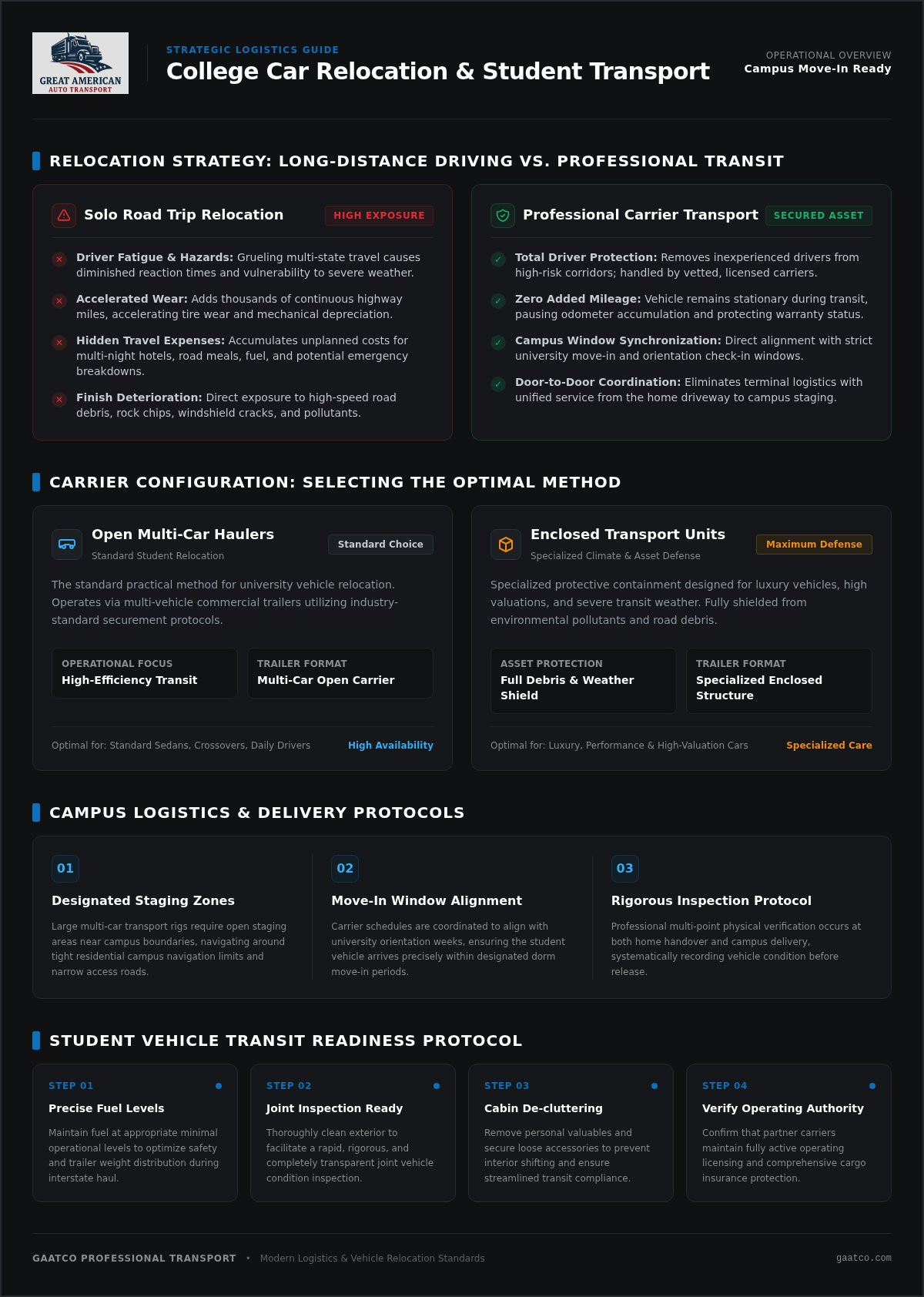
The transition to university life represents a significant milestone that requires meticulous planning and emotional focus. While some families consider driving the vehicle to campus a rite of passage, the logistical reality often involves unnecessary risks and hidden burdens. Professional college car shipping offers a sophisticated alternative that prioritizes safety and preserves the integrity of the vehicle. Beyond the obvious fuel requirements, long-distance driving necessitates expenditures for hotels, meals, and emergency maintenance. These costs, combined with the immediate depreciation caused by adding thousands of miles to the odometer, often outweigh the perceived simplicity of a road trip.
Choosing professional relocation allows families to remain focused on the student's needs during a hectic move-in schedule. Instead of managing complex two-way travel logistics or recovering from highway fatigue, parents can enjoy a seamless transition. A dedicated partner handles the operational complexities, providing a calm and reliable service that ensures the vehicle arrives precisely when needed. This level of coordination is especially valuable when navigating the high-stakes environment of elite university admissions and orientation weeks.
Eliminating Highway Hazards and Driver Fatigue
Young drivers, despite their best intentions, often lack the seasoned experience required to navigate grueling multi-state corridors. Grueling hours behind the wheel lead to diminished reaction times and increased vulnerability to unpredictable weather patterns or road hazards. By entrusting the journey to a professional carrier, you eliminate these variables. Licensed and vetted drivers operate with a level of precision that novice drivers cannot replicate. This professional oversight shields the student from the stress of potential mechanical breakdowns in remote areas, ensuring their focus remains on their upcoming academic responsibilities.
Preserving Vehicle Reliability and Minimizing Mileage
Interstate travel places immense strain on a vehicle's mechanical components. Thousands of miles of continuous highway speeds accelerate tire degradation and engine wear, which can jeopardize manufacturer warranties. Utilizing professional open or enclosed carriers keeps the vehicle stationary during transit, effectively pausing the clock on its mechanical lifespan. This method protects the paint finish and windshield from the abrasive effects of road debris and environmental pollutants. Maintaining low mileage is a critical factor in retaining the vehicle's resale valuation, making shipping a prudent financial decision for the long term. You can request a quote to see how customized scheduling fits your specific relocation needs.
Direct door-to-door transport further simplifies the process by removing the need for secondary transportation to and from shipping terminals. This elite level of service ensures a unified experience from the driveway at home to the designated staging area near campus. It's a discreet and dependable solution for families who value efficiency and uncompromising safety standards.
Selecting the Right Transport Method: Open vs. Enclosed Carriers
Choosing the appropriate method for college car shipping requires a sophisticated balance between logistical efficiency and the specific requirements of the vehicle. Families must consider the environmental conditions of the destination campus, the vehicle's valuation, and the desired level of protection during transit. While the industry offers various configurations, the primary decision rests between open multi-car trailers and specialized enclosed units. Each format provides distinct advantages in terms of security, exposure, and transit speed, allowing for a customized approach to student relocation.
It's essential to verify that your chosen carrier adheres to rigorous handling standards. Professional logistics providers maintain strict protocols for vehicle securement and inspection, ensuring that every asset is treated with the respect it deserves. For those seeking a tailored solution that aligns with specific academic timelines, exploring GAATCO professional transport services provides the necessary expertise to manage these complex operational realities.
Open Car Transport: The Practical Standard for Campus Relocation
Multi-car open haulers represent the industry standard for vehicle relocation, accounting for approximately 90 to 95 percent of all shipments in the United States. This method is the most efficient and cost-effective option for everyday campus sedans and compact SUVs. Professional haulers utilize strategic protective placement on the trailer to safeguard vehicles from the most common road hazards. While the vehicle remains exposed to the elements, this mirrors the conditions of standard highway driving. The critical distinction is that the vehicle reaches its destination without the associated engine runtime, mechanical wear, or tire degradation inherent in a solo road trip.
Enclosed Carrier Transport: Specialized Protection for High-Value Vehicles
For families transporting high-end sports cars, restored classics, or vehicles with significant sentimental value, enclosed trailers provide an elite level of security. These specialized units shield the vehicle from severe weather, road salt, and ambient airborne industrial fallout. Beyond environmental protection, enclosed carriers often utilize hydraulic lift gates. This engineering feature allows for a completely level loading process, which is vital for preventing undercarriage scraping on vehicles with lowered suspension platforms. Furthermore, these carriers often operate under higher insurance coverage ceilings, providing an additional layer of reassurance for luxury investments.
Regardless of the trailer type, all reputable carriers must comply with federal vehicle shipping regulations regarding consumer protections and cargo insurance requirements. Understanding these standards helps families make informed decisions about the safety of their student's primary mode of transportation. By selecting the method that best aligns with the vehicle's age and the campus location, you ensure a predictable and secure arrival for the start of the semester.
Navigating Campus Logistics: Move-In Windows and Delivery Protocols
Successful college car shipping requires more than just highway transit; it demands a sophisticated understanding of the destination's physical environment. University campuses are historically designed for pedestrian flow and light passenger vehicles rather than the expansive dimensions of commercial logistics equipment. Orchestrating a seamless arrival involves identifying potential hurdles long before the carrier reaches the campus perimeter. This proactive approach ensures that the vehicle relocation remains a discreet and stress-free component of the broader move-in experience.
Understanding Campus Access Restrictions and Truck Dimensions
Standard auto carriers, which can extend up to 80 feet in length, face significant physical limitations within university grounds. Narrow dormitory access roads, sharp turning radii, and low-hanging tree limbs often make direct door-to-door delivery to a residence hall impossible. Furthermore, many municipalities enforce strict weight limit ordinances on campus-adjacent streets during peak move-in weekends. To maintain operational flow, we coordinate delivery at designated staging zones. These locations, such as university stadium parking lots or nearby commercial shopping centers, provide the necessary clearance for a safe and unhurried handover. Direct communication between the student and the driver is vital to manage real-time ETA adjustments as traffic patterns shift during arrival windows.
- Identify staging areas within a five-minute radius of the primary move-in zone.
- Consult university parking services for commercial vehicle permits or designated unloading areas.
- Ensure the student is available to receive calls from the driver at least two hours prior to the scheduled arrival.
Coordinating with Academic Calendars and Orientation Windows
The late-summer period represents a peak season for the transport industry, characterized by high demand and terminal congestion. To secure a predictable timeline for an August move-in, we recommend initiating the booking process in late June or early July. This lead time allows for meticulous scheduling that aligns with specific orientation dates. It is prudent to include a three-day contingency buffer to account for unpredictable summer weather or interstate traffic delays. This ensures the vehicle is ready for the student's first day of classes without the stress of a missed arrival date.
A designated adult or the student must be present during the delivery to perform a comprehensive physical inspection. This final step is a non-negotiable pillar of professional transport, as it confirms the vehicle's condition against the original bill of lading. By aligning these logistical steps with the academic calendar, families can focus on the student's transition while our team of professionals handles the complex operational realities of the move. For those requiring precise coordination with university schedules, our customized relocation services provide the necessary expertise to navigate these high-stakes transitions.
How to Prepare a Student Vehicle for Transport: A Practical Checklist
Preparation is the foundation of a successful vehicle relocation. A clean exterior is not a matter of aesthetics; it's a technical requirement for a precise pre-shipment inspection. When the vehicle is free of road grime, all pre-existing blemishes are clearly visible to both the owner and the carrier. Fuel levels should be maintained strictly between one-eighth and one-quarter of a tank. This range provides sufficient fuel for loading and unloading while minimizing unnecessary weight and adhering to safety protocols. Finally, ensure all toll tags, transponders, and parking passes are removed. Automated highway billing systems can trigger charges even when the vehicle is on a trailer, leading to unwanted administrative burdens.
Managing Personal Belongings and Dorm Essentials Inside the Car
Department of Transportation regulations strictly prohibit auto carriers from functioning as household goods movers. However, families often wish to utilize the vehicle's storage capacity for dorm essentials. You may pack a limited amount of soft goods, such as bedding or clothing, provided they remain in the trunk and below the window line. This prevents obstruction of the driver's view and maintains the carrier's center of gravity. Electronics, expensive textbooks, and irreplaceable personal documents must never remain in the vehicle. These items are not covered by carrier cargo insurance and should travel with the passenger to ensure their security.
- Secure soft goods strictly in the trunk area to maintain visibility.
- Keep all items below the window line to comply with safety standards.
- Remove all high-value electronics and academic materials before loading.
Documenting Vehicle Condition on the Bill of Lading
Meticulous documentation is your primary safeguard during the college car shipping process. Before the carrier arrives, take high-resolution, time-stamped photographs of the wheels, bumpers, rooflines, and glass. These images provide an objective record of the vehicle's condition. Upon the driver's arrival, conduct a thorough joint inspection to record any findings on the Bill of Lading. This document serves as the official legal record of the vehicle's state at the point of origin. When the vehicle reaches the campus staging area, the student must perform a reciprocal inspection before countersigning the destination condition report. If you are ready to begin this process, you can schedule your professional vehicle relocation with our team of logistics experts.
This disciplined approach to documentation ensures that every detail is accounted for, providing peace of mind for both parents and students. By following these practical steps, you ensure the vehicle is prepared for a safe and efficient journey, allowing the family to focus on the student's academic transition.
Booking Seamless Student Transport: Your Next Operational Steps
The final phase of orchestrating a student's vehicle relocation requires the same level of meticulous attention as the initial planning. Transitioning from preparation to booking involves gathering essential documentation, including the vehicle's current registration and the designated contact information for both the origin and destination. Establishing clear communication lines between the parent, the student recipient, and the logistics coordinator is vital to ensure every party remains informed of the vehicle's progress. By choosing trusted auto shipping specialists, you ensure that these complex operational realities are handled by seasoned experts who understand the high-stakes nature of academic transitions.
Vetting Your Auto Logistics Partner for Integrity
Integrity in the transport industry is defined by transparency and rigorous adherence to safety standards. Before finalizing your booking, it's essential to verify the carrier's safety ratings and FMCSA licensing credentials. A reputable partner will maintain active motor carrier authority and provide proof of comprehensive cargo insurance that protects your investment from the moment of loading through final delivery. This vetting process differentiates experienced transport coordinators from low-cost lead aggregators. These aggregators often lack dedicated customer support and may re-broker shipments to unverified parties, compromising the safety and predictability of your college car shipping experience. We prioritize a unified team approach, ensuring that every carrier in our network meets our non-negotiable pillars of reliability.
Securing Your Move-In Schedule with Confidence
Timing is a critical variable when navigating the surge of a new semester. To secure your preferred transit window during peak move-in periods, you should select your transport timeline well in advance. Late-summer demand can impact carrier availability, so early commitment is a prudent strategy. It's also wise to designate a local emergency contact authorized to accept the vehicle handoff. This contingency plan is invaluable if a student's orientation schedule or class conflict prevents them from being present at the staging area. A trusted advisor manages these nuances so the family doesn't have to, providing a discreet and dependable service that aligns with the student's needs.
Securing a clear logistical assessment is the first step toward a stress-free relocation. When you request an auto transport quote, you gain access to a tailored plan that accounts for geographic advantages and specific university protocols. This professional oversight ensures that the vehicle arrives safely and efficiently, allowing the student to focus entirely on their academic journey. Our commitment to customized outcomes and operational excellence provides the quiet luxury of peace of mind during a significant family transition.
Orchestrating a Seamless Transition to University Life
Securing a student's vehicle for the upcoming semester doesn't have to be a source of parental anxiety. By prioritizing professional college car shipping, you eliminate the physical risks of long-distance highway travel and preserve the mechanical integrity of the asset. A successful relocation hinges on two critical pillars: selecting the appropriate carrier method and coordinating precisely with university-specific move-in protocols. These steps ensure the vehicle is ready for use without the hidden costs of depreciation or the stress of highway fatigue.
With over two decades of dependable vehicle transport coordination nationwide, GAATCO acts as a discreet and dedicated partner in this high-stakes transition. We utilize only licensed, vetted, and comprehensively insured motor carriers to maintain the highest safety standards. Our door-to-door coordination is specifically designed to accommodate the complexities of academic calendars and campus access restrictions. You can request a personalized college car shipping quote to secure your student's delivery schedule with our team of logistics experts. We look forward to facilitating a predictable and elegant arrival for your student's next chapter.
Frequently Asked Questions
Can a college student pack dorm essentials or personal items inside the vehicle during transport?
Students may pack a limited volume of soft dorm essentials, such as linens or clothing, provided these items remain secured in the trunk and below the window line. Department of Transportation regulations prohibit carriers from operating as household goods movers, so weight must remain minimal. High-value assets like laptops, expensive textbooks, or irreplaceable documents should never remain in the vehicle. These items aren't covered by cargo insurance and are best transported personally by the student.
Can an auto carrier drop off a vehicle directly at a college dormitory?
Direct delivery to a dormitory doorstep is rarely feasible due to the expansive dimensions of modern multi-car trailers. In congested academic hubs like Boston or Chicago, narrow residential streets and low-hanging trees prevent access for 80 foot carriers. Instead, we coordinate handovers at designated staging zones, such as university stadium lots or perimeter shopping centers. This approach maintains safety and ensures a professional inspection occurs in a controlled, spacious environment.
How far in advance should we schedule college car shipping before the semester begins?
For the fall semester, we recommend initiating your college car shipping arrangements in late June or early July. This lead time is essential to secure preferred transit windows during the peak summer rush, when demand for professional carriers is highest. For the spring semester, booking two weeks in advance is typically sufficient. Providing a three day contingency buffer helps account for interstate traffic or summer storms that may impact schedules in markets like Atlanta or Austin.
What should a student do if the vehicle delivery is delayed past their orientation date?
If a delivery window shifts beyond the orientation date, the student should immediately notify their logistics coordinator. Professional dispatchers in metropolitan areas like Denver or Nashville maintain constant contact with drivers to provide precise ETA adjustments. If the student is unavailable due to academic commitments, a pre-authorized emergency contact can facilitate the handoff. This ensures the vehicle relocation remains a discreet and reliable process that doesn't disrupt the student's first days of classes.
Does the student need to be present at delivery, or can another party accept the car?
The student does not strictly need to be present, provided a designated adult is authorized to act on their behalf. This representative must be available to conduct a rigorous physical inspection alongside the driver and sign the Bill of Lading. Whether the delivery occurs in Seattle or Miami, this documentation is the final legal record of the vehicle's condition. Establishing this contact early allows for seamless door to door coordination regardless of the student's orientation schedule.
How does vehicle transit insurance work during professional auto shipping?
All licensed auto transport carriers are legally required to maintain comprehensive cargo insurance, which protects your vehicle against transit damage. This coverage remains active from the moment the vehicle is loaded until it is released at the destination. It is important to remember that this insurance specifically covers the vehicle itself, not any personal belongings left inside. Families should verify the carrier's active operating authority to ensure their investment is fully protected during the journey.
Is an open carrier safe enough for a student's everyday commuter car?
Open car transport is the reliable industry standard for everyday student sedans and compact SUVs, accounting for approximately 95 percent of all shipments. While the vehicle is exposed to the elements, this mirrors the conditions of standard highway driving without adding thousands of miles of mechanical wear. For students attending universities in regions with predictable weather, such as Phoenix or Dallas, this method offers a sophisticated and efficient solution for long distance vehicle relocation.


