
A polished website and an unusually low quote are not proof that a transporter is trustworthy. Reputable car shipping companies earn confidence through details you can verify: clear licensing and insurance information, honest explanations of whether they act as a broker or carrier, and written terms that explain who will handle your vehicle. Those checks matter when you’re entrusting someone with a valuable car.
It’s reasonable to worry about damage, unexpected charges, or silence while your vehicle is in transit. A professional shipping partner should be prepared to explain the inspection and bill of lading process, clarify what the quoted price includes, and set expectations for communication before transport begins. If a company avoids straightforward questions or won’t identify the carrier, take that seriously.
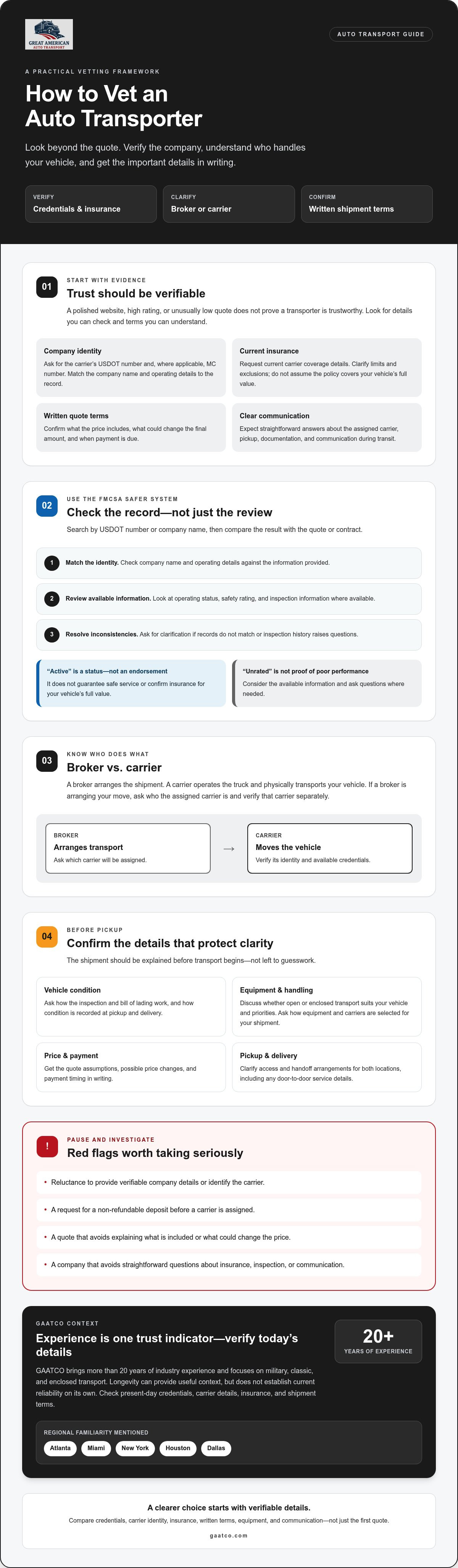
This guide outlines practical criteria for assessing auto transporters, from checking credentials through the FMCSA’s SAFER database to reviewing insurance documentation, quote terms, and customer communication. You’ll also learn how to distinguish a broker’s role from the carrier’s and what to confirm before pickup, so you can make an informed choice and approach delivery with greater confidence.
Key Takeaways
- Reputable car shipping companies make their role, credentials, insurance information, and terms clear before you book. Use those details to assess whether a transporter prioritizes vehicle care and transparent communication.
- Check the company’s USDOT and MC numbers through the FMCSA’s SAFER system, then review the available safety information before making a decision.
- Understand whether you’re speaking with a broker or a carrier, and ask who will physically transport your vehicle and how that carrier is vetted.
- Treat requests for a non-refundable deposit before a carrier is assigned, or reluctance to provide verifiable company details, as reasons to pause and investigate.
- Learn how GAATCO’s 20-plus years of experience and focus on military, classic, and enclosed transport may inform your choice of shipping partner.
What Defines a Reputable Car Shipping Company in 2026?
Reputation in auto transport should be supported by evidence, not just polished marketing or a high rating. Look for a company that communicates clearly, explains whether it arranges transport or operates the truck, and can provide verifiable registration and insurance details for the carrier handling your vehicle. The FMCSA’s SAFER system is one place to review company identification and available safety information. It is a useful screening step, not a substitute for reading the terms of your shipment.
There is also a practical difference between a business focused mainly on moving volume and one that takes time to understand the vehicle, route, and handling needs. A classic car, for example, may call for a different transport arrangement than a standard daily driver. Ask how the company selects equipment and carriers for your specific shipment, and how it records the vehicle’s condition at pickup and delivery.
The Core Pillars of Professional Auto Logistics
Experience can provide useful context. A company with a long operating history has had time to develop logistics knowledge and customer processes, although longevity alone cannot establish current reliability or financial stability. GAATCO brings more than 20 years of industry experience, alongside regional familiarity in major U.S. hubs including Atlanta, Miami, New York, Houston, and Dallas. Treat that history as one trust indicator, then verify present-day credentials and shipment terms.
Equipment matters, too. Before booking, confirm whether an open or enclosed car carrier suits your vehicle and transport priorities. Reputable car shipping companies should be able to explain the practical differences and discuss options such as enclosed transport for vehicles requiring added protection. Door-to-door service can also simplify handoff, but clarify access, pickup, and delivery arrangements for your locations.
Why “Cheap” Often Costs More in the Long Run
An unusually low estimate can be an invitation to ask more questions, not a reason to book immediately. A quote may change if its assumptions are unclear or the carrier has not yet been assigned. Before committing, request written terms that specify what is included, what could affect the final amount, and when payment is due. Avoid non-traceable payment requests and be cautious if a company will not identify the carrier.
Insurance deserves the same scrutiny. Ask for current carrier coverage details and clarify its limits and exclusions; do not assume a policy covers the vehicle’s full value. A transparent written quote may not be the lowest, but it gives you a clearer basis for comparing service, carrier credentials, equipment, and communication. That clarity is more useful than a low initial figure that leaves important details unresolved.
The Professional Verification Checklist: Vetting Your Carrier
Reviews can describe a customer’s experience, but they cannot confirm a transporter’s current operating status or insurance. Before booking, ask for the carrier’s USDOT number and, where applicable, MC number. Search the identifiers in the FMCSA’s SAFER system and make sure the company name and operating details match the information you were given. If a broker is arranging the shipment, request the identity of the assigned carrier and verify that carrier separately.
Mastering the FMCSA SAFER Database
Start at the FMCSA SAFER Company Snapshot page, search by USDOT number or company name, and compare the resulting record with your quote or contract. Review the carrier’s identity, operating status, safety rating, and inspection information where available. “Active” indicates an operating status in the record; it is not an endorsement, a guarantee of safe service, or confirmation that your vehicle is insured for its full value. An “Unrated” safety status is also not, by itself, proof of poor performance. Ask for clarification if records appear inconsistent or inspection history raises questions.
Confirm the company’s physical business address and contact details, then note how its logistics coordinators respond to specific questions. Clear, timely answers about the assigned carrier, pickup process, and documentation are useful signs of professional communication. FMCSA’s consumer guide to rights and responsibilities addresses household moves, so use it for that context rather than as a vehicle-shipping rulebook.
Insurance Coverage: Beyond the Basics
Liability coverage and cargo coverage serve different purposes. Ask what the carrier’s liability policy covers and request current cargo-insurance documentation that specifies limits, exclusions, and the claims process. Then compare the cargo limit with your vehicle’s value and ask whether the policy applies to your transport arrangement. A certificate is a starting point, not a complete explanation of coverage.
For enclosed transport or a high-value classic vehicle, verify that the carrier’s cargo coverage is appropriate for the vehicle and obtain confirmation that the policy is currently in force. If anything is unclear, ask the insurer or agent to confirm the policy details, rather than relying solely on a verbal assurance. Reputable car shipping companies should be willing to help you identify the carrier and understand which documentation to review.
Use this checklist before signing: match the company’s identifiers, review the SAFER record, confirm the address and assigned carrier, and verify current insurance in writing. GAATCO states that it works with licensed and insured carriers; you can review its auto transport services as you assess the details of a potential shipment.
Broker vs. Carrier: Understanding the Industry Infrastructure
A broker and a carrier perform different roles. The broker arranges the shipment, coordinates logistics, and connects the customer with a suitable transporter. The carrier supplies the truck and trailer and physically moves the vehicle. Clarifying those roles before you book helps you understand who is responsible for each part of the process, from scheduling to the condition report at pickup and delivery.
A logistics partner can add value by matching a shipment with an available carrier, route, and transport method that fit the vehicle and delivery needs. A broad network alone does not ensure attentive service. Ask how carriers are selected, what information will be shared once a carrier is assigned, and who you should contact for updates. Forbes offers a useful guide to shipping a car that covers transport options and the broader booking process.
The Logistics Manager Advantage
An experienced broker can assess route options and coordinate with carriers familiar with the relevant lanes. That can be especially useful when a vehicle needs a particular arrangement, such as enclosed transport for a classic car. GAATCO arranges open and enclosed car transport and specialized military and classic car shipping, using licensed and insured carriers. The broker coordinates the shipment; the assigned carrier remains responsible for physically transporting the vehicle.
If damage is reported, document it on the bill of lading and contact the carrier and its insurer according to the claims process. A broker may help direct communication and clarify what documentation to provide, but it does not replace the carrier’s insurance policy or determine whether a claim is covered. Confirm the process and relevant contacts before pickup, not after a concern arises.
Ensuring Accountability in a Multi-Party System
Clear accountability depends on knowing who will answer your questions throughout the shipment. Before booking, ask whether you will have a consistent logistics contact, how updates will be provided, and how the company handles changes to pickup or delivery coordination. Reputable car shipping companies should explain where their responsibility ends and the carrier’s begins, without leaving you to untangle the arrangements alone.
Regional knowledge can also support more informed coordination. GAATCO serves major U.S. hubs including Houston and Miami, among others. Familiarity with these markets may help a logistics team discuss route and scheduling considerations with greater context, though it cannot guarantee a particular pickup date or transit time. For a clearer view of GAATCO’s role in arranging transport, review its auto transport services and ask how carrier selection and shipment communication will work for your route.
Avoiding Scams and Identifying Red Flags
Protect yourself by checking whether a company’s claims remain consistent from the first conversation through the written agreement. A polished website or persuasive quote is not enough. Before paying a deposit, confirm who is arranging the shipment, whether a carrier has been assigned, and what the payment terms say. A request for a non-refundable deposit before carrier assignment deserves careful scrutiny, especially if the company cannot explain the refund policy or accept a traceable payment method.
Watch for signs of a “phantom” company: a business that presents another carrier’s DOT number as its own, gives inconsistent company details, or cannot be reached through independently verified contact information. Compare the legal business name, address, and phone number with the relevant FMCSA record. If the details do not match, pause and ask for an explanation before sharing payment or vehicle information.
The “Bait-and-Switch” Pricing Trap
An exceptionally low quote may leave out important terms or fail to reflect what it will take to arrange the shipment. If the price rises on pickup day, you may feel pressured to accept rather than delay transport. Request a written agreement that identifies the quoted amount, payment schedule, included services, and any circumstances that could change the total. Ask for revised terms in writing before agreeing to additional charges.
Do not compare estimates by headline figure alone. Compare what each company has confirmed about the carrier, transport method, pickup and delivery arrangements, and possible fees. Reputable car shipping companies should be able to explain the quote without pressuring you to decide immediately.
Communication Red Flags
Professional communication is specific and consistent. A generic email address or automated reply is not proof of fraud, but unanswered questions, conflicting explanations, or an inability to reach a knowledgeable coordinator should give you pause. Before booking, ask how you will receive status updates and whom to contact if plans change. A promise of tracking should come with a clear explanation of what information is actually available.
Finally, review the bill of lading at pickup and delivery. This document records the vehicle’s condition, so inspect the car with the driver and ensure existing marks or new damage are accurately noted before signing. Keep a copy with your shipment documents. If you want to assess a transport provider using these standards, review GAATCO’s auto transport services and confirm the details of your shipment before booking.
Why Discerning Clients Choose GAATCO for National Transport
For more than 20 years, GAATCO has worked in the American auto transport market, arranging vehicle shipments with attention to the route, transport method, and type of vehicle involved. That experience is useful context when comparing reputable car shipping companies, but it should sit alongside practical questions about the assigned carrier, insurance documentation, communication, and written terms. GAATCO works with licensed and insured carriers and specializes in open and enclosed car transport, as well as military and classic car shipping.
The service approach is measured rather than overstated: understand the shipment, explain the available transport options, and coordinate the logistics with care. For clients moving a daily-use vehicle, a classic car, or a military vehicle, the right arrangement depends on the vehicle and transport requirements. Ask what is included and have the details confirmed in writing before booking.
Regional Expertise in Major U.S. Metros
National transport still depends on local details. Pickup access, traffic, and suitable meeting locations can affect coordination in a major city. GAATCO serves hubs including Atlanta, Miami, New York, Houston, and Dallas. Its familiarity with these markets provides useful regional context when discussing door-to-door vehicle shipping, while specific pickup arrangements and timing should always be confirmed for the addresses involved.
This regional focus is distinct from making unsupported claims about service in every U.S. city. If your route begins or ends outside the listed hubs, ask whether the company can arrange transport for those locations and how the carrier handoff will be managed.
Transport Options for Different Vehicle Needs
Open transport is a practical option for many standard shipments; enclosed transport may be worth considering when added protection is a priority, including for classic vehicles. Review GAATCO’s open and enclosed car transport options and discuss which arrangement fits your vehicle. GAATCO also provides military vehicle shipping, though customers should confirm the specific shipment details and coordination requirements directly.
For any transport method, ask who will carry the vehicle, what insurance documentation is available, how condition will be recorded, and whom to contact for updates. Those answers help establish expectations without relying on broad assurances.
Clear Terms and Attentive Coordination
Professional service includes clear communication and written shipment terms. Before booking, review the quote and ask about any conditions that could affect the final amount; do not rely on an informal estimate or an unsupported promise of “no hidden fees.” A dedicated point of contact can also help keep logistics questions organized, but confirm how communication will work for your shipment.
If you are considering open, enclosed, military, or classic car transport, request a professional shipping quote and review the proposed terms before making your decision.
Choose Your Transport Partner with Confidence
Secure vehicle transport begins with evidence, not promises. Before booking, verify the company and assigned carrier, review current insurance information, and make sure the quote and shipment terms are documented. Knowing whether you are working with a broker or carrier, and how to reach your logistics contact, can also set clear expectations from pickup through delivery.
These checks help distinguish reputable car shipping companies from providers whose claims are difficult to confirm. GAATCO brings more than 20 years of industry experience, works with licensed and insured carriers, and coordinates door-to-door vehicle transport, including specialized military and classic car shipping. Each shipment deserves careful consideration of its route, vehicle, and transport requirements.
For a clear starting point, request a transparent auto transport quote and review the proposed arrangements before you book. With the right questions and a knowledgeable logistics partner, you can move forward with greater assurance and focus on the arrival ahead.
Frequently Asked Questions
How do I check if an auto transport company is legitimate?
Search the company’s USDOT number, and its MC number if applicable, in the FMCSA’s SAFER system. Compare the record with the company name and contact details you received, then review available operating and safety information. Request current carrier insurance documents and written shipment terms, and confirm a physical business address. GAATCO lists service in Atlanta, Miami, New York, Houston, Dallas, San Diego, San Francisco, Seattle, Orlando, Boston, Nashville, Denver, Austin, Chicago, Las Vegas, and Phoenix.
What is the difference between a car shipping broker and a carrier?
A broker coordinates the shipment and arranges a connection with a carrier; the carrier provides the truck and physically transports your vehicle. Ask whether the company you contact is acting as a broker or carrier, and request the assigned carrier’s name and credentials before pickup. Also clarify who will provide updates and whom to contact with concerns. Knowing each party’s role helps you understand how the transport is organized.
Is my car insured during transport by the shipping company?
Coverage depends on the carrier’s policies, so verify the details rather than assuming your vehicle is fully protected. Request current cargo-insurance documentation and ask about coverage limits, exclusions, and the claims process. Liability and cargo coverage are not interchangeable, and a policy limit may not equal your vehicle’s value. You can also contact your personal auto insurer to ask whether your policy applies during transport.
Should I choose open or enclosed transport for my vehicle?
Open transport is a common option for everyday vehicles, while enclosed transport offers a more sheltered environment and may suit classic or high-value cars. Neither method eliminates all transport risks, so consider your vehicle’s condition, value, and protection preferences. Ask what equipment will be used, what the carrier’s insurance covers, and whether the chosen transport method is confirmed in your written shipment terms.
What documents should I receive when shipping my car?
Before transport, request written shipment terms that identify the agreed service, payment conditions, and any factors that could change the quote. Confirm the assigned carrier and request its current insurance details. At pickup and delivery, review the bill of lading, which records the vehicle’s condition. Inspect the car with the driver and ensure any existing or newly observed damage is noted before signing. Keep copies of all documents.
How much should I expect to pay for a reputable car shipping service?
There is no single price that applies to every shipment. The quote can depend on mileage, vehicle size, transport method, and applicable fuel surcharges. Request a written quote that explains what is included and which circumstances could affect the final amount. Compare the terms as well as the initial figures, and ask for clarification if an estimate is unusually low or the company cannot explain its pricing.
Can I ship personal items inside my vehicle during transport?
Ask the assigned carrier before placing anything in the vehicle, because personal-item policies vary. Some carriers may allow a limited amount in the trunk, but belongings generally should not be assumed to have coverage under the carrier’s vehicle insurance. Confirm any weight or placement restrictions in writing, remove valuables and important documents, and follow the carrier’s instructions so personal items do not complicate loading or inspection.
What happens if my car is damaged during the shipping process?
Document the damage promptly with clear photographs and note it on the bill of lading at delivery before signing. Notify the carrier and follow its stated claims process, keeping copies of the inspection record and related correspondence. If a broker arranged the shipment, contact its coordinator for help identifying the carrier and next steps. Coverage and claim outcomes depend on the applicable policy and documented circumstances.


