

The speed of a cross-country vehicle transport isn't determined by the urgency of your schedule, but by the rigid safety standards of the Department of Transportation. Many professionals planning a major relocation feel a sense of unease when they realize the average time it takes to ship a car cross country is often misunderstood as a simple drive time. You're right to feel that a precise schedule is essential for a seamless transition. Whether you're coordinating the arrival of a classic car or a primary vehicle, the gap between a pickup window and the actual transit time is where most logistical confusion occurs.
This guide provides a comprehensive analysis of modern transit expectations to ensure your move remains sophisticated and stress-free. We'll examine the specific variables that influence delivery, from the 80,000-pound federal weight limits to the 2026 FMCSA shift toward unified USDOT identifiers. You'll gain a realistic calendar for your move and a clear understanding of the regulatory constraints that govern professional carriers. By the end of this article, you'll have the confidence to plan your arrival with the certainty that only established logistical expertise can provide.
Key Takeaways
- Identify the 7 to 10-day industry standard for coast-to-coast deliveries and how distances exceeding 2,500 miles dictate this timeline.
- Understand how the average time it takes to ship a car cross country is strictly governed by FMCSA safety regulations and modern electronic logging mandates.
- Compare the logistical advantages of Open Car Transport against the specialized protection offered by Enclosed Carrier Transport for luxury vehicles.
- Optimize your relocation schedule by accounting for the professional five-day pickup window and essential pre-loading preparation.
- Recognize the value of transparent, realistic timelines rooted in over 20 years of sophisticated logistical expertise.
The Standard Timeline for Cross-Country Vehicle Transport
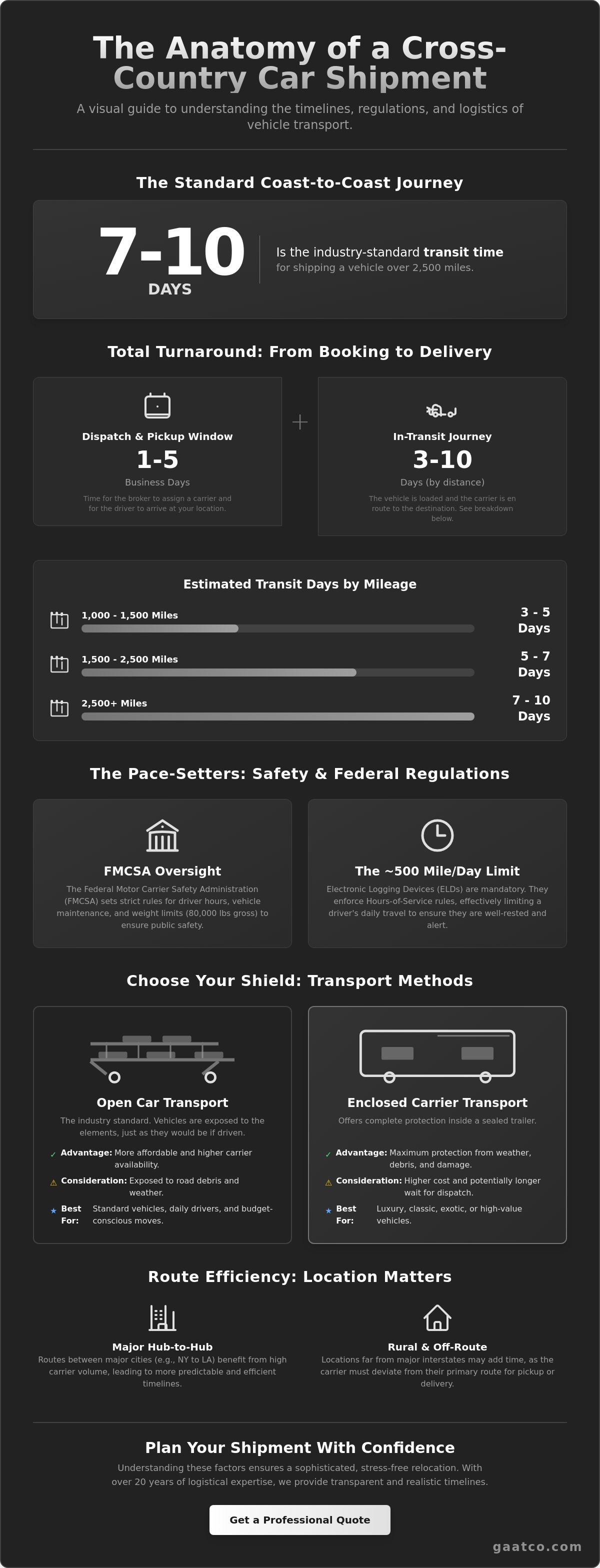
Defining cross-country transport requires a distinction between regional moves and true long-haul logistics. In professional circles, we define cross-country as any route exceeding 2,500 miles, such as a transit from Boston to San Francisco or Seattle to Miami. The average time it takes to ship a car cross country in 2026 remains centered on a 7 to 10-day industry standard for coast-to-coast delivery. This window respects the physical reality of the American interstate system and the safety protocols designed to protect your vehicle during its journey.
To better understand the logistical framework behind these timelines, watch this helpful video:
It's essential to distinguish between the carrier's transit time and the initial dispatch period. While a professional auto transport broker facilitates the critical connection between your schedule and available carrier capacity, the delivery clock officially begins once the vehicle is loaded. Even with 2026 infrastructure improvements and safety technology mandates like Automatic Emergency Braking (AEB) systems, the average time it takes to ship a car cross country hasn't drastically shortened. Safety and reliability are non-negotiable pillars that take precedence over hurried timelines.
Mileage vs. Estimated Transit Days
Logistical flow is a precise calculation of distance divided by safety. While external variables like seasonal weather patterns exist, these benchmarks provide a reliable foundation for your planning:
- 1,000 to 1,500 miles: Typically 3 to 5 days in transit.
- 1,500 to 2,500 miles: Typically 5 to 7 days in transit.
- 2,500+ miles: The 7 to 10-day cross-country window.
Major Hub-to-Hub Efficiency
Shipping between high-volume corridors like New York, Dallas, and Los Angeles often results in a more predictable turnaround. These routes benefit from a dense network of carriers and established operational patterns that ensure consistent movement. If your pickup or delivery is in a rural location, you should account for an "off-route" delay. Carriers prioritize efficiency; leaving a major interstate to reach a remote destination requires additional hours that aren't reflected in standard mileage estimates. Choosing specialized transport services ensures these geographical nuances are handled with the meticulous attention to detail your investment deserves.
Regulatory and Physical Factors Influencing Velocity
Precision in transport isn't merely about the distance covered; it's defined by the strict legal framework that ensures every vehicle arrives in pristine condition. While clients often focus on the average time it takes to ship a car cross country, the actual velocity is dictated by Federal Motor Carrier Safety Administration (FMCSA) regulations. These laws prioritize public safety and driver well-being over expedited delivery, creating a structured environment where reliability is the ultimate goal. This regulatory oversight ensures that your vehicle isn't just moved quickly, but moved with the highest level of operational integrity.
Electronic Logging Devices, or ELDs, have transformed the industry by providing real-time data on driver activity. These devices remove the possibility of "marathon" driving by strictly monitoring hours of service. Under current mandates, ELD regulations limit a driver to roughly 500 miles per day. This ensures that every professional carrier operating on a cross-country route is well-rested and fully alert. When you request a quote for specialized transport, you're engaging with a system that respects these non-negotiable safety pillars.
The logistical complexity of multi-car trailers also plays a role in the average time it takes to ship a car cross country. A standard carrier often transports up to nine vehicles at once. This requires a sophisticated sequence of loading and off-loading at various intervals. Each stop involves meticulous inspections and careful maneuvering to ensure no vehicle is disturbed during the delivery of another. This sequential process is a hallmark of professional service, prioritizing the safety of every asset on the trailer.
Federal Safety Standards and Speed
Mandatory rest periods are a cornerstone of modern logistics. These intervals aren't delays; they're essential safeguards against driver fatigue. A carrier that promises a "rushed" timeline often indicates a disregard for these safety protocols, which can jeopardize the security of your vehicle. We believe that true professionalism lies in transparent communication regarding these rest requirements, as a well-rested driver is the best insurance for a successful delivery.
Environmental and Infrastructure Variables
In 2026, weather patterns and infrastructure developments continue to influence transit speed. Winter northern routes often require slower speeds through the Midwest and Rockies to navigate ice and snow safely. Conversely, summer southern routes may face delays due to high-volume road construction or metropolitan traffic congestion. Natural disasters or significant infrastructure disruptions are treated as non-negotiable factors where the safety of the cargo always takes precedence over the clock.
Comparing Transport Methods and Service Levels
Selecting the appropriate transport method is a decision that balances personal preference with logistical reality. While many clients focus on the cost to ship a car, the choice between open and enclosed carriers significantly influences the average time it takes to ship a car cross country. Open carriers represent the backbone of the industry, accounting for approximately 85% to 90% of all vehicle shipments. This high volume translates to greater availability and more frequent departure windows from major metropolitan hubs, making it the standard choice for most relocations.
The trade-off between cost-efficiency and delivery precision is a central theme in professional logistics. Standard services offer a balance of reliability and value, while premium tiers provide enhanced control over the schedule. Regardless of the level you choose, the underlying infrastructure remains committed to safety and meticulous handling. Our role is to act as a bridge, ensuring that the method you select aligns perfectly with your specific timeline and the unique requirements of your vehicle.
Open vs. Enclosed Carrier Logistics
The average time it takes to ship a car cross country can actually be shorter with Enclosed Car Transport, despite what common misconceptions suggest. Because enclosed trailers typically carry fewer vehicles than the standard nine-car open hauler, they often require fewer stops for sequential off-loading. Research indicates enclosed carriers average 500 to 550 miles per day, whereas open carriers typically cover 400 miles daily. This specialized network is essential for classic and luxury vehicles, providing a sanctuary from road debris and seasonal weather wear during the long transit through diverse climates.
Vehicle dimensions also dictate carrier selection. Larger SUVs or modified classic cars may require specific trailer configurations, which can occasionally extend the initial dispatch period. Our team prioritizes matching your vehicle with the most efficient carrier type to ensure that operational flow remains uninterrupted and your expectations are met with precision.
The Reality of Expedited Surcharges
Expedited shipping is often misunderstood as a way to bypass federal safety mandates. In reality, no surcharge can legally extend a single driver's hours of service. Instead, expedited services often utilize two-driver teams, known as tandem driving. This allows the truck to remain in motion while one driver rests, effectively nearly doubling the daily mileage without violating FMCSA standards. This method can reduce a coast-to-coast journey to a 5 to 7-day window.
It's important to distinguish between a "Guaranteed Pickup" and a "Guaranteed Delivery." The former ensures your vehicle is removed from your premises on a specific date, while the latter is a much more complex logistical promise. Investing in expedited shipping is professionally justifiable when strict relocation deadlines or corporate schedules leave no room for the standard five-day pickup window. It's a premium service designed for those who value time as their most precious commodity.
Planning Your Timeline: The Total Turnaround
Successful logistics depend on a clear understanding of the distinction between booking, dispatching, and actual movement. The average time it takes to ship a car cross country is a calculation that only begins once the carrier physically secures the vehicle on the trailer. Most professional services operate within a three to five-day pickup window from your requested date. This buffer allows for the meticulous coordination of carrier routes and ensures that your vehicle is integrated into an efficient operational flow that prioritizes safety over haste.
Many clients mistakenly believe the transit clock starts the moment a service agreement is finalized. In reality, the dispatch phase is a separate administrative and logistical process. Pre-transport preparation is your primary contribution to this timeline. Ensuring your vehicle is clean for inspection, removing personal items, and maintaining a quarter-tank of fuel are small but essential steps. These actions prevent loading delays and help maintain the integrity of the carrier's schedule. Our team handles the complex logistics behind the scenes so your transition remains discreet and dependable.
The Dispatch and Pickup Phase
The concept of the "First Available Date" is central to your shipping timeline. This is the earliest day your vehicle is ready for pickup. Professional carriers use this date to synchronize your shipment with others on a similar route. Preparing your documentation in advance, including the Bill of Lading and insurance details, prevents administrative stalls that could extend the initial waiting period. It's vital to remember that the interstate journey only commences once the physical loading and initial inspection are complete.
Receiving Your Vehicle
As your vehicle nears its destination, the focus shifts to the final-mile delivery. The industry standard includes a 24-hour notice from the driver to confirm the delivery window. If your schedule prevents you from being present, arranging for a trusted representative is a common and professional solution. This proxy must be authorized to conduct the final inspection and sign the delivery documents. This final step is crucial for verifying the condition of your vehicle after its long-distance journey. High-stakes relocations require this level of detail to ensure the average time it takes to ship a car cross country results in a seamless experience.
When you're ready to secure a timeline that reflects established expertise, we invite you to request a personalized quote for your cross-country transport needs.
The GAATCO Commitment to Professional Logistics
With over 20 years of expertise in navigating complex cross-country routes, we understand that reliability is the ultimate luxury. While the average time it takes to ship a car cross country is influenced by federal laws and physical distance, our role is to manage these variables with meticulous care. We prioritize transparent, realistic timelines over marketing-driven promises that often fail to account for the realities of the road. By maintaining a deeply vetted carrier network in major hubs like Houston, Atlanta, and San Diego, we ensure that your vehicle is handled by professionals who mirror our standards of excellence. This geographic advantage allows us to maintain a steady operational flow even during peak seasons.
Our Door-to-Door Auto Shipping service is designed to minimize client effort by handling the entire logistical chain from origin to destination. You won't need to coordinate with secondary terminals or navigate the complexities of local transport. Instead, we act as a bridge between your needs and the rigorous operational requirements of long-haul transit. This seamless approach ensures that the average time it takes to ship a car cross country remains a predictable part of your broader relocation plan. We handle the intricate details so you don't have to, maintaining a discreet and dependable partnership throughout the process.
Sophisticated Tracking and Communication
Providing peace of mind is a non-negotiable pillar of our service. You'll receive regular status updates that keep you informed without being intrusive, reflecting our commitment to a measured and professional communication rhythm. Behind every update is a dedicated advisor, a seasoned expert who manages your shipment and is prepared to resolve unforeseen logistical disruptions with calm confidence. This human-centric approach ensures that technical details regarding your vehicle's location and safety are always accessible. We believe that true elite service lies in the ability to remain calm under pressure while providing absolute transparency.
Securing Your 2026 Transport Schedule
To ensure the highest level of service and carrier availability, we recommend booking your cross-country route two to three weeks in advance. This lead time allows our team to secure a position within our network and coordinate the most efficient route for your vehicle's specific requirements. You can request a tailored quote today to begin the process of a customized transport experience. As you plan your 2026 move, trust in our commitment to operational excellence and the quiet luxury of a journey handled with precision. Our collective team of professionals is dedicated to ensuring your vehicle arrives safely, on time, and with the level of care that your investment deserves.
Finalizing Your Cross-Country Logistics
Mastering the logistics of a long-distance move requires a clear perspective on the interaction between safety regulations and transit speed. You've gained insight into how Electronic Logging Devices and mandatory rest periods define the 7 to 10-day coast-to-coast window. While the average time it takes to ship a car cross country remains anchored in these physical realities, the difference between a stressful move and a seamless relocation lies in transparent communication and meticulous planning.
GAATCO offers more than simple transport; we provide a partnership built on 20 years of industry expertise. Our network consists of licensed and fully insured carriers, ensuring that every classic car or military vehicle we handle receives the highest level of care. When you're ready to move forward with a partner that values precision and quiet luxury, we invite you to Request a Professional Auto Transport Quote from GAATCO. Let our collective team of professionals manage the intricate variables of your transport so you can focus on the next chapter of your journey with complete confidence.
Frequently Asked Questions
How many miles per day does a car transport carrier typically travel?
A professional carrier typically covers between 400 and 500 miles per day. Open carriers usually average 400 miles, while enclosed trailers can reach 500 to 550 miles daily because they handle fewer vehicles. These limits are strictly enforced by federal hours-of-service mandates to ensure driver safety and cargo security during long-haul transits.
Can I track my car while it is being shipped cross country?
Status updates are provided through sophisticated tracking systems and dedicated advisors who manage your shipment. While some carriers offer real-time GPS access, the industry standard focuses on regular communication at key milestones. This ensures you remain informed of your vehicle's progress without the need for constant monitoring, reflecting a high-end service model centered on peace of mind.
Does the time of year affect how long it takes to ship a car?
Seasonal demand and weather patterns significantly influence the average time it takes to ship a car cross country. Summer is the peak season, which can lead to higher demand for carrier capacity and slightly longer dispatch windows. Conversely, winter months often introduce delays on northern routes due to ice and snow, requiring a more measured pace to maintain safety.
What is the fastest way to ship a car from one coast to the other?
Expedited transport utilizing a two-driver team is the most efficient method for rapid delivery. This tandem approach allows the truck to remain in motion for longer periods while complying with all federal safety regulations. It effectively reduces the coast-to-coast timeline to a 5 to 7-day window for clients with urgent relocation requirements who prioritize speed.
Why do cross-country shipments take longer than the driving time on Google Maps?
Commercial carriers must adhere to strict federal safety standards that don't apply to personal vehicles. Unlike a solo driver, a professional transporter must manage mandatory rest periods, perform multiple inspections, and coordinate sequential loading for other clients on the trailer. These logistical layers are essential to ensure the highest level of security for your vehicle throughout the average time it takes to ship a car cross country.
Will my car be on the same trailer for the entire cross-country trip?
Your vehicle typically remains on the same trailer for the duration of a professional door-to-door shipment. This consistency minimizes the risks associated with reloading and ensures that the initial inspection report remains accurate. High-end service providers prioritize a single-carrier transit to maintain operational integrity and provide a more stable environment for your vehicle.
What happens if my car delivery is delayed by weather or road conditions?
Safety remains the non-negotiable priority when unforeseen conditions arise on the interstate. If severe weather or infrastructure disruptions occur, the carrier will pause transit until it's safe to proceed. Our team provides clear, proactive communication during these events, ensuring you understand the revised timeline while your vehicle remains secured in a controlled professional environment.
How much notice will I receive before the driver arrives at my destination?
You will receive a standard 24-hour notice before the carrier reaches your destination. This allows you or your authorized representative to coordinate the final inspection and sign the delivery documents. A final confirmation call is typically made two to four hours before the physical arrival to ensure the delivery process is handled with professional precision and minimal disruption to your schedule.


