With cargo theft incidents rising by 27% in 2024 and commercial insurance premiums continuing their steady climb, the precision required when filing an insurance claim with a car shipper has never been more critical. You likely feel a sense of unease when considering the possibility of vehicle damage, particularly when the distinction between broker and carrier responsibilities remains unclear. It is natural to fear that a minor technicality could lead to a claim denial, leaving you to absorb the loss of your vehicle's value.
We understand that your vehicle represents a significant investment, and the claims process should be a disciplined administrative exercise rather than a source of stress. Clarity is your greatest defense. This guide offers a sophisticated roadmap designed to help you handle damage claims with authority and precision. We will examine the essential role of the Bill of Lading, the impact of 2026 FMCSA regulations such as the Motus registration system, and the exact protocols required to secure successful reimbursement for your transport needs.
Key Takeaways
- Understand the regulatory governance of the FMCSA and the specific legal obligations carriers maintain to protect your cargo during transit.
- Distinguish between standard coverage inclusions and the complexities of "Act of God" clauses to understand your protections against environmental variables.
- Utilize the Bill of Lading as your primary legal instrument, ensuring that all vehicle conditions are documented with absolute precision.
- Follow a disciplined timeline when filing an insurance claim with a car shipper to preserve your rights and meet critical administrative deadlines.
- Establish a comprehensive evidence dossier consisting of repair estimates and photographic records to facilitate a professional and successful resolution.
The Framework of Auto Transport Insurance and Carrier Liability
Understanding the legal architecture of vehicle transport is the first step toward a successful resolution. Carrier liability is the non-negotiable legal obligation of transporters to protect your asset from the moment of possession until delivery. The Federal Motor Carrier Safety Administration (FMCSA) oversees this framework, ensuring that every entity operates within strict safety and financial parameters. In 2026, the FMCSA transitioned to the Motus registration system, requiring all carriers to maintain updated filings to retain their operational authority. This sophisticated oversight provides a layer of protection for every client, though the nuances of individual policies vary significantly.
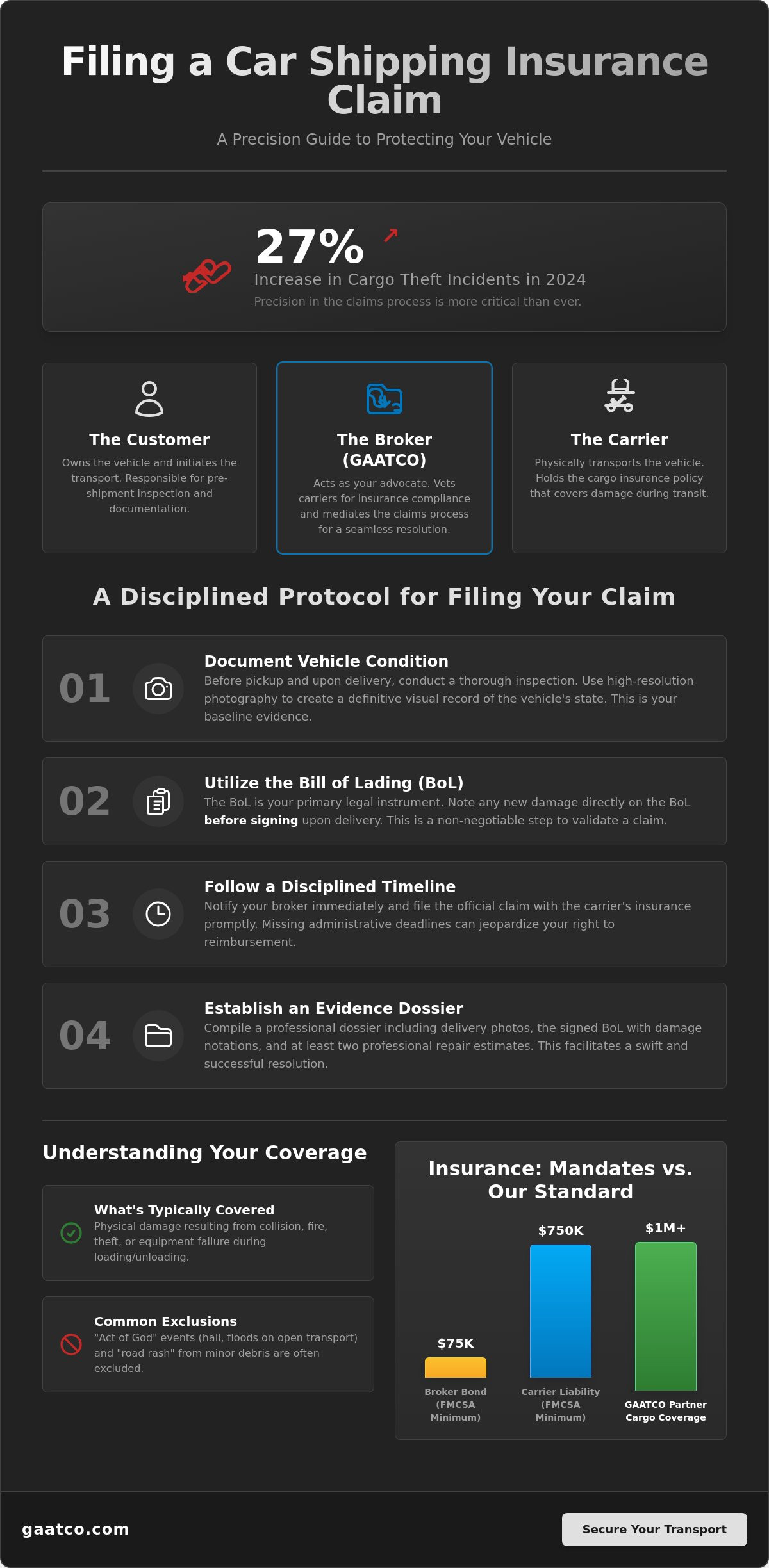
To visualize the nuances of transport protection, please review this professional overview:
When you're considering the possibility of filing an insurance claim with a car shipper, you must distinguish between the broker's professional liability and the carrier's cargo insurance. Since January 16, 2026, brokers and freight forwarders are required to maintain a minimum $75,000 surety bond under 49 CFR Part 387. This financial security protects against broker failure; however, it's the carrier’s cargo policy that addresses physical damage to your vehicle. At GAATCO, we partner only with carriers who maintain impeccable insurance ratings and high coverage limits, often mandating $1,000,000 in coverage to ensure your peace of mind.
Cargo Insurance vs. Liability Insurance
Cargo insurance is the specific instrument that protects your vehicle against transit-related damage, such as equipment failure during loading or collisions. Public liability insurance covers third-party property damage or bodily injury during operations. As of 2026, the FMCSA mandates a minimum of $750,000 in public liability for for-hire property carriers with a GVWR of 10,001 pounds or more. Elite transport standards typically demand higher limits for specialized assets, particularly when shipping through customized enclosed car transport options.
The Relationship Between Broker, Carrier, and Customer
The transport process functions as a triad of responsibility. While the carrier physically moves the vehicle, the broker acts as a discreet mediator and advocate for the client. If damage occurs, the Bill of Lading serves as the definitive legal contract and evidence of condition. Although your broker facilitates the process, direct communication with the carrier’s insurance provider is often a procedural necessity to finalize the claim. Our team manages these complex logistics, ensuring that technical details are clear and accessible throughout the resolution period.
Determining Coverage: What is Protected During Transit?
The landscape of vehicle protection is defined by specific parameters that dictate what is, and is not, a compensable loss. Standard cargo insurance policies typically encompass significant physical damage resulting from collision, fire, theft, or equipment failure during the loading process. When filing an insurance claim with a car shipper, the precision of your initial contract becomes your primary shield. It's vital to recognize that while carriers are legally required to maintain insurance, the scope of that coverage varies based on the transport method you select.
The "Act of God" clause remains a pivotal consideration for those opting for open transport. Weather events like hail, windstorms, or localized flooding are frequently excluded from standard cargo policies because they're deemed beyond the carrier's control. To protect your interests, you must document any damage with high-resolution photography before the vehicle is even loaded. This creates a definitive baseline. It prevents carriers from attributing transit damage to pre-existing conditions or environmental factors that occurred prior to their possession.
Common Exclusions in Standard Policies
Most standard policies exclude "road rash" or pitting caused by pebbles and road debris on open carriers. These are often viewed as inherent risks of the road. Similarly, damage caused by leaking fluids from a vehicle positioned on an upper deck is a frequent point of contention. While professional loading protocols aim to prevent this, the resulting stains may not always be covered under basic cargo terms. Mechanical failures, such as a battery dying or a transmission failing during transit, are also generally excluded unless they're the direct result of improper handling by the operator.
High-Value Vehicle Considerations
For clients utilizing enclosed car transport, the coverage ceilings are significantly higher to reflect the value of luxury and exotic assets. Standard limits that suffice for a daily driver are often inadequate for multi-million dollar classic cars. In these instances, supplemental "gap" coverage or specialized riders are necessary to ensure full protection. We meticulously verify that our partner carriers maintain limits that align with the current market valuation of your vehicle. If you're moving a high-value asset, requesting a quote that includes a detailed insurance summary is a prudent step toward a secure transport experience.
The Bill of Lading: Your Primary Legal Instrument for Claims
The Bill of Lading (BOL) is the definitive legal contract between you and the carrier. It dictates the terms of carriage and serves as the official record of the vehicle's condition. When you're filing an insurance claim with a car shipper, this document is your most powerful asset. We often refer to the "Golden Rule" of transport: if a defect isn't documented on the BOL at the time of delivery, it legally didn't happen during transit. This makes the initial and final inspections non-negotiable pillars of a safe transport experience.
To understand the federal protections surrounding these documents, you should consult the FMCSA's Your Rights and Responsibilities When You Move. This publication clarifies the mover's obligations and the legal framework for liability. It's a vital resource for any client who values transparency and rigorous operational standards. Relying on a professional partner ensures these technical details are handled with the seriousness they deserve.
Executing a Professional Inspection
To ensure a systematic review, we recommend the "Clock Method." Start at the front bumper and move clockwise around the vehicle's exterior. This methodical approach ensures no panel is overlooked. Capture high-resolution imagery under clear lighting conditions at both the origin and destination. If you're receiving a vehicle after dusk, use a high-powered flashlight to inspect the finish. Hidden damage discovered after the driver departs is notoriously difficult to claim, so your baseline origin photos are your only real protection.
Recording Exceptions Properly
Precision in language is your greatest ally. Avoid subjective terms. If you see a dent, measure it. If you see a scratch, check if it reached the metal. Use specific notes like "3-inch scratch to primer on driver-side rear panel" rather than vague descriptions. The driver's signature on the BOL acknowledging these specific "exceptions" is the trigger for the insurance process. Whether you use a traditional paper BOL or a modern digital version, verify that you receive an immediate, legible copy. This immediate record-keeping is vital when filing an insurance claim with a car shipper, as it creates an indisputable timeline of events.
A Disciplined Protocol for Filing Your Insurance Claim
Precision in timing is just as vital as precision in documentation. When you find yourself filing an insurance claim with a car shipper, the initial 24 to 48 hours represent a critical window for action. This period isn't merely a suggestion; it's a procedural necessity to ensure that the carrier’s insurance provider cannot claim the damage occurred post-delivery. Our team at GAATCO prioritizes this sense of urgency, acting as a bridge between you and the carrier to ensure the administrative flow remains uninterrupted and professional.
To build a compelling case, you must assemble what we call an Evidence Dossier. This collection should include your high-resolution origin and destination photographs, a legible copy of the signed Bill of Lading with noted exceptions, and professional repair estimates. While the carrier’s insurance agent is the primary point of contact for the financial settlement, our professionals assist in organizing these technical details to present a polished, authoritative claim. We understand the high-stakes nature of specialized transport and treat every claim with the meticulous attention it deserves.
Step-by-Step Submission Guide
- Step 1: Ensure the damage is recorded on the Bill of Lading before the driver departs the delivery site.
- Step 2: Secure two to three independent repair estimates from certified facilities that specialize in your vehicle's specific make and model.
- Step 3: Submit a formal written claim to both the carrier and their insurance provider, including your full Evidence Dossier.
- Step 4: Maintain a steady, measured rhythm of follow-up with the insurance adjuster to ensure the settlement reflects the true cost of restoration.
Managing the Adjuster’s Inspection
The arrival of an insurance adjuster is a standard part of the protocol. They'll review the vehicle to verify the extent of the damage and its alignment with the reported incident. It's helpful to provide historical maintenance records; these documents prove the vehicle's pristine condition prior to transport. If you encounter low-ball offers or "betterment" deductions, remain calm and rely on your documented evidence. If you're planning a future shipment and want to ensure you're working with a partner who understands these complexities, you can request a quote for our elite transport services today. Our seasoned experts handle the complex logistics so you don't have to, maintaining a unified standard of safety across all our service lines.
Ensuring Seamless Resolution Through Professional Mediation
The final phase of any claim is the adjudication and settlement process. While the carrier’s insurance provider handles the financial disbursement, the presence of a seasoned advisor transforms the experience from a confrontation into a structured administrative resolution. Our team brings over 20 years of industry experience to the table, providing a steady hand when navigating the complexities of filing an insurance claim with a car shipper. We act as your discreet advocate, ensuring that every technical detail aligns with established industry standards and federal regulations.
Maintaining professional, written correspondence is your most effective tool during mediation. Every email and letter serves as a permanent record of the negotiation. If a carrier or their insurer becomes unresponsive, these records provide the necessary foundation for escalation. In rare instances where a resolution cannot be reached through standard channels, you may involve the Better Business Bureau or the FMCSA’s National Consumer Complaint Database. These entities provide a formal path for oversight, though our rigorous oversight often resolves issues long before such measures become necessary.
Finalizing the settlement requires a keen eye for detail. Most carrier cargo policies include a deductible; in a professional transport arrangement, the carrier is typically responsible for this amount, ensuring you aren't out of pocket for their operational failures. Before funds are released, you'll likely be asked to sign a release of liability form. Do not sign this document until you've verified that the settlement amount covers the full scope of the certified repair estimates you provided in your Evidence Dossier.
The GAATCO Advantage in Risk Mitigation
Our commitment to your vehicle's safety begins long before the first mile. We employ a rigorous vetting process that identifies the top 5% of licensed haulers in the nation. This isn't a static check; we monitor carrier insurance renewals and safety ratings in real-time through the FMCSA's Motus system. This proactive stance significantly reduces the likelihood of you ever needing to initiate the claims process. You can learn more about our secure transport services to see how we prioritize operational integrity at every stage.
Concluding the Transport Experience
A claim is a hurdle, not a conclusion. By following a disciplined protocol and partnering with a dedicated advisor, you protect your investment and maintain control over the outcome. We handle the heavy lifting of logistics and mediation so you can focus on your move with absolute confidence. If you're ready for a seamless move backed by elite expertise, request a professional transport quote from our team today. We remain a trusted partner, bridging the gap between your needs and the complexities of global logistics.
Securing Your Asset with Elite Operational Standards
Navigating the complexities of vehicle transport requires a commitment to administrative precision and a thorough understanding of the legal framework. By prioritizing the Bill of Lading and acting within the critical 48-hour window, you ensure that your vehicle's value is protected against transit-related risks. While the process of filing an insurance claim with a car shipper can feel daunting, it's ultimately a disciplined exercise in documentation and professional mediation. Relying on a partner who monitors carrier safety ratings and insurance renewals in real-time provides the ultimate peace of mind.
At GAATCO, we bring over 20 years of industry expertise to every shipment, partnering exclusively with licensed and insured carriers who meet our rigorous standards. Whether you require specialized luxury transport or military vehicle shipping, our team manages the complex logistics so you don't have to. We invite you to Request a Secure Auto Transport Quote from GAATCO and experience a service defined by reliability and quiet confidence. Your vehicle deserves the highest standard of care, and we're here to ensure a seamless journey from origin to destination.
Frequently Asked Questions
Does my personal car insurance cover damage during shipping?
Most personal auto policies don't provide coverage for your vehicle while it's in the custody of a commercial transporter. You should consult your insurance agent to verify your specific terms, but the carrier's cargo insurance serves as the primary protection during transit. Relying on the carrier's professional policy is the industry standard for ensuring your asset is protected against operational risks.
What should I do if the driver refuses to sign the damage report?
Contact your broker immediately and document the refusal with a timestamped photograph or video of the interaction. You must note the driver's refusal clearly on the Bill of Lading yourself before providing your signature. This action ensures a record of the dispute exists. Don't let the driver leave the premises until you've notified their dispatch office of the situation to create an administrative trail.
How long do I have to file an insurance claim after delivery?
You should initiate the process of filing an insurance claim with a car shipper within 24 to 48 hours of delivery for the most effective resolution. While federal FMCSA regulations allow for a filing window of up to nine months, waiting significantly weakens your case. Immediate notification prevents the carrier from claiming the damage happened after the vehicle left their possession.
Will I have to pay a deductible for a car shipping insurance claim?
You aren't responsible for the carrier's insurance deductible in a professional transport arrangement. The carrier is the policyholder and must absorb this cost as part of their operational overhead. If a carrier tries to pass this expense to you, it's a deviation from elite industry standards. Your broker will typically intervene to ensure your settlement matches the full value of the repair estimates.
Can I still file a claim if I discovered damage after the driver left?
You can still file a claim, but the burden of proof increases dramatically once you've signed the Bill of Lading without noting exceptions. You'll need undeniable evidence, such as high-resolution photographs from the pickup point, to prove the damage didn't exist before transit. Without a notation at delivery, insurance adjusters often deny these requests, attributing the damage to post-delivery use.
What are the most common reasons car shipping claims are denied?
Claims are most frequently denied due to a lack of notation on the Bill of Lading or insufficient photographic evidence from both transit points. Other common reasons include damage classified as "road rash" on open carriers, which is usually an excluded risk, or pre-existing mechanical failures. Filing an insurance claim with a car shipper after the carrier's internal deadline has passed can also result in a denial.
Does enclosed transport include higher insurance coverage than open transport?
Enclosed transport carriers typically maintain much higher cargo insurance limits to protect high-value luxury and classic assets. While a standard open carrier might have coverage between $100,000 and $250,000, enclosed trailers often carry policies of $1,000,000 or more. This higher ceiling reflects the exclusive nature of the cargo and the specialized equipment used to move it.
How do I check a car carrier’s insurance status before shipping?
You can verify a carrier's insurance and safety status through the FMCSA's Motus system using their USDOT or MC number. This database provides real-time updates on their active cargo insurance filings and public liability status. A professional broker performs this verification for every shipment, ensuring that only carriers with impeccable insurance ratings handle your vehicle.


