

Why does a journey you could complete in forty-eight hours behind the wheel often require seven days or more when managed by a professional carrier? This discrepancy frequently leads to a sense of frustration and a perceived lack of transparency within the logistics industry. It is natural to feel a degree of anxiety when delivery windows remain fluid, particularly when the safety of a high-value asset is at stake. Identifying the primary factors that affect car shipping transit times is the first step toward reclaiming control over your relocation schedule and establishing realistic expectations for arrival.
We understand that uncertainty is the enemy of effective planning. This guide will empower you to master the complex variables of auto transport, enabling you to coordinate your vehicle relocation with absolute precision. We shall examine how professional logistical orchestration, the logistical nuances of multi-stop routes, and the stringent February 2026 FMCSA digital trail requirements dictate the pace of a secure journey. From the specialized requirements of classic car transport to the efficiency of door-to-door services, you will gain the confidence that comes from understanding the sophisticated infrastructure operating behind every successful delivery.
Key Takeaways
- Analyze the mathematical correlation between total mileage and transit duration to establish a precise baseline for your vehicle relocation plan.
- Examine the regulatory factors that affect car shipping transit times, such as FMCSA hours-of-service mandates that prioritize driver safety and cargo security.
- Evaluate how specific vehicle dimensions and the selection of specialized equipment, such as enclosed transport, influence trailer capacity and scheduling priority.
- Master the nuances of seasonal demand and environmental variables to navigate the "Snowbird" effect and potential weather-related detours with confidence.
- Identify strategic methods for shortening delivery windows through expedited shipping options and optimized pickup flexibility.
The Foundation of Transit: Distance and Route Popularity
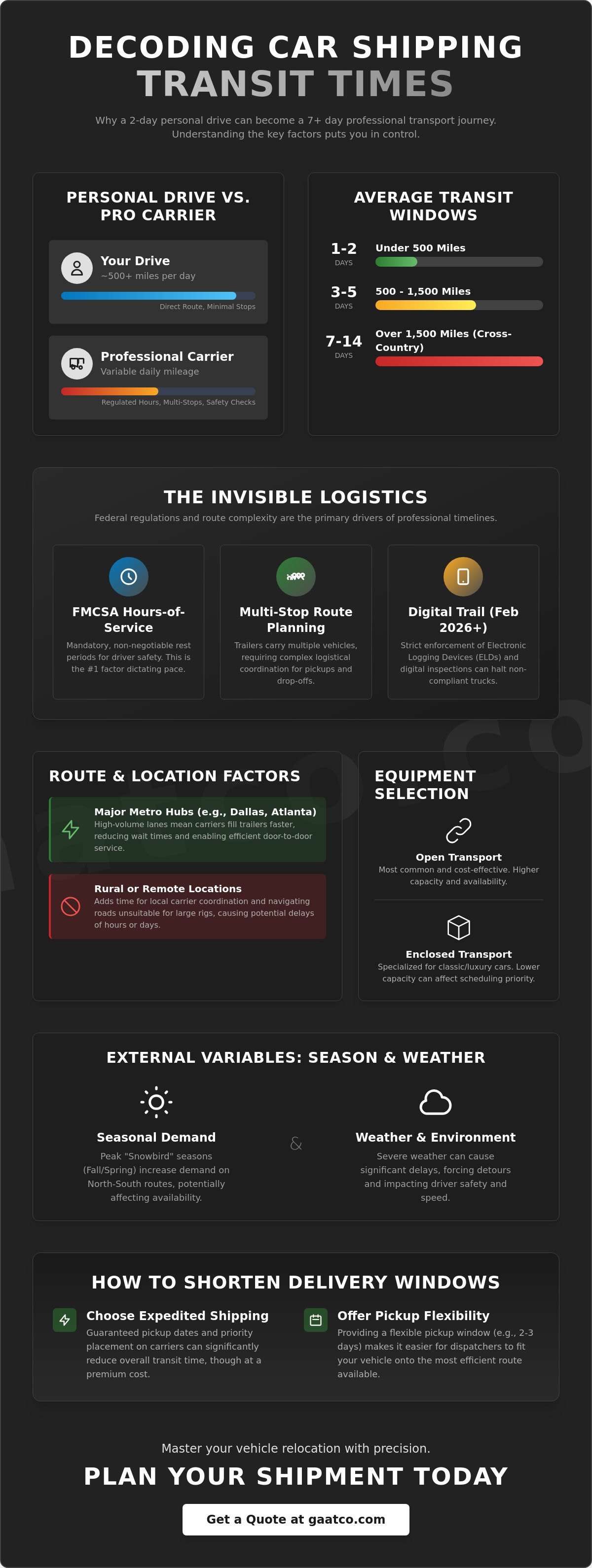
Distance serves as the fundamental baseline for any logistical timeline. While an individual driver in a passenger vehicle might cover 500 miles in a single day, a professional carrier operates within a more rigid and regulated framework. These primary factors that affect car shipping transit times begin with the mathematical reality of mileage, yet they are immediately influenced by the specific geography of the route. A direct path between two major metropolitan areas often moves more swiftly than a shorter distance involving rural detours. Our experience indicates that the most efficient journeys are those that remain on primary interstate arteries where infrastructure supports heavy equipment.
The efficiency of a journey is frequently dictated by the volume of traffic moving along high-frequency lanes. Carriers prioritize routes that connect significant commercial hubs to ensure trailers remain at optimal capacity, which minimizes downtime. This strategic alignment reduces the time a vehicle spends waiting at a terminal or consolidation point. To gain a deeper perspective on the practicalities of modern vehicle transport and how it's managed by industry experts, consider the insights provided in this professional overview:
Average Transit Windows by Distance
Logistical planning requires a realistic understanding of how distance translates into days. For short-haul transport under 500 miles, a window of one to two days is the standard. These routes are common for dealer-to-dealer transport or regional relocations. Mid-range distances, spanning 500 to 1,500 miles, typically require three to five days. This timeframe allows the operator to manage multi-stop loads effectively without compromising the safety of the cargo. For cross-country transit exceeding 1,500 miles, a seven to fourteen-day window is the professional reality. This duration accounts for the vast scale of the geography and the necessity of maintaining a steady, safe pace across multiple state lines.
The Advantage of Major Metro Hubs
Shipping between established logistical centers like Houston, Dallas, and Atlanta offers a distinct advantage. These cities act as primary nodes in a sophisticated network where Door-to-Door Auto Shipping is most efficient. Because these are high-volume lanes, the waiting period for a carrier to fill a trailer is significantly reduced. Conversely, remote or restricted-access neighborhoods introduce logistical friction. An Auto transport broker must often coordinate with specialized local carriers to bridge the gap between a rural pickup point and the main interstate artery. These off-interstate detours can add several hours or even days to a schedule as the carrier navigates narrow roads or weight-restricted bridges that are unsuitable for large transport rigs.
Invisible Logistics: Federal Regulations and Multi-Stop Loads
While distance provides the geographic framework, the actual pace of transport is governed by stringent federal oversight. The primary Federal Motor Carrier Safety Administration (FMCSA) regulations dictate exactly how many hours a driver may spend behind the wheel. These mandates are non-negotiable. They ensure that every operator remains alert and every asset remains secure. Understanding these regulatory factors that affect car shipping transit times helps you set realistic expectations for a safe delivery window.
Since February 2026, enforcement has become significantly more rigorous. Officers now have the authority to place a vehicle out of service immediately if an Electronic Logging Device (ELD) is found on the revoked list. Additionally, the transition to digital Driver Vehicle Inspection Reports (DVIRs) means that illegible or missing paperwork can result in out-of-service violations and fines reaching $19,000. These protocols aren't mere bureaucracy. They're essential safeguards that prevent the risks associated with driver fatigue and mechanical failure.
The Reality of Multi-Car Carriers
Most vehicles travel on trailers designed for eight to ten units. This load optimization is necessary for efficiency, yet it introduces a "domino effect" into the schedule. Each intermediate stop requires the driver to navigate local streets and manage the physical loading process. If one client is unavailable for their scheduled window or a vehicle is found to be inoperable without prior notice, the delay impacts every other vehicle on the trailer. These logistical layers are critical factors that affect car shipping transit times. Your vehicle's position on the rig also matters. A car positioned in the middle may require the temporary unloading of others to reach it, adding small but cumulative amounts of time to the journey.
Safety as a Non-Negotiable Pillar
We believe that speed should never come at the expense of security. Professional carriers prioritize Hours of Service (HOS) compliance because it's the only way to guarantee the safety of high-value cargo. When you request a quote for professional transport, you're investing in a system that values precision over haste. Hours of Service mandates function as the primary factor for safe, legal transit. This commitment to safety creates a reliable environment where your vehicle is protected from the hazards of an overworked driver or a rushed schedule.
Equipment Selection and Vehicle Specifications
The physical characteristics of your vehicle and the equipment chosen for its relocation are significant factors that affect car shipping transit times. Logistics is a precise science of space and weight management. A carrier must balance the trailer to ensure it meets federal safety standards while optimizing the route for all clients on board. Choosing between different transport methods isn't merely a matter of preference; it's a strategic decision that influences the availability of carriers and the complexity of the loading process.
High-end logistics often involve specific protocols for luxury assets. When we coordinate Classic Car Transport, the preparation phase is notably more meticulous. This white-glove approach ensures the preservation of the vehicle's condition but requires a more measured pace during the inspection and securing phases. This commitment to detail is what distinguishes a professional service from a standard carrier.
Open vs. Enclosed Carrier Dynamics
Open Car Transport is the most frequently utilized method across North American routes. Because these trailers are more common, the time spent waiting for a matching carrier is typically shorter. In contrast, Enclosed Car Transport offers a higher degree of exclusivity and protection from environmental elements. However, these specialized trailers are fewer in number. Scheduling an enclosed carrier requires more precision because the operator must align a smaller pool of equipment with specific regional demands.
Beyond availability, the physical dimensions of the trailer play a role. Enclosed trailers often have lower ground clearance and height restrictions. Loading a low-profile sports car or a tall SUV into a confined space requires more time than the relatively straightforward process of an open multi-car rig. While the carrier adheres to Federal Hours of Service regulations during the journey, these technical loading nuances can extend the initial departure window.
Transporting Non-Running or Oversized Vehicles
The condition of the vehicle is a critical variable that many owners overlook. If a car is categorized as an Inoperable Vehicle Transport, it cannot be driven onto the trailer. This necessitates the use of specialized winches and additional manual labor. The time required to safely winch a non-running vehicle onto a rig is significantly higher than simply driving a functional car into position. This added complexity is one of the many factors that affect car shipping transit times.
Similarly, oversized vehicles like lifted trucks or large SUVs present unique challenges. These vehicles occupy more space on a trailer and may push the rig close to federal weight limits. Finding a carrier with the specific space and weight capacity for a modified vehicle can add days to the scheduling phase. We prioritize matching your vehicle's specific dimensions with the most appropriate equipment to ensure a seamless and secure transition.
External Variables: Seasonal Demand and Environmental Factors
While logistical planning provides a structured foundation, the external environment introduces variables that even the most seasoned professionals must respect. These factors that affect car shipping transit times are often beyond human control, yet they are entirely manageable through proactive monitoring and strategic scheduling. We understand that your timeline is precise, which is why we account for seasonal shifts and environmental volatility before the journey begins. A truly professional logistics partner views these variables not as obstacles, but as data points to be navigated with technical precision.
The calendar itself is a primary driver of transit variability. Peak moving season, which typically spans from May through September, creates a significant capacity crunch across the industry. During these months, the sheer volume of vehicles requiring transport can extend pickup windows as carriers manage back-to-back assignments. Conversely, the industry often experiences its slowest period from November to December. This seasonal ebb and flow dictates the availability of specialized equipment and the speed at which a carrier can finalize a multi-car load.
Snowbird season, occurring at the beginning of the year, creates a similar surge on specific North-South corridors. This predictable migration of vehicles between the northern states and the Sunbelt requires meticulous coordination to navigate the high demand for trailer space. These seasonal surges are critical factors that affect car shipping transit times, as they influence how quickly a driver can consolidate a full trailer and commence the journey. Without an expert team to navigate these peaks, a relocation can easily fall behind schedule.
Seasonal Market Fluctuations
Relocation cycles for corporations and academic institutions also influence market availability. The late summer months often coincide with college move-in dates and the finalization of corporate transfers, placing additional strain on regional logistics. We have found that planning your vehicle's journey during off-peak months, specifically from October to April, often results in more predictable timelines and a smoother scheduling process. This foresight allows for a more relaxed pace and ensures that your vehicle receives the dedicated attention it deserves.
Environmental and Infrastructure Delays
Safety remains the non-negotiable pillar of our operations. When severe weather strikes, particularly in the Mountain West during winter, professional carriers may receive mandatory "stop-drive" orders or be forced to take significant detours to avoid hazardous passes. These environmental delays are essential for the preservation of your asset and the safety of the driver. Similarly, major infrastructure projects or unexpected road closures in dense urban centers like New York or Seattle can introduce delays in local pickup and delivery.
Our team utilizes sophisticated tracking and real-time weather monitoring to mitigate these risks. By identifying potential disruptions before they manifest, we can adjust routes or suggest alternative timing to ensure your vehicle arrives securely. To begin planning your relocation with an expert partner who understands these complexities, we invite you to request a professional transport quote today.
Strategies for Expedited Transit and Reliable Delivery
Achieving a precise delivery window requires a combination of professional foresight and client-side preparation. While many variables remain external, understanding the strategic factors that affect car shipping transit times allows you to influence the outcome of your relocation. Expedited vehicle shipping serves as a premium solution for those with uncompromising schedules. By securing a priority window, you enable our team to bypass the standard consolidation process and focus exclusively on your specific timeline. This service ensures your asset receives the fastest available routing within the bounds of federal safety compliance.
Flexibility with your pickup date is another powerful lever for efficiency. By providing a wider window, you allow logistics experts to match your vehicle with the most efficient route and the most reliable carrier currently in the area. This often results in a faster overall transit than a rigid, single-day requirement might permit. Accurate vehicle descriptions are equally vital. A carrier's trailer is a complex puzzle of weight and volume; any discrepancy in the vehicle's size or condition can lead to immediate loading delays that ripple through the entire schedule. We prioritize precision in these details to ensure a seamless transition from your driveway to the destination.
Optimizing Your Shipping Timeline
Professional logistical planning begins long before the carrier arrives. We recommend a booking window of two to three weeks as the industry standard. This lead time ensures that your vehicle is positioned for the most efficient route available and allows for the selection of the highest-rated equipment. While Door-to-Door Auto Shipping offers the highest level of convenience, certain specialized cases may benefit from terminal arrangements if local access is restricted. Preparing your vehicle for immediate loading, including ensuring the battery is functional and removing personal items, prevents unnecessary friction at the point of origin. These small steps are essential factors that affect car shipping transit times and overall service reliability.
The GAATCO Commitment to Precision
Our team brings over 20 years of specialized experience to every relocation. This legacy of expertise allows us to streamline the request-quote process, identifying potential hurdles before they impact your schedule. We believe that transparency is the hallmark of a luxury service. You'll receive clear, consistent communication throughout the journey, providing peace of mind as your asset moves toward its destination. Our sophisticated infrastructure and human-centric approach work in tandem to handle the complex logistics so you don't have to. We invite you to request a customized transport quote today and experience a relocation managed with absolute precision.
Secure Your Vehicle Relocation with Professional Precision
Mastering the various factors that affect car shipping transit times allows you to transition from uncertainty to a state of controlled expectation. You now understand that a journey's duration is defined by more than mileage; it's a sophisticated balance of FMCSA safety compliance, trailer optimization, and the nuances of your specific vehicle's dimensions. Whether you're moving a high-value asset via enclosed transport or coordinating a regional relocation, these variables form the backbone of a successful delivery.
Our team leverages over 20 years of industry expertise to navigate these complexities on your behalf. We utilize a network of licensed and fully insured carriers to provide specialized military vehicle shipping and classic car transport solutions with absolute reliability. By prioritizing safety and transparency, we ensure your vehicle arrives securely and within the projected window. We invite you to Request a Professional Auto Transport Quote today to begin your relocation with a partner who understands the high stakes of specialized logistics. Your vehicle deserves a journey managed with the highest standards of professional care.
Frequently Asked Questions
How long does it typically take to ship a car cross-country?
Shipping a vehicle across the country typically requires seven to fourteen days for distances exceeding 1,500 miles. This timeline reflects the physical reality of transcontinental travel while adhering to federal safety protocols and mandatory rest periods. A professional carrier must manage multiple pickup and delivery points along the route, which influences the total duration. Factors that affect car shipping transit times on these long-haul journeys include the specific interstate corridor and the efficiency of multi-stop load consolidation.
Can I get a guaranteed delivery date for my vehicle?
Most standard transport services provide a delivery window rather than a single guaranteed date due to the variables inherent in long-distance logistics. While we strive for absolute precision, factors such as traffic congestion or regulatory inspections can introduce minor adjustments. For clients with uncompromising schedules, expedited shipping options offer prioritized scheduling and significantly narrower arrival windows to ensure your relocation remains on track with the highest level of reliability.
Does the type of trailer (Open vs. Enclosed) change the transit time?
The choice between Open and Enclosed Car Transport primarily influences the initial scheduling phase rather than the speed of travel. Open trailers are more abundant, which often leads to a shorter waiting period for a matching carrier to become available. Enclosed trailers provide a higher level of protection for luxury assets but are fewer in number, requiring a more deliberate scheduling process to align specialized equipment with your specific geographic route.
Why is my car shipping taking longer than the initial estimate?
Transit delays are often the result of the "domino effect" within multi-car loads. If another client on the same trailer experiences a delay during their pickup or delivery window, it can impact the schedule for all remaining vehicles. Other factors that affect car shipping transit times include unexpected road construction or surges in regional traffic that limit the carrier's daily mileage. We prioritize transparent communication to keep you informed of any such logistical adjustments.
How does the "Snowbird" season affect car transport timelines?
The "Snowbird" season creates a significant surge in demand along North-South corridors during the early months of the year. This increased volume can extend pickup windows as carriers manage a high frequency of requests for trailer space. Planning your relocation outside of these peak migration periods or allowing for additional lead time ensures a more predictable and steady transit experience for your vehicle while avoiding the capacity crunches common in these high-traffic lanes.
Does an inoperable vehicle take longer to ship than a running one?
Transporting an inoperable vehicle generally requires more time than a functional one because of the specialized equipment involved. A carrier must utilize a winch and additional manual labor to safely secure a non-running car onto the trailer without causing damage. This technical process adds time to both the loading and unloading phases, which must be factored into the overall logistical timeline to maintain the standards of professional care and safety.
What happens if weather delays my vehicle shipment?
Safety remains our non-negotiable priority when severe weather impacts a route. If conditions become hazardous, professional carriers may receive "stop-drive" orders to protect both the driver and your high-value asset. While these pauses can extend the delivery window, they are essential for ensuring that your vehicle arrives in pristine condition. Our team monitors real-time environmental data to navigate these challenges and implement detours that prioritize the security of your shipment.
How many hours a day is an auto transport driver allowed to drive?
Federal Motor Carrier Safety Administration (FMCSA) regulations limit drivers to a maximum of 11 hours of driving within a 14-hour on-duty window. After reaching these limits, a mandatory 10-hour rest period is required. These strict Hours of Service (HOS) mandates are a primary factor dictating daily mileage caps, ensuring that every operator remains alert and every journey is conducted with the highest level of professional safety and regulatory compliance.


