Statistics indicate that over 90% of antique car owners prefer specialized shipping over driving their vehicles long distances to preserve their mechanical integrity. This choice reflects a deep understanding that a vintage engine or a pristine original finish isn't just a part of a car; it's a piece of history. However, ensuring your vehicle arrives in the same condition it left requires a thorough grasp of antique car transport requirements. These standards have evolved significantly for 2026, demanding a higher level of preparation from both the owner and the carrier to ensure every detail is managed with care.
It's natural to feel a sense of trepidation when handing over the keys to a high-value asset, especially when you're concerned about insurance limits or the nuances of specialized handling. We've designed this guide to help you master the technical, legal, and mechanical protocols necessary for absolute precision during transit. You'll gain clarity on the latest 2026 FMCSA regulatory updates, including the mandatory verification of driver medical certifications through Motor Vehicle Records. We'll also detail how to verify the specialized handling protocols that define elite service. By the end of this discussion, you'll have a clear roadmap to a damage-free delivery and the transparent communication you deserve.
Key Takeaways
- Identify the specific criteria that distinguish antique vehicle logistics from standard auto shipping, focusing on the preservation of historical integrity.
- Navigate the mandatory documentation and antique car transport requirements necessary to establish a precise legal record of your vehicle's condition.
- Evaluate the necessity of climate-controlled enclosed transport to protect original paint and delicate finishes from environmental stressors.
- Implement a rigorous mechanical preparation protocol designed specifically for the unique vulnerabilities of vintage gaskets, fluids, and systems.
- Learn how to leverage specialized logistics expertise in major metropolitan hubs to ensure a seamless and secure door-to-door experience.
The Essential Standards of Antique Car Transport Requirements
Antique car transport is more than moving a vehicle; it's a specialized discipline within global logistics that prioritizes the preservation of historical integrity over mere transit speed. For vehicles exceeding 25 years of age, standard shipping protocols are often insufficient. These older assets require a tailored approach that accounts for aged metallurgy, delicate paintwork, and unique mechanical configurations. Understanding the specific antique car transport requirements is the first step in ensuring your investment remains preserved throughout its journey.
To better understand the evolution of these specialized logistics, watch this helpful video:
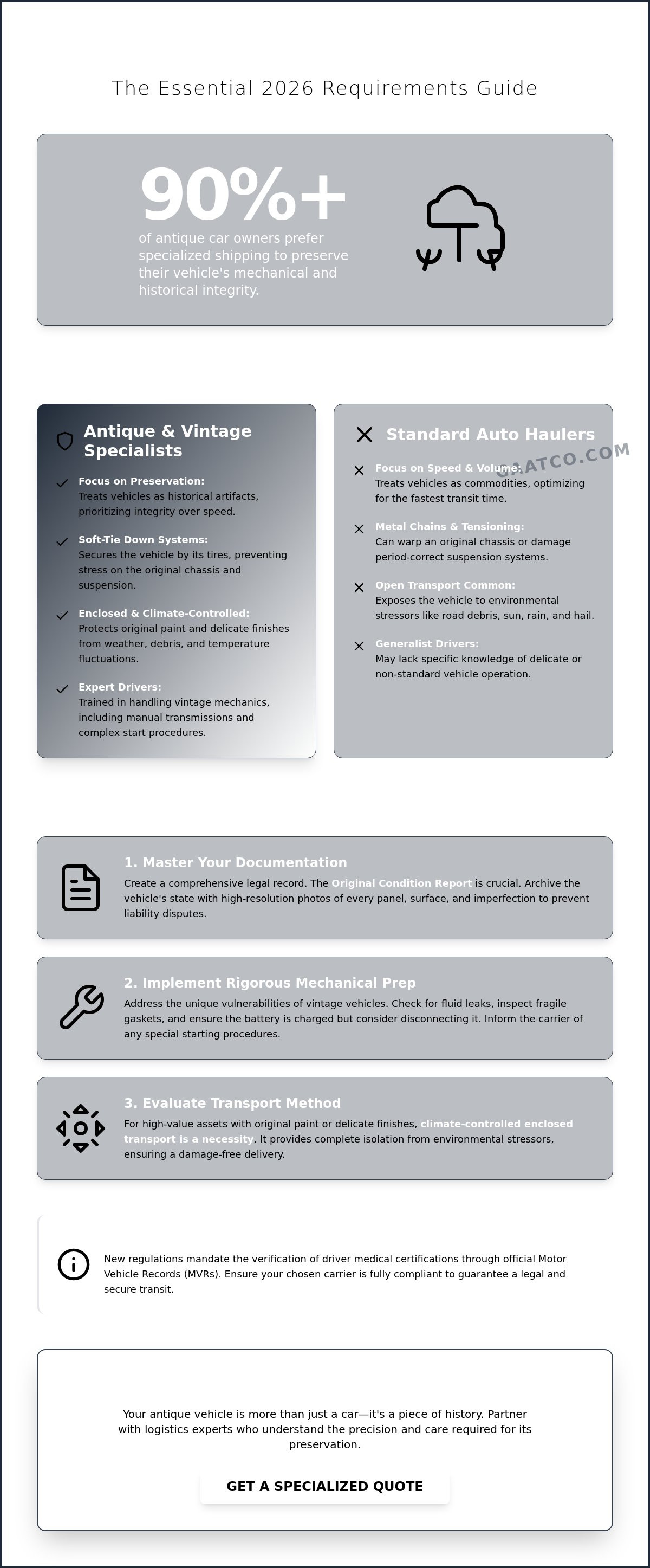
In 2026, the distinction between classic and antique status has become more technically rigorous. While a classic car might be a well-maintained vehicle from the 1990s, an antique vehicle is defined by its historical significance and the fragility of its original components. Standard carriers often rely on metal chains or aggressive tensioning that can warp an original chassis or damage period-correct suspension systems. Specialized logistics prioritize the structural integrity of the asset above all else. This focus on preservation is a non-negotiable pillar for any reputable provider in the high-end market.
Defining the Antique Vehicle Category
Carriers typically use a 25-year threshold to classify a vehicle as an antique, though this status often triggers more stringent loading protocols. As a vehicle ages, the structural loading requirements change. What was once a robust frame may now require specific weight distribution to avoid stress fractures during transit. This historical value necessitates a higher tier of service that treats the car as a curated artifact rather than a commodity. Our team at GAATCO recognizes that every antique relocation is a preservation mission that demands meticulous attention to detail.
The Role of Specialized Carriers
A critical component of these requirements involves the expertise of the driver. Handling vintage machinery often requires knowledge of manual transmissions, complex starting procedures, and even double-clutching. Specialized carriers utilize soft-tie down systems that secure the vehicle by the tires rather than the frame. This prevents unnecessary tension on an original chassis. When evaluating Enclosed vs. Open Requirements, the choice often comes down to the level of environmental isolation required for high-value assets. Professional teams understand that these machines aren't just cars; they're legacies that require a discreet and dependable partner to handle the complex logistics on your behalf.
Documentation and Insurance Compliance Requirements
Securing the relocation of a high-value automotive asset requires a rigorous approach to administrative detail. Unlike standard vehicle shipping, meeting antique car transport requirements involves establishing a comprehensive legal record that protects the vehicle's historical and financial value. This process begins long before the trailer arrives, focusing on a multi-layered documentation strategy that serves as your primary defense against liability disputes. It's a formal transfer of responsibility that demands precision from every professional involved.
A central pillar of this strategy is the Original Condition Report. This document is far more than a cursory inspection; it's an exhaustive archive of the vehicle's current state, including high-resolution photography of every panel, trim piece, and interior surface. While federal law dictates what items may remain within a vehicle during transit, as outlined in the Mechanical and Physical Preparation Requirements, the documentation of the vehicle itself remains the owner's most critical responsibility. It provides the baseline for any future assessment of the transport's success and ensures that our team can maintain the high standards our clients expect.
The Bill of Lading for Collectors
The Bill of Lading (BOL) functions as the definitive legal contract between the collector and the carrier. In 2026, the legal weight of the pre-transport inspection is absolute. It's essential to document existing patina, which is often a source of value in the antique market, to distinguish it from potential transport wear. Notations should be specific, identifying non-standard features such as period-correct glass or original hood ornaments that require specialized handling. A precise BOL ensures that all parties are in complete agreement regarding the asset's condition at the point of origin, leaving no room for ambiguity during the journey.
Verifying Insurance Coverage Limits
Understanding the nuances of insurance is vital for any collector handling rare assets. While the FMCSA mandates carrier liability, the minimums often fall short of an antique car's true market value. Most enclosed carriers provide cargo insurance ranging from $250,000 to $1,000,000, yet rare vehicles may require an additional insurance rider. We recommend distinguishing between the carrier's cargo insurance and your private collector policy. "Gap" coverage is often necessary to account for the total value of irreplaceable original parts. If you're uncertain about the coverage levels needed for your specific vehicle, you can request a detailed quote to review our specialized protection options. Our team operates with the transparency required to give you peace of mind throughout the entire route.
Selecting the Transport Method: Enclosed vs. Open Requirements
Deciding between open and enclosed trailers is a fundamental aspect of meeting antique car transport requirements. Statistics indicate that roughly 60% of luxury and classic car owners select enclosed options, a preference driven by the need for absolute environmental isolation. For a vehicle with original paint or a century-old wood-frame body, the variables of the open road present a risk profile that requires careful evaluation. The choice is rarely about cost alone; it's about the technical needs of the asset's preservation.
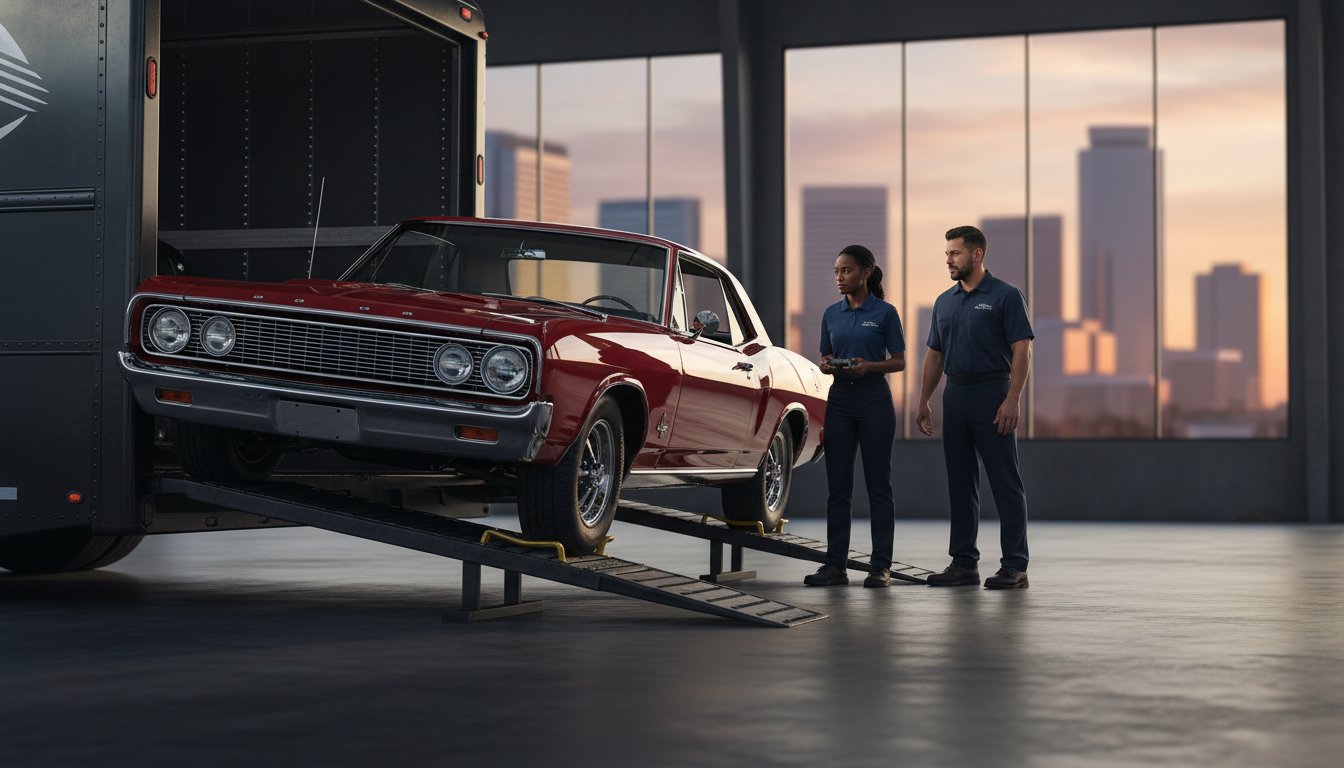
Enclosed auto transport provides 99.9% protection against transit-related damage. This level of security is essential for high-value assets where a single stone chip could diminish the vehicle's provenance or historical value. In 2026, climate-controlled environments have moved from a luxury addition to a logistical standard for sensitive materials like early plastics, horsehair upholstery, or nitrocellulose lacquer. Owners must choose between hard-side trailers, which offer a solid metal shell, and soft-side trailers that utilize heavy-duty curtains. For vehicles with minimal ground clearance, the use of a hydraulic lift-gate loading system is a non-negotiable requirement. These systems eliminate the steep angles of traditional ramps, ensuring the delicate undercarriage remains untouched during the loading process.
The Enclosed Advantage for Antiques
Protection from road debris, UV exposure, and inclement weather is the primary driver for choosing enclosed shipping. Hard-side trailers are particularly effective at maintaining a stable internal temperature, which prevents the expansion and contraction cycles that can crack aged finishes. The requirement for lift-gate loading is equally critical. Unlike standard ramps, lift-gates keep the vehicle perfectly level, which is vital for early 20th-century cars with low-hanging components or fragile suspension geometries. This "white-glove" approach ensures that the vehicle's structural integrity is never compromised by the loading equipment itself.
When Open Transport is Permissible
Open car transport remains a pragmatic logistics solution for specific scenarios, such as moving an antique restoration shell or an inoperable "project" car. When a vehicle is destined for a complete strip-down or lacks sensitive interior components, the 30-60% cost savings compared to enclosed methods is a logical choice. It's an efficient solution for short-distance hauls, such as moving a chassis to a specialized workshop for metalwork. Even in these cases, we prioritize placement on the upper deck of a multi-car carrier to mitigate the risk of fluid leaks from vehicles positioned above. For collectors managing multiple assets, Open Car Transport offers a reliable way to relocate less delicate inventory without overextending the logistics budget.
Beyond physical protection, the transport method addresses the need for operational discretion. High-profile collections or celebrity-owned assets often require the anonymity provided by an unmarked enclosed trailer. This prevents unwanted attention at fuel stops or during overnight layovers. By aligning the transport method with the specific mechanical and social requirements of the vehicle, we act as a trusted advisor in the preservation of your automotive history. Our team handles these complex logistics so you can focus on the enjoyment of your collection.
Mechanical and Physical Preparation Requirements
The transition from a climate-controlled garage to a specialized transport trailer requires a meticulous mechanical assessment. Fulfilling the antique car transport requirements is a proactive measure that respects the engineering of a bygone era while acknowledging the physical stresses of a long-distance journey. Even within the protective shell of an enclosed carrier, a vehicle must be prepared to remain stationary yet stable across varying elevations and road conditions. This preparation is the bridge between a successful relocation and a logistical complication.
One of the most frequent challenges in vintage logistics involves the management of fluid systems. Older gaskets and cork seals are notorious for weeping, especially when subjected to the vibrations of transit. We recommend checking all fluid levels but keeping the fuel tank at approximately one-quarter capacity to reduce weight and comply with safety protocols. To prevent any accidental fluid transfer to the trailer deck or other high-value assets, placing an absorbent mat under the engine and transmission is a sophisticated touch that reflects a collector's attention to detail.
Mechanical Stability for Transit
A significant gap in many standard guides is the specific handling of inoperable units. For restoration projects or "barn finds," the vehicle must still possess functional steering and a reliable braking system to be safely loaded. If a vehicle cannot roll or steer, it falls under the category of Inoperable Vehicle Transport, which requires specialized winching equipment and a different operational approach. Additionally, original tires require specific care. We suggest inflating them to the maximum recommended pressure to ensure the tie-down straps can maintain consistent tension without the risk of flat-spotting or shifting during the route. Isolating the electrical system by disconnecting the battery is a non-negotiable step to prevent parasitic drain or electrical shorts in aged wiring harnesses.
Exterior and Interior Safeguarding
The physical safeguarding of the vehicle starts with a thorough cleaning. A clean exterior is a prerequisite for a precise pre-transport inspection, allowing every existing patina mark or historical imperfection to be documented. Delicate components such as "flying lady" hood ornaments, loose chrome trim, or aftermarket side mirrors should be removed and packed separately. If the vehicle features a convertible top, it must be securely latched in the "up" position to maintain structural tension. Inside the cabin, we utilize protective wrapping for steering wheels and period-correct upholstery to prevent the transfer of dust or oils. Removing historical documentation and personal items from the glovebox or trunk ensures the transport remains compliant with federal regulations and protects irreplaceable provenance records. Our team at GAATCO acts as a discreet partner in these preparations, ensuring every technical detail is managed with the calm confidence your collection deserves.
Partnering with GAATCO for Specialized Antique Logistics
Choosing a logistics partner for a high-value asset requires more than comparing rates; it demands a synergy between the collector's standards and the provider's operational reach. At GAATCO, our 20-year legacy in the industry has been built on a foundation of quiet luxury and absolute reliability. We recognize that meeting antique car transport requirements isn't merely a checklist; it's a commitment to preserving automotive history. Our team operates as a bridge, handling the intricate complexities of specialized hauling so you can focus on the stewardship of your collection.
Our presence in major metropolitan hubs like Houston, Dallas, and Atlanta allows us to provide a level of door-to-door precision that standard carriers cannot match. We've developed a sophisticated infrastructure that caters to the specific needs of the antique market, ensuring that every relocation is treated with the seriousness it deserves. We don't just move cars; we manage the relocation of legacies through a licensed carrier network that shares our commitment to core operational values.
Regional Expertise in Major US Markets
The logistics of moving a vehicle to a high-profile auction in Las Vegas or Miami require more than just a trailer; they require strategic routing and local intelligence. Our professionals are deeply familiar with the logistical corridors of New York and Chicago, where urban density and traffic patterns demand a measured, professional approach. We prioritize strategic routing to avoid high-risk weather zones, ensuring that sensitive cargo is never exposed to unnecessary environmental stressors. Whether you're moving a single asset or a multi-car collection, our regional expertise provides a significant geographic advantage that ensures a stable, controlled environment throughout the route.
Initiating Your Preservation Mission
The process begins with a detailed consultation where we define your vehicle's unique requirements, from mechanical quirks to specific loading protocols. We believe in transparent pricing that reflects the elite nature of our enclosed and specialized services. There are no hidden fees or unexpected complications; only a steady, measured flow of information from pickup to delivery. We understand the nuances of high-end service and the critical urgency required for specialized transport. When you're ready to secure the future of your automotive legacy, we invite you to request a customized antique transport quote. Our unified team is standing by to act as your trusted advisor in the high-stakes world of specialized logistics, handling every detail with the calm confidence that comes from decades of expertise.
Securing Your Automotive Legacy for the Road Ahead
Relocating a high-value vintage vehicle is an exercise in meticulous preservation rather than simple transit. By establishing a rigorous Bill of Lading, selecting climate-controlled enclosed trailers, and performing comprehensive mechanical checks, you ensure your asset's historical integrity remains intact. Mastering these antique car transport requirements provides the technical foundation needed to navigate the complexities of 2026 logistics with absolute precision. It's a process that demands a dedicated focus on every detail to prevent cosmetic or structural wear during the journey.
With over 20 years of specialized logistics experience, our team offers the discreet and dependable partnership required for such high-stakes movements. We utilize a licensed and fully insured carrier network to provide dedicated enclosed transport for your most precious assets, bridging the gap between operational demands and your peace of mind. We invite you to Request a Specialized Antique Transport Quote from GAATCO to begin your vehicle's next chapter. Your collection deserves the attentive care and seasoned expertise that comes from a legacy of excellence.
Frequently Asked Questions
What are the primary differences between classic and antique car transport requirements?
Antique vehicles, typically defined as those over 25 years old, require more stringent preservation protocols than standard classic cars. These assets often feature fragile structural components, aged gaskets, and sensitive nitrocellulose finishes that demand climate-controlled environments and soft-tie down systems. While classic transport focuses on safety, antique car transport requirements prioritize the absolute isolation of the vehicle from environmental and mechanical stressors to maintain its historical provenance.
Do I need to empty the fuel tank of my antique car before shipping?
It's not necessary to completely drain the fuel tank; however, you should maintain a level of approximately one-quarter. This specific volume minimizes the total weight on the trailer while ensuring there's enough fuel to move the vehicle under its own power during the loading and unloading process. Keeping the tank at this level also complies with safety protocols regarding the transport of flammable liquids on multi-car carriers.
How does GAATCO handle inoperable antique vehicles during the loading process?
We utilize specialized winching equipment and hydraulic lift-gates to manage inoperable units with the same precision as running vehicles. For a successful relocation, the vehicle must still possess functional steering and a reliable braking system to ensure it can be guided safely onto the trailer. If these systems are compromised, we coordinate additional equipment to handle the asset as a static load, maintaining our commitment to a damage-free delivery.
Is enclosed transport a mandatory requirement for all antique cars?
Enclosed transport isn't a legal mandate, but it's a technical standard for any antique with original paint or a high market valuation. Statistics show that roughly 60% of collectors choose enclosed trailers to ensure 99.9% protection from road debris and inclement weather. For vehicles with delicate interior materials or exposed engine components, this method is the only way to meet the rigorous antique car transport requirements expected in the high-end market.
What should I look for in the Bill of Lading when my antique car is delivered?
You should meticulously compare the vehicle's current state against the high-resolution photography and notations made in the pre-transport inspection report. Pay close attention to the specific condition of the original trim, glass, and paintwork documented at the point of origin. Before signing the Bill of Lading to release the carrier from liability, ensure that no new imperfections have occurred and that the vehicle's historical patina remains exactly as recorded.
Can I ship extra parts or a spare engine with my antique vehicle?
Federal regulations and carrier weight limits generally prohibit the inclusion of loose parts, spare engines, or personal items inside the vehicle during transit. Such items can shift and cause internal damage to original upholstery or glass. If your relocation includes a significant inventory of spare components, we recommend handling them through a separate, specialized freight service to ensure both the car and the parts arrive securely.
How do I verify that a carrier is properly insured for a high-value antique?
You can verify a carrier's credentials and active insurance limits by accessing the FMCSA carrier database with their DOT number. Reputable enclosed carriers typically maintain cargo insurance between $250,000 and $1,000,000. It's essential to confirm that their policy specifically covers high-value automotive assets and to determine if an additional insurance rider is necessary to match the full market value of your specific vehicle.
What are the specific requirements for shipping an antique car to a major auction in Houston or Miami?
Auction logistics demand strict adherence to pre-scheduled delivery windows and specific gate protocols established by the auction house. We coordinate directly with the event organizers in these major hubs to ensure your vehicle arrives clean, documented, and ready for the showroom floor. This includes managing the transition from the trailer to the auction's intake team with the discreet professionalism required for high-profile sales environments.


