

Loose parts can complicate a project-car shipment as much as the vehicle’s condition. Shipping a project car with loose parts takes more than identifying the car as non-running: the carrier needs to know what you want to ship, how each item will be secured, and whether it can be accepted inside the vehicle.
It’s understandable to worry that components could shift, damage the car, or go unaccounted for, particularly when the vehicle is incomplete or cannot move under its own power. Treat every part as a separately managed item, not incidental cargo. Acceptance and handling policies vary, so confirm the assigned carrier’s requirements before pickup instead of assuming loose parts are covered.
This guide explains how to describe the car’s condition, prepare a useful parts inventory, and secure any components the carrier agrees to transport. It also compares open and enclosed transport with separate shipping for parts, so you can discuss an arrangement that fits the car and pickup access. Before booking, you’ll know what to ask about loading, documentation, and insurance terms.
Key Takeaways
- Confirm separately whether the carrier will accept the project car and any loose parts before booking.
- For shipping a project car with loose parts, create a clear inventory and document each item’s condition before handoff.
- Compare open and enclosed vehicle transport with separate shipping for parts. The vehicle option does not determine whether loose cargo is accepted.
- Describe whether the car runs, rolls, steers, and brakes, and discuss access at both pickup and delivery addresses.
- Before pickup, review the carrier’s loading, documentation, and insurance terms for your specific shipment.
Shipping a Project Car With Loose Parts: What to Confirm First
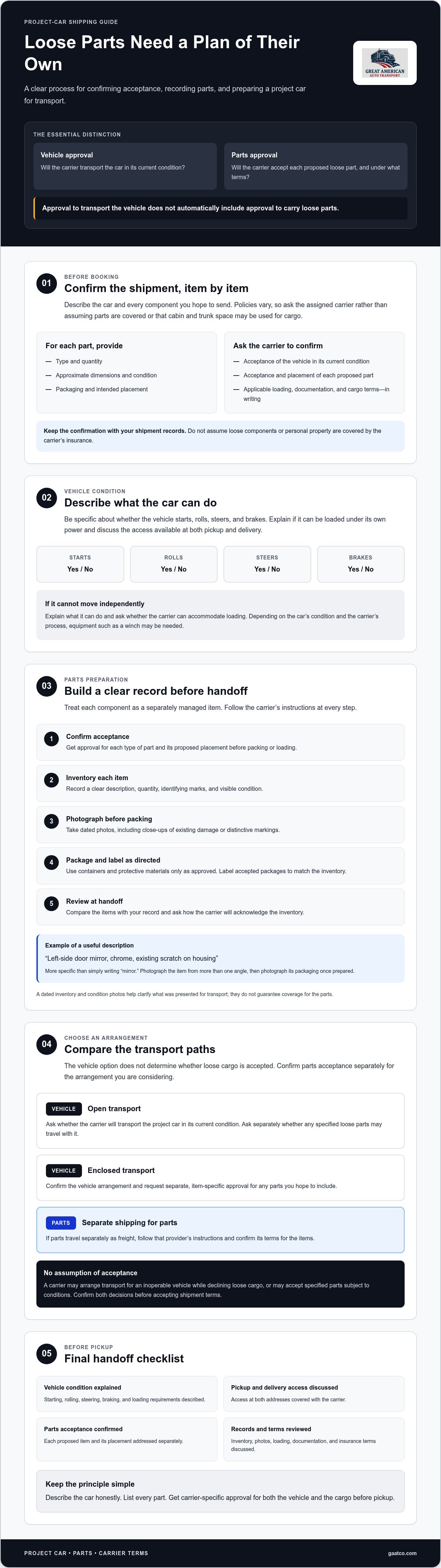
A project car may be incomplete, partly disassembled, or undergoing restoration. Explain that clearly, but do not assume every carrier will assess the vehicle the same way. Before arranging transport, confirm two separate things: whether the carrier will transport the vehicle in its current condition and whether it will accept any loose parts inside it.
Approval to transport the vehicle does not automatically include approval to carry unsecured parts. Space in the cabin or trunk is not permission to use it for cargo. Ask for item-specific written approval and review the carrier’s loading, documentation, and cargo terms. Do not assume loose components or personal property are covered by the carrier’s insurance.
Can loose parts travel inside a project car?
Policies differ, so describe every proposed item before loading. For each part, provide its type, quantity, approximate dimensions, packaging, and intended placement. A boxed set of small trim pieces presents different handling questions from a loose bumper or heavy engine component.
- List each part and its current condition.
- Describe how it will be packaged and secured.
- Identify where it will be placed in the vehicle.
- Ask the carrier to confirm acceptance and applicable terms in writing.
Keep the inventory and any carrier confirmation with your shipment records. These documents help clarify what was agreed, but they do not guarantee coverage for the parts.
How does the car's condition affect transport?
State whether the car starts, steers, brakes, and can be loaded under its own power. If it cannot move independently, explain what it can do and ask whether the carrier can accommodate the loading requirements. Depending on the vehicle’s condition and the carrier’s process, an incomplete or inoperable car may need equipment such as a winch.
Assess the vehicle and its parts separately. A carrier may be able to arrange transport for an inoperable vehicle while declining loose cargo, or may accept specified parts subject to conditions. Confirm both decisions before accepting the shipment terms.
If you are coordinating through an auto transport broker, confirm how the assigned carrier’s requirements and written approvals will be communicated. For shipping a project car with loose parts, start with a complete description of the vehicle, its condition, and every component you hope to include.
How to Inventory, Prepare, and Secure Loose Project-Car Parts
A consistent record helps you and the carrier understand what is traveling with the car and the condition of each item before pickup. When shipping a project car with loose parts, use a simple process and follow the carrier’s instructions. Do not assume that a container or empty footwell is acceptable.
- Confirm acceptance. Get approval for each type of part and its proposed placement before packing or loading.
- Inventory the items. Record a clear description, quantity, identifying marks, and visible condition for each component.
- Photograph them. Take dated photos of each item before packing, including close-ups of existing damage or distinctive markings.
- Package as directed. Use containers and protective materials only as approved by the carrier.
- Label clearly. Mark accepted packages so their contents can be matched to your inventory.
- Review at handoff. Compare the items with your record and ask how the carrier will acknowledge the inventory.
A dated inventory and condition photos give you and the carrier a clearer record of what was presented for transport. They do not guarantee coverage for the parts.
Build a useful parts inventory
Use details that distinguish similar components. For example, write “left-side door mirror, chrome, existing scratch on housing” rather than simply “mirror.” Photograph each item from more than one angle, then photograph its packaging once prepared. Keep copies with your shipment records, and ask whether the carrier wants the inventory submitted in advance or reviewed at pickup.
Package and place parts only as approved
If the carrier accepts containerized parts, confirm any size or weight limits and how the container must be closed and secured. Do not leave heavy, sharp, fragile, or fluid-containing components loose in the cabin. Parts must not obstruct vehicle access, controls, windows, or loading points. If parts are traveling separately as freight, follow that provider’s instructions. The Federal cargo securement rules provide a reference for cargo securement, but they do not establish that a vehicle carrier will accept items inside your car.
At handoff, ask the driver to review the agreed arrangement and document any difference between the inventory and the shipment. Keep the carrier’s written approval with your photos and list, and confirm applicable cargo terms rather than assuming an inventory proves insurance coverage. To compare transport arrangements for your vehicle, review GAATCO’s vehicle transport services.
Open, Enclosed, or Separate Freight: Compare Project-Car Shipping Options
The right arrangement depends on the car’s condition, how much exposure you are comfortable with, and the carrier’s written terms for any parts. Open and enclosed describe how the vehicle is transported. Neither option automatically includes loose cargo, so confirm the parts policy separately before choosing.
| Option | Vehicle exposure | Project-car suitability | Parts arrangements | Questions to verify |
|---|---|---|---|---|
| Open transport | Vehicle travels exposed to weather and road debris. | May suit a project car that meets the carrier’s loading and transport requirements. | Loose parts require separate approval. Do not assume they can travel inside. | Can the vehicle be loaded in its current condition? Are specified parts accepted, and how must they be secured? |
| Enclosed transport | Vehicle is carried inside an enclosed trailer, offering additional protection from weather and road debris. | May suit a vehicle when reduced exposure is a priority, subject to carrier acceptance and loading requirements. | Enclosure does not mean loose parts are approved. Confirm each item and its placement. | Do the vehicle’s dimensions and condition fit the carrier’s requirements? What are the parts and loading terms? |
| Separate parcel or freight shipment | Parts travel separately from the vehicle. | Can be considered when the carrier will not accept parts in the car or when components need individual handling. | Packaging, acceptance, handling, and coverage depend on the selected parcel or freight provider. | Can the recipient accept delivery? How will arrival timing coordinate with the vehicle? |
When might open or enclosed transport make sense?
Open transport is worth discussing for project cars that meet the carrier’s requirements and do not need the additional enclosure. Enclosed transport may suit owners seeking added protection from weather and road debris, but it does not resolve questions about an incomplete vehicle or its loose components.
For either method, describe whether the car starts, rolls, steers, and brakes. Confirm loading requirements, vehicle dimensions, and whether the carrier can accommodate its condition. Then get a separate answer about every part you propose to include.
When should parts travel separately?
Consider separate shipment for valuable, fragile, bulky, or carrier-restricted components. Coordinating the vehicle and parts in one move may be more convenient, while separate parcel or freight transport can allow item-level packaging and handling. These are different arrangements, and neither should be assumed to include the other.
Before dispatch, check the parts provider’s delivery estimate and the receiving location’s availability. Coordinating arrival helps avoid parts reaching the project site before anyone can receive them or well before the vehicle arrives. For shipping a project car with loose parts, choose a transport method only after matching the car’s condition and parts plan to confirmed carrier terms.
A Step-by-Step Checklist for Booking and Handoff
A reliable booking starts with an accurate account of the vehicle and access at pickup and delivery. Before accepting transport terms, share the car’s condition and every proposed loose-parts arrangement with the carrier. For shipping a project car with loose parts, clear disclosure helps the carrier assess loading needs and confirm what the shipment includes.
Before confirming the carrier
- Describe the car’s condition. State whether it starts, rolls, steers, and brakes. Explain what is incomplete or disassembled, and provide dimensions if unusual bodywork or components affect its size.
- Detail every part. List the type and quantity of items, their approximate dimensions, packaging, and intended placement. Ask whether the carrier accepts each item and how it must be packed or secured.
- Confirm the loading plan. If the car cannot start, steer, or brake, explain exactly what it can do and ask what loading method and equipment the carrier can accommodate.
- Check both addresses. Describe driveway, gate, or other access limitations at pickup and delivery. In dense streets or restricted-access areas, ask whether a nearby meeting point is more practical and confirm the arrangement with the carrier.
- Review documentation and terms. Ask which shipment records will describe the vehicle’s condition, approved parts, and applicable cargo or insurance terms. Confirm how the parts inventory will be submitted or acknowledged.
Prepare for pickup and delivery
Before the driver arrives, remove belongings and components that have not been approved. Keep accepted parts packaged and secured exactly as directed. Check with the carrier before making last-minute changes to the number of items, their placement, or their packaging.
At pickup, review the vehicle’s condition with the driver and compare the agreed parts arrangement with what is present. Make sure relevant observations or inventory details are recorded in the shipment documentation. Retain copies of the inventory, photographs, written approvals, and transport terms. These records clarify what was presented, but do not by themselves establish insurance coverage.
Confirm who will provide access at pickup and who will receive the vehicle at delivery. If parts are traveling separately, coordinate with the recipient so they can accept that shipment too. GAATCO arranges open, enclosed, door-to-door, and inoperable-vehicle transport. Confirm loose-parts acceptance with the assigned carrier. Discuss your project-car transport requirements with GAATCO before agreeing to the shipment terms.
Arrange Project-Car Transport With GAATCO
Planning a project-car move starts with a complete description, not an assumption that the car or its components will fit a standard shipment. Share the vehicle’s condition, provide a parts list, confirm the assigned carrier’s acceptance and terms, then choose the transport arrangement that suits the car. GAATCO’s primary service is open car transport, with enclosed, door-to-door, and inoperable-vehicle transport also available to discuss based on shipment needs.
What information helps plan a project-car shipment?
Gather the details before requesting transport so the proposed arrangement can be assessed accurately. Include pickup and delivery locations, the vehicle’s year and model, and whether it starts, rolls, steers, and brakes. Note dimensions if unusual bodywork or installed components could affect loading.
- Parts: Describe each item, its quantity and approximate size, how it will be packaged, and where you propose placing it.
- Access: Explain driveway, gate, street, or other restrictions at both addresses, along with any known loading needs.
- Separate shipments: If parts will travel independently, identify the receiving location and contact so delivery can be coordinated.
This information gives the transport provider a practical basis for discussing options. GAATCO has more than 20 years of industry experience arranging U.S. vehicle transport, but loose-parts acceptance and applicable terms still need to be confirmed with the assigned carrier for your shipment.
Confirm the arrangement before the vehicle is collected
Before accepting terms, ask the assigned carrier to confirm in writing whether the listed parts are accepted, how they must be packaged or placed, and what documentation records the vehicle’s condition and the parts arrangement. Review the loading plan and relevant cargo and insurance terms with the transport provider. Do not treat space inside the car as approval or assume that carrier insurance covers loose parts.
For shipping a project car with loose parts, clear communication at booking helps align the vehicle’s condition, loading needs, and parts plan before pickup. Review GAATCO’s vehicle transport services to compare available options. Once you have gathered the shipment details, you can request a project-car shipping quote and discuss the arrangement before confirming carrier terms.
Set Your Project-Car Shipment Up for a Clear Handoff
Successful shipping a project car with loose parts starts with a precise account of the vehicle and its contents. Describe whether the car runs, rolls, steers, and brakes; inventory the parts; and confirm in writing whether the assigned carrier accepts them and under what terms. An organized record and suitable loading plan help reduce uncertainty at pickup and delivery.
GAATCO brings more than 20 years of industry experience to vehicle transport arrangements and works with licensed and insured carriers. Open transport is its primary service, with enclosed, door-to-door, and inoperable-vehicle options available to discuss based on the shipment. Loose-parts acceptance and applicable cargo terms still need to be confirmed for your specific carrier and shipment.
GAATCO arranges vehicle transport involving Atlanta, Miami, New York, Houston, Dallas, San Diego, San Francisco, Seattle, Orlando, Boston, Nashville, Denver, Austin, Chicago, Las Vegas, and Phoenix. Once you have the vehicle details, parts list, and access information ready, request a project-car transport quote and discuss the arrangement before accepting terms. Careful preparation and clear communication can help you move forward with greater confidence and keep your restoration plans on track.
Frequently Asked Questions
Can I ship loose parts inside a project car?
Possibly, but confirm acceptance with the assigned carrier before loading. Policies differ, and approval to transport the vehicle does not automatically include approval for parts inside it. Provide an itemized description, quantity, approximate dimensions, packaging, and intended placement for each component. Ask for written confirmation of what is accepted and how it should be secured, then keep that confirmation with your shipment records.
Will auto transport insurance cover loose parts inside my car?
Do not assume that carrier insurance covers loose parts or personal property inside the vehicle. Coverage and applicable terms depend on the specific shipment and carrier documentation. Before pickup, ask what the carrier’s records say about the vehicle, approved parts, and condition, and request clarification about applicable cargo terms. An inventory and photographs can document what you presented, but they do not establish insurance coverage or guarantee reimbursement.
How should I prepare loose parts for car transport?
First, get the carrier’s approval and packaging instructions for each part. Record each item’s description, quantity, identifying marks, and visible condition, then take dated photographs before and after packaging. If the carrier accepts containers, confirm any size or weight restrictions and label them as directed. Avoid leaving heavy, sharp, fragile, or fluid-containing components loose, and keep approved items clear of controls, windows, access points, and loading areas.
Can a non-running project car be transported with parts?
A non-running project car may be eligible for inoperable-vehicle transport, but the carrier must assess its condition and loading needs. Explain whether it rolls, steers, and brakes, as well as whether it can be loaded under its own power. Discuss suitable loading equipment with the transport provider. Parts are a separate matter: disclose and get approval for every item, even if the vehicle itself can be transported.
Is open or enclosed transport better for a project car?
Neither option is universally better. Choose based on the vehicle’s condition, exposure preferences, loading requirements, and confirmed carrier terms. Open transport is GAATCO’s primary service, while enclosed transport may suit owners seeking additional protection from weather and road debris. For either method, confirm that the vehicle’s dimensions and condition can be accommodated. Ask separately whether loose parts are accepted, since the carrier type does not automatically approve cargo.
Should I ship project-car parts separately?
Separate parcel or freight shipment may be practical for valuable, fragile, bulky, or carrier-restricted components. It lets you arrange packaging and handling apart from the vehicle, although you should check the provider’s terms independently. A single coordinated move may be more convenient if the carrier accepts the parts. Compare the arrangements, confirm delivery timing, and make sure someone can receive separately shipped items.
What should I tell a car transport company before booking?
Provide pickup and delivery locations, the car’s year and model, dimensions if unusual, and whether it starts, rolls, steers, and brakes. Describe every proposed part, including quantity, approximate size, packaging, and intended placement. Disclose access restrictions and loading needs at both addresses, then ask for written confirmation of parts acceptance, documentation, and applicable terms. For moves involving Atlanta, Miami, New York, Houston, Dallas, San Diego, San Francisco, Seattle, Orlando, Boston, Nashville, Denver, Austin, Chicago, Las Vegas, or Phoenix, share the exact addresses and access details.


