
Professional vehicle transport is never an interchangeable commodity; it's a meticulous logistical operation where precision, transparency, and protective custody define true value. When evaluating national car shipping services, discerning owners often confront the transport industry's most frustrating friction points: unexpected surcharges appearing after vehicle collection, radio silence during cross-country transit, and genuine concern over exterior damage on open highways. Entrusting a valuable vehicle to a carrier network shouldn't require navigating an obstacle course of uncertain operating credentials or ambiguous contracts.
You deserve an uncompromising standard of safety and proactive communication from initial dispatch to destination. In this guide, you'll discover the nuances of safe, reliable vehicle transport through our expert analysis of carrier methods, specialized logistics, and transparent pricing frameworks. We examine the functional distinctions between open and enclosed carriers, demystify motor truck cargo insurance obligations, and outline the operational standards that guarantee a seamless, door-to-door transit experience.
Key Takeaways
- Understand the vital operational distinctions between licensed freight brokers and motor carriers to ensure your asset is protected under verified cargo coverage.
- Learn how to evaluate enclosed transport against standard open carrier methods to select the most appropriate car shipping services for your vehicle's specific valuation.
- Master the logistics of hassle-free door-to-door delivery and discover how rigorous condition reports safeguard you against transit disputes.
- Navigate specialized transport protocols, including military relocation guidelines and dedicated winch procedures required for inoperable assets.
- Deconstruct transparent pricing frameworks to understand how transit distance, vehicle dimensions, and fluctuating fuel surcharges shape your transport quote.
What Are Professional Car Shipping Services in 2026?
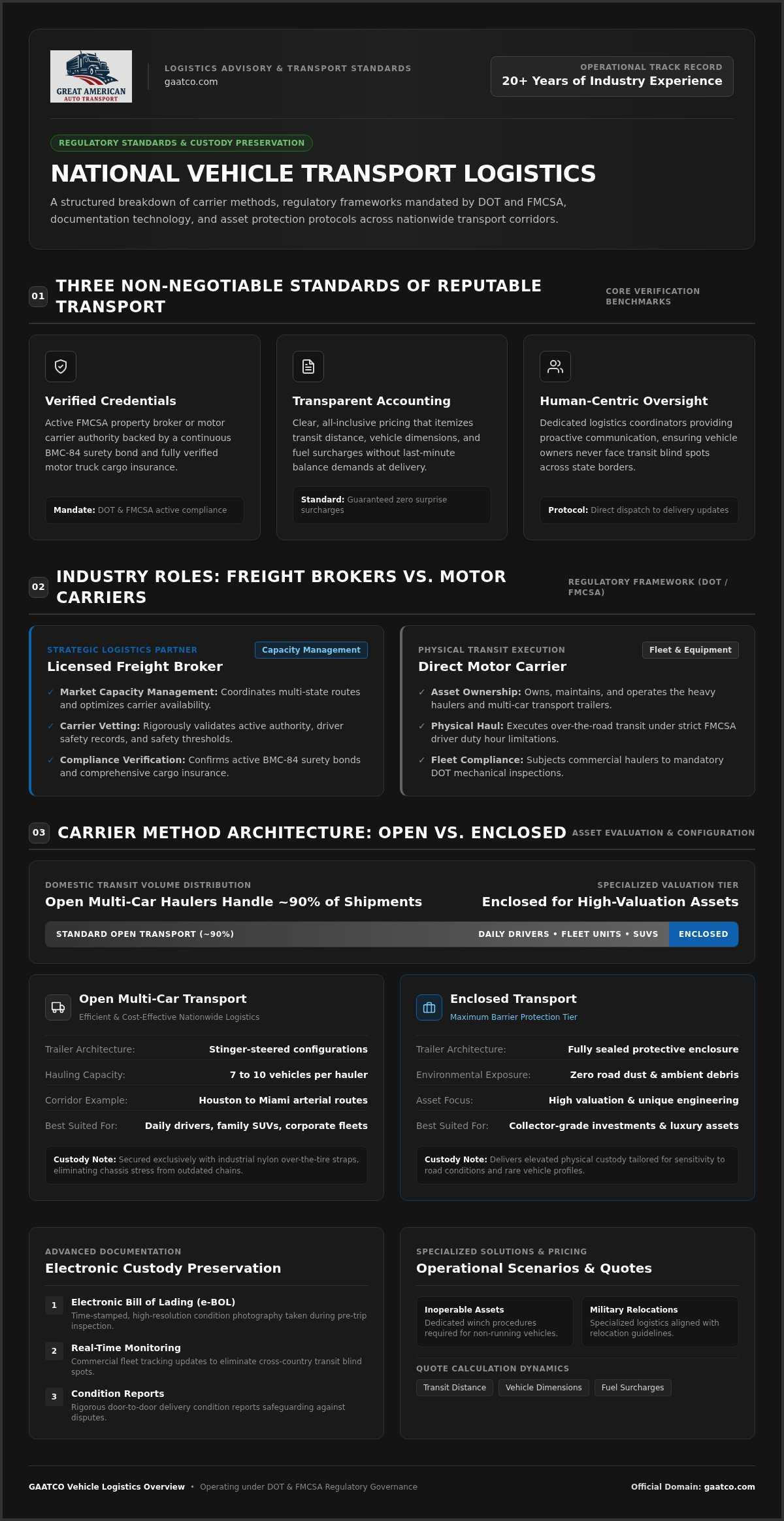
Professional vehicle transport represents an orchestrated logistical discipline rather than a basic freight transaction. Instead of subjecting an asset to prolonged interstate driving, where road debris, mechanical strain, and driver fatigue accumulate, specialized carriers deliver total custody preservation. Premium car shipping services operate under structured regulatory standards established by the Department of Transportation (DOT) and the Federal Motor Carrier Safety Administration (FMCSA). These regulatory bodies mandate driver duty thresholds, regular fleet inspections, and rigorous licensing benchmarks to ensure public safety and operational accountability across national highway networks.
Discerning owners must also recognize the distinct operational roles within the industry. Licensed freight brokers manage market capacity, vet carrier safety records, and verify active authority, while direct motor carriers own the heavy haulers and execute the physical haul. To better understand how reputable logistics advisors differentiate themselves from questionable operators, watch this detailed industry overview:
The Evolution of Modern Vehicle Logistics
Auto transport serves as an indispensable link in the domestic supply chain, orchestrating the secure relocation of personal and commercial automotive assets across state borders. The sector has transitioned decisively away from manual logistics. Today's commercial fleets utilize real-time shipment monitoring alongside electronic Bills of Lading (e-BOL) that feature time-stamped, high-resolution condition photography. Drawing upon more than 20 years of industry experience, GAATCO integrates these advanced documentation practices to ensure absolute clarity from the moment of dispatch to final offloading.
Identifying Reputable Car Shipping Companies
Securing an elite transport partner requires examining core operational credentials rather than promotional rhetoric. Reputable providers consistently exhibit three non-negotiable qualities:
- Verified Credentials: Active FMCSA property broker or motor carrier authority backed by a continuous BMC-84 surety bond and fully verified motor truck cargo insurance.
- Transparent Accounting: Transparent, all-inclusive pricing that clearly itemizes route variables without last-minute balance demands at delivery.
- Human-Centric Oversight: Dedicated logistics coordinators who communicate proactively, ensuring clients never face transit blind spots.
A distinguished provider approaches every shipment as a trusted advisor, coordinating bespoke car shipping services that preserve vehicle condition and deliver peace of mind.
Comparing Transport Methods: Open vs. Enclosed Carriers
Selecting the appropriate trailer architecture forms the foundational decision in national vehicle logistics. While open multi-car haulers safely handle approximately 90% of domestic shipments, unique engineering and high valuations call for an elevated protective barrier. Assessing the risk profile of your journey ensures that your vehicle receives custody appropriate to its build, rarity, and road sensitivity.
Open Car Transport: Safe and Efficient
For daily drivers, family sport utility vehicles, and corporate fleet units, open multi-car trailers offer an efficient, reliable transport solution. Modern open haulers utilize stinger-steered configurations designed to transport seven to ten vehicles smoothly across dense domestic corridors, such as high-volume transit routes between Houston and Miami.
GAATCO maintains exacting safety standards across our open carrier operations. Transport specialists secure vehicles exclusively with industrial nylon over-the-tire straps, entirely eliminating the outdated practice of chassis chains that can induce unnecessary frame and suspension stress. Although vehicles face typical ambient elements and road dust during transit, they remain structurally shielded from normal highway friction under vigilant carrier stewardship.
Enclosed Car Transport: The Elite Choice
Preserving collector-grade investments, track exotics, and bespoke luxury engineering requires a complete physical shield. Once an asset valuation exceeds the $70,000 threshold, industry underwriting standards strongly encourage enclosed transit to safeguard immaculate paint finishes from road debris, fluid drift, and unpredictable weather patterns.
Enclosed carriers represent the pinnacle of protective custody through specialized structural enhancements:
- Precision Ramp Technology: Hydraulic liftgates and extended race ramps maintain level loading angles, ensuring zero undercarriage contact for low-clearance vehicles.
- Superior Cargo Protection: Fully enclosed, hard-sided walls provide continuous defense against precipitation, ultraviolet rays, and interstate grit.
- Expanded Insurance Limits: Dedicated enclosed policies offer cargo coverage ranging from $250,000 to over $1,000,000, matching the exceptional value of elite automotive cargo.
Aligning the right trailer architecture with your vehicle's mechanical profile ensures effortless asset preservation. To explore which method best accommodates your timeline and protection preferences, review our specialized car shipping services to establish an optimal logistics plan.
The Logistics of Door-to-Door Auto Shipping
Door-to-door transport remains the benchmark for modern vehicle logistics, eliminating the inconvenience of remote regional storage yards. In practical logistics, the term signifies delivery as close to your designated address as legally and physically feasible. Professional car shipping services replace administrative burdens with a coordinated, white-glove handoff that respects both your schedule and your vehicle's safety.
Central to this process is the driver's role in executing the Bill of Lading (BOL). The BOL serves three vital legal and operational functions: a receipt of freight, a contract of carriage, and an official pre-trip condition report. During pickup, the transport operator documents every pre-existing panel mark, glass flaw, or bumper scuff. Signing off on this document formalizes baseline custody, ensuring that both client and carrier share an indisputable record before the hauler departs.
Managing Pickups in Major Metropolitan Hubs
Navigating dense urban cores requires rigorous route planning. Commercial multi-car haulers measure up to 80 feet in length, span 102 inches in width, and weigh up to 80,000 pounds. These physical dimensions prevent drivers from legally or safely entering tight residential areas, cul-de-sacs, or historic districts subject to strict axle-weight bans and low-hanging utility lines in cities such as Boston, New York, and San Francisco.
To overcome municipal restrictions while preserving convenience, our dispatchers arrange accessible, nearby commercial transfer zones. Coordinating pickups at broad retail plazas, highway frontage corridors, or designated freight staging points allows drivers to load vehicles without property risk. Through the tailored solutions outlined in our GAATCO services, clients in complex metropolitan environments receive customized routing that eliminates downtown congestion delays.
Ensuring a Seamless Delivery Experience
Consistent, transparent communication underpins a stress-free transit journey. Rather than dealing with automated call centers, clients receive advance updates directly from their logistics coordinator and driver as the carrier approaches the delivery window.
Upon delivery, a joint walk-around inspection verifies vehicle integrity against the initial Bill of Lading:
- Systematic Visual Review: Inspecting all exterior painted surfaces, glass, and alloy wheels in direct sunlight or adequate lighting.
- Mechanical Verification: Confirming baseline operating status, battery charge, and odometer continuity.
- Formal Sign-Off: Endorsing the electronic delivery report to confirm that your asset arrived safely in pristine condition.
For corporate executives and discerning vehicle owners, this meticulous verification process delivers total accountability and an effortless transit experience.
Specialized Solutions for Military and Unique Assets
Standard transport frameworks frequently fall short when coordinating non-traditional vehicle relocations. Moving high-value antique collections, handling disabled machinery, or orchestrating critical fleet exchanges requires tailored mechanical configurations. As a trusted logistics partner, GAATCO provides purpose-built car shipping services designed to accommodate complex operational parameters, including reliable dealer-to-dealer transport solutions that keep commercial automotive inventories moving between regional networks without operational delays.
Supporting Our Service Members: Military PCS Moves
Permanent Change of Station (PCS) relocations demand absolute punctuality and strict adherence to federal guidelines. Under the Joint Travel Regulations, the military does not fund POV (Privately Owned Vehicle) shipping for standard continental United States (CONUS-to-CONUS) assignments; service members receive a Monetary Allowance in Lieu of Transportation (set at $0.205 per mile for 2026) to manage their travel. When driving a secondary family car cross-country is impractical alongside tight reporting dates, private transport becomes essential.
We coordinate secure relocations across major military hubs, including San Diego, Norfolk, and San Antonio. Our dispatch teams align carrier arrival schedules with strict base reporting deadlines, providing our armed forces personnel with dependable custody and timely delivery.
Handling Non-Running and Classic Vehicles
Relocating an inoperable vehicle introduces intricate physical challenges that exclude standard drive-on ramps. Safely loading a disabled powertrain or a project vehicle undergoing restoration requires heavy-duty winching equipment, specialized snatch blocks, and careful cable positioning to avoid chassis distortion. Both the carrier and dispatch team must confirm whether the vehicle can steer, roll, and brake to select the correct mechanical gear before dispatch.
Classic car transport demands a similarly elevated degree of stewardship to protect delicate mechanical systems and irreplaceable period finishes:
- Low-Angle Loading Ramps: Specialized hydraulic liftgates ensure that vintage automobiles with low clearances avoid bumper or exhaust contact.
- Soft-Strap Anchorage: Premium nylon wheel netting replaces harsh axle chains, eliminating mechanical strain on delicate vintage suspensions during long-distance transit.
- Sealed Transport Enclosures: Hard-walled trailers maintain a climate-controlled, dust-free environment, protecting vulnerable lacquer paintwork and exposed engine bays from highway contaminants.
Whether you require specialized winch recovery or white-glove enclosed transport for an irreplaceable investment, GAATCO provides complete logistical oversight. If you are preparing for a military relocation or moving a collector-grade asset, request a quote to initiate your personalized transit plan.
Evaluating Car Shipping Costs and Securing Your Quote
Transport pricing reflects dynamic operational variables rather than arbitrary flat fees. A legitimate quote accounts for route geometry, required trailer architecture, and current national diesel fuel surcharges that fluctuate alongside federal energy benchmarks. When timelines demand expedited vehicle placement, dedicated dispatch surcharges compensate haulers for adjusting complex regional staging schedules to secure immediate pickup windows. Evaluating these operational levers empowers owners to select transparent car shipping services without facing unbudgeted balance demands mid-transit.
Understanding the Pricing Framework
Vehicle curb weight and physical dimensions directly dictate carrier deck allocation. Because commercial multi-car haulers operate under strict federal gross vehicle weight ceilings, heavy full-size trucks and extended utility vehicles consume substantially more capacity than compact sedans. Consequently, physical dimensions, ground clearance requirements, and overall vehicle mass influence both hauler fuel consumption and available trailer space.
Seasonal migration patterns also shift carrier capacity across regional corridors. Imbalances in freight volume between disparate metropolitan hubs, such as Seattle and Orlando, create directional supply and demand swings throughout the calendar year. When you request a quote, our logistics specialists analyze these market variables to present a realistic, binding pricing structure tailored to your exact transit requirements.
Finalizing Your Vehicle Transport Agreement
Carefully examining the terms of carriage provides vital reassurance before transfer of custody occurs. Asset owners should confirm active motor truck cargo policies, verify deductible structures, and ensure that contingency provisions are transparently outlined in writing. In the auto haul industry, an unusually cheap introductory bid often signals an unvetted carrier, delayed scheduling windows, or hidden administrative fees billed after pickup.
Securing elite logistics means prioritizing reliability, safety compliance, and direct accountability over cut-rate promises. With over two decades of nationwide freight management experience, GAATCO manages every phase of transit with meticulous precision, providing complete transparency and trusted expertise from pickup to final offloading.
Partnering for Precision Vehicle Logistics
Selecting dependable car shipping services comes down to choosing operational precision, verified regulatory compliance, and complete logistical transparency. Safe vehicle transport doesn't have to be a source of anxiety. It requires matching your asset's mechanical profile to the proper trailer architecture, insisting on rigorous condition documentation via the Bill of Lading, and partnering with a provider who values integrity over cut-rate shortcuts.
Backed by over 20 years of logistics expertise, GAATCO orchestrates nationwide transport through an extensively vetted, licensed and fully insured carrier network. We eliminate transit friction with proactive communication and tailored execution, providing specialized services for luxury and military clients alongside effortless door-to-door delivery. Your vehicle represents a significant investment, and its relocation deserves uncompromised professional oversight. To ensure your asset arrives safely and on schedule, request a professional auto transport quote from GAATCO and experience logistics delivered with confidence.
Frequently Asked Questions
How much does it cost to ship a car across the country in 2026?
National auto transport costs depend on several core operational variables rather than a static flat rate. Total transit mileage, vehicle curb weight, trailer configuration, and regional diesel fuel surcharges shape the final rate. Moving a vehicle between major hubs like Seattle and Miami or Boston and Phoenix requires custom routing calculations, so requesting a tailored quote ensures accurate pricing without unexpected post-dispatch fees.
What is the difference between a car shipping broker and a carrier?
A licensed freight broker coordinates national logistics, evaluates carrier safety records, and negotiates route capacity, whereas a motor carrier physically owns the tractor-trailers and executes the highway transit. Reputable car shipping services often operate under broker authority to curate a vetted, compliant carrier network. This structure provides shippers with nationwide coverage, continuous oversight, and dedicated customer support that direct owner-operators rarely maintain.
Is my vehicle insured during the car shipping process?
Every legitimate commercial auto carrier must maintain active public liability insurance alongside dedicated motor truck cargo coverage. Standard open trailers generally hold between $100,000 and $250,000 in cargo insurance, while specialized enclosed carriers carry coverage limits ranging from $250,000 to over $1,000,000. Before dispatch, your logistics coordinator verifies that the assigned hauler holds an active certificate of insurance naming appropriate policy thresholds.
How long does it typically take to ship a car from New York to Los Angeles?
Cross-country transit between the East and West Coasts typically takes between 7 and 10 business days once loaded. Federal safety mandates limit commercial truck drivers to 11 hours of daily driving following a mandatory 10-hour rest break. Regional weather, route topography, and multi-vehicle stops across metropolitan corridors like Chicago, Denver, or Las Vegas can occasionally adjust arrival windows.
Can I ship personal items inside my vehicle during transport?
Carriers generally discourage packing personal belongings inside a vehicle because federal motor carrier regulations strictly govern freight classifications. Commercial car haulers face strict 80,000-pound interstate gross vehicle weight caps, and auto carrier cargo insurance policies do not cover personal property against theft or transit shifting. Leaving cargo in the cabin or trunk risks carrier fines and overweight penalties at state weigh stations.
What is required to prepare my car for professional shipping?
Preparing a vehicle requires maintaining a quarter tank of fuel to minimize dead weight while preserving operational ability for staging. Wash the vehicle thoroughly so existing exterior blemishes are clearly visible during the pre-trip inspection. Ensure tires are properly inflated, disengage automated toll transponders, remove loose exterior accessories, and secure personal items before the hauler arrives for pickup in hubs like Dallas or Atlanta.
Do you offer car shipping services for inoperable vehicles?
Yes, GAATCO coordinates specialized transit for non-running vehicles, classic rebuild projects, and rolling chassis across our national network. Moving an inoperable vehicle requires specialized trailer equipment, including heavy-duty electric winches and reinforced synthetic line gear. When booking, inform your logistics specialist whether the vehicle rolls, steers, and brakes so we can assign an appropriately equipped hauler to the assignment.
How does door-to-door auto transport work in crowded cities like New York?
Door-to-door transit delivers your vehicle as close to your designated address as safety and local laws permit. Because 80-foot commercial car carriers cannot navigate narrow residential avenues, tight turns, or low-hanging bridge overpasses in cities like New York, Boston, or San Francisco, drivers arrange convenient staging points. Pickup and offloading routinely take place at nearby retail parking plazas or accessible frontage roads within minutes of your door.


