
Relying solely on government entitlements for a Permanent Change of Station often leaves a family's most valuable assets at the curb. While the military provides essential support for a single vehicle during OCONUS moves, the reality of modern service frequently requires the relocation of a second car, a classic restoration, or a high-performance luxury vehicle. You likely understand that the standard military pov shipping process, while functional, involves rigorous cleaning inspections and significant wait times at crowded Vehicle Processing Centers. It is a system designed for volume rather than the meticulous care your personal property deserves.
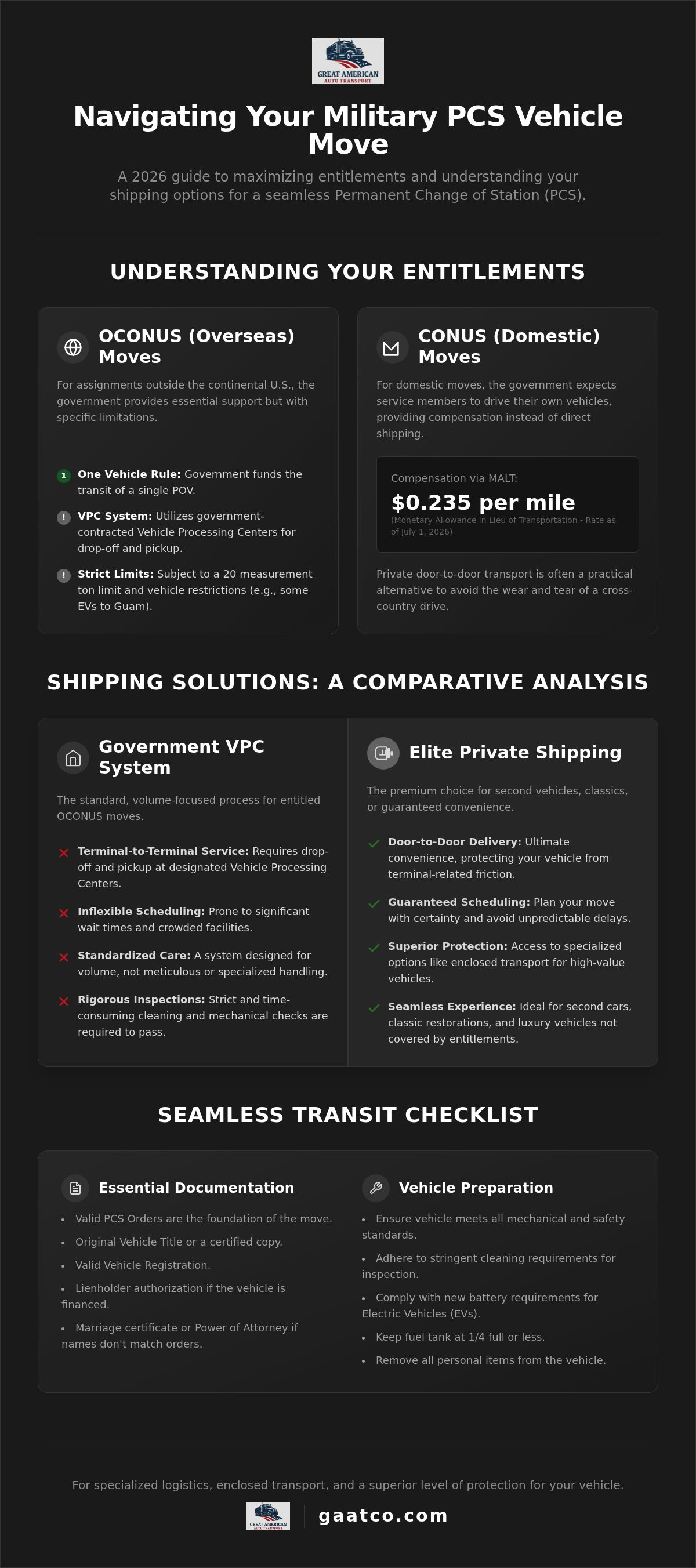
This guide provides a sophisticated roadmap for managing your vehicle logistics in 2026, ensuring you maximize your entitlements while addressing the gaps in official coverage. You will gain clarity on the latest Joint Travel Regulations, including the July 2026 MALT rate increase to $0.235 per mile and the stringent new battery requirements for electric vehicles. We will also explore how elite private shipping alternatives offer a seamless, door to door experience that protects your investment from the logistical friction of a standard PCS. We provide the professional insights necessary to navigate these complexities with the calm confidence of a seasoned expert.
Key Takeaways
- Understand the critical distinctions between OCONUS entitlements and CONUS self-procured moves to ensure all relocation expenses are properly managed.
- Master the documentation requirements, including valid PCS orders and lienholder authorizations, to prevent administrative delays during vehicle transit.
- Evaluate the advantages of private military pov shipping solutions, such as door-to-door delivery and guaranteed scheduling, over the standard government-contracted terminal system.
- Learn the precise mechanical and maintenance standards required to pass stringent inspections and ensure the safety of your vehicle during transport.
- Discover how specialized enclosed transport and customized logistics provide a superior level of protection for high-value and classic vehicles during a transition.
Understanding Military POV Shipping: Entitlements and Definitions
A Permanent Change of Station (PCS) represents more than a mere reassignment; it is a complex logistical operation that requires meticulous oversight of your personal assets. In the 2026 regulatory environment, the term Personally Owned Vehicle (POV) refers to any motor vehicle owned or leased by a service member for primary transportation. While the definition is straightforward, the execution of military pov shipping depends entirely on whether your orders take you across the ocean or across the continent. Understanding these nuances is the first step in maintaining the operational flow of your household during a transition.
The government typically observes the 'One Vehicle Rule' for overseas assignments, funding the transit of a single POV to your OCONUS duty station. This often leaves military families with a difficult choice regarding their second vehicle or high-value classic cars. While the 2025 National Defense Authorization Act explored provisions for shipping a second vehicle, these changes haven't been implemented in the Joint Travel Regulations as of early 2026. Because official channels prioritize volume and standardized processing, private shipping has become the preferred choice for those who require a higher level of care and scheduling certainty. If you are considering a dedicated shipping unit for a second vehicle or additional household goods, you can learn more about GT Containers to see how they support secure relocations. Watch this video to understand the standard turn-in process at a government facility:
OCONUS vs. CONUS Moving Logistics
Overseas transport involves government-contracted Vehicle Processing Centers located in strategic hubs such as San Diego, Houston, and Seattle. These terminals act as the primary intake points for OCONUS moves, though regional stability can impact availability, such as the VPC closure in Bahrain effective July 2026. However, for domestic moves within the continental United States, the government generally expects members to drive their own vehicles. You are compensated via the Monetary Allowance in Lieu of Transportation (MALT), which increases to $0.235 per mile on July 1, 2026. For many professionals, the wear and tear of a cross-country drive makes private door-to-door transport a more sophisticated and practical alternative to self-driving.
Determining Your Eligibility for Government-Funded Shipping
Eligibility is dictated by the Joint Travel Regulations (JTR), which serve as the authoritative source for all travel allowances. In 2026, official military pov shipping remains subject to a 20 measurement ton limit. If your vehicle exceeds this size or if you are moving to a location with specific restrictions, such as the current prohibition on shipping EVs to Guam, you must seek private solutions. Reviewing your orders for these specific vehicle entitlements allows you to identify gaps early. For vehicles not covered by government funding, exploring professional transport services ensures your entire household arrives at your new destination without compromise.
Essential Documentation for Military Vehicle Relocation
The administrative integrity of your relocation depends on the precision of your documentation. Successfully executing military pov shipping requires more than just mechanical readiness; it demands a comprehensive dossier of legal and official records. Your Valid PCS Orders serve as the foundation of this process, providing the legal authority for the move and defining your specific entitlements. Without these orders, neither government nor private carriers can initiate the transport of your vehicle.
Proving ownership is the next critical hurdle. You must provide the original vehicle title or a certified copy, alongside a valid registration. The names on these documents should ideally align with the service member's name on the PCS orders. If the vehicle is registered in a spouse's name, additional documentation, such as a marriage certificate or a specialized Power of Attorney, may be required to establish a clear chain of authority. For domestic moves, having these documents organized early allows you to secure a precise transport quote and avoid last-minute delays.
Navigating Financed Vehicles and Leases
If your vehicle is financed or leased, you don't technically hold the clear title. In these instances, a lien holder authorization letter is mandatory. This document must be on the financial institution's letterhead and explicitly state that the vehicle is authorized for transport to the specific destination listed in your orders. For international transit, the language must be precise, acknowledging that the vehicle will leave the country. We recommend requesting this letter at least three to four weeks before your shipping date, as bank processing times vary and errors in the destination address can cause significant setbacks at the port or terminal.
Power of Attorney for Military Spouses
Logistical realities often mean the service member cannot be present for the vehicle turn-in or delivery. In such cases, a Power of Attorney (POA) is essential. While a General POA grants broad authority, many transport hubs and VPCs prefer a Special Power of Attorney. This document specifically identifies the vehicle by its Year, Make, Model, and VIN, and explicitly authorizes the spouse or representative to sign inspection forms and shipping contracts. Every POA must be notarized and remain valid through the entire transit window. Ensuring your documentation is military-compliant before you arrive at the terminal preserves the professional flow of your transition and prevents the frustration of a rejected turn-in.
Private Carriers vs. Government VPCs: A Comparative Analysis
Selecting the appropriate method for military pov shipping requires an evaluation of value that extends far beyond the initial price tag. While the government provides a baseline service for OCONUS relocations through Vehicle Processing Centers (VPCs), these facilities operate on a terminal-to-terminal basis. This structure necessitates that you personally deliver and retrieve your vehicle from a specific hub, often resulting in hundreds of miles of additional driving and significant time away from your family during a sensitive transition. In contrast, private carriers prioritize your schedule, offering guaranteed windows that align with your specific PCS timeline rather than the constraints of a government contractor's queue.
The perceived benefit of "free" government shipping often fades when you factor in the hidden expenses of travel, fuel, and lodging required to reach a VPC. Furthermore, standard government transport typically utilizes large, open multi-car trailers designed for maximum volume. For those relocating a high-value asset, a classic restoration, or a luxury vehicle, the lack of specialized care can be a source of significant anxiety. Private logistics allow for a more bespoke approach, including the option for enclosed car transport which shields your vehicle from road debris and seasonal elements during its journey.
The Advantage of Door-to-Door Delivery
Eliminating the logistical friction of terminal drop-offs is the primary hallmark of a premium transport experience. Private door-to-door service ensures that a professional carrier meets you at your residence or a nearby accessible location, providing a seamless transition from your old home to your new duty station. Our team at GAATCO leverages over 20 years of experience to streamline these moves in major hubs like Houston, San Diego, and Seattle. By removing the need for long-distance drives to a VPC, you maintain the operational flow of your relocation without unnecessary detours.
Insurance and Liability: Protecting Your Asset
The protection of your property is a non-negotiable pillar of professional transport. While government liability limits exist, they may not fully cover the replacement value of a specialized or high-end vehicle. Private carriers provide robust cargo insurance that offers a higher degree of financial security. This process begins with a meticulous inspection and the issuance of a Bill of Lading, which serves as a definitive record of the vehicle's condition. For owners of classic or modified POVs, this level of detail provides the reassurance that their investment is handled with the same level of seriousness that they apply to their own professional duties.
Preparing Your POV for a Seamless Transit
Preparation is the final phase of active participation for the vehicle owner before the logistics professionals take over. While military pov shipping involves complex routing, your personal contribution ensures the vehicle passes stringent safety and agricultural inspections without delay. Every detail matters. Start with a thorough mechanical check. Verify that fluid levels are correct, the battery is secure and healthy, and tire pressure is adjusted to manufacturer specifications. Ensure there are no active leaks, as carriers often refuse transport for vehicles that pose a drip risk to others on the trailer.
Safety regulations dictate a strict fuel limit for all vehicles in transit. You must ensure the tank is no more than one-quarter full at the time of pickup or turn-in. This standard reduces the total weight of the shipment and minimizes the risk of combustion during the journey. If you are shipping an electric vehicle, please consult the latest 2026 guidelines regarding the state of charge, as these requirements vary by destination and carrier type.
Exterior and Interior Cleaning Standards
A pristine vehicle is not merely a matter of personal pride; it is a functional requirement for a successful inspection. Remove all non-permanent accessories such as roof racks, bike carriers, or aftermarket spoilers that could be damaged or interfere with the loading process. Clean the undercarriage thoroughly to remove soil and organic matter, as agricultural inspectors are particularly vigilant about cross-contamination between regions. Inside the cabin, vacuum every crevice and remove all loose personal effects. Legally, only permanent vehicle components should remain. Items like air fresheners, toll tags, or loose change should be cleared to prevent loss or damage during the move.
The Pre-Transport Inspection Process
The final walkthrough is your opportunity to establish a clear baseline for your vehicle's condition. Conduct this joint inspection with your GAATCO professional with meticulous care. Use high-resolution photography to document the exterior and interior from multiple angles, ensuring you capture any existing chips, dents, or scratches in clear light. These details must be clearly noted on the official documentation to ensure transparency. The Bill of Lading is the definitive legal receipt for your vehicle's condition. By maintaining a disciplined approach to these final steps, you ensure a transparent and secure transit for your investment. Ready to begin your relocation? Request a personalized quote to secure your transport window today.
The Elite Experience: Choosing GAATCO for Your PCS Move
Selecting a logistics partner for your relocation is a decision that impacts the security of one of your most significant investments. At GAATCO, we have dedicated over 20 years to mastering the nuances of military pov shipping, positioning ourselves as a trusted advisor to service members who require more than just a standard transport service. Our expertise allows us to handle the complex operational realities of a PCS move with a calm confidence, ensuring that your transition remains seamless and your vehicle remains protected. We operate as a discreet and dependable partner, managing the intricate details of transport so you can focus on the mission ahead.
Our commitment to transparency is a non-negotiable pillar of our service. Unlike many providers in the industry, we offer clear, professional pricing with no hidden military surcharges or unexpected fees. We provide a human-centric approach that recognizes the unique pressures of military life, offering both open and enclosed carriers to suit your specific needs. Whether you are relocating a dependable family SUV or a specialized performance vehicle, our unified team of professionals applies the same level of meticulous attention to every shipment. We leverage our expansive operational reach to provide reliable door-to-door service, bridging the gap between global standards and local service nuances.
Specialized Services for Luxury and Classic POVs
For owners of high-value assets, the standard government-contracted transit is often insufficient. We specialize in Enclosed Car Transport, which provides an elite level of protection for luxury, classic, and high-performance vehicles. This service shields your asset from environmental elements and road debris, maintaining its showroom condition throughout the journey. Our specialized handling protocols are designed for vehicles with low ground clearance or sensitive finishes, ensuring that every movement is executed with the sophisticated care that high-end investments demand.
Next Steps: Securing Your 2026 PCS Shipping Date
Securing your 2026 PCS shipping date requires foresight and coordination. Given the seasonal demand in major hubs like San Diego and Houston, we recommend initiating your logistics plan as soon as your orders are finalized. Our move coordinators work with you to establish precision timing that aligns with your household goods shipment and your reporting date. By choosing a partner with two decades of established expertise, you ensure that your vehicle's relocation is handled with the seriousness it deserves. To begin your journey, you may Request a professional military POV shipping quote from GAATCO and experience a relocation defined by reliability and understated elegance.
Mastering Your 2026 PCS Transition
Navigating the complexities of a Permanent Change of Station requires a disciplined approach to both regulatory entitlements and personal property protection. By mastering 2026 documentation requirements and understanding the limitations of official government transport, you position your household for a seamless transition. While the military provides the baseline for your move, private military pov shipping offers the elite, door-to-door reliability required for secondary vehicles or high-value assets that demand specialized handling.
Our professionals bring over 20 years of military relocation expertise to every mission. We provide comprehensive cargo insurance and expert door-to-door service across the United States to ensure your investment remains protected. We handle the logistical friction so you don't have to, allowing you to focus on your new assignment with complete peace of mind. Secure your military POV shipping with a professional GAATCO quote today. Your next duty station awaits, and we're ready to help you arrive with confidence.
Frequently Asked Questions
Does the military pay to ship my car during a CONUS PCS?
The military does not fund vehicle transport for domestic relocations within the continental United States. Instead, service members receive a Monetary Allowance in Lieu of Transportation (MALT) to cover the costs of driving. For those who prefer to avoid the wear of a cross-country journey, military pov shipping through a private carrier is the standard solution. This allows you to manage your transition with greater flexibility while the government compensates your mileage at the current 2026 rates.
Can I ship two vehicles during a military move?
How long does military POV shipping typically take?
Transit times vary based on the distance and the specific logistics model employed. While government-contracted OCONUS shipments through a VPC may take 30 to 60 days, private domestic transport is significantly more efficient. Most CONUS deliveries are completed within 5 to 14 days, depending on the route. Private carriers offer the advantage of guaranteed pickup windows and more precise delivery estimates, which are essential for coordinating a sophisticated PCS transition without unnecessary delays.
What happens if my vehicle is damaged during military transport?
Liability and recovery procedures depend on the type of service utilized for your move. If damage occurs during private transport, the carrier's cargo insurance provides the primary source of protection. It's essential to document the vehicle's condition on the Bill of Lading at both pickup and delivery. This legal receipt serves as the definitive evidence required to initiate a claim. Our team ensures that every vehicle is handled with meticulous care to minimize such risks.
Are there weight limits for shipping a POV with a private carrier?
Private carriers do not typically enforce the strict 20 measurement ton limit used by government VPCs. However, the size and weight of your vehicle do influence the logistics and equipment required for transport. Oversized vehicles, such as heavy-duty trucks or modified SUVs, may require specific trailer configurations. When requesting a quote, providing accurate dimensions ensures that we can assign the appropriate carrier and maintain the high standards of safety your investment deserves.
Can I leave personal items in my car when shipping it via GAATCO?
Standard safety protocols and federal regulations generally prohibit the inclusion of personal effects inside a vehicle during transit. Only permanent fixtures, such as a spare tire or a fixed car seat, should remain. Removing loose items prevents potential damage to the interior and ensures the vehicle meets the weight specifications recorded during the initial inspection. This discipline maintains the professional integrity of the military pov shipping process and protects your belongings from loss.
What is the 1/4 tank rule for military vehicle shipping?
The one-quarter tank rule is a non-negotiable safety standard designed to minimize fire risk and manage total shipment weight. Both government VPCs and private carriers require that your fuel level does not exceed this limit at the time of turn-in or pickup. For electric vehicles, 2026 regulations often require a battery state of charge between 30% and 50%. Adhering to these specifications ensures your vehicle is accepted for transport without administrative friction or safety concerns.
How do I ship a non-operational vehicle for my PCS move?
Shipping an inoperable vehicle requires specialized equipment that standard government contractors often cannot provide. If your vehicle cannot move under its own power, you must utilize a private carrier that offers inoperable vehicle transport. These professionals use specialized winches and loading protocols to secure the vehicle safely. Providing advance notice of the vehicle's condition allows our team to deploy the necessary infrastructure, ensuring a controlled and reliable relocation despite mechanical limitations.


