
Shipping a vehicle that cannot move under its own power isn't merely a transport task; it's a specialized engineering feat that demands meticulous oversight. Many owners understandably fear that winching a non-running car might lead to structural damage or that the final invoice will be inflated by undisclosed surcharges. At GAATCO, we recognize that inoperable vehicle transport requires a higher standard of care and technical proficiency. We understand the anxiety that comes with trusting a non-functional asset to a carrier, especially when specialized equipment is a non-negotiable requirement for a safe arrival. With carrier pay per mile rising by 22.8% in the first half of 2026, choosing a partner with established expertise is more critical than ever.
This guide offers the expert insights necessary to navigate these complexities with confidence. You'll learn how to secure damage-free delivery through professional handling and transparent logistics. We'll examine the technical requirements for winching, the impact of 2026 market shifts on carrier availability, and our refined door-to-door processes in major hubs like Houston, Miami, and Seattle. By the end of this article, you'll have a clear roadmap for a seamless, sophisticated transport experience that prioritizes the safety of your vehicle above all else.
Key Takeaways
- Distinguish between non-starting and non-steering units to ensure your carrier arrives with the precise equipment required for your vehicle's specific mechanical condition.
- Master the technical nuances of inoperable vehicle transport, including the critical role of electric winches and hydraulic liftgates in maintaining structural integrity during loading.
- Gain clarity on how specialized labor and trailer positioning impact logistical surcharges, ensuring a transparent and predictable investment for your shipment.
- Optimize pickup logistics in restricted urban hubs like New York or San Francisco by utilizing professional transfer point strategies for heavy equipment access.
- Rely on GAATCO's twenty years of specialized expertise to provide the discreet, authoritative oversight necessary for complex, door-to-door deliveries of non-running assets.
Defining the Inoperable: When a Vehicle Becomes a Logistics Challenge
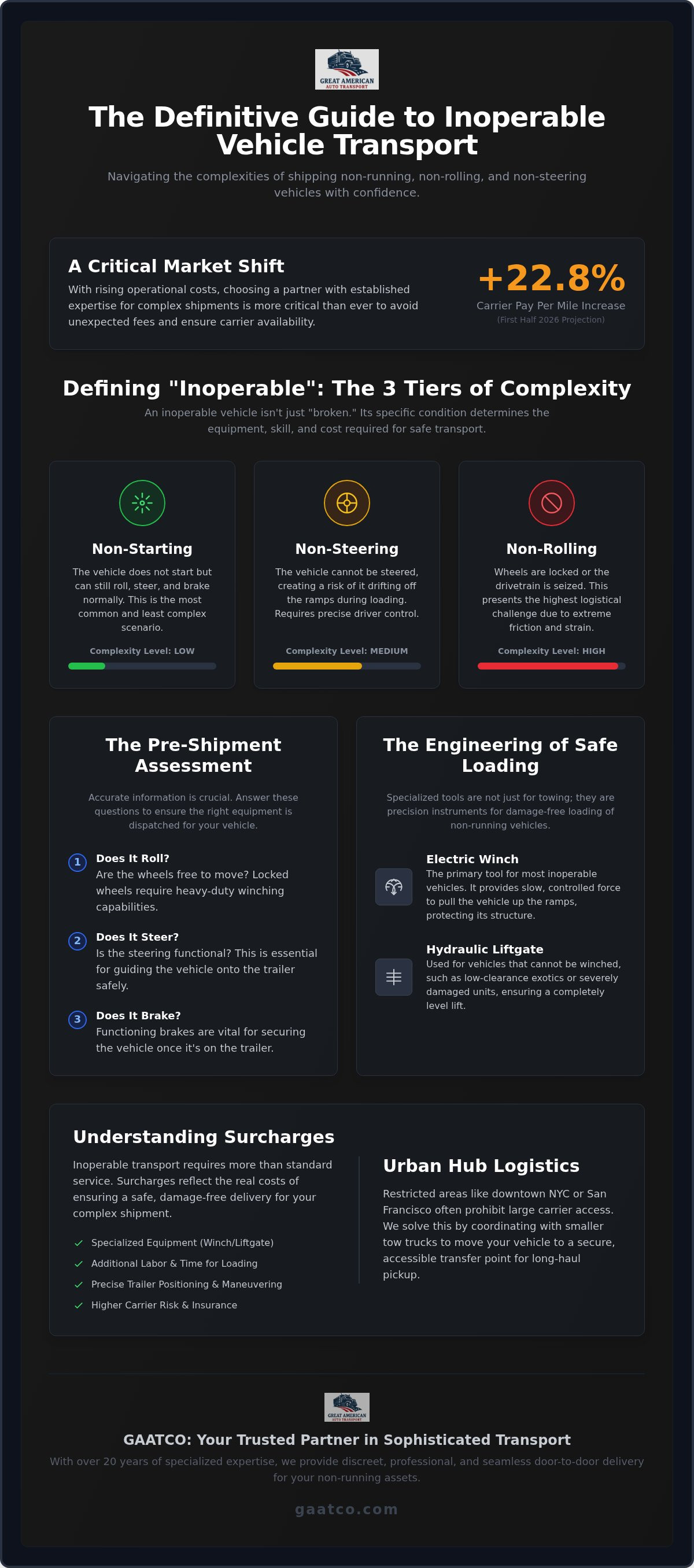
In the context of professional logistics, an inoperable vehicle is defined as any unit requiring external force for loading and unloading. While many owners assume a car that doesn't start is simply "broken," the industry views these units through a lens of mechanical resistance and equipment compatibility. Successfully managing inoperable vehicle transport requires a precise understanding of the vehicle's physical state before a carrier is even dispatched. GAATCO classifies these challenges into three distinct tiers: non-starting, non-rolling, and non-steering. Each tier demands specific operational workflows to ensure the safety of both the vehicle and the transport professional.
To better understand the nuances of shipping a vehicle that doesn't run, watch this helpful overview:
A non-starting vehicle that still rolls and steers is the most common scenario, often handled with a standard electric winch. However, non-rolling vehicles represent the highest logistical complexity because they lack the basic mechanical fluidity needed to move up a ramp. When wheels are locked or the drivetrain is seized, the friction creates immense strain on loading equipment. This status directly affects carrier selection within the GAATCO network, as we only partner with operators who possess the heavy-duty winching capabilities or specialized trailers required for such high-resistance loads. Unlike the specialized railroad rolling stock used for bulk factory shipments, individual transport for non-runners relies on customized, manual oversight.
The Roll, Steer, and Brake Assessment
Carriers must verify if a vehicle can be steered to ensure it tracks correctly during the winching process. If a car cannot steer, it may drift off the ramps, risking damage to the chassis. Functioning brakes are equally vital; they allow the driver to secure the vehicle once it reaches its position on the trailer. Simple issues like flat tires or missing ignition keys can quickly escalate a transport category from a standard non-runner to a complex recovery job. Providing accurate details about these factors allows our team to coordinate the right transport services for your specific needs.
Project Cars vs. Salvage Units
There's a significant logistical difference between a pristine classic project car and a collision-damaged salvage unit. Project cars often require delicate handling to protect aging components, while salvage units might have loose parts or leaking fluids that require containment. If you're shipping a vehicle with detached components, these must be secured within the cabin or trunk to prevent loss during transit. GAATCO brings over 20 years of experience to these diverse conditions, providing dependable solutions across major hubs like Houston, Atlanta, and Los Angeles. We act as your trusted advisor, ensuring that whether it's a rare restoration or a recovered asset, the delivery remains professional and discreet.
The Engineering of Loading: Specialized Equipment for Non-Running Cars
Loading a vehicle that lacks its own motive power is a sophisticated exercise in mechanical physics. For standard open carrier transport, the electric winch serves as the primary tool for recovery. This equipment allows the driver to slowly draw the vehicle up the loading ramps with controlled force. It isn't a simple "tow job." It requires a carrier who understands the weight distribution and structural integrity of the unit. GAATCO ensures that every driver in our network is proficient in these non-traditional loading protocols, maintaining a steady and measured pace to protect your inoperable vehicle transport investment in hubs like Houston and Miami.
When dealing with high-value assets or classic cars, enclosed car transport often utilizes hydraulic liftgates. This method is the preferred choice for inoperable units because it eliminates the steep angles associated with traditional ramps. The vehicle remains level as it's raised to the trailer's deck, which is essential for cars with compromised suspension or low ground clearance. Our commitment to these professional standards aligns with Federal Consumer Protection Regulations, which govern the liability and operational conduct of specialized motor carriers. By adhering to these frameworks, we provide a layer of security that casual service providers often overlook.
Winching Mechanics and Safety
The technical success of inoperable vehicle transport depends heavily on identifying secure attachment points. Drivers must utilize factory tow-eyes or specific frame locations to prevent structural distortion. If the cable tension is inconsistent, the vehicle can lurch, creating safety hazards for the operator and potential damage to the chassis. We prioritize a clear safety zone during this process. It's a meticulous operation where the driver acts as a technician, constantly monitoring the incline and the alignment of the cable. If you're unsure about your vehicle's attachment points, our team can help you prepare for a seamless pickup.
Forklifts and Heavy Machinery
In cases where a vehicle is truly non-rolling, such as salvage units with seized axles, a winch may not be sufficient. A forklift or heavy-lift crane becomes necessary to place the vehicle onto the trailer. This adds a layer of complexity, particularly at residential locations in hubs like Dallas or Seattle. Coordination is key. The client must often arrange for a local heavy-lift provider to assist at the pickup or delivery site. If you require specialized recovery or heavy-lift assistance in Western Australia, you can discover Allout Towing for professional roadside support. While this represents the most challenging tier of logistics, our experienced dispatchers bridge the gap between your needs and the operational realities of heavy machinery, ensuring the process remains controlled and safe.
Navigating the Costs: Why Inoperable Transport Incurs Specific Surcharges
In instances where the cost of such specialized recovery exceeds the vehicle's value, owners might instead opt to sell the asset to a professional buyer like Cash For Junk Cars Michigan to avoid the complexities of heavy-lift logistics.
Understanding the financial structure of inoperable vehicle transport requires looking past the surface level surcharge. This fee isn't an arbitrary penalty; it's a direct reflection of the technical demands and specialized equipment maintenance required for a safe recovery. Carriers must invest in high-grade electric winches and hydraulic systems that undergo more rigorous wear than standard loading ramps. According to standards upheld by the American Trucking Associations, specialized equipment maintenance is a non-negotiable pillar of operational safety. When a vehicle cannot move under its own power, the carrier assumes a higher level of physical labor and mechanical liability, which is reflected in the final logistics profile.
Logistical efficiency also dictates the cost. Inoperable units often require specific "spots" on a multi-car carrier, typically near the rear or in direct alignment with the winch assembly. This placement isn't always the most space-efficient for the driver's overall load. If a non-running car is positioned behind several functional vehicles, it may need to be unloaded and reloaded multiple times to facilitate other deliveries along the route. This complexity impacts the total shipment duration and contributes to the overall route mileage, especially when navigating high-traffic hubs like Atlanta or Los Angeles where fuel surcharges are closely monitored against 2026 diesel price fluctuations.
Labor and Opportunity Cost
The time investment for a non-running unit is substantial. Loading an inoperable car typically adds 45 to 90 minutes to a driver's schedule compared to a standard drive-on load. In an industry where time is the primary currency, this extra labor represents a significant opportunity cost. Many owner-operators choose not to equip their trucks with winches to maximize their speed, which naturally reduces the market supply of qualified carriers. GAATCO bridges this gap by maintaining a network of elite partners who specialize in these complex recoveries. We provide a transparent pricing model that accounts for these variables upfront, ensuring no hidden fees emerge during the door-to-door process.
Specialized Insurance Considerations
Safety remains our core operational value, particularly regarding financial protection. It's a common misconception that an inoperable status might void standard cargo coverage. In reality, our licensed and insured carrier partners maintain robust policies that cover the unique risks of winching and stationary transport. For high-value non-runners in enclosed trailers, we often facilitate higher coverage limits to mirror the asset's worth. This commitment to security ensures that your vehicle is protected from the moment it's secured in Seattle or Miami until it reaches its final destination. We act as a discreet partner, handling these technical details so you don't have to worry about the nuances of cargo liability.
Preparation and Site Logistics: Ensuring a Seamless Pickup for Non-Drivable Units
Picking up an inoperable vehicle in a dense urban center like New York, San Francisco, or Boston presents a unique set of challenges that standard transport guides often overlook. Large carriers, which can span up to 80 feet in length, find it nearly impossible to navigate narrow residential streets or tight cul-de-sacs. For inoperable vehicle transport, this difficulty is magnified because the vehicle cannot be driven to a more accessible location. We often recommend a "Transfer Point" strategy. This involves meeting the carrier in a wide-access parking lot or industrial zone. It ensures the driver has the necessary space to deploy winching equipment safely without obstructing local traffic or risking damage to the asset during the loading phase.
Documentation is the foundation of a professional shipment. The Bill of Lading (BOL) serves as a critical technical record. For non-running units, this document must explicitly detail the vehicle's mechanical state at the moment of pickup. If the vehicle has non-functional windows or loose exterior trim, these must be secured with automotive-grade tape or removed before the carrier arrives. This prevents wind-induced damage or the loss of parts during transit. GAATCO acts as a discreet partner in this process, ensuring that every detail is captured to protect your interests from the first point of contact.
Site Readiness for Large Carriers
Tires should be inflated to facilitate a smoother roll up the ramps. If a tire is completely shredded or seized, we can utilize specialized dollies, though this must be communicated during the booking process. Clearing the interior of personal items is essential; excess weight can strain winching cables and often violates DOT weight regulations. Verifying the steering and braking capability remains the final step of the driver's pre-trip inspection. This ensures the unit remains controllable as it ascends the ramp, providing a safe environment for everyone involved. If you are ready to secure a professional transport solution, request a customized logistics quote from our expert team today.
GAATCO’s Professional Approach to Sophisticated Inoperable Transport Solutions
With over 20 years of industry experience, GAATCO has refined the art of non-standard logistics into a seamless, managed solution. We don't just facilitate a simple transaction; we act as a discreet and dependable partner for clients facing the high-stakes reality of inoperable vehicle transport. Our team understands that shipping a non-running unit requires a level of precision that only decades of dedicated exposure can provide. Whether you're moving a classic restoration from Houston or a delicate salvage unit from Seattle, our national reach ensures a local touch that prioritizes reliability and safety as non-negotiable pillars.
The personality of our brand is that of a seasoned expert who remains calm under the pressure of complex logistics. We take pride in being a trusted advisor rather than a mere service provider. By choosing our team, you're opting for a sophisticated approach where technical details regarding operational specifications are handled with elite care. We bridge the gap between your specific needs and the complex operational realities of the road, ensuring that every transition in the transport process is handled with a consistent level of seriousness.
Vetted Carrier Network
Unlike bidding platforms that often prioritize the lowest cost at the expense of equipment quality, GAATCO hand-selects every partner in our network. We verify that each carrier possesses proven winch and liftgate expertise specifically tailored for non-functional loads. This vetting process ensures that the equipment is not only present but meticulously maintained to handle the physics of a non-powered unit. Consistent communication remains a core value of our service. You'll receive updates that reflect the steady, measured progress of your shipment across major hubs like Atlanta and Los Angeles. For a complete overview of our capabilities, explore our full range of GAATCO Services.
The Path to a Hassle-Free Quote
Obtaining an accurate estimate for inoperable vehicle transport starts with full transparency. When you contact us, please have the vehicle's specific mechanical details ready for our team. We need to know if the unit rolls, steers, or has functioning brakes. Being honest about the vehicle's mechanical state prevents onsite delays and ensures the driver arrives with the correct recovery tools for a damage-free pickup. This level of detail allows our professionals to provide a clear and accessible logistics plan without losing their sophisticated edge. When you're ready to transition from a logistical problem to a managed solution, we invite you to Request a Quote for your specialized transport needs.
Securing Your Non-Running Asset for the Journey Ahead
Successfully managing a non-functional vehicle shipment requires more than just a trailer; it demands a strategic alignment of specialized engineering and professional oversight. We've explored how identifying the correct tier of inoperability and preparing urban sites in hubs like San Francisco or New York mitigates the risks of structural damage. By prioritizing technical proficiency, you'll ensure that your asset receives the discreet care it deserves during its transit.
GAATCO remains a dedicated partner in this specialized field. With over 20 years of professional logistics experience, we provide a fully licensed and insured carrier network capable of executing seamless door-to-door delivery across all major US hubs, including Houston, Dallas, and Seattle. Our refined approach to inoperable vehicle transport removes the burden of complex logistics in cities like Atlanta or Los Angeles, allowing you to focus on the destination with total peace of mind.
Transition from logistical uncertainty to a managed solution today. We invite you to Request an Inoperable Vehicle Transport Quote and experience the confidence that comes from working with a seasoned industry expert. We look forward to facilitating a safe and elegant arrival for your vehicle.
Frequently Asked Questions
Can I ship a car that doesn’t run or drive?
You can indeed ship a vehicle that doesn't run or drive by utilizing specialized equipment like an electric winch. GAATCO leverages over 20 years of experience to coordinate these complex moves for collectors and corporate clients alike. While standard carriers require vehicles to be driven onto the trailer, our specialized inoperable vehicle transport solutions ensure that non-running units are safely loaded and secured without requiring internal engine power.
How much extra does it cost to ship an inoperable vehicle?
Transporting a non-running vehicle incurs a surcharge to account for the specialized equipment and additional labor required by the driver. This fee reflects the technical challenge of winching a stationary asset and the extra time spent during the loading and unloading phases. Factors such as the vehicle's rolling and steering capability will influence the final logistics profile. GAATCO maintains transparent pricing to ensure that these specialized requirements are accounted for upfront.
Do all car shipping trailers have winches for non-running cars?
Not all trailers are equipped with the winches or hydraulic systems necessary for non-running cars. Many standard open carriers only accept functional vehicles to maximize their route efficiency. GAATCO maintains a vetted network of partners who specifically carry the recovery equipment needed for inoperable vehicle transport. We ensure that your assigned carrier in hubs like Atlanta or Miami is fully prepared with the mechanical tools required for a safe, professional recovery.
What happens if my car becomes inoperable during the shipping process?
If a vehicle loses its ability to run during transit, it is reclassified as inoperable for the delivery phase. The driver will need to utilize external force or a winch to unload the unit at the destination. Owners should be aware that an additional labor fee may be applied to cover the unexpected complexity of the delivery. Our dispatchers work closely with clients in cities like Chicago or Denver to manage these rare mechanical transitions smoothly.
Can you ship a car with flat tires or a seized engine?
We can facilitate the shipment of vehicles with seized engines or flat tires, provided the condition is disclosed during the booking process. Units with seized engines are typically recovered using high-tension winches. If the tires cannot hold air, drivers may utilize specialized dollies to prevent damage to the rims or the trailer. Clear communication regarding these mechanical faults is essential for ensuring the carrier arrives in Houston or Dallas with the appropriate equipment.
Is enclosed transport better for inoperable luxury or classic cars?
Enclosed transport is often the superior choice for high-value inoperable assets because it frequently utilizes hydraulic liftgates. This equipment allows the vehicle to remain perfectly level during the loading process; this is critical for classic cars with delicate suspensions or low ground clearance. By avoiding the steep angles of traditional ramps, we provide a sophisticated layer of protection for luxury units being delivered to discerning clients in San Francisco or Nashville.
How do I prepare a non-running car for professional transport?
Preparation involves several technical steps to ensure a safe transit. Owners should inflate tires to their maximum recommended pressure and verify that the steering and braking systems remain functional for control during winching. It is also necessary to remove all personal items to comply with DOT weight regulations and secure any loose exterior components. These steps help our professional drivers in Seattle or Boston maintain a controlled environment during the pre-trip inspection and loading.
Does GAATCO offer door-to-door service for inoperable vehicles in major cities?
GAATCO provides comprehensive door-to-door solutions across major hubs including Houston, Dallas, Seattle, and New York. While we aim for direct pickup, dense urban areas like San Francisco or Boston may require a Transfer Point strategy if the street is too narrow for an 80-foot carrier. In these cases, we coordinate a meeting at a nearby wide-access location to ensure the winching process is conducted safely and professionally without obstructing local traffic.


