
Entrusting a prized motorcycle to a carrier is far more than a simple logistical transaction; it's a significant transfer of stewardship that requires meticulous attention to detail. You likely understand the anxiety that comes with handing over your keys, especially when considering the risks of cosmetic damage or the nuances of insurance coverage. It's natural to seek a level of precision that matches the value of your machine, ensuring every mile of the journey is managed with professional care and absolute reliability.
Mastering how to prepare a motorcycle for shipping is the essential first step in securing a seamless, sophisticated transport experience. Our expert-led protocol is designed to safeguard your motorcycle while providing you with the quiet confidence that comes from established industry expertise. We've refined the process into a clear, professional checklist that ensures your bike is insurance-ready for a successful door-to-door delivery. This guide outlines the precise mechanical and administrative steps required to transition your motorcycle from your garage to its final destination with total peace of mind.
Key Takeaways
- Establish a meticulous baseline for transport by understanding the professional "Ready-to-Ship" standard required by elite carriers.
- Conduct a comprehensive pre-transport audit, including a thorough cleaning and detailed cosmetic log, to safeguard your legal and financial interests.
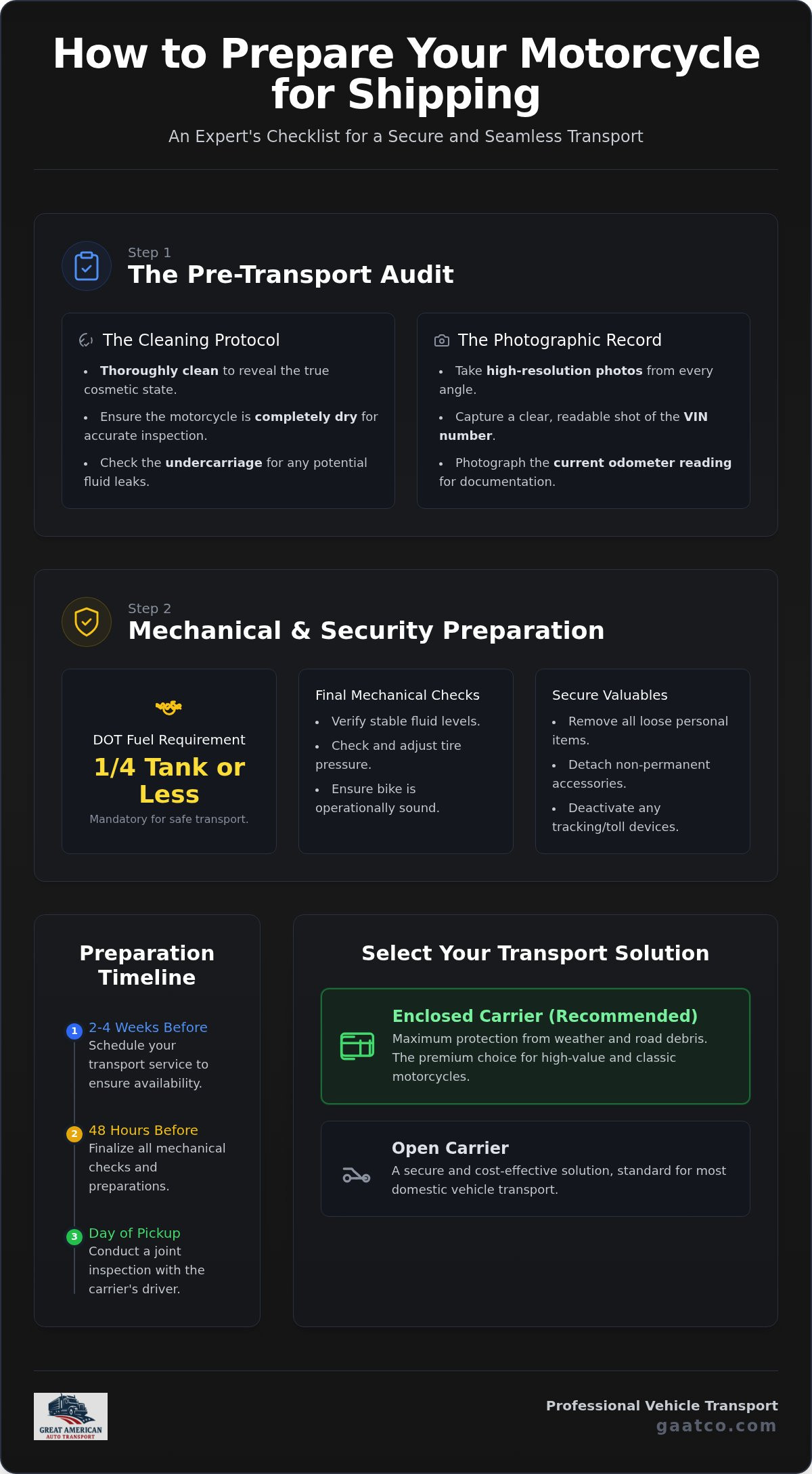
- Learn exactly how to prepare a motorcycle for shipping by mastering mechanical protocols, such as adhering to the 1/4 tank fuel requirement for 2026.
- Secure your investment by removing non-permanent accessories and deactivating electronic tracking or toll devices before the carrier arrives for collection.
- Evaluate the nuances between open and enclosed carrier services to select the transport solution that best aligns with your vehicle’s value and your personal requirements.
The Professional Standard for Motorcycle Shipping Preparation
Professional preparation serves as the cornerstone of any successful logistics contract. It's the difference between a routine delivery and a complex liability dispute. When we define the "Ready-to-Ship" state, we're not merely asking for a clean bike; we're requiring a vehicle that's operationally sound for the specific rigors of transport. This status ensures that our team can secure the motorcycle safely using specialized equipment without compromising its structural or cosmetic integrity.
While international transit often involves heavy crating and complex customs documentation, domestic shipping within the United States focuses on operational flow and Department of Transportation (DOT) compliance. Understanding how to prepare a motorcycle for shipping for domestic routes requires an awareness of the owner's role in the liability framework. The carrier's insurance typically covers transit risks, but the owner remains responsible for ensuring the vehicle's mechanical stability and the accuracy of the initial condition report. This partnership between the client and the logistics provider is what ensures a seamless door-to-door experience.
Why Meticulous Preparation Matters
A disciplined approach to preparation mitigates mechanical strain during the critical loading and unloading phases. Professional carriers utilize ramps and hydraulic lifts. A bike that isn't properly prepared can shift or leak, creating hazards for other vehicles on the trailer. Adhering to DOT safety standards isn't optional; it's a regulatory requirement that keeps the carrier compliant and your vehicle protected. Most importantly, your preparation establishes a definitive baseline for insurance. Without a clear record of the bike's state prior to handover, resolving claims for cargo protection becomes significantly more difficult. Our 20 years of experience show that the most successful transports begin with a well-documented vehicle.
The Timeline for Preparation
Successful logistics depend on a measured timeline. We recommend scheduling your service two to four weeks in advance to ensure availability on our specialized routes through major hubs like Miami, Dallas, or San Diego. This window allows you to address any mechanical issues that might arise during your final rides before the transport period begins. Finalize your mechanical checks approximately 48 hours before the scheduled pickup, including verifying fluid levels and tire pressure. On the day of handover, your GAATCO driver will conduct a joint inspection. You can expect a professional, calm interaction where every detail is documented. Our drivers are seasoned experts who understand the nuances of high-end transport, treating your vehicle as the elite asset it is.
Documenting Condition: The Essential Pre-Transport Audit
Establishing a definitive record of your vehicle's condition is a non-negotiable pillar of the transport process. This audit isn't merely a precautionary measure; it's the primary legal safeguard that protects your financial interests throughout the journey. When considering how to prepare a motorcycle for shipping, documentation serves as the objective truth that bridges the gap between the owner's expectations and the carrier's liability. A professional audit ensures that every detail, from the pristine finish of the tank to the integrity of the mirrors, is accounted for before the vehicle is secured on the trailer.
The Cleaning Protocol
A thorough cleaning is the first step in a successful audit. Removing road grime, dust, and debris is essential to reveal the true state of all cosmetic surfaces. We require the motorcycle to be completely dry upon the driver's arrival. A wet vehicle can mask fine scratches or swirls, making it impossible for the driver to perform an accurate inspection. Pay particular attention to the undercarriage. Cleaning this area allows you to identify potential fluid leaks that might have gone unnoticed, preventing complications during transit and protecting other vehicles on the carrier. For those managing high-value collections, partnering with a discreet logistics expert ensures these details are never overlooked.
Professional Photography Standards
High-resolution imagery provides the irrefutable evidence required by insurance providers. Utilize natural, indirect light to capture the motorcycle from every angle, ensuring the finish is clearly visible without harsh reflections. You must include clear shots of the VIN and the current odometer reading to verify the vehicle's identity and ensure no unauthorized use occurs during transit. We recommend using date-stamped imagery to maintain insurance integrity. Take detailed close-ups of any existing wear and tear, such as small stone chips or minor dings. This transparency prevents disputes and ensures that our professional team can focus on maintaining the vehicle's current state.
The culmination of this audit is the Bill of Lading (BOL). This document is more than a receipt; it's a legally binding contract that summarizes the condition of your motorcycle at the point of handover. If a blemish isn't noted on the BOL during the initial inspection, it becomes significantly harder to prove it occurred during transit. Review the driver's notes meticulously before signing. Your signature confirms that you agree with the carrier's assessment, establishing the baseline for the entire transport operation. This level of precision is what defines a truly professional shipping experience.
Mechanical Protocols and Fluid Management
Beyond the cosmetic documentation established in the previous phase, the mechanical integrity of your vehicle dictates its safety within the carrier's environment. A motorcycle isn't just cargo; it's a complex machine with volatile fluids and pressurized systems that must remain stable under the varying g-forces of transit. When refining your strategy for how to prepare a motorcycle for shipping, mechanical stability is as critical as cosmetic documentation. Our team prioritizes a controlled environment, but the owner's attention to mechanical detail is what prevents minor issues from becoming significant transit delays.
Fuel and Fluid Safety
Adhering to the 1/4 tank fuel rule is a non-negotiable standard for domestic shipping in 2026. This specific level provides the optimal balance; it's enough to facilitate loading and unloading without adding unnecessary weight or increasing the fire risk within the trailer. You should meticulously inspect all seals for oil, coolant, and brake fluid integrity before the carrier arrives. A leak doesn't just affect your vehicle. It can cause irreparable damage to other high-end or classic cars sharing the transport space. For safety and regulatory compliance, we strictly prohibit the transport of hazardous spare fluids, such as extra canisters of oil or fuel, within any storage compartments or panniers.
Mechanical Readiness
Your motorcycle must be in a "rollable" condition to ensure a professional and safe handover. This means the steering must be unlocked, the tires must be functional, and the brakes must be responsive. Inflate your tires to the manufacturer's precise specifications. Proper inflation doesn't just aid the driver in moving the bike; it helps the suspension absorb the vibrations of the road, protecting the frame from unnecessary stress. If your motorcycle has a unique ignition sequence or mechanical quirks, you should provide a typed, concise sheet of these special starting instructions and secure it to the handlebars for the driver's reference. This simple step ensures that our professionals can handle your vehicle with the exact care it requires.
The battery also requires specific attention to maintain its charge and ensure the safety of the electrical system. Ensure the battery is securely mounted and that the terminals are tight to prevent any arcing during transit. If your motorcycle is equipped with an alarm system, it's best to deactivate it or set it to "transport mode" to prevent the battery from draining or the siren from triggering due to the motion of the trailer. Understanding how to prepare a motorcycle for shipping involves these technical nuances that reflect a sophisticated approach to vehicle stewardship. By addressing these mechanical pillars, you ensure your motorcycle remains a stable and secure asset from the moment it leaves your driveway.
Securing Accessories and Removable Equipment
A motorcycle's silhouette is often defined by its custom enhancements, but for the purpose of professional transit, a minimalist profile is the gold standard. While mechanical and cosmetic preparations establish the vehicle's baseline, securing removable equipment is what prevents avoidable losses and operational friction. When you're finalizing how to prepare a motorcycle for shipping, you must view every add-on as a potential liability that could be affected by wind resistance or vibration during the journey. Our team prioritizes a secure environment, but a "clean" bike is always the safest bike to transport.
External Accessories and Luggage
Non-permanent features such as saddlebags, tank bags, and loose fairings should be removed and packed separately. These components are designed for the specific airflow of a rider, not the multi-directional pressures found on a transport trailer. Removing them reduces the vehicle's footprint and eliminates the risk of a fastener failing mid-transit. We also recommend folding or removing mirrors to create a narrower transport profile. This adjustment is particularly important for specialized transport on open carriers, where exposure to the elements is a constant factor. By stripping the bike to its factory dimensions, you ensure it fits securely within the specialized chocks and tie-down systems used by our professional drivers.
Electronics and Security
Modern motorcycles are often equipped with sophisticated electronics that require specific attention before handover. Understanding how to prepare a motorcycle for shipping means acknowledging that even the smallest electronic device can disrupt the logistical flow. Electronic toll tags and GPS units are frequently overlooked, yet they can lead to "phantom" charges as the carrier moves through regional hubs like Dallas or Miami. These devices should be removed and stored securely. Similarly, anti-theft alarms must be fully deactivated or placed in a dedicated transport mode. A triggered alarm during transit doesn't just distract the driver; it can lead to a completely depleted battery upon delivery.
You should also ensure you have a dedicated set of keys and remote fobs ready for the carrier. It's best practice never to provide your only set. Instead, hand over a functional spare that allows the driver to manage the steering lock and ignition as needed. This level of detailed preparation ensures that your vehicle remains a discreet and secure asset throughout its journey. If you're ready to experience a higher standard of logistics, you can request a customized quote to begin your transport process. Our team handles these complex details so you can focus on the arrival of your machine.
Choosing the Right Transport: GAATCO’s Specialized Solutions
The successful delivery of your vehicle depends as much on the choice of carrier as it does on the meticulous steps taken beforehand. Once you've mastered how to prepare a motorcycle for shipping, the final stage is selecting a transport solution that reflects the value of your machine. At GAATCO, we provide a spectrum of services tailored to meet the specific demands of diverse owners, from corporate clients to private collectors. Our operational flow is designed to be seamless; we ensure that every asset is treated with the understated elegance and professional care it deserves.
Open vs. Enclosed Motorcycle Shipping
Open Carrier Transport is the efficient, industry-standard choice for many riders. It offers a dependable way to move a motorcycle across the country while maintaining a focus on operational efficiency. However, for those with luxury or classic bikes, Enclosed Carrier Transport provides an unparalleled level of protection. This service shields your vehicle from inclement weather, road salt, and airborne debris, maintaining the pristine state established during your pre-transport audit. When evaluating the cost-to-value ratio, consider the long-term preservation of your motorcycle's finish and mechanical components. You can explore our specialized transport services to determine which level of protection best serves your specific needs.
Finalizing Your Shipment
Our door-to-door service is a hallmark of our commitment to convenience and reliability. By eliminating the logistical friction of terminal drop-offs, we provide a discreet partnership that respects your time and your vehicle's security. GAATCO’s 20 years of experience as a licensed and insured carrier ensures that every shipment is backed by established expertise. We handle the complex logistics so you don't have to; we provide a steady and measured rhythm from pickup to delivery. This professional stability is essential when navigating the high-stakes nature of specialized vehicle transport. Understanding how to prepare a motorcycle for shipping is only half the battle; the other half is trusting a partner who values your investment as much as you do.
Reviewing your GAATCO quote is the final step toward a successful handover. We pride ourselves on transparent pricing and a hierarchical approach to communication that keeps you informed without feeling rushed. Our team coordinates pickups in major hubs such as Houston, Atlanta, and Seattle, utilizing our expansive reach to bridge the gap between regional service and global standards. When you are ready to secure your transport, request a professional motorcycle shipping quote to begin the final phase of your journey. We are here to ensure your motorcycle arrives exactly as intended.
Secure Your Machine’s Future Journey
Meticulous preparation is the definitive bridge between your garage and a successful delivery. By establishing a rigorous cosmetic audit and adhering to mechanical safety standards, you transition from a vehicle owner to a proactive steward of your asset’s value. Mastering how to prepare a motorcycle for shipping ensures that every mile of the journey is underpinned by documentation and technical readiness. This measured approach protects your legal interests while facilitating a seamless handover to professional carriers.
GAATCO stands as your discreet partner in this process, bringing over 20 years of vehicle transport expertise to every shipment. We utilize a network of fully licensed and insured nationwide carriers to provide A+ rated door-to-door logistics that prioritize safety above all else. Our team handles the intricate operational details so you can focus on the destination rather than the distance. Secure your professional motorcycle transport quote with GAATCO today and experience the peace of mind that comes from elite service. Your motorcycle deserves a journey as refined as the machine itself.
Frequently Asked Questions
Do I need to drain the gas tank before shipping my motorcycle?
You should maintain approximately a 1/4 tank of fuel for domestic ground transport. This specific level is required by DOT regulations in 2026 to minimize weight and fire risk while allowing the driver to move the vehicle during loading. Completely draining the tank is typically only necessary for international air or sea freight, not for standard domestic carrier services.
Is my motorcycle insured during the shipping process?
Your vehicle is protected by the carrier's cargo insurance throughout the duration of the transit. GAATCO ensures all partners are fully licensed and maintain comprehensive coverage to safeguard your investment. You should review the specific policy limits and maintain detailed pre-transport photography to ensure your interests are fully protected in the unlikely event of a claim.
Can I ship personal items or gear with my motorcycle?
Carriers generally prohibit the inclusion of personal items, such as helmets or riding gear, within the transport area. Loose items can shift during the journey, potentially causing cosmetic damage to your bike or other high-value vehicles on the trailer. Removing all non-permanent equipment is a critical step in how to prepare a motorcycle for shipping to maintain a secure environment.
How long does it take to ship a motorcycle across the country?
A typical cross-country transport usually requires between 7 and 14 days to complete, depending on the specific route and seasonal demand. While our team prioritizes efficiency, we maintain a measured pace to ensure the highest safety standards. We coordinate logistics through major hubs like Dallas and Miami to provide a reliable and predictable delivery timeline for our clients.
What is a Bill of Lading and why is it important?
The Bill of Lading is a legally binding contract that functions as an official receipt and a condition report. It documents the exact state of your motorcycle at both the point of origin and the final destination. This document serves as the primary evidence for insurance providers, making its accuracy essential for resolving any potential disputes regarding the vehicle's condition.
Can you ship a motorcycle that is not in working condition?
We provide specialized inoperable vehicle transport for motorcycles that are not currently running. You must disclose this status during the quoting process so we can assign a carrier equipped with the necessary winches or loading tools. The motorcycle must still be "rollable," meaning the tires hold air and the steering is functional, to facilitate a safe loading process.
Do I need to be present for the pickup and delivery?
You or a designated representative must be present at both ends of the journey to conduct the joint inspection. This presence is necessary to sign the Bill of Lading and confirm the transfer of stewardship between you and the driver. If you cannot attend, your representative should be briefed on how to prepare a motorcycle for shipping to ensure the documentation is handled correctly.
Should I crate my motorcycle for domestic ground transport?
Crating is generally not required for domestic ground transport when you utilize specialized carriers. Our enclosed trailers feature advanced wheel chocks and soft-tie systems that provide elite protection without the added cost of professional crating. This approach ensures your motorcycle remains secure while allowing for the operational flow required for efficient door-to-door delivery across the country.


