

Entrusting a high-value vehicle to a cross-country carrier is far more than a simple transaction; it's a significant exercise in professional trust. You likely understand the frustration of vague delivery windows and the persistent anxiety that accompanies a vehicle's multi-day journey across state lines. It's common to feel a sense of confusion regarding why professional transport timelines differ from a personal road trip. This guide provides the definitive answer to the question: how long does it take to ship a car cross country in 2026?
We recognize that for our clients, a predictable delivery window and minimal handling are non-negotiable pillars of service. You'll discover the precise logistics and regional variables that determine transit times, from the impact of stringent federal safety regulations to the nuances of route density. We'll preview the operational standards that ensure your vehicle arrives safely and on schedule, examining how specialized equipment and expert coordination create a seamless, door-to-door experience. By understanding these complex realities, you can move forward with the calm confidence that your logistics are being handled by seasoned experts who prioritize your peace of mind.
Key Takeaways
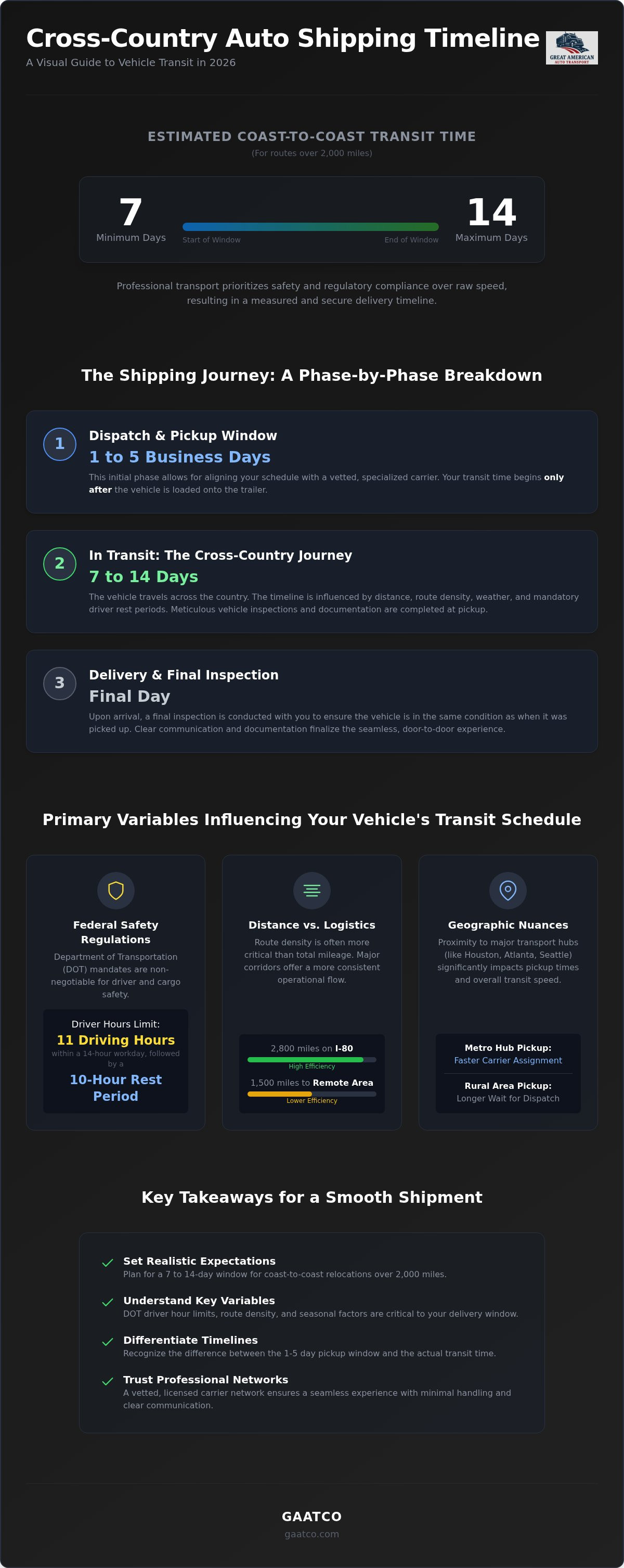
- Establish a realistic expectation of 7 to 14 days for coast-to-coast relocations, focusing on the logistical nuances of routes that exceed 2,000 miles.
- Understand the impact of Department of Transportation driver hour limitations and seasonal variables on your specific delivery window.
- Determine exactly how long does it take to ship a car cross country by evaluating the availability and operational flow of various transport methods.
- Review the phase-by-phase timeline from dispatch to delivery, emphasizing the importance of meticulous vehicle inspections and documentation.
- See how a professional network of vetted, licensed carriers ensures a seamless experience with minimal handling and clear communication.
Defining the Cross-Country Shipping Timeline in 2026
When planning a relocation, the primary inquiry is often: how long does it take to ship a car cross country? For a true coast-to-coast journey, such as a move from New York to San Diego, the baseline expectation in 2026 remains between 7 and 14 days. We define cross-country as any route exceeding 2,000 miles. While a solo driver might traverse this distance in four or five days, professional logistics operate under a different set of priorities. A personal road trip focuses on speed; a professional transport focuses on the safe, meticulous delivery of a high-value asset. This requires adhering to strict federal safety standards and managing a complex sequence of loading and unloading for multiple clients. Professional carriers must also account for mandatory rest periods and weight station inspections, which are variables that a private driver often overlooks.
As an experienced auto transport broker, we manage these complexities so you don't have to. Our role involves bridging the gap between your specific needs and the operational realities of the carrier network. Understanding how long does it take to ship a car cross country requires looking beyond simple mileage to the specific demands of professional vehicle relocation. We ensure that every link in the logistics chain is vetted for reliability, which is a standard that casual transport simply cannot match.
The Difference Between Transit Time and Pickup Windows
It's vital to recognize that the estimated transit time only begins once the vehicle is physically loaded onto the trailer. Before the journey starts, there's a standard pickup window, typically spanning one to five business days. This period allows our team to align your schedule with a specialized carrier that meets our rigorous safety standards. For those with more urgent requirements, our door-to-door auto shipping options can compress this initial wait, ensuring your vehicle moves into the transit phase with greater priority and precision.
Mileage vs. Logistics: Why Distance Is Not the Only Factor
Distance is merely one variable in a sophisticated equation. A 2,800-mile route along high-density corridors like I-10 or I-80 often benefits from a more consistent operational flow than a shorter, 1,500-mile journey into a remote region. Major interstate arteries allow for more frequent carrier activity and smoother transitions between hubs. We leverage these geographic advantages to maintain a steady rhythm, ensuring that even the longest routes remain predictable. Our team treats every mile as a calculated step in a broader logistical chain, prioritizing reliability over rushed timelines. This approach minimizes the risk of mechanical strain on the transport equipment and ensures that each vehicle is handled with the appropriate level of care throughout its transcontinental journey.
Primary Variables Influencing Your Vehicle's Transit Schedule
Determining the precise arrival of a vehicle requires a deep understanding of the operational constraints that govern the transport industry. While distance provides a baseline, the actual answer to how long does it take to ship a car cross country is shaped by a complex interplay of federal law, geographic positioning, and physical logistics. Professional carriers don't simply drive until they reach the destination; they operate within a highly regulated framework designed to prioritize the safety of your cargo and the integrity of the transit process.
Federal Safety Regulations and Driver Mandates
Safety is a non-negotiable pillar of professional vehicle relocation. Modern commercial carriers are required to use Electronic Logging Devices (ELD) to monitor compliance with strict Department of Transportation (DOT) mandates. These regulations limit drivers to 11 hours of driving within a 14-hour workday, followed by a mandatory 10-hour rest period. These rules are essential for preventing driver fatigue and ensuring that high-value assets are not compromised by rushed or unsafe practices. When you review Your Rights and Responsibilities When You Move, it becomes clear that these federal standards are designed to protect the consumer as much as the carrier. Adhering to these safety protocols is why a professional timeline may feel more measured than a personal road trip, yet it remains the only way to guarantee a secure delivery.
Geographic Nuances: Hubs like Houston, Atlanta, and Seattle
Your proximity to major metropolitan corridors significantly influences the speed of carrier assignment. Shipping between major logistical hubs like Houston, Atlanta, or Seattle often results in a more efficient operational flow because these areas have a higher density of vetted carriers. Contrast a Dallas-to-Phoenix route, which benefits from frequent interstate activity, with a delivery to a rural area in Montana or Maine. Rural locations often require "deadheading"—where a driver must travel a significant distance without cargo—to reach your vehicle. Our team leverages extensive regional expertise to navigate these geographic challenges, ensuring that even remote deliveries are handled with the same level of precision as those in major cities. If you are curious about the timeline for a specific route, you can request a customized quote to see how regional variables affect your schedule.
Beyond geography, the physical specifications of your vehicle play a critical role in trailer loading. A standard sedan is simpler to integrate into a multi-car carrier than a heavy, oversized SUV, which requires more meticulous weight distribution and space management. Seasonal demand also fluctuates; during the "Snowbird" season or peak summer months, the high volume of vehicles can extend the initial pickup window. We manage these variables by maintaining a steady, measured rhythm in our logistics chain, ensuring that how long does it take to ship a car cross country remains a predictable and transparent experience for every client.
Comparing Transport Methods: Impact on Delivery Efficiency
The choice between open and enclosed transport involves more than a preference for protection; it fundamentally dictates the rhythm of your vehicle’s journey. While distance remains a constant, the equipment used to bridge that distance influences both the initial pickup window and the specialized handling required at each stop. When evaluating how long does it take to ship a car cross country, one must consider that equipment availability varies significantly across the national logistics network. We prioritize aligning your specific requirements with the most efficient carrier type to ensure a predictable and sophisticated transition.
Standard door-to-door service remains the most efficient method for a client’s schedule because it eliminates the delays associated with third-party terminals. By bypassing storage hubs, your vehicle remains in a continuous operational flow from the moment of pickup. This direct approach minimizes handling and provides a clearer, more reliable delivery window, which is essential for maintaining the high standards of professional vehicle relocation.
Open Carrier Transport: The High-Volume Standard
Open carriers represent the backbone of the industry, offering a high-volume solution for most relocations. Because open transport is roughly nine times more common than enclosed options, these trailers provide the most frequent pickup opportunities in high-traffic shipping lanes. This density of service often leads to a shorter initial wait period. Industry data regarding the average time it takes to transport a car suggests that the sheer number of open carriers on the road allows for greater flexibility when aligning with a client's specific timeline. You can review the technical specifications of these multi-car trailers on our GAATCO services page to determine if this high-efficiency standard meets your needs.
Enclosed Transport: Prioritizing Protection Over Pure Speed
For classic, luxury, or high-value assets, enclosed transport offers an elite level of protection. This method utilizes specialized equipment to shield vehicles from environmental elements and road debris. However, because these trailers are less common than open carriers, the lead time to secure a vetted enclosed carrier may be slightly longer. The loading and unloading protocols for enclosed trailers are also more meticulous, often involving hydraulic lift gates to ensure the vehicle remains level. While the daily mileage for these carriers can be higher, averaging 500 to 550 miles per day, the scarcity of specialized equipment requires a more patient approach to the initial booking phase. This is the "quiet luxury" choice, where the owner values the pristine condition of the asset over the urgency of the arrival date.
For those requiring a compressed schedule, expedited shipping utilizes a two-driver team to nearly double the daily mileage. This method can reduce a standard six-day coast-to-coast transit to as few as three or four days. While this involves a surcharge to account for the increased operational costs, it is the most effective way to influence how long does it take to ship a car cross country when time is the primary constraint.
Navigating the Logistics: A Phase-by-Phase Timeline Breakdown
A successful transcontinental relocation is a symphony of moving parts, each requiring meticulous coordination. When clients ask how long does it take to ship a car cross country, they're often looking for a single number. However, the true timeline is a sequence of distinct operational phases. From the initial dispatch to the final handoff, our team manages every detail to ensure a seamless experience that reflects our commitment to reliability and safety. We don't just move vehicles; we manage the complex logistics so you can focus on your transition with total peace of mind.
Step 1: Dispatch and Carrier Assignment
The journey begins long before the trailer arrives at your door. During the dispatch phase, our logistics experts vet a network of licensed and insured carriers to find the optimal match for your route. We prioritize carriers with proven records in major logistical hubs like Houston, Atlanta, and Seattle, where route density allows for more predictable scheduling. Clear communication is established immediately, bridging the gap between your requirements and the carrier's availability. Providing accurate details when requesting a quote is essential for this phase, as it allows us to secure a carrier that fits your specific timeline and equipment needs without unnecessary delays.
Step 2: The Bill of Lading and Loading Process
Once a carrier is assigned, the focus shifts to the physical security of your vehicle. A thorough pre-load inspection is conducted to document the vehicle's condition, creating a transparent baseline for insurance purposes. This meticulous documentation is recorded on the Bill of Lading. The Bill of Lading is the critical legal receipt of the industry, serving as both a contract of carriage and a formal record of the vehicle's condition at the point of origin. Securing a vehicle on a multi-car trailer requires logistical precision; our drivers use specialized equipment to ensure the asset is stabilized for the long journey ahead. This phase typically takes between 30 and 60 minutes, ensuring every safety protocol is followed to the letter.
Step 3: En Route and Delivery Coordination
During the transit phase, your vehicle moves across multiple state lines and varying climates. Our drivers maintain a steady, measured rhythm, providing regular updates as they approach the destination. Final delivery requires a degree of flexibility, especially in narrow residential areas where a large transport trailer may face access challenges. In such cases, our professionals coordinate a convenient, safe meeting point nearby to facilitate the door-to-door handoff. The process concludes with a final inspection and the signing of the Bill of Lading, marking the successful completion of your relocation. For those seeking a partner that handles these complexities with discreet expertise, you can explore our full suite of professional transport solutions today.
Optimizing Your Shipping Experience with GAATCO’s Professional Network
Choosing a logistical partner for a cross-country relocation is a decision rooted in the desire for certainty. While the technical answer to how long does it take to ship a car cross country involves a range of 7 to 14 days, the quality of that experience depends entirely on the expertise managing the variables. We leverage over 20 years of industry experience to mitigate the common transit delays that often plague less experienced providers. By maintaining a vetted network of licensed and insured carriers, we ensure that every vehicle is handled by professionals who adhere to the highest operational standards.
Our team specializes in managing the high-stakes requirements of diverse clientele, including precise military vehicle shipping and high-volume dealer-to-dealer transport. These specialized service lines require a level of coordination that goes beyond simple hauling. We act as a discreet and dependable partner, handling the complex paperwork and timing requirements so that our clients don't have to. This commitment to transparent communication and hassle-free logistics is what defines our role in the modern transport market.
A Legacy of Reliability in Auto Transport
Since 2004, GAATCO has served as a cornerstone of the US transport industry, evolving from a service provider into a trusted advisor for corporate and individual clients. We understand that behind every sophisticated piece of infrastructure is a human-centric service focused on protecting a significant asset. Our longevity in the field allows us to anticipate regional nuances and seasonal shifts before they impact your schedule. This seasoned perspective is vital for navigating the evolving regulations of 2026, providing a stable and controlled professional environment for your vehicle's relocation.
Securing Your 2026 Relocation Schedule
To ensure a seamless transition, we recommend initiating your logistics planning well in advance. Booking your transport two to four weeks before your desired departure date often provides the greatest flexibility in securing preferred pickup windows. This lead time allows our team to meticulously align your requirements with the most efficient carrier in our network. We encourage you to utilize the GAATCO quote tool to begin this process with precision. Providing detailed information about your vehicle and route allows us to offer a refined perspective on how long does it take to ship a car cross country for your specific situation.
Ultimately, professional vehicle relocation is about more than just movement; it is about the peace of mind that comes from established expertise. When you partner with us, you aren't just booking a trailer space; you're engaging a team of professionals dedicated to a safe, predictable, and elite service standard. We handle the intricacies of the logistics chain so you can arrive at your destination with the calm confidence that your vehicle is in expert hands.
Securing Your Transcontinental Transition with Confidence
Determining exactly how long does it take to ship a car cross country requires a sophisticated understanding of logistics, safety mandates, and regional dynamics. We've explored how a realistic 7 to 14-day window is shaped by federal driver hours and the strategic choice between open or enclosed transport. By prioritizing compliance and safety over pure speed, you ensure that your vehicle arrives in pristine condition. Our team manages these variables with a calm confidence, ensuring every detail is addressed before the journey begins.
GAATCO leverages over 20 years of professional experience to serve as your discreet partner for high-stakes logistics. Our network of licensed and fully insured carriers provides the stability required for a seamless door-to-door experience across the nation. Whether you require specialized enclosed transport for a high-value asset or the high-volume efficiency of an open carrier, we handle the complexities so you don't have to. We invite you to Request a Professional Auto Transport Quote today to begin your relocation with precision. We look forward to providing the meticulous care your vehicle deserves.
Frequently Asked Questions
Is the delivery date guaranteed for cross-country shipping?
Delivery dates for cross-country relocations are presented as estimated windows rather than absolute guarantees. This approach accounts for the inherent unpredictability of interstate logistics, including traffic fluctuations and mandatory safety inspections. We provide these windows to ensure our clients have a realistic expectation of the arrival time. Our team remains in constant contact with the carrier to manage any variables that might influence the final handoff at your destination.
Can I track my vehicle's progress while it is in transit?
You stay informed through a dedicated communication chain between our logistics professionals and the carrier. We provide regular updates regarding the vehicle's location and the progression of the transit phase. This steady flow of information ensures that you can plan your arrival with total peace of mind. Our human-centric service operates behind a sophisticated infrastructure to keep you connected to your asset throughout its transcontinental journey.
Does the time of year significantly affect shipping speed?
Seasonal shifts significantly influence how long does it take to ship a car cross country. Peak demand during the summer months or the winter "Snowbird" season can lead to longer pickup windows as trailer space becomes limited. Additionally, winter weather in northern corridors requires a more measured driving pace to prioritize safety. Planning your relocation during the off-season can often result in more predictable scheduling and faster carrier assignment.
How much notice do I need to give before my preferred pickup date?
We suggest providing a lead time of two to four weeks to secure your preferred pickup window. This period allows our team to vet the most suitable carrier and align the logistics with your specific schedule. Early booking is a strategic way to ensure a seamless transition, especially when utilizing specialized enclosed transport. While we handle urgent requests with professional urgency, advanced notice remains the standard for optimizing your shipping experience.
Why does enclosed transport sometimes take longer than open shipping?
Enclosed trailers are specialized assets that represent a smaller portion of the national fleet compared to open carriers. This scarcity can lead to a longer wait for the appropriate equipment to become available for your specific route. The loading process is also more time-consuming, involving hydraulic lifts and meticulous securement protocols. For luxury or classic vehicles, this investment in time is necessary to guarantee the highest level of protection throughout the move.
What happens if the driver encounters a weather delay during transit?
If a driver encounters severe weather, the safety of your vehicle becomes the primary priority. Carriers will wait for conditions to improve before continuing the journey to prevent any risk of damage or accidents. Our team monitors these regional developments closely and provides immediate updates to adjust your delivery window. This measured approach ensures that your vehicle arrives safely, even when faced with the unpredictability of transcontinental climates and road conditions.
Can I ship personal items in the car to save time during my move?
We advise against placing personal items inside the vehicle during transport. Federal regulations and carrier insurance policies are specifically designed for vehicle relocation rather than household moving. Extra weight can also affect the trailer's balance and compliance with Department of Transportation weight limits. Removing all personal belongings ensures a more efficient inspection process and maintains the high standards of safety required for professional door-to-door auto shipping and handling.
How long does it take to ship a car from New York to Florida specifically?
A relocation from New York to Florida typically spans a transit window of five to seven days. This route is one of the most active corridors in the US, which often facilitates faster carrier assignment due to high route density. When considering how long does it take to ship a car cross country for this regional move, we account for the 1,200-mile distance and the standard rest periods required by federal safety mandates for commercial drivers.


