

What if the figure on your vehicle transport quote is less about the miles on the odometer and more about the delicate balance of global logistics and regional supply? For many discerning owners, the question of how are car shipping costs calculated remains a source of frustration, often obscured by the opaque practices of high-volume brokers and unexpected surcharges. It's understandable to feel a sense of confusion when comparing quotes, especially when the premium for enclosed shipping seems significant without a clear explanation of the underlying operational value.
We believe that transparency is the hallmark of a seasoned expert. This 2026 guide offers a sophisticated framework for evaluating your transport investment, moving beyond simple estimates to reveal the market drivers that define the current industry. You'll gain a comprehensive understanding of the logistical variables, including fuel surcharges and equipment specifications, that influence your final pricing. We'll also preview how to optimize your costs through strategic timing and service selection. By the end of this article, you'll possess the clarity needed to navigate complex logistics with the confidence of a well-informed partner.
Key Takeaways
- Learn how your vehicle's specific dimensions and weight directly influence fuel consumption and the baseline trailer space required for transport.
- Identify the operational distinctions between standard open-air trailers and the specialized protection offered by premium enclosed transport for high-value assets.
- Gain a clear understanding of how are car shipping costs calculated by analyzing the relationship between national fuel price averages and seasonal market demand.
- Evaluate the safety and convenience of door-to-door service as a primary logistical standard for professional vehicle relocation.
- Discover how partnering with a seasoned expert ensures quote integrity through transparent pricing and the rigorous vetting of licensed carriers.
The Fundamental Equation: Distance, Route, and Vehicle Specifications
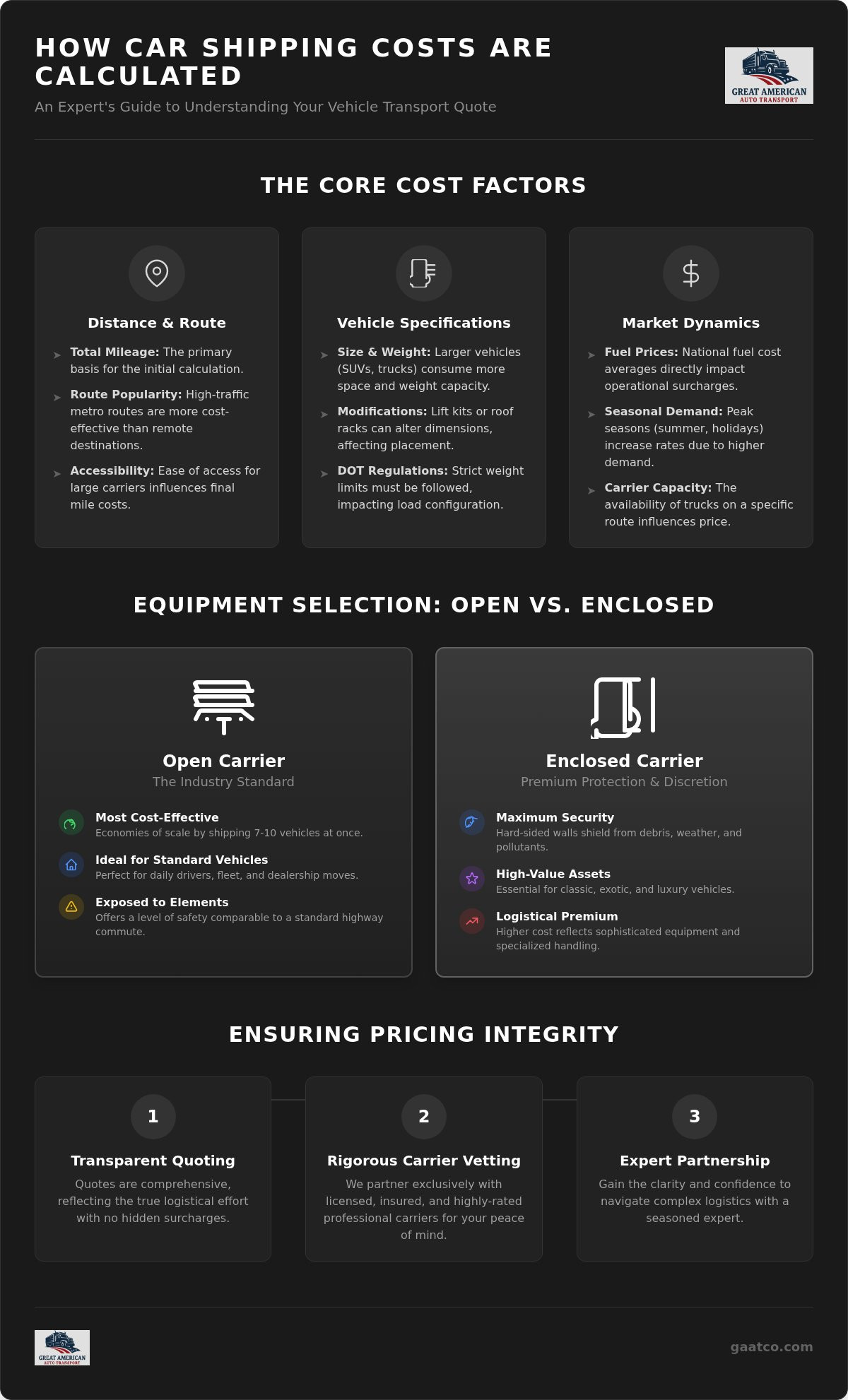
Understanding how are car shipping costs calculated begins with the baseline formula: total mileage multiplied by the prevailing per-mile rate. While distance is the most visible metric, it's rarely a linear calculation. Logistics professionals must account for the operational expenses of every mile, including labor, maintenance, and the complexities of the chosen route. This transparency is essential for discerning clients who want to understand how are car shipping costs calculated in an evolving market.
When you engage an auto transport broker or a direct provider, they analyze these variables to ensure the quote reflects the true logistical effort required. For those requiring specialized transport services, such as classic or military vehicle shipping, these fundamental variables serve as the foundation for a more customized logistical plan.
The Impact of Vehicle Size and Weight
Standard sedans are the gold standard for trailer efficiency. They occupy a predictable amount of real estate on a multi-car carrier. In contrast, a full-size SUV or a heavy-duty truck consumes significantly more space and adds substantial weight. This is a critical factor because the Department of Transportation (DOT) imposes strict gross vehicle weight ratings on all carriers. If a load exceeds these limits, the driver faces heavy fines and potential safety hazards.
Oversized vehicles often necessitate specialized equipment or require the carrier to leave a slot empty to accommodate the extra length or height. Modifications also play a role. A vehicle with a lift kit or a permanent roof rack changes the vertical clearance requirements, potentially limiting where it can be placed on a trailer. Carriers must prioritize the safety of the entire load, which is why these dimensions are scrutinized during the quoting process.
Route Popularity and Accessibility
Route density is a primary driver of carrier availability and pricing. Shipping between major metropolitan hubs like Dallas and New York is generally more cost-effective per mile because there's a constant flow of vehicles. Carriers can easily fill their trailers in both directions, which reduces the financial risk of deadhead miles. Deadheading occurs when a driver must travel with an empty trailer to reach a pickup location, an inefficiency that's typically reflected in the final quote.
In contrast, rural or remote locations require a driver to deviate from primary interstate corridors. This increases fuel consumption and time, making the individual shipment more expensive even if the distance is shorter than a hub-to-hub route. Accessibility also matters. A narrow residential street that cannot accommodate a large carrier may require a secondary, smaller truck for local pickup, adding another layer to the logistical calculation.
Equipment Selection: Open vs. Enclosed Carrier Logistics
Beyond the geographic variables discussed previously, the selection of equipment is a primary driver in how are car shipping costs calculated. This decision often dictates the operational flow of the entire transport mission. Different carrier types require distinct loading protocols, specialized maintenance schedules, and varied insurance structures, all of which influence the final investment required for a secure relocation.
Open Carrier Transport: The Industry Standard
The open-air carrier remains the backbone of the vehicle relocation industry. These sophisticated multi-car trailers, typically accommodating seven to ten vehicles, offer significant economies of scale. By distributing the costs of fuel, tolls, and labor across a larger number of units, carriers can provide a highly efficient solution for standard daily drivers. It's the preferred choice for dealership inventory and corporate fleet relocations. While the vehicle is exposed to the elements, the level of safety is comparable to a standard highway commute, making it the most cost-effective logistical standard for the majority of our clients.
Enclosed Carrier Transport: Protection and Discretion
For owners of classic, exotic, or high-value luxury vehicles, enclosed transport provides a necessary layer of discretion and security. These specialized trailers feature hard-sided walls that shield the cargo from road debris, inclement weather, and environmental pollutants. The logistical premium for this service stems from the sophisticated equipment involved. Many enclosed carriers utilize hydraulic lift gates to ensure low-clearance vehicles are loaded perfectly horizontally. This eliminates the risk of undercarriage damage that can occur on the steep ramps of a standard trailer.
Professional transport partners maintain significantly higher insurance coverage limits for enclosed shipments to reflect the high-stakes nature of the assets involved. These carriers often operate with a lower car-to-driver ratio, which allows for meticulous attention to detail and a more personalized level of care during transit. When evaluating Enclosed Car Transport for a sensitive relocation, it's helpful to recognize that the price reflects a specialized environment designed for asset preservation. Understanding these equipment nuances is a vital step in mastering how are car shipping costs calculated for high-end automotive investments.
Market Dynamics: Seasonality, Fuel, and Carrier Capacity
While equipment selection and distance provide the baseline for a quote, the broader economic climate dictates the final investment. Market dynamics are fluid, representing the intersection of global energy costs and regional migration patterns. To understand how are car shipping costs calculated in the current year, one must look toward the volatile nature of fuel and the seasonal shifts in carrier availability. These external forces are often beyond the control of any single provider, yet they remain central to the logistics of every professional transport mission.
The Influence of Fuel Surcharges
Carriers must adjust their rates to compensate for diesel price spikes to maintain operational stability and safety standards. Fuel is a non-negotiable variable in any professional transport quote. As of August 2026, the national average price for on-highway diesel has reached $5.257 per gallon. This results in a fuel surcharge of approximately $0.67 to $0.73 per loaded mile, depending on the carrier's base price and efficiency. Our team at GAATCO monitors these national fuel trends meticulously to provide accurate, fair pricing. This ensures that the quote you receive reflects the real-world costs of the journey without arbitrary inflation or hidden fees.
Seasonal Fluctuations and the Snowbird Effect
Peak seasons create significant shifts in how are car shipping costs calculated. The summer months, spanning from May to August, typically see a surge in general relocations as families move between school years. However, the "Snowbird" effect exerts a more specialized pressure on North-South corridors. Between October and November, and again from March to May, demand for transport to and from regions like Florida or Arizona spikes dramatically. During these windows, high demand allows carriers to command rates that are often 15-30% higher than off-peak averages.
Carrier capacity also fluctuates during major holidays and fiscal quarter-ends. Many professional drivers prioritize time with their families during the winter holidays, which reduces the number of available trailers just as shipment volumes often peak. This scarcity of supply relative to demand naturally increases the investment required to secure a position on a high-quality carrier. If your schedule allows for flexibility, choosing to ship during the quieter window between January and March can lead to more favorable pricing, as this is historically the period of lowest market demand. By aligning your transport needs with these cycles, you can optimize your investment while still benefiting from the reliability of a seasoned transport partner.
Strategic Logistics: Door-to-Door Service and Expedited Shipping
Strategic decisions regarding the level of service and delivery precision are essential components of how are car shipping costs calculated. While distance and equipment provide the foundation, the specific logistics of the origin and destination dictate the final operational flow. Professional transport is a high-touch service where convenience and timing are balanced against the complexities of local infrastructure; for a detailed look at how these standards are applied, you can visit My Auto Transport Services to read their specialized 2026 door-to-door guide. We treat every shipment as a unique mission that requires meticulous planning to ensure the safety of your investment.
This level of meticulous planning and high-touch service is a standard shared by other premium transportation sectors. For instance, those who require elite personal mobility in Europe can find a similar commitment to excellence with Driver2Go, a premier private chauffeur service in Bordeaux.
Door-to-door shipping is the gold standard for luxury and professional relocations. It prioritizes the client's time by handling the vehicle as close to the residence as safety and local laws allow. However, metropolitan hubs like Seattle, Miami, or Chicago present unique hurdles. Low-hanging trees, weight-restricted bridges, and narrow residential streets often prevent a 75-foot carrier from reaching a front door. In these instances, our team coordinates a meeting at a nearby accessible parking lot with ample clearance. This ensures the safety of the asset and the carrier's equipment. For clients in dense hubs like Atlanta or Houston, this service saves hours of travel to a terminal. You can explore our specific GAATCO services to see how we tailor these solutions for complex urban environments.
Expedited Shipping: Prioritizing Your Timeline
When timing is the primary concern, expedited shipping offers a solution for corporate or military relocations that can't wait for standard windows. The surcharges for this service aren't arbitrary; they reflect the costs of rerouting carriers or securing a dedicated spot on a trailer that's already in motion. It's about buying priority in a crowded market. Despite the increased speed, the safety protocols remain uncompromising. Every vehicle is handled with the same meticulous attention to detail that defines our standard operations. This service is particularly valuable for those who need a guaranteed pickup date to align with a tight relocation schedule.
The condition of the vehicle also plays a role in how are car shipping costs calculated. Inoperable vehicles require specialized winching equipment and additional labor to load and unload safely. This isn't a standard service for every carrier, so it requires careful vetting of the transport partner to ensure the right tools are on-site. If you're managing a complex relocation or moving a non-running classic, you can request a quote to see how these strategic variables apply to your specific needs.
Ensuring Pricing Integrity: The GAATCO Approach to Quotes
After analyzing the technical variables of distance and equipment, the final step in securing your vehicle's journey is identifying a partner who values transparency. Understanding how are car shipping costs calculated empowers you to spot discrepancies before they become costly mistakes. A professional transport partner acts as a bridge between your specific needs and the complex operational realities of the road. We believe that a high-stakes vehicle move deserves the stability and calm confidence that only a seasoned expert can provide.
The industry is unfortunately populated with high-volume brokers who prioritize quantity over the safety of the assets they move. A quote that seems unusually low is often a red flag for hidden surcharges or the use of sub-par carriers. These "bait and switch" tactics can lead to significant delays or unexpected fees upon delivery. Choosing a provider based solely on the lowest price often compromises the integrity of the transport. Instead, we encourage a focus on reliability and a proven history of operational excellence.
Vetting Your Transport Provider
A professional transport provider should offer more than just a price point; they should offer peace of mind. We recommend a rigorous vetting process for any potential partner to ensure they meet the standards required for high-end automotive logistics. Use this checklist to verify their credentials:
- Verify valid Department of Transportation (DOT) registration and licensing.
- Confirm comprehensive insurance coverage that aligns with the current market value of your vehicle.
- Look for a proven track record of at least 20 years of industry experience.
- Ensure they offer transparent, door-to-door solutions without hidden broker fees.
At GAATCO, we've spent over two decades refining our network of licensed and insured carriers. We act as a trusted advisor throughout the entire process, handling the intricate details of logistics so you don't have to. Our team remains calm under pressure, ensuring that every detail of your transport is managed with meticulous attention to detail.
Requesting Your Customized Quote
An accurate quote requires precision and a deep understanding of how are car shipping costs calculated in the current market. To ensure your transport plan is bespoke and free from unexpected adjustments, we gather specific data points. This includes the year, make, and model of your vehicle, along with the precise pickup and delivery locations. This data allows our professionals to account for the route density, fuel surcharges, and vehicle dimensions discussed in our earlier analysis.
We invite you to request a quote for a professional logistics experience tailored to your specific timeline. Our commitment to transparent pricing is a non-negotiable pillar of our brand. When you partner with us, you receive a hassle-free experience defined by reliability and safety. We handle the complex logistics of professional vehicle transport with the quiet luxury and authoritative expertise your vehicle deserves.
Securing Your Automotive Investment with Logical Precision
Mastering the nuances of how are car shipping costs calculated allows you to move beyond simple estimates toward a sophisticated understanding of logistics. You now recognize that your quote reflects a delicate interplay between equipment standards, regional route density, and the volatile nature of global fuel markets. Whether you require the discreet protection of enclosed transport for a classic asset or the efficiency of open-air relocation, the priority remains the same: the safe and predictable arrival of your vehicle. Professional transport isn't merely a service; it's a commitment to asset preservation through meticulous planning.
We invite you to leverage our 20 years of professional experience to manage your next relocation. Our licensed and insured carrier network is specifically vetted to handle the complexities of luxury and military transport with the attention to detail your investment deserves. You can Request a Professional Auto Transport Quote from GAATCO to begin crafting a bespoke logistical plan that prioritizes safety and transparency. We look forward to serving as your trusted advisor on the road ahead, ensuring your vehicle's journey is handled with the expertise it requires.
Frequently Asked Questions
How much does it typically cost to ship a car across the country?
Cross-country transport pricing is determined by a sophisticated combination of total mileage, equipment choice, and route accessibility. While industry averages fluctuate based on national fuel trends and regional demand, the investment typically reflects the logistical complexity of traversing multiple geographic zones. Factors such as the vehicle's dimensions and the current density of the chosen corridor also play a role. We recommend requesting a customized quote to receive a figure that accounts for these precise variables.
Why is enclosed car shipping more expensive than open transport?
Enclosed transport carries a premium due to the specialized equipment and higher operational costs involved in protecting high-value assets. These trailers offer hard-sided protection against environmental hazards and road debris. Additionally, enclosed carriers maintain significantly higher insurance coverage limits and often utilize hydraulic lift gates for low-clearance vehicles. This lower car-to-driver ratio ensures a meticulous level of attention and discretion, which is essential for luxury and classic vehicle owners who prioritize asset preservation.
Does the time of year really affect my car shipping price?
Seasonality is a primary driver in how are car shipping costs calculated. During peak periods, such as the summer months or the winter migration known as "Snowbird" season, demand for specific routes often exceeds available carrier capacity. This allows carriers to command higher rates to manage the increased volume. Conversely, shipping during the quieter window between January and March may offer more favorable pricing, as the industry typically experiences a seasonal lull in general relocation activity.
Are there extra fees for shipping an inoperable vehicle?
Yes, transporting an inoperable vehicle requires specialized equipment and additional labor that influences the final quote. Since these vehicles cannot be driven onto a trailer, carriers must utilize winches or forklifts to secure the load safely. This logistical requirement limits the number of eligible carriers and increases the time needed for loading and unloading. It's vital to disclose the vehicle's condition early to ensure the dispatched carrier is properly equipped for the mission.
How do fuel prices impact my final auto transport quote?
Fuel remains a non-negotiable variable in the logistical equation. As diesel prices fluctuate, carriers implement surcharges to maintain operational stability and safety standards. These surcharges are typically calculated based on national on-highway diesel averages and the loaded mileage of the journey. To understand how are car shipping costs calculated accurately, one must account for the current energy climate, as even minor shifts in per-gallon costs can influence the baseline rate for long-distance transport.
Is door-to-door shipping included in the standard calculation?
Door-to-door service is the preferred standard for professional relocations, prioritizing convenience and security. While it's often the baseline for specialized transport, local infrastructure can impact the final execution. If narrow streets or weight restrictions prevent a full-size carrier from reaching a residence, our team coordinates a safe meeting point nearby. This approach ensures the safety of the vehicle and the carrier's equipment while maintaining the time-saving benefits that define a premium door-to-door experience.
Can I get a discount for shipping multiple vehicles at once?
Shipping multiple vehicles concurrently often presents opportunities for logistical optimization. When a single carrier can secure a larger portion of their load at one location, it reduces the time spent on multiple stops and deadhead miles. While the total investment increases with the number of units, the per-vehicle rate may be more favorable compared to individual shipments. This efficiency is particularly beneficial for corporate relocations or collectors moving several high-value assets between regional hubs.
What is the most cost-effective way to ship a car in 2026?
To optimize your transport investment, consider utilizing open-carrier transport during off-peak windows, such as the early first quarter. Flexibility with your pickup and delivery dates allows providers to align your shipment with existing high-density routes, which reduces operational costs. Additionally, meeting a carrier at a major highway hub or accessible parking lot can lower the logistical premium associated with rural diversions. Partnering with a seasoned expert ensures you achieve these savings without compromising on safety.


