The most conservative line item on a transport quote often results in the most expensive logistical journey once the hidden costs of time and storage are realized. Many professionals assume that utilizing a central hub is the most efficient way to manage a vehicle relocation. While the initial figures may suggest a modest saving, the complexities of door to door vs terminal to terminal shipping in 2026 require a more nuanced perspective. It's understood that you require a solution that balances fiscal responsibility with the absolute security of your vehicle.
This guide provides a comprehensive analysis of modern logistics to ensure your next move is characterized by reliability and discretion. We shall explore how evolving FMCSA regulations, such as the transition to USDOT primary identifiers and electronic medical certifications, influence the current transport environment. By understanding the true operational flow of each method, you can secure a seamless experience that prioritizes the safety of your vehicle above all else; we will examine the narrowing price gap between these methods and the logistical advantages of a more personalized approach.
Key Takeaways
- Distinguish between the precision of origin-to-destination logistics and hub-based systems to determine which operational model best aligns with your relocation requirements.
- Analyze the true total investment of door to door vs terminal to terminal shipping by accounting for secondary transport expenses and potential terminal storage fees that often inflate base quotes.
- Learn why high-value assets, such as classic or luxury vehicles, benefit from the continuous oversight of door-to-door service to mitigate the risks associated with public storage lots.
- Identify strategies to eliminate the logistical burden of "last-mile" coordination, ensuring your vehicle arrives at its precise destination without the need for additional travel.
- Discover how a bespoke approach to vehicle relocation provides the predictable scheduling and transparent outcomes necessary for a seamless, professional experience.
Understanding the Fundamental Logistics: Door-to-Door vs. Terminal-to-Terminal
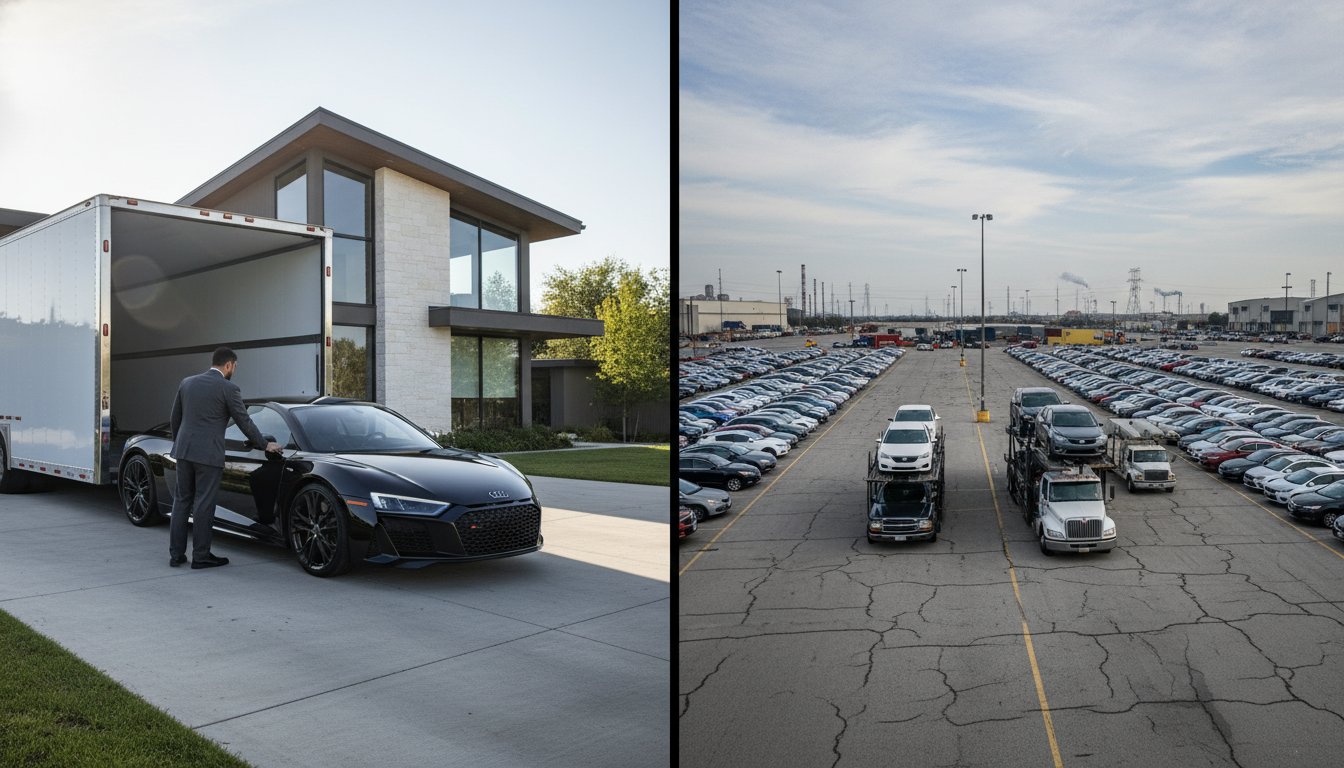
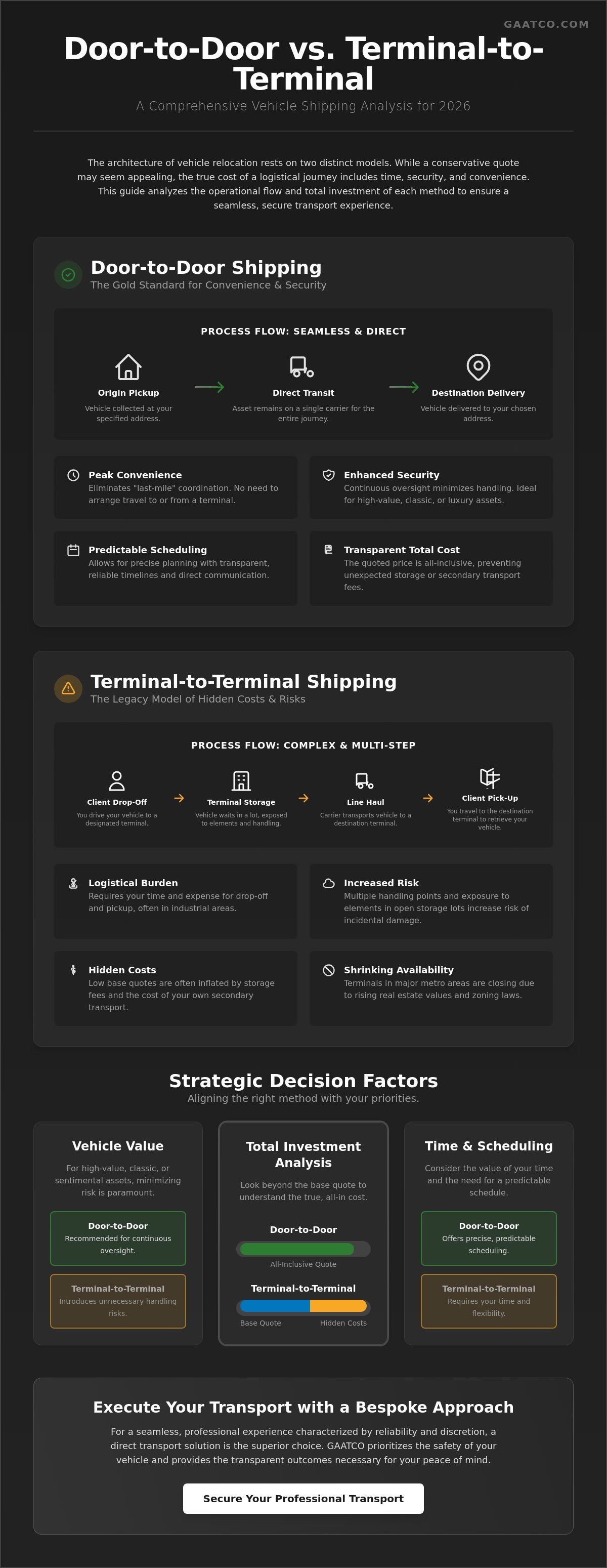
The architecture of vehicle relocation rests upon two distinct operational models that dictate the flow of the entire transport process. Door-to-door shipping represents a personalized service where a carrier retrieves a vehicle from a specific origin and delivers it to a precise destination. Conversely, terminal-to-terminal shipping utilizes a hub-based system where the client is responsible for transporting the vehicle to and from designated consolidation centers. When evaluating door to door vs terminal to terminal shipping, the primary distinction lies in the custody of the asset and the logistical burden placed on the owner. Understanding these Fundamental Logistics is essential for any professional seeking a secure and predictable transport solution.
As we progress through 2026, the transport industry has experienced a decisive move toward direct-to-consumer models. Centralized hubs are increasingly seen as legacy infrastructure, as sophisticated clients prioritize the efficiency of a streamlined, transparent supply chain. Regardless of the chosen method, the Bill of Lading remains the cornerstone of the transaction. This document serves as a binding receipt and a meticulous condition report, providing the legal framework necessary to protect your investment throughout the transport process. It's helpful to review our full range of professional transport services to see how these documents are integrated into a secure workflow.
To better understand the practical application of these different shipping methods, please review the following overview:
The Mechanics of Door-to-Door Delivery
Professional carriers often encounter residential restrictions in dense urban environments like Boston or San Francisco. In these scenarios, our team coordinates a convenient meeting point nearby, such as a large parking facility, to ensure a safe transition without violating local ordinances. This model facilitates a personal hand-off and direct communication with the transport professional. By minimizing "touches" and transitions, door-to-door service significantly enhances vehicle safety. Your asset typically remains on a single trailer for the duration of the journey, which reduces the risk of the incidental damage often found in high-volume sorting facilities.
The Architecture of Terminal Shipping
The architecture of terminal shipping relies on consolidation hubs where multi-car carriers aggregate vehicles destined for similar geographic regions. These facilities often incorporate secondary storage lots, which can introduce unnecessary handling and exposure to the elements. Terminal availability is currently shrinking in major metropolitan areas such as New York and Seattle. Rising real estate valuations and strict urban zoning have led to the closure of several traditional hubs. This trend makes the comparison of door to door vs terminal to terminal shipping more critical than ever, as the "budget" option may now require significantly more travel and coordination for the client than in previous years.
The Sophistication of Door-to-Door Shipping: Why Convenience is the Gold Standard
The logistical superiority of a direct delivery model is most evident when one considers the total cost of time. Choosing door to door vs terminal to terminal shipping removes the "last-mile" coordination that often complicates a relocation. You won't need to arrange for local transport or navigate unfamiliar industrial districts to retrieve your vehicle. This level of service provides the scheduling precision required in high-traffic metros like Houston or Dallas, where timing isn't just a preference but a necessity for professional success. It's a seamless transition that respects your schedule and eliminates the friction of secondary travel.
A critical distinction in 2026 involves the evolution of insurance standards and how they apply to different transit models. Many terminal lots are now managed by independent subcontractors, which can lead to fragmented liability. The FMCSA's Protect Your Move program emphasizes the importance of verifying carrier credentials and insurance to prevent fraud. By opting for a door-to-door approach, you ensure a continuous chain of custody. Your vehicle remains on the carrier's equipment or under their immediate watch, effectively closing the "gray area" of terminal liability. This continuity is a primary reason why professionals favor door to door vs terminal to terminal shipping for high-stakes moves.
Tailored Service for High-Value Assets
The most exclusive relocations frequently utilize enclosed car transport paired with direct delivery. This methodology maintains a quiet luxury experience, ensuring white-glove handling at your private residence. It's a strategy designed to protect the vehicle's value by avoiding the environmental exposure and high-traffic handling common in public hubs. For those managing military PCS moves or sensitive private collections, you can secure a tailored quote that reflects this commitment to excellence.
Navigating Urban Constraints
Operating in historic districts like Nashville or Orlando requires specialized expertise. When narrow streets prevent a large carrier from reaching your driveway, our team implements the Suburban Meeting Point (SMP) strategy. Drivers conduct a professional site assessment to find a safe, accessible location nearby. They'll coordinate with you in real-time to ensure the hydraulic ramp is operated on level ground and the vehicle is handled with precision. It's a meticulous process that balances the convenience of a personal hand-off with the physical realities of urban infrastructure.
Deconstructing Terminal-to-Terminal Transport: Evaluating the Hidden Costs and Risks
The appeal of terminal shipping usually rests on a lower initial quote. However, when examining door to door vs terminal to terminal shipping, the base rate is often a deceptive metric. In 2026, the price gap between these methods has narrowed to approximately $150 to $250. This means the perceived savings are remarkably fragile. If a vehicle sits in a terminal due to a scheduling conflict or a late pickup, daily storage fees can quickly erase any initial financial advantage. These costs are rarely highlighted in the initial quote but represent a significant financial risk for the unprepared client.
Security remains a paramount concern for those relocating high-value assets. Unlike a private driveway or a secure carrier trailer, terminals are often unmonitored consolidation hubs that prioritize volume over individual care. Vehicles in these environments face the risk of "lot rash," which includes minor dings, scratches, and abrasions from constant high-volume movement. There is also the potential for vandalism in facilities that lack 24-hour professional oversight. These unmonitored environments present a security vulnerability that discerning owners simply shouldn't overlook when planning a relocation.
The environmental and mechanical cost of this method is also noteworthy. Driving a vehicle to a distant hub increases your personal carbon footprint and adds unnecessary mileage to the odometer. In 2026, as urban land values have surged, many terminals have moved even further into industrial peripheries. This shift forces clients to travel longer distances, increasing the wear on the vehicle before the actual transport even begins. It's a hidden logistical tax that complicates what should be a straightforward process.
The Logistics Trap: Time and Secondary Transport
Calculating the value of your time spent driving to a terminal in San Diego or Phoenix is essential for a true cost analysis. If the terminal is 50 or more miles away, you'll likely spend half a day coordinating the drop-off or pickup. This doesn't include the cost of secondary transport, such as a rental car or a long-distance rideshare, to return home. Coordination fatigue is a real factor when you're forced to manage two different sets of operating hours and personnel. The friction involved in these "budget" moves often outweighs the modest savings on the transport itself.
Insurance and Liability Gaps
Where the carrier's insurance ends and the terminal's liability begins is a common source of friction in the industry. Proving that damage occurred while parked at an unmonitored hub rather than during transit is notoriously difficult. This ambiguity creates a "gray area" that can leave you unprotected in the event of a claim. This is why our team at GAATCO recommends utilizing licensed and insured carriers for end-to-end protection. By maintaining a single point of responsibility, you ensure that your vehicle is covered under a consistent policy from the moment of pickup to the final delivery at your door.
Strategic Decision Factors: Geography, Vehicle Value, and Scheduling Precision
Determining the most effective method for vehicle relocation requires a sophisticated evaluation of the asset's value and the geographic realities of the route. When considering door to door vs terminal to terminal shipping, the nature of the vehicle often dictates the appropriate strategy. Classic and luxury cars represent significant investments that shouldn't be subjected to the idling risks found in a public hub. Instead, these assets require a bespoke logistics plan that prioritizes safety and minimizes exposure. By focusing on the "Total Cost of Transport" rather than a simple sticker price, you account for the preservation of vehicle value and the elimination of extraneous travel.
The urgency factor is another critical consideration for professional relocations. Door-to-door service effectively removes the hub-dwell time that can delay a shipment by several days. This streamlined approach allows for superior scheduling precision, ensuring that your vehicle arrives exactly when it's required. If you're managing a complex schedule, you should request a personalized quote to see how our operational flow aligns with your timeline.
Vehicle Type as a Deciding Factor
Standard sedans may tolerate the logistical transitions of a terminal, but low-clearance sports cars require the specialized equipment often found in direct-delivery carriers. These vehicles necessitate precise loading dock requirements that many public hubs cannot consistently provide. This distinction is especially vital for military vehicle shipping during strict PCS timelines, where there's no margin for the delays associated with terminal consolidation. Inoperable vehicles also present a unique challenge; terminal shipping is rarely an option for non-runners because most hubs lack the specialized equipment to move a vehicle that cannot be driven onto a trailer.
Regional Nuances in the United States
Geographic accessibility varies significantly across the country, influencing the efficiency of each model. In sprawling metropolitan areas like Houston and Austin, door-to-door service is exceptionally efficient due to the expansive highway infrastructure. Conversely, while Miami maintains a high density of terminals, rural areas often lack any viable hub options within a reasonable distance. Navigating the logistics of the Pacific Northwest, specifically Seattle, requires accounting for different seasonal constraints than the arid Southwest routes toward Las Vegas. Increased frequency of extreme thermal events in 2026 has made unshaded terminal lots particularly hazardous for vehicle finishes and sensitive interior electronics.
Executing Your Transport with GAATCO: A Bespoke Approach to Vehicle Relocation
GAATCO has spent over 20 years perfecting the art of specialized vehicle relocation. With more than 250 coverage points nationwide and a history of serving over 25,000 customers, we understand that every move is a high-stakes event requiring meticulous attention to detail. When you evaluate door to door vs terminal to terminal shipping, the decision often rests on the quality of the partnership you choose. We provide transparent, all-inclusive pricing that eliminates the uncertainty of hidden fees or secondary transport costs. This commitment to clarity allows you to focus on your transition while our team of professionals manages the intricate operational flow behind the scenes.
The GAATCO Driver Network consists of vetted professionals who understand the nuances of elite service. These aren't just carriers; they're seasoned experts who are calm under pressure and dedicated to the safety of your asset. By maintaining a human-centric approach within a sophisticated infrastructure, we bridge the gap between your specific needs and the complex realities of modern logistics. Our goal is to simplify the relocation process, providing a discreet and dependable service that reflects the quiet luxury our clients expect.
The GAATCO Door-to-Door Experience
Our door-to-door model is designed for those who value discretion, security, and precision. You'll receive real-time updates and maintain direct contact with the carrier, ensuring total peace of mind throughout the transit period. We utilize customized routing to optimize both safety and delivery speed, bypassing the rigid and often hazardous constraints of traditional hub systems. This personalized strategy ensures your vehicle is never left unattended in an unmonitored lot. To begin your journey with a partner that prioritizes your vehicle's value, you can request a bespoke quote tailored to your specific route and requirements.
Why Professionalism Matters in 2026
The regulatory landscape of 2026 requires a partner who is meticulously attentive to compliance and safety standards. With the FMCSA now utilizing USDOT numbers as the primary identifier and strictly enforcing English proficiency requirements since June 25, 2026, the industry has moved toward a more digital and disciplined framework. Our professionals operate within these modern systems, including the electronic submission of medical certificates required since June 23, 2026. We act as your trusted advisor, handling these operational pillars so the experience remains seamless for you. Before your scheduled pickup, please ensure you have completed this final checklist:
- Provide one set of keys to the transport professional and retain a spare for yourself.
- Ensure the vehicle has approximately a quarter tank of fuel for loading and unloading.
- Remove all personal items and electronic toll tags from the interior.
- Conduct a final cleaning to facilitate a clear and accurate Bill of Lading inspection.
Securing Your Vehicle's Future with Strategic Logistics
Selecting the right relocation method requires a sophisticated understanding of operational costs that extend far beyond the initial sticker price. While the debate regarding door to door vs terminal to terminal shipping often centers on immediate figures, the true investment is found in the long-term security of your asset and the precision of your schedule. Choosing a direct delivery model ensures a continuous chain of custody and eliminates the logistical friction inherent in legacy hub systems. You've gained the insights necessary to move beyond the base rate illusion and prioritize a seamless, secure experience.
GAATCO leverages over 20 years of industry experience to deliver a service that prioritizes your peace of mind. Our commitment to utilizing licensed and fully insured carriers ensures that high-value and military transport remains protected from origin to destination. We manage the evolving logistics of 2026 with a calm confidence that allows you to focus on your next chapter. It's time to secure a transport partner that understands the nuances of elite service and meticulous detail.
Please Request a Professional Transport Quote from GAATCO to begin your seamless relocation journey today.
Frequently Asked Questions
Is door-to-door shipping always more expensive than terminal shipping?
Not necessarily, as the total cost of transport must include secondary logistics and the value of your time. While terminal-to-terminal rates may appear lower initially, the price gap has narrowed to approximately $150 to $250 in 2026. Once you account for rental cars, rideshares, and fuel to reach a distant hub, door-to-door service often proves more economical. It's a matter of evaluating the total investment rather than just the base quote.
What happens if a transport truck cannot fit on my street for door-to-door delivery?
If local ordinances or narrow streets prevent residential access, our professionals coordinate a nearby meeting point. This is typically a large, accessible parking facility or a wide secondary road that allows the carrier to safely operate hydraulic ramps. We prioritize the safety of your vehicle and the equipment, ensuring a secure hand-off in a location that complies with all regional regulations and safety standards.
Are vehicles insured while they are sitting at a shipping terminal?
Coverage during terminal storage is often fragmented and may not be included in the primary carrier's policy. Many terminals are independent facilities, meaning the carrier's insurance ends upon drop-off and resumes only at pickup. This "gray area" is a significant risk factor in door to door vs terminal to terminal shipping, as proving liability for damage occurring in an unmonitored hub is notoriously difficult for the owner.
How much are typical terminal storage fees in 2026?
Daily storage fees in 2026 vary by region but often range from $35 to $75 per day after an initial grace period. In major metropolitan areas with high land values, these costs can escalate quickly if your pickup is delayed by scheduling conflicts. These hidden expenses are a primary reason why many professionals now prefer the predictable, all-inclusive nature of a direct delivery model to avoid compounding costs.
Can I ship an inoperable vehicle using terminal-to-terminal transport?
Terminal shipping is rarely an option for inoperable vehicles because most hubs lack the specialized winching equipment required to move a non-runner. These facilities are designed for high-volume sorting of drivable cars that can be moved quickly between lots. For non-operational assets, we recommend specialized door-to-door service where the carrier is specifically equipped to handle the loading and unloading of a vehicle that cannot move under its own power.
Which method is faster for cross-country car shipping?
Door-to-door shipping is generally faster because it eliminates the "hub-dwell" time associated with terminal consolidation. In a terminal-based system, your vehicle may wait several days for a carrier to aggregate enough cars to fill a trailer for a specific regional route. Direct service streamlines the process, ensuring the carrier moves toward your destination immediately after the initial pickup is completed, which provides a more predictable arrival window.
Do I need to be present for a door-to-door pickup and delivery?
You or a designated representative must be present to sign the Bill of Lading and conduct the joint condition inspection. This document is the primary legal record of your vehicle's state at the time of transfer. Having a responsible party on-site ensures that any details regarding the vehicle's condition are meticulously documented, protecting your investment and providing the necessary paperwork for continuous insurance coverage throughout the journey.
How do I prepare my car for door-to-door transport with GAATCO?
Preparation involves a thorough cleaning and the removal of all personal items and electronic toll tags from the interior. You should maintain approximately a quarter tank of fuel to facilitate the loading process while minimizing unnecessary transport weight. We also recommend documenting the vehicle's condition with high-resolution photographs before our professional team arrives, ensuring a smooth and transparent inspection process during the door to door vs terminal to terminal shipping transition.


