
A vintage vehicle is far more than a collection of mechanical components; it is a preserved piece of history that requires an engineering approach to relocation. Securing reliable classic car transport denver services becomes particularly complex when that piece of history is an inoperable project car or a low-clearance masterpiece. Most collectors understand that moving a non-running engine or a delicate chassis involves significantly more risk than a standard tow. The anxiety surrounding improper winching techniques or unexpected surcharges for inoperable status is a legitimate concern when handling high-value assets.
This guide provides the expert clarity required to manage the logistics of shipping classic and non-running vehicles throughout Colorado. You will gain a comprehensive understanding of specialized equipment, white-glove preparation, and the transparent pricing structures that define professional service. We will examine the nuances of professional-grade winching, the benefits of enclosed carriers for vintage steel, and the local Denver logistics that ensure your investment arrives safely at its destination without compromise. By the end of this article, you will have the knowledge to secure damage-free delivery for your most prized automotive acquisitions.
Key Takeaways
- Understand how the "Rolling, Steering, Braking" standard dictates the logistical requirements and specialized hardware needed for a successful non-running vehicle move.
- Discover why hydraulic winches and lift gates are indispensable tools for safeguarding low-clearance assets during classic car transport denver.
- Learn to account for Denver's unique environmental factors, including the impact of high altitude on vintage seals and the challenges of steep residential terrain.
- Master the critical preparation steps, such as ensuring tire inflation and clearing loading paths, to facilitate a precise and damage-free pickup.
- Recognize the value of partnering with an experienced advisor who provides transparent surcharge structures and established expertise in handling high-value freight.
Understanding Classic Car Transport in Denver: The Inoperable Factor
Classic car transport in Denver represents a specialized segment of the logistics industry, catering specifically to the preservation of automotive history. Unlike standard vehicle hauling, this service demands a meticulous approach to safety and a deep understanding of vintage mechanics. Whether you're acquiring a pristine 1960s convertible or a rare project vehicle, the process requires a level of care that exceeds conventional standards. It's about moving a legacy, not just a machine.
Within the Denver metro area and across the Front Range, we frequently manage unique scenarios such as high-altitude barn finds or specialized auction acquisitions from facilities like Copart and IAAI. These vehicles often arrive in various states of disrepair, necessitating the use of specialized equipment for vintage vehicles to ensure the frame remains uncompromised. When a car is mid-restoration or has been stationary for decades, it rarely functions as a modern commuter would. This makes the expertise of your classic car transport denver partner the most critical factor in a successful delivery.
To visualize the precision required when handling high-value assets, consider the following demonstration of professional transport standards:
Rolling vs. Non-Rolling: Why the Distinction Matters for Classics
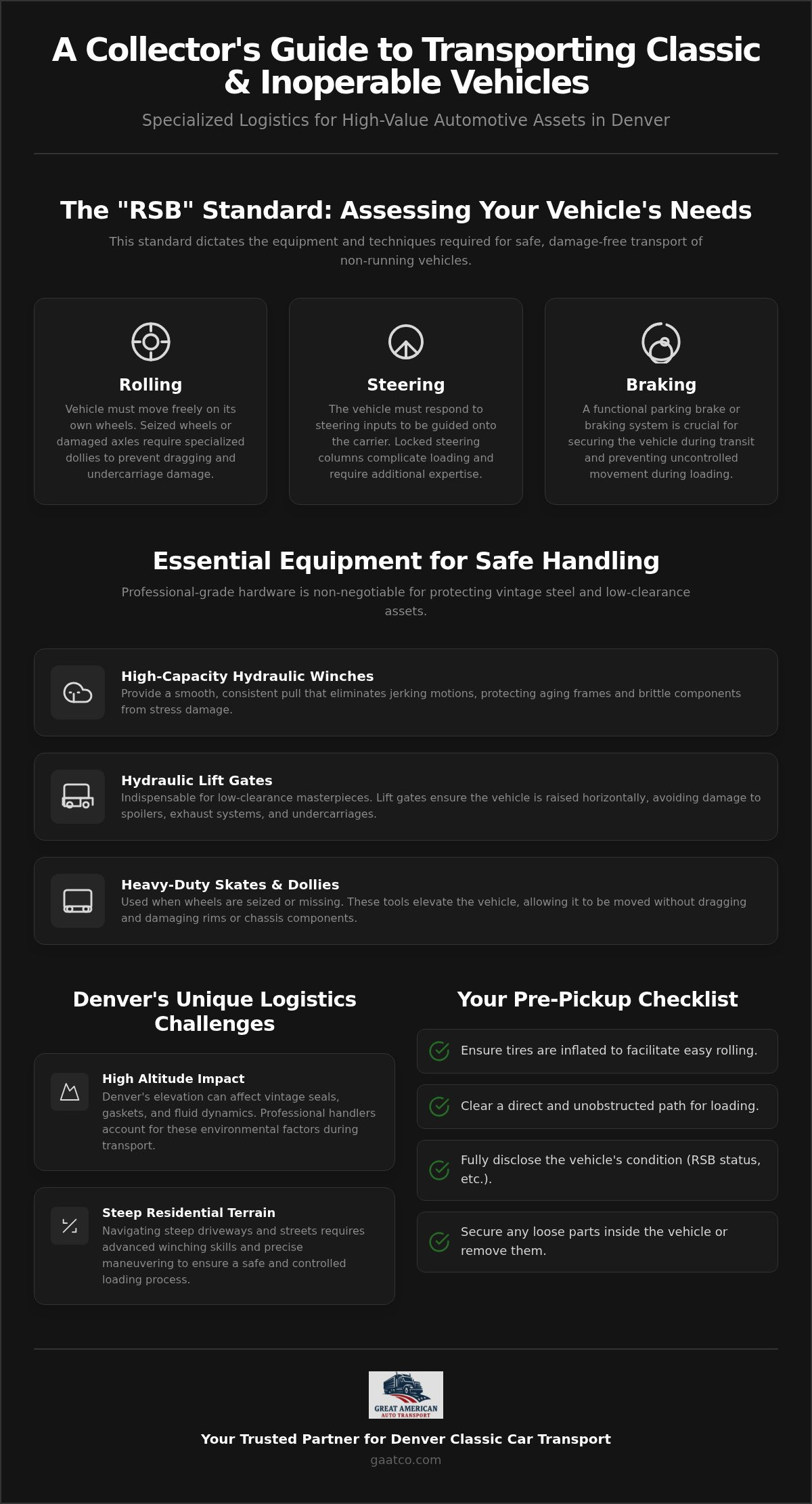
A fundamental distinction in the industry is whether a vehicle meets the "Rolling, Steering, Braking" (RSB) criteria. For standard winching, a vehicle must be able to move freely on its own wheels and respond to steering inputs. If wheels are seized or axles are damaged, our team must deploy additional tools like dollies or specialized skids to prevent dragging. This distinction is a key factor when evaluating GAATCO service selection, as it dictates the specific trailer configuration and labor hours required for a secure load without risking the vehicle's structural integrity.
The Economic Reality of Non-Running Classic Transport
Transporting an inoperable classic involves a transparent surcharge structure that reflects the additional time and technical skill required. Standard carriers often lack the hydraulic winches necessary for a controlled pull, potentially risking damage to vintage frames. While a local tow truck might seem like a shortcut, it lacks the infrastructure for long-distance protection. Providing full disclosure during the quote process ensures that our professionals arrive with the correct equipment, preventing costly delays and ensuring the integrity of your investment from pickup to delivery.
Specialized Equipment for Denver’s Vintage & Non-Running Vehicles
When wheels are seized or tires are missing, our team employs heavy-duty skates or dollies to elevate the vehicle. This prevents the rims or undercarriage from dragging across the pavement, which is a frequent source of damage during amateur loading. All operations are conducted in strict accordance with the safety protocols established by the Federal Motor Carrier Safety Administration (FMCSA). This ensures that even a project car is treated with the same structural respect as a pristine showroom model during transit across the Front Range.
Open vs. Enclosed Carriers for Denver Classics
Choosing between carrier types involves balancing the vehicle's current condition with its restoration goals. Open multi-car carriers are a practical choice for project cars destined for a full exterior overhaul. However, for high-value assets or vehicles with exposed interiors, enclosed transport is the standard. These trailers often feature hydraulic lift gates that remain perfectly level during the loading process. This is a critical advantage for low-clearance classics that would otherwise bottom out on the steep ramps of a standard carrier. If you're weighing these options for your vehicle, you can review our specialized transport options to determine the best fit for your logistics needs.
The Technical Skill of the Driver in Specialized Loading
The equipment is only as effective as the professional operating it. Loading a non-running vehicle from a narrow Denver driveway or a cramped residential carport requires a disciplined understanding of cable tension and safety zones. Our drivers are trained to identify the most secure attachment points on a vintage frame. They avoid delicate components like tie rods or steering linkages that were never engineered to bear the weight of a winch pull. This level of precision ensures that your vehicle remains exactly as you left it, regardless of how complex the initial recovery might be.
Navigating Denver’s Unique Logistics Challenges for Classics
Relocating a vintage vehicle within the Mile High City involves more than managing traffic on I-25. Denver's specific geography and climate introduce variables that can compromise a classic car's integrity if they aren't addressed with professional precision. For example, the region's high altitude and notoriously low humidity can cause vintage rubber seals and gaskets to shrink or become brittle. When we facilitate classic car transport denver for vehicles arriving from coastal climates, we account for these environmental shifts to ensure that the vehicle's structural seals remain intact during the transition to 5,280 feet.
The local terrain also dictates the technical approach to loading. In affluent residential enclaves like Castle Pines or the foothills of Golden, steep driveway gradients are common. Attempting to winch an inoperable project car on a significant incline requires a sophisticated understanding of center-of-gravity physics. Our team meticulously calculates cable tension to prevent the vehicle from shifting laterally, a risk that's amplified when dealing with the narrow, winding roads of the I-70 corridor. Transporting a project car through the mountains demands that all loose components are secured against high-altitude wind resistance and pressure changes.
Winter Operations: Loading Frozen Project Cars
Colorado's winters present a unique set of obstacles for non-running vehicles. Sub-zero temperatures often lead to seized brake drums or tires that have frozen directly to the asphalt. For a successful winter pickup, it's helpful to clear snow from the loading path and apply salt to the area where the carrier will align. Our drivers prioritize safety over speed in these conditions, utilizing specialized heating elements or lubricants to safely free seized components. We don't rush the process, as the goal is a damage-free load regardless of the thermometer's reading.
Urban vs. Rural Access in the Denver Metro Area
The logistical footprint of a 75-foot car hauler doesn't always mesh with the tight corners of historic Denver neighborhoods or the restricted access points of specialized body shops. When residential streets in areas like Wash Park or Capitol Hill are too narrow for safe maneuvering, we coordinate a discreet staging area at a nearby commercial lot. This ensures a straight, controlled winch pull without risking damage to the vehicle or surrounding property. Whether the pickup is at a rural restoration shop or a suburban garage, we handle the complex routing so the client doesn't have to manage the municipal constraints.
Preparing Your Classic or Project Car for Denver Pickup
Successful extraction of a non-running vehicle requires more than just a scheduled appointment. It demands meticulous staging to ensure the transition from garage to carrier is seamless. While standard preparation lists often focus on cosmetic cleaning, classic car transport denver for project vehicles prioritizes mechanical access and geometry. The loading process relies on a straight winch pull; therefore, you should clear a direct path that allows the carrier to align perfectly with the vehicle's front or rear axle. Any obstructions or tight angles can complicate the pull and increase the risk of lateral stress on the frame.
Before our team arrives, verify that the steering column is unlocked and the transmission can be shifted into neutral. These two factors are non-negotiable for a safe winch operation. If the tires can't hold air, please provide advanced notice so we can deploy specialized dollies or skates. Additionally, ensure all keys are organized and available. Project cars frequently contain loose parts in the trunk or cabin; having the correct keys allows our drivers to secure these areas and verify the contents against the inventory list. Proper documentation, including the title or a notarized bill of sale, should be ready for inspection to prevent administrative delays during the pickup window.
Auction-Specific Protocols: Copart and IAAI Denver
Acquiring a classic through local auctions like Copart or IAAI in Denver involves strict logistical timelines. Once a vehicle is marked as ready for release, storage fees can accumulate rapidly. Our professionals are experienced in navigating the specific gate pass requirements and loading zones of these facilities. We coordinate directly with auction staff to manage the winching of non-running purchases, ensuring your new acquisition is moved before additional costs are incurred. If you've recently secured a vehicle at auction, you can request a specialized transport quote to initiate the recovery process immediately.
Mechanical Disclosures and Condition Documentation
Complete transparency regarding a vehicle's mechanical state is the most effective way to protect your investment. If a vehicle has a broken axle, missing wheels, or a seized steering rack, these details must be disclosed during the booking process. Such conditions require specific technical interventions that differ from a standard winch pull. We recommend taking high-resolution photographs of the non-runner from multiple angles before the carrier arrives. This establishes a clear baseline of the vehicle's condition, which is then reflected on the Bill of Lading. Ensuring this document accurately describes the inoperable status protects all parties and maintains the high standards of safety we bring to every classic car move.
GAATCO: Your Trusted Partner for Denver Classic Car Transport
GAATCO has spent over two decades refining the art of automotive logistics, establishing a reputation as a premiere provider for classic car transport denver. Our team recognizes that a vintage vehicle is often a client's most significant passion project or a high-value investment asset. We've built our infrastructure around the unique requirements of the Front Range, offering seamless door-to-door service that bridges the gap between global transport standards and local Colorado nuances. Every carrier in our network undergoes a rigorous vetting process, ensuring they possess the specific expertise and industrial-grade equipment necessary to handle inoperable or delicate vintage freight with absolute precision.
Our commitment to safety is a non-negotiable pillar of our operations. By maintaining a disciplined focus on specialized moves, we provide a level of reliability that standard towing companies cannot match. We understand that handling a non-running classic requires a controlled, engineering-based approach rather than brute force. This established expertise allows us to manage complex recoveries from Denver residential areas or high-altitude mountain towns with the calm confidence our clients expect from a seasoned industry leader.
The GAATCO Difference: Professionalism and Precision
Our approach is defined by a sense of quiet luxury and unwavering reliability. We don't merely move vehicles; we act as dedicated logistics advisors who manage the complexities of a move so you don't have to. While budget-focused providers might offer a lower initial price, they often lack the specialized winching hardware or the experience required to navigate Denver's steep residential terrain without incident. We prioritize the safety of your investment above all else, maintaining a steady and measured rhythm of communication throughout the process. This level of professional handling is essential for collectors who require the reassurance that their historic steel is in expert hands.
Getting Started with Your Denver Transport
Initiating your relocation with GAATCO is a straightforward and transparent process. It begins with a detailed consultation where we discuss your vehicle's specific operational status, clearance requirements, and any geographic challenges at the pickup or delivery sites. During this phase, we'll confirm the necessary equipment, such as hydraulic lift gates or specialized dollies, to ensure a damage-free load. Our team then coordinates the logistics, providing you with a clear timeline and a comprehensive understanding of the surcharge structure for inoperable vehicles. To begin your journey with a partner who understands the high-stakes nature of vintage logistics, you can obtain a specialized quote through our secure portal. We're ready to provide the elite service your classic deserves. Request your Denver auto transport quote today and experience the peace of mind that comes from working with seasoned experts.
Secure the Future of Your Automotive Legacy
Moving a non-running masterpiece requires a departure from standard logistics and a commitment to specialized engineering. You've learned that the success of classic car transport denver hinges on the integration of industrial-grade hydraulic winching systems and a driver's technical precision. Proper preparation, such as ensuring steering mobility and providing accurate mechanical disclosures, serves as the foundation for a damage-free recovery. By accounting for Denver's unique environmental variables and residential terrain, you ensure that your project vehicle remains protected throughout its transition to the restoration shop or a private collection.
GAATCO stands as a discreet and dependable partner, bringing over 20 years of professional logistics experience to every specialized move. Our network utilizes fully licensed and insured carriers who specialize in high-value freight, employing the necessary lift-gate equipment for low-clearance non-runners. We handle the complex operational details so you can maintain your focus on the vision for your vehicle. When you're ready to proceed with a team that prioritizes safety and understated excellence, we invite you to Request Your Specialized Denver Classic Car Transport Quote. Your vintage investment deserves the highest standard of care, and we're honored to facilitate its next chapter.
Frequently Asked Questions
Can you transport a classic car in Denver if it has no wheels?
Yes, we can facilitate the transport of a vehicle without wheels by utilizing specialized heavy-duty skates or dollies. This process requires advanced notice to ensure the carrier arrives equipped with the necessary hardware to elevate the chassis without causing structural damage. Our team manages the technical aspects of the load to ensure the frame remains uncompromised throughout the journey.
How much extra does it cost to ship an inoperable vehicle in Colorado?
Transporting an inoperable vehicle involves a transparent surcharge to account for the additional labor and specialized equipment required. This fee covers the deployment of industrial hydraulic winches and the technical expertise needed to secure a non-running asset safely. We provide customized quotes that reflect the specific logistical needs of your classic car transport denver, ensuring full financial clarity before the pickup occurs.
Does my classic car need to be able to steer for winching?
Ideally, a vehicle should meet the "Rolling, Steering, Braking" standard, but we can accommodate assets with seized steering. In these instances, our professionals deploy specialized dollies to guide the vehicle onto the carrier deck. It's essential to disclose any steering or axle issues during your initial consultation so we can dispatch a driver with the appropriate recovery tools for your specific situation.
What happens if the carrier cannot reach my specific Denver address?
If a residential street is too narrow for a 75-foot car hauler, we coordinate a nearby staging area for a secure transfer. This is a common solution in historic Denver neighborhoods or steep foothill areas where large equipment cannot maneuver safely. We prioritize the safety of your vehicle and the surrounding property by selecting a level, accessible location for the loading and unloading process.
Are inoperable classic vehicles covered by insurance during transport?
Yes, every vehicle we relocate is covered by the carrier's cargo insurance policy, which is specifically tailored for high-value and vintage assets. This coverage protects your investment against negligence during the loading, transit, and unloading phases. We only partner with licensed and insured professionals who understand the unique risks and high stakes associated with moving non-running classic cars.
How long does it take to schedule an inoperable pickup in the Denver area?
Scheduling an inoperable pickup typically requires a lead time of several business days to secure a carrier with the correct winching equipment. While timelines vary based on your specific route and seasonal demand, we work diligently to align our logistics with your restoration or auction deadlines. We recommend initiating the booking process at least one week in advance to ensure optimal equipment availability.
Do I need to be present for the pickup and delivery of my project car?
We require you or a designated representative to be present at both the pickup and delivery locations to oversee the transition. This presence is necessary to sign the Bill of Lading and conduct a thorough joint inspection of the vehicle's condition. For project cars, this step is vital to document the state of the vehicle and any loose components before the transport begins.
Can you pick up a non-running car from a Denver salvage or classic auction?
Yes, we possess extensive experience coordinating professional pickups from major Denver auction facilities such as Copart and IAAI. Our team understands the specific gate pass protocols and the urgency required to avoid accumulating daily storage fees. We handle the communication with auction staff to ensure a seamless and efficient recovery of your non-running classic car transport denver purchase.


