

Low-profile tires and custom wheels do not prevent a vehicle from being shipped, but wheel width, ground clearance, and finish affect loading and protection. Shipping a car with low profile tires and custom wheels calls for sharing the vehicle’s current dimensions and loading clearance when arranging transport. Custom finishes also benefit from protection against contact during handling.
It is natural to focus on the wheels: limited clearance or a delicate finish can make routine handling feel like a concern. The practical step is to share the wheel and tire setup when arranging transport, so the shipment can be planned around those details.
This guide explains how wheel width and offset relate to clearance, what to consider when protecting polished, painted, or customized wheel faces, and how these features may affect transport planning and quotes. You will also learn what information to prepare and how open and enclosed transport differ, helping you choose an option that fits your vehicle.
Key Takeaways
- Share your wheel and tire dimensions, offset, and ground-clearance details when arranging transport so loading requirements can be considered.
- Protect custom wheel faces with suitable padding, and document their condition before the vehicle is collected.
- Transport rates can depend on vehicle dimensions and loading needs; changing wheel or tire sizes may also change the vehicle’s height.
- Read the shipping contract and review the vehicle’s condition records so you understand how wheel or tire damage is documented and handled.
- Compare open and enclosed transport in light of your vehicle’s finish and protection priorities.
Protecting wheel faces and custom finishes
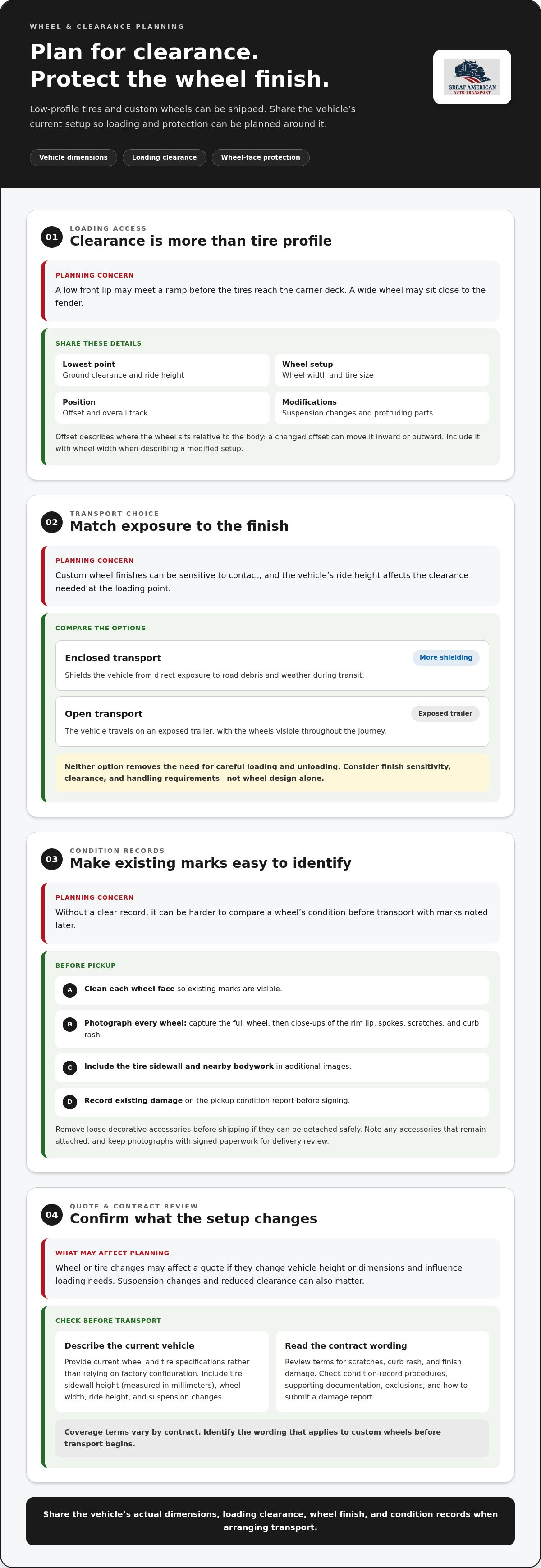
Wheel faces need protection from contact during loading, transit, and unloading. Choose transport and preparation steps based on the finish, wheel design, and vehicle clearance.
Choosing Open or Enclosed Transport
Enclosed transport shields a vehicle from direct exposure to road debris and weather during transit. Open transport carries vehicles on an exposed trailer, leaving the wheels visible throughout the journey. Neither option eliminates the need for careful loading and unloading. For custom wheels, weigh exposure against the finish’s sensitivity, then consider the vehicle’s ride height and the clearance needed at the loading point.
Enclosed transport provides more protection from external exposure, while open transport can also suit a vehicle with custom wheels. The right option depends on the finish, clearance, and handling requirements, not wheel design alone.
Selecting a Modified-Vehicle Carrier
Choose a carrier that can account for modified vehicles, including low-clearance cars and aftermarket wheel setups. Discuss wheel width, tire sidewall, ride height, and any parts that extend beyond the body. These details help assess whether the loading approach suits the vehicle. Sharing the specifications makes it possible to plan for the car’s actual setup rather than treating it as a standard-height sedan.
For example, share the vehicle’s lowest clearance point and say whether the wheel faces are polished, painted, or coated. These specifics give the transport team useful information for planning loading and handling.
Checking Wheel Damage Coverage
Review the contract terms for wheel and tire damage, including scratches, curb rash, and finish damage. Check how condition is recorded at pickup and delivery, what documentation supports a damage report, and how to submit one. Read exclusions and claim procedures closely. Because coverage terms vary by contract, identify the wording that applies to custom wheels before transport begins.
A pre-existing scrape on a spoke should appear in the condition record, making it easier to compare with any mark documented later. Keep copies of the signed paperwork and photographs with your shipping documents.
Documenting Wheel Condition Before Shipping
Before pickup, clean each wheel face so existing marks are visible. Photograph every wheel in full, then take close-ups of the rim lip, spokes, and any existing scratch or curb rash. Include the tire sidewall and nearby bodywork in additional images. These views help distinguish wheel damage from marks that were present before loading.
Remove loose decorative accessories before shipping if they can be detached safely. A spare wheel does not replace the installed wheels during transport. Record any accessories that remain attached, and note existing damage on the condition report before signing.
- Capture clear images of each wheel face and tire sidewall.
- Record existing chips, scratches, and curb rash in the pickup condition report.
- Keep photographs and signed documents together for delivery review.
Wheel width and clearance
A standard carrier can transport low-profile tires when the vehicle’s dimensions and loading clearance suit its equipment. Carrier and state constraints are assessed through overall dimensions, wheel width, suspension changes, and safe loading access.
Standard Carrier and Loading Needs
Low-profile tires alone do not determine whether a standard carrier can load a vehicle. Key measurements include the car’s lowest point, approach angle, wheel width, and overall track. A sedan with limited clearance may need a different loading approach from a similar sedan at standard ride height. Provide the tire and wheel setup, along with any suspension changes, during transport planning.
Both the loading equipment and the vehicle’s path onto the carrier matter. A wide wheel may sit close to the fender, while a low front lip could meet a ramp before the tires reach the deck. Sharing these details helps assess whether the equipment suits the car.
Oversized Wheel and Suspension Rules
For oversized wheels or modified suspension, focus on the vehicle’s complete dimensions and loading clearance. State and carrier requirements can depend on the vehicle’s width, height, and configuration. Give the carrier the wheel width, tire size, ride height, and any protruding parts. These details help identify whether the vehicle fits the available equipment and route constraints.
Offset also affects how a wheel sits relative to the body. RAW Wheels + Tires explains that offset measures the mounting surface from the center of the rim. A changed offset can move the wheel inward or outward, so include it alongside wheel width when describing a modified setup.
Wheel and Tire Effects on Rates
Wheel and tire changes can affect a quote if they alter the vehicle’s height or dimensions and influence loading needs. Compare the car’s factory height with its current setup. RAW Wheels + Tires advises comparing stock vehicle height with new wheel options because changing rim size can change vehicle height. A lower ride height may call for a loading plan suited to reduced clearance.
Provide current wheel and tire specifications instead of relying on the original factory configuration. Tire sidewall height is measured in millimeters, according to RAW Wheels + Tires. Include that measurement, wheel width, and suspension changes when describing the vehicle. Clear specifications help explain how modifications affect transport planning.
Review transport options alongside the car’s dimensions and loading needs. A precise description of the wheel setup helps assess an appropriate arrangement.
Do low-profile tires or custom wheels affect car shipping rates?
Low-profile tires and custom wheels can affect a shipping quote if they change the vehicle’s dimensions or loading requirements. The wheel finish alone does not determine the rate. An estimate depends on the car’s current height, width, configuration, route, and transport arrangement. For example, a modified coupe that sits lower than its factory setup may need different loading considerations from the same model at stock height.
Shipping a car with low profile tires and custom wheels starts with describing its current setup, not relying only on factory specifications. RAW Wheels + Tires advises comparing stock vehicle height with new wheel options because changing rim size can change vehicle height. That difference matters if reduced clearance affects the approach to loading equipment. Share current measurements and suspension details when requesting a quote.
Wheel width can also affect the vehicle’s overall footprint. A wider setup may sit closer to the fender or extend beyond the body, changing the space needed for loading and positioning. Offset measures the mounting surface relative to the rim center, according to RAW Wheels + Tires. Include wheel width, offset, and tire dimensions when describing the car. These details help clarify whether modifications affect handling requirements.
Other quote factors include vehicle size, pickup and delivery locations, route, and transport type. Loading needs may matter if a low front end or altered suspension limits the approach angle. Open and enclosed transport also differ in exposure and equipment. The suitable option depends on the vehicle and your protection preference, not simply on whether the wheels are custom.
Pricing is provided through a transparent quote with no hidden fees. Route, vehicle dimensions, transport type, and loading requirements inform the estimate. To help make the quote relevant, prepare these details:
- Record the current vehicle height and overall width.
- List wheel width, offset, and tire size.
- Describe suspension changes and low body components.
- Identify pickup and delivery locations and preferred transport type.
For example, describe a lowered suspension, wider wheels, and a front splitter together. This gives a clearer basis for assessing loading needs than saying only “custom wheels.” The quote for shipping a car with low profile tires and custom wheels reflects the vehicle’s configuration and transport requirements, so precise details help make the estimate more useful.
What should I check on a car shipping contract for wheel and tire damage coverage?
Read the written contract before signing, paying particular attention to vehicle damage, inspection records, and claims. For custom wheels, look for wording that covers wheel faces, rims, tires, and finishes rather than relying on a broad reference to vehicle condition. The contract should identify which document records the car’s condition at pickup and delivery. Compare that wording with the paperwork you receive.
Pay close attention to damage definitions and exclusions. A contract might describe visible damage generally, while another section explains how existing marks or removable accessories are handled. Check whether scratches, curb rash, cracked finishes, and tire sidewall damage receive distinct treatment. If a term is unclear, ask for its meaning in writing before signing. Keep the response with your contract for reference.
Review the claims process as carefully as the coverage wording. Identify where to report damage, which documents to submit, and any deadline stated in the contract. Check whether the process requires pickup and delivery condition reports, photographs, or a written description. For example, a close-up image of a rim edge can help distinguish an existing scrape from a newly observed mark. Follow the written steps and keep copies of every submission.
- Find the section describing responsibility for damage during transport.
- Check how the contract treats custom finishes, wheel faces, tires, and existing damage.
- Locate exclusions, claim instructions, and any stated reporting deadline.
- Keep the signed contract, condition reports, photographs, and claim correspondence together.
Read insurance or liability documents alongside the shipping contract. Confirm that the vehicle, transport period, and responsible parties match the shipment described in your agreement. Do not assume a general certificate explains whether a specific wheel finish is covered. For instance, a certificate may identify insurance details, while the contract explains how to report a damaged wheel. Use both documents to understand their separate roles.
Before signing, compare the contract with the car’s actual configuration. If the vehicle has aftermarket rims, a distinctive coating, or low-profile tires, record those details accurately in the shipping paperwork. Make sure the condition report describes visible chips or curb rash instead of using only a general note such as “wheels inspected.” Clear descriptions create a useful record if you later need to discuss a difference in condition.
At delivery, compare each wheel with the pickup record before completing the handover. If you see a new mark, photograph it clearly and follow the contract’s reporting instructions promptly. Keep the delivery paperwork and note the specific wheel, location, and visible damage. A precise description, such as “driver-side rear rim lip,” is more useful than a general note that a wheel appears damaged.
For shipping calculations, the author estimates a mounted wheel and tire weighs about 50 lbs. If you are discussing a separate shipment or replacement parts, ask whether the contract’s weight basis applies to the mounted assembly or to the vehicle as shipped. Keep any clarification with the written agreement, so the calculation and coverage terms are not confused.
Does car shipping insurance cover scratches, curb rash, or damage to custom wheels?
Coverage for scratches, curb rash, and custom-wheel damage depends on the written terms for the shipment. The word “insurance” alone does not explain which parts, finishes, or damage events are covered. Read the transport contract and insurance documents together. Look for wording that specifically addresses wheel faces, rim lips, tires, and cosmetic damage.
Distinguish damage that existed before pickup from marks first seen at delivery. For example, a photograph of an older scrape on the passenger-side front rim provides a useful comparison. Document a new mark on another wheel separately. Pickup and delivery condition reports provide a written record, so inspect each wheel and note visible marks before signing.
Also review exclusions and claim instructions. A policy or contract may distinguish cosmetic marks from other damage, and its wording determines how a claim is assessed. Identify the required documents, reporting method, and any deadline stated in the paperwork. Keep the signed contract, condition reports, photographs, and claim correspondence together. Rely on the written terms rather than a verbal explanation of coverage.
- Find the written terms for wheel, tire, and cosmetic damage.
- Review exclusions and the procedure for submitting a claim.
- Compare pickup and delivery records for each affected wheel.
- Keep clear photographs and signed documents with the shipment records.
At delivery, inspect all wheels in good light, including spoke faces, rim edges, and tire sidewalls. If you find curb rash or a scratch, photograph its location and the surrounding area before moving the car. Record which wheel is affected, such as “driver-side rear,” and follow the contract’s reporting procedure. A specific description is more useful than writing only “wheel damage.”
Custom finishes call for careful documentation because a mark can look different on polished, painted, or coated surfaces. Photograph each finish from more than one angle, and take close-ups of existing chips that clearly show their location. If the wheel has a removable center cap or decorative trim, record its condition separately. This creates a clearer record than a single distant image of the vehicle.
For shipping a vehicle with distinctive wheels, use the written condition record as the reference point from pickup through delivery. Check that the report identifies visible damage accurately, and retain a copy after handover. To arrange transport for a vehicle with custom wheels, request a vehicle shipping quote with its wheel and tire details.
GAATCO: Open Car Transport
GAATCO offers Open Car Transport Services for owners shipping vehicles with low-profile tires and custom wheels. If reduced clearance or a distinctive finish shapes your transport preference, Enclosed Car Transport is another option. Door-to-Door Auto Shipping can also suit owners coordinating pickup and delivery between specific locations.
Share the vehicle’s current wheel, tire, and suspension details when arranging transport. This gives the shipment request useful context beyond make and model, including modifications that may affect loading. Choose between open and enclosed transport based on the vehicle’s setup and your preference for exposure during transit.
For details about arranging transport for your vehicle, visit GAATCO’s website.
Plan Your Vehicle’s Next Journey
Make the transport decision part of your vehicle preparation, not an afterthought. Before arranging shipping a car with low-profile tires and custom wheels, gather the specifications that describe its current setup and decide what matters most for the journey: transport exposure, pickup convenience, or both. This gives you a clear starting point for discussing the vehicle’s needs.
GAATCO offers Open Car Transport Services and Enclosed Car Transport, along with Door-to-Door Auto Shipping. These options provide different ways to plan the vehicle’s movement, depending on your preferences and shipping needs. Share your wheel and tire details when arranging the shipment so the transport plan can reflect the vehicle you are sending.
A considered plan can make the next steps feel more straightforward. Contact GAATCO about car shipping to discuss your vehicle’s transport.
Frequently Asked Questions
How should custom wheels and low-profile tires be protected during transport?
Prepare the vehicle so wheel components cannot loosen or shift during handling. Remove detachable center caps, valve-stem decorations, and other accessories, then store them securely inside the vehicle if permitted by the shipment arrangements. Check that each tire is properly inflated for ordinary driving before pickup. Tell the carrier about unusual wheel locks or protruding hardware, since these details affect access to the wheels.
How much ground clearance does a car need for loading onto a car carrier?
There is no single clearance figure that suits every carrier and vehicle. Loading depends on the car’s lowest fixed point, approach angle, and transition from ramp to carrier deck. Measure clearance on level ground, including low splitters, exhaust components, and modified underbody parts. For example, a car may clear a flat surface but scrape where a sloped ramp meets the deck, so describe both its ride height and lowest components.


