
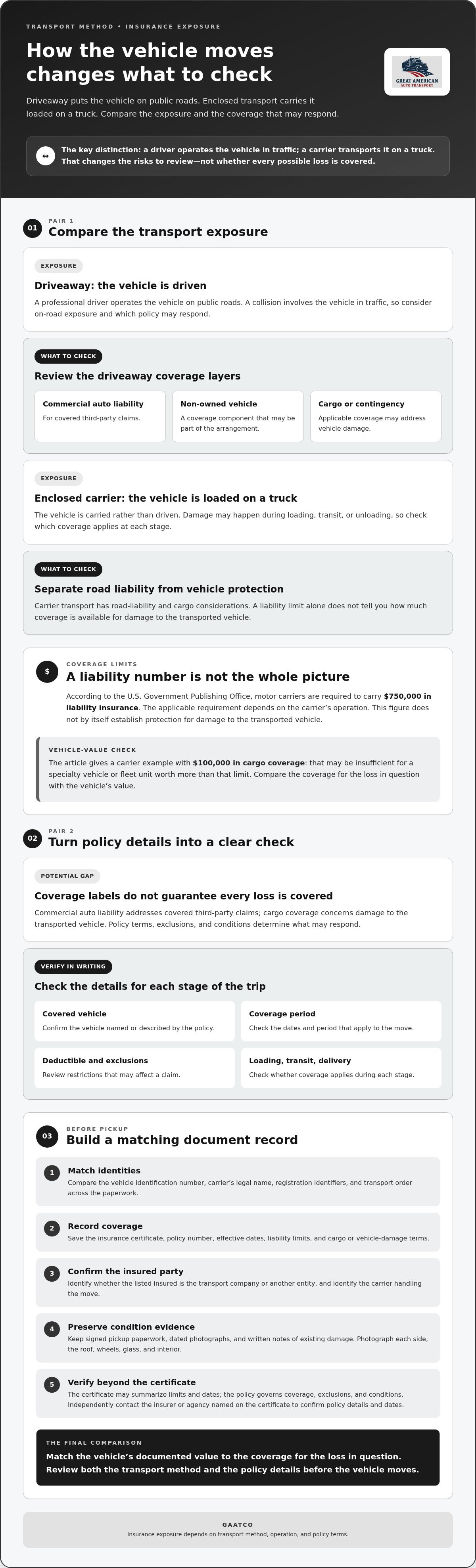
Choosing transport means choosing how the vehicle will be exposed on the journey. The central distinction in driveaway service insurance vs licensed carrier insurance is that a driveaway professional drives the vehicle on public roads, while an enclosed carrier transports it loaded on a truck. According to the U.S. Government Publishing Office, motor carriers are required to carry $750,000 in liability insurance.
That difference matters: driveaway coverage typically combines commercial auto liability, non-owned vehicle coverage, and applicable cargo or contingency coverage. Carrier transport has its own liability and cargo considerations. Neither description alone shows whether protection fits your vehicle’s value or the specific trip.
This guide explains who may insure a vehicle during a driveaway, how on-road exposure compares with enclosed transport, and which insurance records and condition details to document before pickup. It also covers how coverage limits and transport method affect the decision, so you can review the arrangements before the vehicle moves.
Key Takeaways
- Driveaway transport puts the vehicle on public roads, while enclosed transport carries it inside a hauler; that difference changes the exposures to consider.
- Before pickup, document the vehicle’s condition and obtain the transport provider’s insurance details, including coverage limits that suit the vehicle’s value.
- According to the U.S. Government Publishing Office, motor carriers are required by law to carry $750,000 in liability insurance; this does not by itself establish protection for damage to the transported vehicle.
- Insurance requirements and coverage can depend on how a vehicle is titled, used, and operated, so personal and business use should not be treated as interchangeable.
- When you prefer transport on a carrier rather than having the vehicle driven, GAATCO’s Open Car Transport and Enclosed Car Transport provide carrier-based options to consider.
Driveaway versus enclosed-hauler insurance exposures
With driveaway transport, a professional driver drives the vehicle. With enclosed transport, a truck carries it. The difference changes the exposure and the coverage questions to consider.
Cargo and Liability Coverage Comparison
Driveaway coverage typically combines commercial auto liability, transport-company non-owned vehicle coverage, and applicable cargo or contingency coverage. Enclosed transport separates road liability from coverage for the vehicle while it is being carried. This distinction matters because liability claims and vehicle damage are different losses.
For example, a collision during a driveaway involves a vehicle in traffic, while damage in an enclosed hauler may happen during loading, transit, or unloading. The policy terms determine which coverage may respond. A liability limit alone does not establish how much is available for damage to the transported vehicle.
Insurance Limits and Costs
In the United States, motor carriers are required by law to carry $750,000 in liability insurance, according to the U.S. Government Publishing Office. Federal financial-responsibility rules apply as provided in 49 CFR §§ 387.3 or 387.27, according to the National Archives and Records Administration. The applicable requirement depends on the carrier’s operation.
Driveaway operators also need coverage suited to driving vehicles on public roads, but the required limit depends on the operation and applicable rules. No single insurance cost applies equally to driveaway and enclosed-carrier arrangements. Premiums reflect factors such as vehicle value, operating exposure, coverage limits, claims experience, and the insured business’s profile.
For a high-value vehicle, compare the cargo or contingency limit with its value, not only the carrier’s liability limit. A carrier’s $100,000 cargo coverage may be insufficient for a specialty vehicle or fleet unit worth more than that limit. The same principle applies to any transport method: the relevant amount is the coverage for the loss in question.
Coverage Exclusions
Exclusions restrict which losses a policy covers, and they can differ between driveaway and carrier policies. For example, commercial auto liability addresses covered third-party claims, while cargo coverage concerns damage to the transported vehicle. Neither coverage label alone means every loss is covered.
Before transport, identify the policy’s covered vehicle, coverage period, deductible, and exclusions for loading, transit, or delivery. A gap can arise if a loss falls outside the coverage intended for that stage. Written policy details and transport documents help distinguish a liability claim from a vehicle-damage claim.
In practice, the driveaway-versus-carrier decision depends on how the vehicle moves and which policy may respond to each risk. Compare liability limits with cargo or physical-damage protection, then consider the vehicle’s value and transport method. These details help show whether the arrangement addresses both road incidents and damage to the vehicle itself.
Pre-transport insurance documentation
Before pickup, assemble a dated record connecting the vehicle, transport arrangement, and applicable insurance documents. For example, a sedan’s signed condition report should identify the same vehicle as the transport order and coverage paperwork.
For interstate motor carriers, federal financial-responsibility rules apply under 49 CFR §§ 387.3 or 387.27, according to the National Archives and Records Administration. State requirements depend on the operation and jurisdiction, so distinguish interstate movement from an in-state move.
To verify insurance and carrier credentials, match the carrier’s legal name and registration identifiers on its paperwork with the insurance certificate. Then independently contact the insurer or agency named on that certificate to confirm the policy details and dates.
Keep the insurance certificate with the transport order, but do not treat it as a substitute for the policy. The certificate may summarize liability limits and policy dates; the policy governs coverage, exclusions, and conditions. For a company-owned vehicle, retain its commercial auto insurance details alongside the transport provider’s records.
- Match identities: Compare the vehicle identification number, carrier’s legal name, and transport order across the documents.
- Record coverage: Save the insurance certificate, policy number, effective dates, liability limits, and cargo or vehicle-damage terms.
- Confirm the parties: Note whether the listed insured is the transport company or another entity, and identify the carrier handling the move.
- Preserve evidence: Keep signed pickup paperwork, dated photographs, and written notes describing existing damage.
For a specialty vehicle, compare its documented value with the transport coverage limit before release. A valuation record, purchase document, or fleet inventory can help establish the vehicle’s worth if damage occurs. Keep a copy with the pickup condition report.
Take clear photographs of each side, the roof, wheels, glass, and interior. Include close-ups of existing scratches or dents, and make sure the pickup report describes those areas. At delivery, compare the vehicle with the pickup record before signing the final condition acknowledgment.
These records create a practical sequence: identify the vehicle, document its condition, preserve the insurance terms, and retain signed transport paperwork. For a carrier-based move, review vehicle transport arrangements alongside the documentation you prepare.
For businesses moving high-value vehicles or multiple units, check that the transport provider’s coverage limits are adequate for the vehicles being moved. Include this review in the pre-pickup document check rather than relying on a general assurance. Match each vehicle to its transport order and valuation record, then compare its documented value with the applicable coverage limit. If the paperwork does not show which vehicle or units a stated limit applies to, clarify this with the transport provider before release and retain the response with the order and insurance documents. Use the same vehicle identifiers in the comparison, condition reports, and photographs. This keeps a consistent record of what was being moved, its condition at pickup, and the coverage information reviewed before transport. Review the paperwork again if the vehicle list or transport arrangement changes, and keep updated records with the rest of the file.
Who provides insurance during a driveaway trip
Driveaway service insurance refers to coverage arranged for a vehicle driven to its destination by a professional driver. It typically combines commercial auto liability, transport-company non-owned vehicle coverage, and applicable cargo or contingency coverage. Policies may involve different insured parties, so distinguish protection for injuries or property damage from coverage for the transported vehicle. The driveaway service insurance vs licensed carrier insurance comparison starts by identifying who arranged each policy.
Responsibility for vehicle damage depends on how the loss happened, the transport agreement, and the applicable policy terms. For example, an accident while driving may involve the driver’s or transport company’s liability coverage, while damage to the vehicle itself may fall under cargo or contingency coverage. For carrier transport, the carrier’s policy terms and evidence about the damage also matter. These details help clarify which party may handle a particular claim.
For motor carriers, the U.S. Government Publishing Office states that the law requires $750,000 in liability insurance. That figure is a liability requirement, not a statement that every vehicle’s physical damage is insured up to that amount. In the driveaway service insurance vs licensed carrier insurance comparison, separate the required liability limit from cargo coverage or other protection for the vehicle.
During a driveaway trip, the transport company’s commercial auto policy may address covered liability arising from the driver’s use of the road. Non-owned vehicle coverage may address the company’s exposure when it transports a vehicle it does not own. Applicable cargo or contingency coverage concerns damage to the vehicle, subject to policy terms, limits, and exclusions. The policy documents identify the insured entity and the losses addressed.
A liability limit alone does not determine who pays after an accident. The cause, the driver’s role, the transport contract, and the type of loss affect which policy may respond. A collision that damages someone else’s property raises a different coverage question from a scrape to the transported vehicle during handling.
- Record the damage: Photograph the vehicle and note the location, time, and visible condition.
- Preserve the paperwork: Keep the transport agreement, condition reports, and insurance documents together.
- Report the incident: Notify the transport company and relevant insurer promptly, then retain written communications.
- Describe the loss precisely: Separate damage to the vehicle from damage or injury involving another party.
For example, if a customer receives a car with a new dent, the pickup and delivery reports can help establish when its condition changed. Document the dent before altering or repairing the area. Clear records give the insurer and transport company details to assess against the policy terms and transport timeline.
For either transport method, the policy and documented facts guide the claim. A carrier’s liability insurance and cargo protection serve different purposes, just as driveaway liability and vehicle-damage coverage do. Comparing these categories helps clarify which party may handle a particular accident-related loss.
Driveaway service safety and risks
A driveaway trip puts the vehicle in ordinary road traffic, with the risks of commercial driving. An enclosed hauler carries it on a transport vehicle instead, changing its exposure during the journey. This distinction matters for safety planning and for determining which coverage may apply to a loss.
Distance is one practical factor. For trips over 1,500-2,000 miles, traditional carrier shipping is often described as cheaper, safer, and more practical than driveaway service. For moves over 1,500 miles, carrier transport usually offers better pricing and lower overall risk than driveaway. The route, vehicle type, and transport arrangement still shape the decision.
A professional driveaway driver can typically cover 400 to 600 miles per day, depending on conditions and legal driving limits. A 1,000-mile driveaway relocation typically takes 2 to 3 days. That means the vehicle remains in active use on public roads across multiple travel days, rather than being secured on a hauler for the route.
Consider a classic vehicle being moved across several states. A driveaway exposes it to road use throughout the trip; an enclosed hauler carries it inside the transport vehicle. Enclosure changes its exposure to road conditions, but loading, transit, and unloading still matter. Choose based on the vehicle’s condition, value, and the owner’s priorities.
- Assess whether it can be driven: A vehicle that does not run or cannot be safely operated is not suited to a driveaway trip. Inoperable Vehicle Transport addresses a different transport need.
- Consider trip length: Compare the driving time and road exposure with carrier transport, especially on long routes.
- Match coverage to the situation: Separate liability protection from coverage for physical damage to the vehicle.
- Record condition at handoff: Use dated photographs and a written condition report to establish the vehicle’s starting state.
Insurance does not change the operational difference between driving and hauling. An accident during a driveaway may involve road liability, while damage during carrier transport may involve the carrier’s applicable cargo terms. Policy limits, exclusions, and the documented cause of damage determine how coverage applies.
For a long-distance move or a high-value vehicle, compare the road exposure of driveaway with the protection sought from an enclosed hauler. A shorter route and a vehicle suitable for driving may make driveaway practical; a long route or a vehicle needing added protection may favor carrier transport. The right choice depends on the vehicle, route, and coverage needs.
Because the vehicle is driven rather than loaded onto a carrier, its journey includes the ordinary on-road risks of commercial vehicle operation.
Exceptions to insurance requirements
Insurance exceptions are narrow and depend on the vehicle’s use and the rule involved. A personal car driven to one office, without tools or clients, usually remains on personal auto insurance, subject to confirming its use with the insurer. This example concerns personal vehicle classification, not a general exemption for a transport company moving cars.
Federal passenger-carrier insurance requirements also have defined exceptions. A taxi with fewer than 7 passenger seats is outside the stated requirements if it does not operate on a regular route or between specified points. A vehicle carrying fewer than 16 people on a single daily round trip to and from work is also outside those stated requirements.
School-related exceptions are also specific. The stated federal passenger-carrier insurance requirements do not apply to vehicles transporting only school children and school personnel to and from school. They also do not apply to vehicles operated under contract for school-district-organized, sponsored, and paid extracurricular trips involving pre-primary, primary, and secondary students.
- Personal office travel: A car driven to one office without tools or clients may remain under personal auto insurance, based on its use.
- Taxi service: The exception concerns taxis with fewer than 7 passenger seats and the stated route conditions.
- Commuter trips: The exception concerns fewer than 16 people on a single daily round trip to work.
- School transport: The stated exceptions are limited to school journeys and qualifying school-district extracurricular trips.
These passenger-carrier exceptions should not be mistaken for blanket exemptions from vehicle transport insurance rules. A company moving a customer’s car has a different operation from a taxi carrying passengers or a school vehicle. Separate the question of operating authority from financial responsibility: commercial-zone and other operating-authority exemptions are covered by 49 CFR Part 372, but that reference does not itself establish an insurance exemption.
For a business vehicle, its actual use matters. A car used for a simple office visit differs from a work truck used for contracting, hauling, or delivery. A personal policy’s light-business-use endorsement may fit appointments if the insurer agrees, while contracting, hauling, and delivery generally fall outside that described endorsement. A vehicle titled to an LLC or company is presented as needing a commercial auto form, even if the business owns only one car.
Keep a written record of the vehicle’s title, purpose, occupants, route, and business activity. For example, note whether the trip carries school passengers, commuters, or a vehicle being transported. To review carrier-based options for a vehicle move, explore vehicle transport services.
GAATCO: Open Car Transport
GAATCO offers Open Car Transport Services for owners seeking carrier-based vehicle shipping instead of a driveaway trip. For vehicles that need added enclosure, Enclosed Car Transport provides another transport option. Door-to-Door Auto Shipping supports pickup and delivery at the vehicle’s locations.
The right option depends on the vehicle, route, and preferred transport method. Comparing these details with the coverage documents helps align the shipping arrangement with the needs identified in this guide. GAATCO also offers Military & Student Vehicle Shipping Services.
For a carrier-based transport plan, visit gaatco.com and contact GAATCO to discuss your vehicle’s shipping requirements.
Choose a Transport Plan That Fits Your Priorities
The next step is to match the transport method to the vehicle’s value, condition, and intended use. The driveaway service insurance vs licensed carrier insurance comparison can frame that decision, but the right fit also depends on how you want the vehicle moved and delivered.
GAATCO offers Open Car Transport Services and Enclosed Car Transport for different carrier-based transport needs, along with Door-to-Door Auto Shipping for pickup and delivery at the vehicle’s locations. These options provide a practical starting point for discussing transport arrangements alongside the insurance documents you have prepared.
Share the vehicle details and your preferred transport approach when you reach out. Contact GAATCO with your insurance questions and take the next step toward a transport plan suited to your needs.
Frequently Asked Questions
What Is Driveaway Service?
Driveaway service moves a vehicle by having a professional driver drive it to its destination. It may suit a roadworthy vehicle that needs relocation without being loaded onto a carrier. For example, an owner moving from Atlanta may choose this approach if the vehicle can be driven and road use fits the plan. The driver’s operation and the vehicle’s policy classification affect the insurance questions.
Does personal auto insurance cover a vehicle driven by a driveaway service?
Personal auto insurance does not automatically establish coverage for a vehicle driven by a professional driveaway driver. The policy’s permitted drivers, vehicle use, and exclusions determine how it applies. Before the trip, review the policy’s driver and business-use terms, then compare them with the transport agreement. A personally titled car used for work may require a different classification from one used only for personal travel.


