

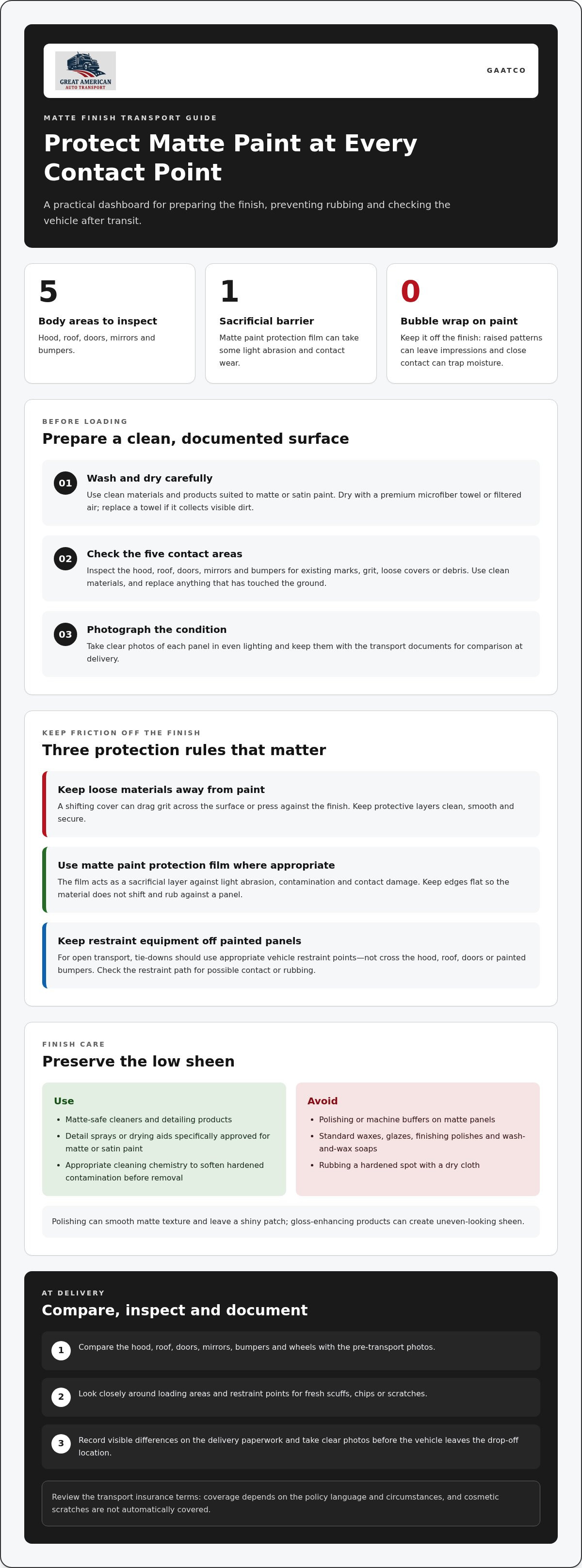
The wrong protective layer can mark matte paint just as easily as direct contact. To understand how to protect a matte paint finish during transport, start with a clean, dry surface, keep straps and loose materials from rubbing against the panels, and avoid placing bubble wrap directly on the paint. Matte paint protection film can act as a sacrificial barrier against light abrasion and other surface damage.
It is understandable to focus on keeping the vehicle covered, but a cover that shifts, traps dirt, or presses against the finish can cause the very damage you want to prevent. The safer approach is a clean, secure setup that limits movement and uses materials suited to the vehicle’s finish.
This guide explains how to prepare matte paint for transport, reduce the risk of scratches and contact marks, choose suitable protection, and care for the finish after arrival. It also covers when enclosed transport may help reduce exposure during the journey.
Key Takeaways
- Wash and dry matte paint carefully before transit, using products and clean materials suited to matte or satin finishes.
- Keep bubble wrap and other loose packing materials off the paint; prevent protective layers from shifting or trapping dirt against the surface.
- Consider matte paint protection film as a sacrificial barrier against light abrasion and contact damage.
- Choose transport protection based on the vehicle’s exposure and handling needs, and secure anything that could rub against the finish.
- After transport, maintain the finish with matte-safe detailing products and gentle washing rather than polishing or gloss-enhancing treatments.
Avoiding bubble wrap directly against painted surfaces
- Keep bubble wrap off matte paint. Its raised pattern can leave impressions, and close contact can trap moisture against the surface. If the vehicle needs a protective layer, use matte paint protection film as a sacrificial barrier rather than pressing packing material onto the finish.
For a closer look at matte clear coat and protective options, watch this discussion:
- Inspect every contact point before wrapping or loading. Check the hood, roof, doors, mirrors, and bumpers for loose covers, grit, or debris. Even a clean-looking cloth can carry particles that drag across matte paint when it shifts, so use clean materials and replace anything that touches the ground.
- Choose a barrier designed for the finish. Matte paint protection film helps guard against light surface abrasion, contamination, and contact damage. It creates a sacrificial layer, allowing the film to take some wear instead of the painted surface. Keep the protective material smooth and secure, since a loose edge can shift during transit and rub against a panel.
- Do not polish matte paint to remove a mark before transport. Polishing smooths the surface texture that gives matte paint its flat appearance and can leave a shiny patch. Abrasive polishes and compound-heavy spot treatments can also make one panel look different from the surrounding finish. Keep machine buffers away from matte panels.
- Avoid gloss-enhancing products before the journey. Standard waxes, glazes, finishing polishes, and wash-and-wax soaps can increase sheen and leave uneven-looking areas. Use detail sprays and drying aids only if they are specifically approved for matte or satin paint. For example, choose a matte-safe cleaner instead of a product marketed to deepen gloss.
- Dry the vehicle without dragging contamination across the finish. Use a premium microfiber towel or filtered air, and replace the towel if it collects visible dirt. Do not rub a hardened spot with a dry cloth; soften the contamination with appropriate chemistry before removing it. This reduces unnecessary friction on a finish that ordinary polishing cannot restore.
When packing a painting, keep the contact rule clear: bubble wrap should not touch the painted surface because it can leave impressions and trap moisture. Acid-free tissue or glassine paper is recommended as the layer directly against a painting’s surface. Bubble wrap is therefore not the recommended material for the layer touching the painted face. Check which material will sit directly against the paint rather than judging a protective layer only by its cushioning purpose. This distinction is useful when preparing painted objects for handling or transport.
For matte vehicle paint, choose products that preserve the finish’s low sheen. Use detail sprays and drying aids only if they are specifically approved for matte finishes, since gloss-boosting products can leave uneven sheen. Standard waxes, glazes, finishing polishes, compound-heavy spot treatments, and wash-and-wax soaps are generally unsuitable because they can increase shine. Traditional waxes can raise the sheen, while abrasive polishes can leave shiny patches and aggressive compounds can make a panel look different from the rest of the vehicle.
Protecting painted surfaces from scratches and contact damage
Protecting a matte paint finish during transport starts with reducing friction, loose debris, and pressure on painted panels. A careful condition record also helps identify changes after delivery.
-
Prepare Matte Paint for Transport
Clean the vehicle before loading so grit does not sit between the paint and a moving cover. Inspect the hood, roof, doors, mirrors, and bumpers for existing marks, then photograph each panel in clear, even lighting. Keep the images with your transport documents. This record gives you a useful comparison at delivery and helps distinguish pre-existing blemishes from newly observed damage.
-
Protect Against Scratches and Contamination
Use matte paint protection film as a sacrificial barrier against light abrasion, contamination, and contact damage. Check that the film edges lie flat and that no loose covering can shift over the paint. Bird droppings, bug remains, tree sap, and fuel spills can stain or etch matte finishes. Remove them promptly with appropriate cleaning products instead of scraping or scrubbing.
- Keep restraint equipment clear of painted body panels. On an open transport trailer, tie-downs should use appropriate vehicle restraint points rather than crossing the hood, roof, doors, or painted bumpers. Before loading, inspect the intended restraint path and identify anything that could touch or rub against the finish as the vehicle moves. Knowing how to protect a matte paint finish during transport means considering loading contact as well as road exposure.
- Inspect the vehicle before accepting delivery. Compare the hood, roof, doors, mirrors, bumpers, and wheels with your pre-transport photographs. Look closely around loading areas and restraint points for fresh scuffs, chips, or scratches. Record visible differences on the delivery paperwork and take clear photographs before the vehicle leaves the drop-off location. A prompt, dated record helps document the condition you observed.
- Read the transport insurance terms for how paint damage is treated. Coverage depends on the policy language and the circumstances of the damage; transport insurance does not automatically cover every cosmetic scratch. Review how the policy addresses pre-existing marks, cosmetic damage, documentation, and claims. If a scratch reaches through the finish, polishing cannot restore matte paint, and any repair must match the surrounding appearance.
- Plan the shipment around the vehicle’s finish and handling needs. The question of how to protect a matte paint finish during transport involves both surface preparation and reducing opportunities for contact. If you are arranging vehicle transport, vehicle transport options can help you consider an appropriate arrangement for the journey.
Choosing a protective sleeve or rigid crate
For a vehicle, choose protection based on the carrier and contact points, not an art sleeve or crate. Enclosed transport reduces exposure to road debris and weather, while careful handling remains important.
- Choose enclosed transport when reducing exposure to road debris and weather is a priority. Enclosed vehicle transport generally reduces these external risks compared with open transport, but cannot prevent every contact mark during loading or handling. Matte paint still needs careful preparation and restraint placement.
- Use a car cover only if it is clean, correctly fitted, and secured against movement. A loose cover can shift during transit, allowing trapped grit to rub against the paint and alter its appearance. Before fitting it, check the inside for dirt, seams, or damaged areas that could touch the vehicle’s panels.
- Do not let a cover press tightly against dirty or damp surfaces. A dusty cover moving over a door can create friction, while trapped moisture can remain against the finish. Remove visible debris before covering the vehicle, and do not use a cover that drags across the hood, roof, or mirrors.
- Ask for restraint points and loading procedures that keep straps clear of painted body panels. A cover is not a substitute for secure vehicle loading, and fabric beneath a strap does not eliminate the risk of pressure or movement. Before the journey, check the hood, roof, doors, and bumpers for possible contact with equipment.
- Match the transport choice to the vehicle’s finish and journey conditions. Open transport leaves the vehicle exposed to the elements, while enclosed transport provides a protective barrier from road debris and weather. Compare vehicle transport options with the level of exposure you want to reduce, then prepare the matte surface and cover accordingly.
- Inspect the vehicle at delivery before removing a cover. Lift it carefully instead of pulling it across the paint, then examine the panels in good light for fresh scuffs or scratches. Compare the finish with your pre-transport photographs, especially around the hood, doors, mirrors, and bumpers, where contact or shifting may leave visible marks.
For paintings, choose packaging based on both the work’s format and the journey. A rigid crate is recommended for high-value paintings or long-distance shipping. A painting sleeve should leave a few centimetres of clearance around the painting. Breathable packaging is recommended to reduce moisture buildup in transit. Keep the options distinct: follow the guidance on rigid crates for high-value works or long-distance shipping, and consider a sleeve with the specified clearance when choosing a sleeve. Identify whether the work is unframed and rolled, or on canvas or panel, before selecting a tube.
Cardboard tubes are suitable only for unframed, rolled works, not paintings on canvas or panel. Do not use a tube for a work outside those limits. When comparing a sleeve, crate, or tube, let the painting’s format and the stated shipping circumstances guide your choice. If using a sleeve, retain the recommended clearance, and consider breathable packaging to reduce moisture buildup during transit. These distinctions help match the packaging to the kind of painting being shipped and the conditions described in the guidance.
Maintaining protected matte paint
Maintain the finish according to the protection applied, whether matte paint protection film or a matte-compatible coating. Consistent, low-friction care helps preserve the surface’s appearance without adding unwanted gloss.
- Wash the vehicle weekly using the two-bucket method and shampoo labelled safe for matte finishes. Keep the wash media clean, and use a separate rinse bucket to reduce the chance of carrying grit back onto the paint. Work gently across each panel rather than scrubbing. A regular routine also makes it easier to spot fresh contamination or changes in the finish.
- Dry matte paint with clean microfiber towels or filtered air. Use a fresh towel if the first collects dirt, and avoid dragging a contaminated towel across another panel. Press lightly and follow the towel manufacturer’s care instructions to prevent detergent or fabric-softener residue from transferring to the surface. Do not let water dry on the finish, especially if mineral spotting is a concern.
- Choose detailing products labelled for matte or satin finishes. A cleaner, detail spray, or drying aid made to boost gloss can leave uneven sheen, so check the product label before applying it. For example, use a matte-safe cleaner for a local mark instead of a finishing polish. Keep abrasive polish, machine buffers, and standard waxes out of your maintenance routine.
- Follow the care instructions for the specific film or coating applied to the vehicle. Matte paint protection film can help defend against light abrasion, while a matte-compatible ceramic coating can aid washability and chemical protection. A coating does not stop rock chips as film does. Use automotive-grade detailing solutions and microfiber towels for matte PPF, as recommended for maintaining the protected surface.
- Schedule an annual inspection of the film or coating, then arrange a sealant top-up or coating reapplication as recommended for that product. Check for lifting film edges, worn areas, or changes in water behaviour, and address them according to the manufacturer’s guidance. Matte ceramic coatings may last 1-3+ years, depending on the product and climate, so care intervals vary.
- Remove hardened contaminants from matte paint with suitable cleaning products instead of scraping or scrubbing. Bird droppings, bug remains, and tree sap can mark the finish if left in place, while aggressive rubbing can cause abrasion. Apply a matte-approved cleaner as directed, let it loosen the residue, then lift it away with clean microfiber. This focused approach helps protect both the paint and its protective layer.
How to prepare matte paint before transporting a vehicle
- Wash the vehicle by hand with pH-balanced soap labelled safe for matte or satin finishes. Use lubricated wash media and clean microfiber to reduce friction while lifting road film. Work on cool panels in the shade, since direct heat can make water dry quickly and leave spots. Avoid wash-and-wax soaps, which can add unwanted sheen to the finish.
- Remove bird droppings, bug remains, tree sap, and fuel spills before loading. These contaminants can stain or etch matte paint if left on the surface. Use a cleaner approved for matte finishes and follow its directions. Soften hardened residue before lifting it away; do not scrape it with a fingernail, blade, or dry cloth.
- Rinse thoroughly, then dry the panels immediately with clean microfiber or filtered air. This helps limit water spotting, especially when rinse water contains minerals. If your household water is especially hard, deionized or softened rinse water may help reduce mineral deposits. Keep each towel clean as you move across the hood, roof, doors, and lower panels.
- Do not polish the paint to remove a mark or improve its appearance before transit. Abrasive polishing can smooth the texture that gives matte paint its flat look, leaving a shiny patch. Machine buffers and compound-heavy spot treatments can make a repaired area stand out from the rest of the panel. Use a matte-safe cleaner for surface contamination instead.
- Assess embedded contamination carefully before using a clay treatment. Severe contamination may require clay, but the process needs proper lubrication and professional judgment to avoid altering the finish. Do not use a clay bar as a routine shortcut on matte paint. If residue remains after gentle cleaning, do not move to a more abrasive method without the necessary expertise.
- Let the cleaned surface dry fully before fitting any protective layer or preparing the vehicle for loading. Check panel edges, mirrors, and trim for remaining moisture or debris that could become trapped beneath a cover. Keep gloss-enhancing detail sprays and drying aids off the finish unless specifically approved for matte paint. To coordinate the next stage, plan your vehicle transport after preparation is complete.
GAATCO: Open Car Transport
GAATCO offers Open Car Transport for owners arranging vehicle delivery and Enclosed Car Transport for those seeking added protection from road debris and weather. Neither option replaces careful matte-paint preparation or attention to contact points during loading and transit. Choose based on the vehicle’s exposure needs and your delivery plan.
Door-to-Door Auto Shipping gives vehicle owners a direct delivery option between locations. Before shipment, prepare the finish with matte-safe products and document its condition so you can inspect it on arrival.
For details about arranging vehicle transport, visit GAATCO online or contact the team.
Plan Your Vehicle’s Next Journey
Protecting a distinctive finish starts with treating transport as part of the vehicle’s care plan. A clear approach to protecting matte paint during transport helps you prepare with purpose, communicate your priorities, and choose an arrangement suited to the vehicle.
GAATCO offers Open Car Transport, Enclosed Car Transport, and Door-to-Door Auto Shipping. Consider which option best suits your delivery plan and desired level of exposure protection, then make matte-paint care part of your transport arrangements. Clear communication about the finish and your preparation helps keep its needs in view throughout the process.
For a considered next step, contact GAATCO about your transport needs. A well-planned journey can make caring for your matte finish feel straightforward from preparation through delivery.
Frequently Asked Questions
How to protect matte paint from road debris and weather during transport?
To protect a matte paint finish during transport, choose an enclosed carrier and have the vehicle clean and dry at pickup; grit trapped under a cover can rub the surface. Avoid laying a loose sheet directly on the paint, since movement may cause scuffing. For shipments involving Atlanta, Miami, New York, Houston, Dallas, San Diego, San Francisco, Seattle, Orlando, Boston, Nashville, Denver, Austin, Chicago, Las Vegas, or Phoenix, enclosed transport can reduce direct exposure to road spray and weather.
What products or tape should be avoided on matte automotive paint?
Avoid adhesive tape, masking tape, and paint-protection films unless the vehicle manufacturer or paint specialist confirms they are suitable for that specific finish. Adhesives may leave residue or create uneven-looking areas, and removing them may require corrective cleaning. Avoid waxes, polishes, abrasive compounds, and standard gloss-enhancing cleaners, which can change the appearance of matte paint. Before applying any cleaner or protectant, check the vehicle’s care guidance and test approved products on a discreet area.


