

A broker’s quote is only part of the picture. You also need to know which carrier will transport your vehicle and what the quoted service includes. The most useful questions to ask the actual truck driver, not just the broker, cover the carrier’s identity and registration, the driver’s relevant experience, insurance, and capacity during busy periods. For interstate moves in the United States, brokers and movers must be registered with the Federal Motor Carrier Safety Administration (FMCSA), according to the agency.
A broker may arrange the shipment, but clear answers about the carrier and driver help you understand how transport will work and what may affect the freight cost. Find out how to verify registration and review complaint history, ask about relevant experience and insurance, and understand whether busy-period capacity could affect your plans.
These questions also clarify the difference between the broker’s role and the driver’s, what the quote covers, and which cost details to understand before you commit. With those points clear, you can make a more informed transport decision.
Key Takeaways
- Match the carrier’s registration details to the company and vehicle handling your shipment, and review its complaint history before proceeding.
- Ask about the driver’s experience with your vehicle type and transport requirements to assess whether the shipment is a suitable fit.
- Clarify what the carrier’s insurance covers, who handles claims, and how the broker’s role differs from the carrier’s responsibility.
- Discuss peak-season capacity, pickup flexibility, and delivery timing early, since limited availability and route demand can affect the plan and freight costs.
1. Checking registration and complaint history
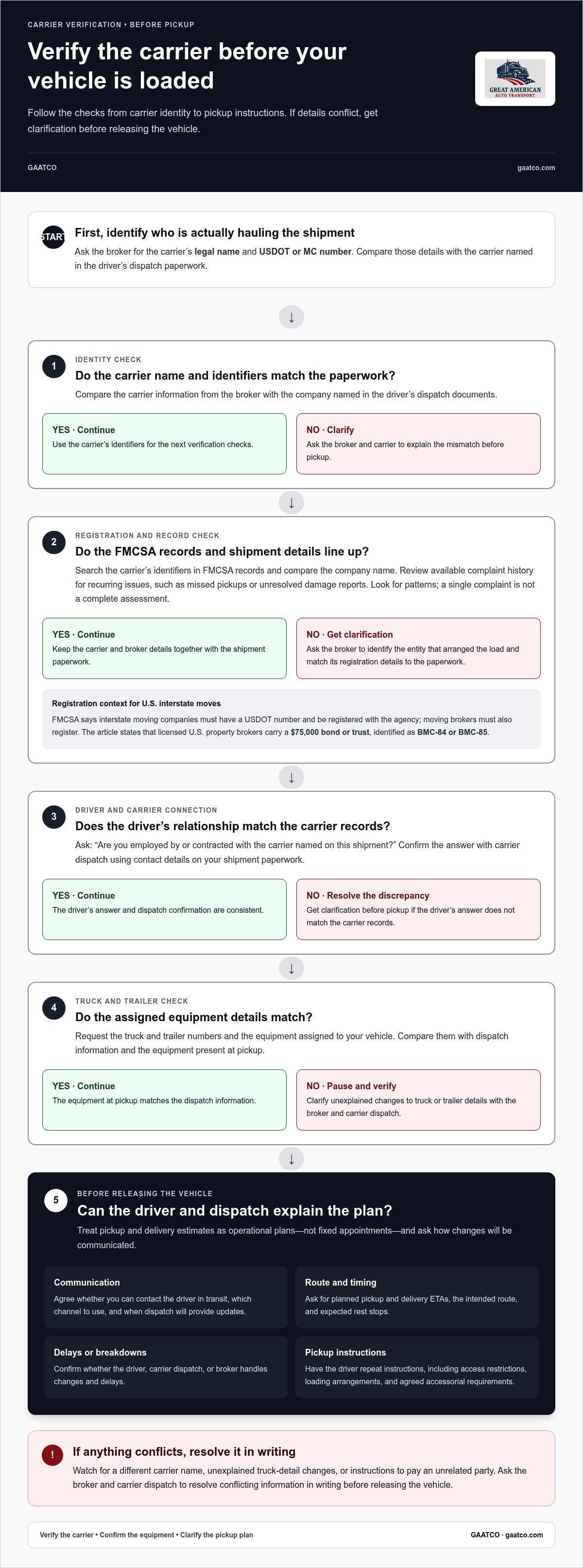
Before discussing freight costs, establish which carrier will handle your shipment. Ask the broker for the carrier’s legal name and USDOT or MC number, then compare them with the carrier named in the driver’s dispatch paperwork.
According to the Federal Motor Carrier Safety Administration, licensed U.S. property brokers carry a $75,000 bond or trust, identified as BMC-84 or BMC-85. Ask which broker entity arranged the load and match its registration details to the paperwork.
Search the carrier’s identifiers in FMCSA records and compare the company name. Review any available complaint history for recurring issues, such as missed pickups or unresolved damage reports. Look for patterns rather than treating a single complaint as a complete assessment.
Ask the driver, “Are you employed by or contracted with the carrier named on this shipment?” Then confirm the relationship with the carrier’s dispatch contact, using the contact details on your shipment paperwork. If the driver’s answer does not match the carrier records, get clarification before pickup.
Request the truck and trailer numbers, as well as the equipment assigned to your vehicle. Confirm that the identifiers match the dispatch information and the equipment at pickup. Agree on whether you can contact the driver in transit, which channel to use, and when dispatch will provide updates.
Ask for the planned pickup and delivery ETAs, intended route, and expected rest stops. Treat these as operational plans, not fixed appointments, and ask how changes will be communicated.
Before loading, confirm who handles delays or breakdowns: the driver, carrier dispatch, or broker. Ask the driver to repeat the pickup and delivery instructions, including access restrictions, loading arrangements, and any agreed accessorial requirements.
Watch for inconsistencies, such as a different carrier name, unexplained changes to truck details, or instructions to pay an unrelated party. Before releasing the vehicle, ask the broker and carrier dispatch to resolve conflicting information in writing.
FMCSA says interstate moving companies must have a USDOT number and be registered with the agency. Moving brokers must also register with FMCSA as brokers.
2. Industry and freight-type experience
Ask the driver how often they handle freight like yours. Experience with general cargo may differ from experience transporting vehicles, machinery, or temperature-sensitive goods. Request a specific example of comparable freight and ask what handling requirements mattered. The answer should address your shipment, not rely only on broad claims about time on the road.
Describe the freight accurately before asking about the driver’s experience. For a vehicle, share its make, model, condition, and modifications. For other cargo, explain its dimensions, weight, packaging, and handling sensitivities. Then ask which parts of that description the driver has handled on previous loads. Specific follow-up questions reveal whether their experience fits your requirements.
How will the driver secure, protect, and handle your specific freight? Ask them to explain the loading sequence, contact points, and how they will restrain the shipment in transit. For a vehicle, also ask how its condition will be documented at pickup and delivery, and how existing damage or inoperable components may affect handling.
Ask about practical judgment, not just familiarity with a type of freight. What could complicate loading? What information is needed at the pickup location? How would the driver respond if the freight differs from its description? For example, a vehicle that will not start may need different loading arrangements than a running vehicle—or, if freight expenses exceed the car's worth, owners may choose local vehicle disposal through providers like melbournecarremoval.com.au instead of shipping. The explanation should connect the condition you described to a clear handling plan.
Confirm that the driver has reviewed the shipment instructions and can explain any special requirements in their own words. Ask whether the assigned equipment suits the freight and what might require a change in equipment or loading method. Compare the answers with the broker’s written description. Resolve any differences before pickup and record the agreed instructions in writing.
Focus on specific evidence: comparable loads, familiarity with the equipment, loading procedures, and clear answers about your freight’s condition. These details distinguish relevant experience from general assurances and help you determine whether the driver understands the shipment well enough to follow the agreed plan without confusion at pickup.
3. Insurance verification
Start by separating the broker’s role from the carrier’s insurance coverage. Freight brokers are not required to carry cargo insurance. Ask the broker for the actual carrier’s legal name, then request policy or certificate details for that carrier. Confirm that the document identifies the company transporting your shipment, not just the intermediary arranging it.
What cargo insurance applies, and who is responsible for filing a claim? Ask the carrier to explain the policy’s covered events, exclusions, deductible, and applicable limits in writing. Confirm whether the carrier or shipper must initiate a claim, and get the correct contact and documentation process before pickup.
For a vehicle shipment, ask whether coverage applies during loading, transit, and unloading. Clarify how the policy treats existing damage, mechanical issues, and differences in the vehicle’s recorded condition. Ask whether the vehicle’s declared value or special features affect the applicable coverage. The answers should relate to your shipment, not just a general statement that insurance is in place.
Request the certificate holder’s name, insurer, policy dates, and coverage description. Compare the carrier name with the one on your dispatch documents. If the names differ, ask the broker and carrier to explain the relationship and provide matching documentation. A certificate can help identify coverage, but the policy terms determine how a claim is handled.
Ask what evidence to preserve if damage occurs. Clarify whether to record the vehicle’s condition at pickup and delivery, photograph damage, note exceptions on the delivery paperwork, or keep repair estimates. Ask about notice deadlines and submission channels, then save the answers with your shipping records. Prompt, complete documentation helps the responsible party assess a claim.
Finally, ask who will communicate with the insurer if an incident occurs: the driver, carrier claims team, or broker. Record the contact and steps for reporting damage. Do not treat a broker’s assurance as a substitute for carrier-specific coverage details. The carrier’s written terms, shipment documents, and condition records are central to understanding coverage and next steps.
4. Peak-season capacity
Seasonal demand can affect carrier availability, pickup windows, routing, and the freight quote. Ask the driver whether the carrier has assigned a truck to your shipment or is still planning capacity. Then clarify whether your requested pickup window is firm or flexible. For example, a narrow window may leave fewer routing options than flexible dates.
Ask how the carrier’s route affects your shipment during busy periods. A vehicle moving between major cities may fit an established route, while a remote pickup can require more coordination. Ask whether the driver expects other scheduled stops, how they affect the order of pickups and deliveries, and whether a route adjustment could change your pickup or delivery estimate.
Confirm the carrier’s plan if the assigned truck becomes unavailable. Ask who will notify you, whether another truck or driver may be assigned, and how the change will be documented. Any change in equipment or driver should be communicated before pickup, especially if it affects the agreed handling arrangements or arrival window.
Clarify what flexibility could make coordination easier. Ask whether adjusting the pickup date, delivery timing, or pickup location would help. For instance, a nearby location suitable for carrier loading may offer more options than a restricted street. Discuss how each change could affect routing and the quoted freight cost.
Before accepting the arrangement, ask the driver to restate the pickup window, expected delivery timing, planned route, and update process. Have the broker put any agreed changes in writing, so the driver and dispatch team work from the same instructions. This is particularly useful when seasonal demand shifts schedules after booking. To discuss your vehicle transport requirements, plan your shipment.
GAATCO: Open Car Transport
GAATCO offers Open Car Transport Services for customers arranging vehicle delivery and looking for a clear transport plan. If you are comparing a broker’s quote with carrier details, these questions can help you clarify who will handle your vehicle, what the arrangement covers, and how scheduling will be communicated.
For vehicles that need a different transport approach, GAATCO also offers Enclosed Car Transport and Door-to-Door Auto Shipping. The right option depends on your vehicle and delivery requirements, so consider which service best fits your shipment.
For details about arranging vehicle transport, visit GAATCO’s website.
Put Clear Answers Into Your Transport Plan
Turn the conversation into a shared plan. Keep the carrier’s written details, handling instructions, communication arrangements, and agreed timing together so everyone can refer to the same information. If the route or schedule changes, that record makes it easier to identify what needs updating and who should be informed.
The right transport arrangement should reflect your vehicle and delivery requirements. GAATCO offers Open Car Transport Services, Enclosed Car Transport, and Door-to-Door Auto Shipping. Use these questions to ask the actual truck driver, not just the broker, and clarify what matters for your vehicle before arranging transport.
Contact GAATCO to discuss your vehicle transport. A well-defined plan is a considered start to a smoother shipment.
Frequently Asked Questions
What do I do if I am working with a broker?
Keep the broker as your booking contact and ask how the handoff to the carrier will work. Before authorizing dispatch, clarify who can approve changes to the shipment instructions and how those approvals will be recorded. For an Atlanta-area pickup, provide the precise location and any gate or staging requirements. Clear details help the broker pass workable instructions to the assigned carrier.
What questions should I ask the truck driver directly before booking a load?
Ask whether the assigned equipment can accommodate the vehicle as described, including its condition and modifications. Questions for the actual truck driver, not just the broker, should establish whether the driver has reviewed your shipment details and understands any handling constraints. If a driver has not yet been assigned, ask the broker when the carrier information and driver contact will be available.
What are the driver's pickup and delivery ETA, route, and planned rest stops?
Ask the driver for the planned pickup and delivery ETAs, intended route, and expected rest stops. Treat these as operational plans, not fixed appointments, and ask how changes will be communicated.


