
A polished five-star profile does not prove dependable car shipping. Knowing how to spot fake car shipping reviews means comparing feedback across Google, BBB, and Trustpilot, then checking for repeated wording, sudden clusters of posts, and comments with few specific shipping details. Consistent patterns matter more than one glowing review or a single complaint.
It makes sense to read reviews before trusting a company with your vehicle, but star ratings alone can hide important context. Recent feedback, varied reviewer histories, and balanced accounts describing communication, pickup, or delivery can give you a clearer picture of customer experiences.
This guide explains how to compare review sites, assess complaint patterns, and identify details that make a review more credible. It also covers how to check a company’s identity and shipping information so you can make a more informed decision before arranging transport.
Key Takeaways
- Compare feedback across Google, BBB, and Trustpilot to see whether consistent experiences emerge across platforms.
- Look for repeated wording, clusters of posts, and recurring complaints about communication, timing, or unexpected charges.
- Give more weight to reviews with practical details, such as pickup locations, delivery dates, and the vehicle’s condition on arrival.
- Cross-check the company’s identity and shipping details against relevant records before making a booking decision.
1. Comparing feedback across Google, BBB, and Trustpilot
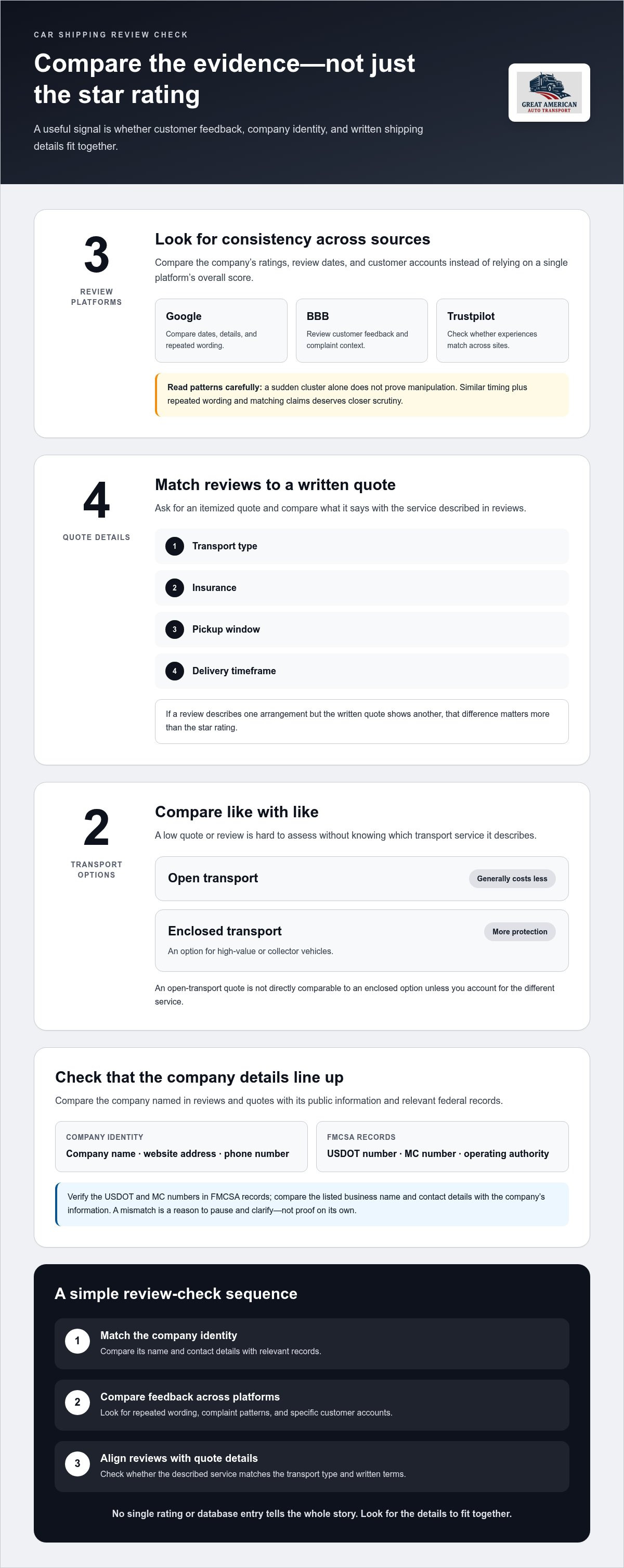
Look for the same company name on Google, BBB, and Trustpilot. Compare ratings, review dates, and the substance of customer accounts instead of relying on one platform’s overall score. Specific praise on one site alongside recurring concerns elsewhere deserves a closer look. Search for matching phrases across platforms: identical wording in several reviews may indicate coordinated or inauthentic feedback.
Check the business identity before treating its reviews as evidence. Compare the company name, website address, and phone number with federal records, and look for mismatches. A fake site may use stock images or copied reviews to appear established. A hijacked identity can also cause confusion by using details associated with a legitimate company. Conflicting contact information is a reason to pause, not proof on its own.
Compare transport options as well as reviews. Open trailers generally cost less, while enclosed transport provides more protection for high-value or collector vehicles. Compare like with like: a quote for open transport is not directly comparable to an enclosed option unless you account for the different service. Reviews praising a low quote but omitting the transport type may lack important context.
Ask for written, itemized quotes before comparing offers. Each quote should clarify the transport type, insurance, pickup window, and delivery timeframe. Check that the company name and contact details match the identity you researched. If a review describes one arrangement but the written quote shows another, that difference matters more than the star rating.
Follow a clear sequence: match the company identity, compare feedback across Google, BBB, and Trustpilot, then align the reviews with written quote details. This helps distinguish consistent customer experiences from generic praise, copied wording, or incomplete claims. No single rating or database entry tells the whole story. The useful signal is whether the company’s identity, customer accounts, and proposed shipping details fit together.
2. Evaluating review patterns and customer complaints
Read customer reviews as a timeline, not just a score. On Google, BBB, or Trustpilot, compare post dates with their detail and tone. Reviews appearing steadily over months or years can reflect ongoing feedback; a sudden cluster of similar praise deserves closer scrutiny. A burst alone does not prove manipulation, but repeated wording and matching claims make the concern more credible.
Look for recurring service patterns across independent customer feedback. Several accounts describing late pickups, unclear communication, or unexpected fees may point to an issue worth investigating. One complaint may reflect an isolated experience; repeated accounts across different dates and profiles provide more context. Compare the company’s responses, too: specific replies address the reported event, while generic wording may offer little insight.
Check whether reviewer profiles show varied writing and activity. A profile with comments about different businesses and services provides more context than one containing only near-identical car shipping praise. This is a clue, not a verdict: genuine customers may have limited review histories, and profile details alone cannot verify a shipment.
To assess the broader pattern, compare ratings and complaint records rather than simply counting stars. BBB feedback and FMCSA complaint records can add context to online reviews. Note whether the same concern appears in both customer accounts and formal complaints. Older posts may describe practices that have changed, so give recent feedback more weight while watching for recurring issues over time.
If a complaint describes a problem, read the full exchange before drawing conclusions. For example, distinguish a documented pickup delay from a vague accusation, then check whether the response explains what happened. If you experienced a shipping scam, sharing a factual account on a consumer-review site can help create a public record for other readers.
These checks help separate repeated, relevant concerns from isolated reactions. For practical context on vehicle transport, review vehicle transport information alongside the patterns you find in customer feedback.
3. Checking reviews for verifiable shipping details
Use FMCSA records to compare a carrier’s USDOT and MC numbers, operating authority, business identity, phone number, and website. Match those details with the company named in the written quote. For insurance, review the information in the quote and compare the named carrier with the carrier identified in the records. Resolve inconsistencies before booking.
Specific review details are more useful than broad claims. Look for accounts describing a vehicle’s pickup location, delivery date, route, or condition upon arrival. For example, “the car arrived safely” offers little context, while a review describing pickup in one city and delivery in another gives you details to compare with the service described.
Check whether the reviewer’s account matches the company’s stated role. A broker and a carrier can be different businesses involved in one shipment, so a review may name the booking company while another company handles transport. Compare the names in the review, quote, and federal records. A mismatch may reveal an incomplete account or identity confusion and deserves clarification.
Verify the identifiers rather than trusting numbers copied onto a company website. Search the USDOT and MC numbers in FMCSA records, then compare the listed business name and contact details with the company’s public information. Check that the carrier’s operating authority corresponds to the shipment. A review mentioning a carrier’s name does not prove that the carrier is authorized.
Use review details as a starting point for research, not a substitute for checking records. If a customer describes Door-to-Door Auto Shipping, for example, look for a clear account of pickup and delivery. Compare the named transport company with the quote and carrier information. This helps distinguish firsthand descriptions from generic writing that could apply to any car shipping service.
4. Spotting fake or unreliable car shipping reviews
Genuine car shipping reviews often describe practical details, such as pickup timing, vehicle condition at delivery, or communication during transit. Fake or unreliable posts tend to rely on generic praise, repeated phrases, or dramatic claims without explaining what happened. Treat these signs as prompts for closer review, not automatic proof.
A review may be unreliable even when it is negative. To assess whether a post might be targeting a competitor, look for a cluster of similar accusations, repeated wording, and profiles posting the same claims across platforms. A complaint without dates, shipment details, or a clear account is difficult to assess. None of these clues alone establishes who wrote the review or why.
A run of reviews published within a short period can be a red flag, especially when their wording and tone match. Compare those posts with the company’s longer review record and feedback on other platforms. Balanced accounts that mention a minor concern alongside specific praise can provide more context than uniformly glowing or broadly hostile statements.
If you suspect a review is fake, save its wording, date, profile, and platform. Compare it with other posts for copied phrases, then use the platform’s reporting process if the review appears to violate its rules. Avoid repeating an accusation as fact: document what you observed and let the platform assess the post.
Apply the same care to claims about booking or a deposit. A review alleging unexpected payment demands should explain when the request occurred and what the written agreement said. Compare the account with the quote and contract rather than treating one post as conclusive. Specific evidence is more useful than an unsupported accusation.
Before booking, use those checks to make a measured decision about your shipment. Request a car shipping quote to discuss your transport requirements and review the proposed arrangements.
GAATCO: Open Car Transport
GAATCO provides Open Car Transport for customers arranging vehicle shipping across the United States. Once your research clarifies the transport type and delivery requirements, match those needs with a suitable service.
Open transport is one option; Enclosed Car Transport offers premium protection for luxury and classic vehicles. GAATCO also provides Door-to-Door Auto Shipping and Military Vehicle Shipping to meet different transport needs. Reviewing the written details alongside your selected service helps set clear expectations before booking.
For a vehicle shipment, share your transport requirements with GAATCO or visit gaatco.com.
Make your next shipping decision with clarity
Knowing how to spot fake car shipping reviews gives you a stronger basis for choosing a transport arrangement, but your decision should also reflect your vehicle and delivery needs. Consider what level of protection suits your car and whether door-to-door service fits your plans. Clear expectations make it easier to move from online research to a considered booking.
GAATCO offers Open Car Transport, Enclosed Car Transport, and Door-to-Door Auto Shipping. These options provide different ways to arrange vehicle transport, and the right fit depends on your priorities. Review the service details and consider how each option aligns with your shipment before taking the next step.
Contact GAATCO for car shipping help and discuss the transport arrangement that suits your needs. A careful decision can help you move forward with greater confidence.
Frequently Asked Questions
What are common signs of fake car shipping reviews?
Common warning signs include generic praise, repeated wording, unusually similar claims, and several posts appearing close together. A practical way to spot fake car shipping reviews is to compare wording and timing across platforms, then check whether the accounts describe distinct shipping experiences. A short or new profile alone does not prove a review is false; treat it as one clue, not a verdict.
How can you verify a car shipping reviewer's identity and shipment?
You usually cannot establish a reviewer’s identity from a public profile alone. Check whether the account shows varied activity, then compare the review’s route, dates, and transport details with information you can verify independently. For a shipment you arranged, keep your quote, messages, and delivery paperwork together. Do not ask a reviewer to publish private documents; their personal information should remain protected.
Which review platforms are most reliable for car shipping companies?
No single platform can establish that every review is genuine. Google, BBB, and Trustpilot each offer useful perspectives, while BBB and FMCSA complaint records provide different forms of context. Compare several sources and focus on concrete, consistent accounts. For location-specific research, compare reviews mentioning routes involving Atlanta, Miami, New York, Houston, Dallas, San Diego, San Francisco, Seattle, Orlando, Boston, Nashville, Denver, Austin, Chicago, Las Vegas, or Phoenix.
How can you check a car shipping company's reviews on the BBB, FMCSA, and Google?
Search the exact business name on Google and BBB, checking that each profile refers to the same company. Read the dates and details of individual reviews, not just the displayed rating. Then search the company’s USDOT or MC number in FMCSA records and compare its identity with the business information you found. FMCSA records are not customer reviews, but complaint information can add useful context.
What review patterns suggest paid, incentivized, or bot-generated feedback?
Repeated phrases, broad claims without shipment details, and a sudden run of similar posts can suggest coordinated feedback. Look for profiles whose writing and review activity seem unusually alike, but do not assume a shared pattern proves payment or automation. A disclosed incentive also does not, by itself, establish that a customer’s experience was false. Compare the account’s detail and consistency with other independent feedback.
What do real car shipping reviews say about quotes, deposits, delays, and vehicle damage?
Useful accounts describe what happened, such as a quote changing after booking, a deposit request, a pickup delay, or damage noticed at delivery. Look for timing and supporting context, including what the written agreement said and how the customer documented the vehicle’s condition. A review is one person’s account, not proof of cause; dated photos and shipment records can help clarify a damage claim.


