
A vintage vehicle is far more than a mechanical assembly; it is a curated piece of history. It represents a significant financial asset that requires a level of care far exceeding standard transport protocols. When considering how to ship a classic car, the primary concern for the discerning collector is not merely the destination, but the absolute preservation of the vehicle during transit. You likely recognize that the transition from a private collection to a transport carrier represents the moment of greatest risk for your investment.
This definitive guide provides a masterclass in prioritizing sophisticated logistics and elite equipment over common commodity shipping methods. We understand the anxiety associated with road debris, unpredictable weather, and the potential for improper handling by inexperienced operators. By the conclusion of this professional overview, you will possess the knowledge necessary to secure seamless door-to-door delivery. We will explore the critical advantages of enclosed transport, the importance of high-limit cargo insurance, and the specific operational standards that define a truly professional relocation experience. Our team of experts has refined these protocols over two decades to ensure that your vehicle arrives in the exact condition it departed.
Key Takeaways
- Identify why enclosed transport is the essential standard for protecting vintage assets from environmental elements and road hazards.
- Master the technical preparation protocols, including fluid levels and battery maintenance, required for secure long-distance transit.
- Learn the professional requirements for how to ship a classic car by verifying carrier licensing and high-limit cargo insurance coverage.
- Understand the logistical requirements for door-to-door delivery in complex metropolitan environments to ensure a seamless arrival.
- Recognize the value of partnering with a seasoned expert who utilizes specialized handling protocols refined over two decades.
Selecting the Appropriate Transport Methodology for Vintage Assets
Selecting the appropriate methodology is the foundational decision in any relocation project. While standard logistics may prioritize speed or cost, classic car transport prioritizes asset preservation and risk mitigation. Understanding how to ship a classic car requires a discerning eye for the subtle differences between available carrier types. While the Roll-on/roll-off transport methodology is a standard for high-volume maritime logistics, specialized overland transit for vintage assets demands a more boutique approach that focuses on individual handling and environmental isolation.
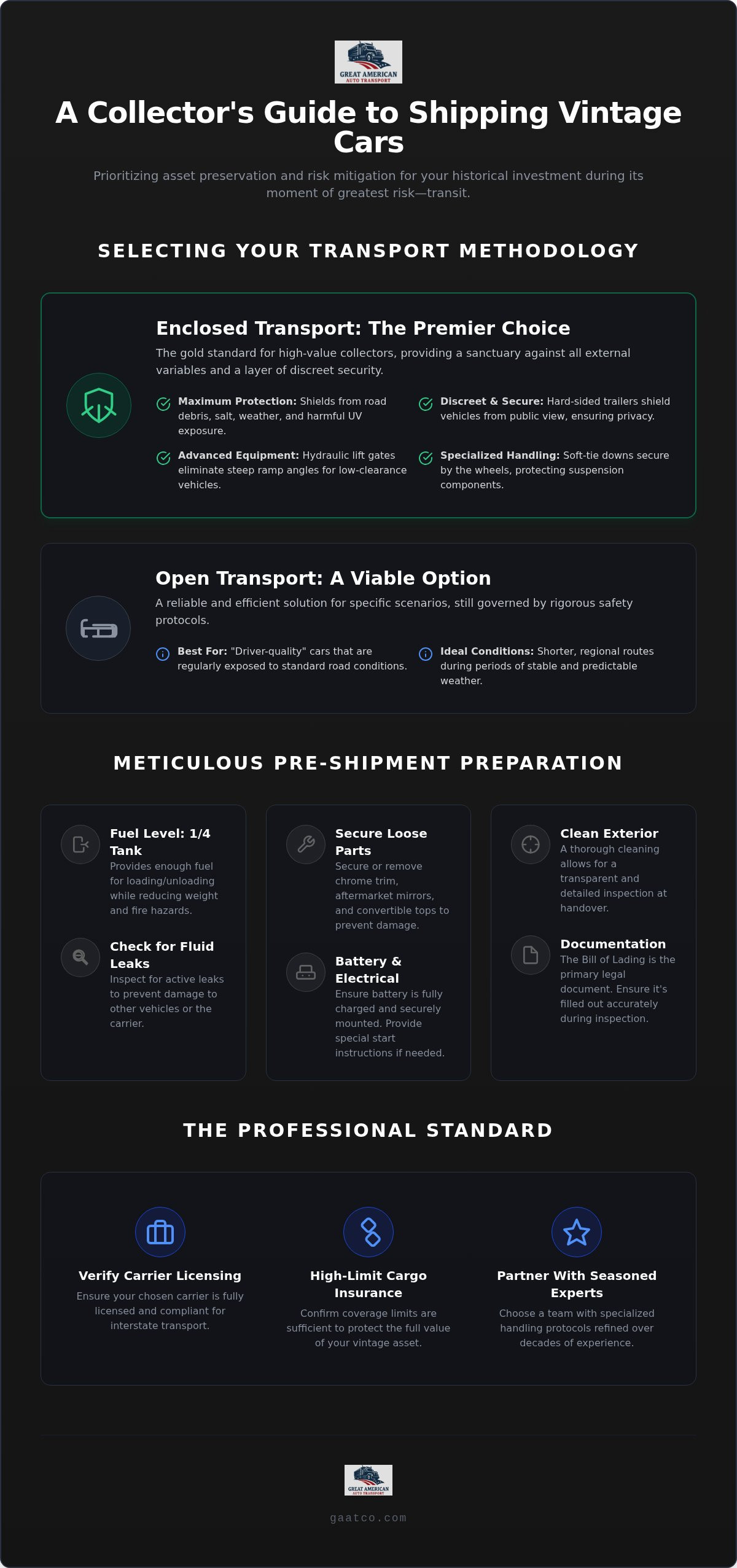
Enclosed transport serves as the gold standard for high-value collectors. It provides a sanctuary against external variables such as road salt, abrasive debris, and harmful UV exposure that can degrade original paint and delicate interior materials. Beyond environmental protection, fully enclosed, hard-sided trailers offer a layer of discreet security. This ensures that the vehicle remains shielded from public view throughout its journey, maintaining the privacy that many high-net-worth individuals require.
Enclosed Carrier Transport: The Premier Choice
Hard-sided trailers provide maximum structural integrity compared to soft-sided curtains. We utilize hydraulic lift gates to ensure a perfectly level loading process. This is particularly critical for vintage vehicles with low ground clearance, as it eliminates the steep angles associated with traditional ramps. Once inside, our professionals employ specialized soft-tie down methods. These secure the vehicle by the wheels rather than the chassis, preventing unnecessary stress on aging suspension components. This meticulous attention to detail ensures that the mechanical geometry of your asset remains undisturbed during transit.
When Open Transport May Suffice
When determining how to ship a classic car of driver-quality, open transport remains a viable option for certain scenarios. This is particularly true for shorter regional routes during periods of stable weather. If the vehicle is regularly driven and already exposed to standard road conditions, an open carrier can provide a reliable relocation solution. At GAATCO, we apply rigorous safety protocols to our open car transport services. This includes strategic positioning on the trailer to minimize exposure and frequent inspections to ensure the vehicle remains secure. It is a calculated choice that balances operational efficiency with a non-negotiable commitment to safety.
Meticulous Preparation for Classic Vehicle Relocation
The physical preparation of a vintage asset is a critical component of professional risk management. When determining how to ship a classic car, the process must begin with a rigorous mechanical assessment to ensure the vehicle is prepared for the unique stresses of transit. This phase is not merely about logistics. It is about the preservation of a historical investment. A comprehensive understanding of how to ship a classic car involves mastering the nuances of documentation and mechanical readiness before the carrier arrives.
Mechanical and Exterior Readiness
Maintaining a quarter-tank of fuel is the industry standard requirement for classic vehicle relocation. This specific volume provides sufficient fuel for loading and unloading maneuvers while reducing unnecessary weight and mitigating fire hazards. All loose exterior components require meticulous attention. Chrome trim, aftermarket mirrors, and convertible tops must be secured or removed to prevent damage from transit vibrations. A thorough cleaning of the exterior is essential. This allows for a transparent and detailed inspection of the paintwork and body panels during the initial handover.
Fluid management is equally vital for vintage engines. Owners should inspect the vehicle for any active leaks, as fluids can damage other vehicles on the carrier or the trailer surface. Batteries must be fully charged and securely mounted to prevent shifting. If the vehicle features a specialized electrical system or a unique starting procedure, clear written instructions for the transport professional are necessary. If you are uncertain about the specific requirements for your vehicle, you may request a quote to receive a customized preparation checklist tailored to your asset.
The Bill of Lading and Documentation
The Bill of Lading serves as the primary legal document governing the relocation process. It functions as both a formal receipt and a definitive condition report. Before evaluating carrier credentials, an owner should ensure that their own documentation is prepared with professional precision. A joint inspection with the transport professional is a non-negotiable step. This collaborative review ensures that any pre-existing conditions are documented accurately on the Bill of Lading. Documenting these conditions should involve taking high-resolution photographs from multiple angles, including the undercarriage and interior. Agreed Value documentation is a necessary requirement to align insurance coverage with the current market valuation of the asset.
Evaluating Carrier Credentials and Professional Insurance
Securing the proper credentials is the most critical step when researching how to ship a classic car. It's not enough for a carrier to simply possess a truck. They must maintain active authority from the Federal Motor Carrier Safety Administration (FMCSA) and demonstrate a history of operational excellence. While the federal baseline for liability insurance is $750,000 for carriers operating vehicles under 10,000 pounds, this figure often proves insufficient for high-value collections. We act as a discreet partner, ensuring every carrier in our network meets the rigorous safety standards required for specialized transport. Auto transport brokers are also required by the FMCSA to maintain a $75,000 surety bond, which serves as a baseline of financial responsibility for the logistics firm itself.
Understanding Cargo Insurance Limits
It's vital to distinguish between a carrier's liability insurance and their Motor Truck Cargo Insurance. While liability covers third-party damage, cargo insurance specifically protects your vehicle during transit. For open transport, coverage often starts at $100,000. However, enclosed carriers typically provide limits ranging from $250,000 to $1,000,000 to reflect the higher value of their cargo. We verify that these limits align with the current market value of your asset before any contract is signed. If a valuation exceeds standard limits, our team facilitates 'gap' coverage to provide total financial security throughout the journey. Our vetting process involves a deep dive into insurance certificates and safety ratings. This ensures no vehicle is ever entrusted to a carrier with a compromised safety record or lapsed coverage.
For collectors managing multi-million dollar portfolios, standard coverage is rarely sufficient. We understand that a single transport may involve assets that far exceed a carrier's primary cargo limit. In these instances, we coordinate specialized high-value policies that offer comprehensive protection against all transit risks. This meticulous attention to detail is what separates a standard move from a professional relocation.
Risk Mitigation and Professional Oversight
A seasoned partner handles complex logistics so you don't have to. With over 20 years of industry experience, we've developed a hierarchical approach to risk management that prioritizes asset preservation. This includes established protocols for claim handling that prioritize the client's interests if an incident occurs. Our team manages the communication with insurance adjusters and provides the necessary documentation to expedite a resolution. This level of oversight is a non-negotiable pillar of our service. By leveraging two decades of regional expertise and global standards, we mitigate risks before the vehicle is even loaded. We believe that true professional service is defined by the ability to remain calm under pressure and meticulously attentive to every technical detail.
Logistics of Door-to-Door Delivery in Major Metropolitan Hubs
This commitment to technical precision is shared by specialized operators globally; for instance, Done Wright Towing & Transport provides professional towing and transport services that adhere to these high standards of asset protection.
Similarly, specialized automotive centers in the U.S., such as Grand Prix Cafe in Southampton, New York, offer the high-level professional services and sales environments that require such precise shipping standards.
The door-to-door auto shipping process represents the most refined method for relocating a vintage vehicle between residential addresses. While the concept suggests a simple pickup and drop-off, the execution in major metropolitan hubs requires sophisticated oversight. Understanding how to ship a classic car into high-density environments like New York or San Francisco involves accounting for the physical dimensions of a multi-car enclosed trailer. These carriers often exceed eighty feet in length. This presents significant challenges in historic neighborhoods or areas with strict commercial vehicle restrictions. Mastering the nuances of how to ship a classic car involves more than just selecting a trailer; it's a process that requires a deep understanding of regional geography and urban infrastructure.
In major transport corridors such as Houston or Miami, flexible scheduling becomes a critical component of the logistics chain. High traffic volumes and regional infrastructure demands mean that a rigid timeline is often less effective than a dynamic, well-communicated plan. Our team coordinates with local authorities and monitors real-time transit data. This ensures that the arrival of your asset is handled with the discretion and precision it deserves. This proactive approach allows us to navigate the complexities of major shipping lanes while maintaining the integrity of the delivery window.
Navigating Urban Constraints
Physical barriers such as low-hanging trees, narrow residential streets, and overhead power lines frequently prevent large trailers from accessing a specific driveway. In these instances, our professionals implement a pre-arranged protocol to meet the vehicle owner at a nearby location with wide-access capabilities. This might include a large parking facility or a commercial staging area. It ensures the safety of the vehicle and the transport equipment. Additionally, regional weather patterns in hubs like Seattle or Chicago are monitored closely. We adjust transit routes to avoid severe precipitation or temperature extremes that could impact the loading or unloading process.
Coordinating the Delivery Window
Precise timing is the hallmark of a professional relocation service. We maintain a continuous communication flow between our dispatchers and the vehicle owner to provide accurate updates as the carrier approaches high-traffic regions like Phoenix or Dallas. This personalized service eliminates the uncertainty often associated with standard freight shipping. Our professionals understand the value of your time and the importance of a seamless handover. To experience this level of meticulous coordination for your next acquisition, you should request a professional transport quote today. We handle the complex logistics so you can focus on the enjoyment of your collection.
The GAATCO Standard: White-Glove Classic Car Care
The standard of care required for a vintage asset transcends the capabilities of a typical logistics provider. At GAATCO, we have spent over twenty years refining a white-glove approach that treats every vehicle as a unique historical artifact rather than a unit of freight. This philosophy is built upon a foundation of technical expertise, safety, and absolute transparency. When you are determining how to ship a classic car, the primary objective is to find a partner who understands the high stakes of asset preservation. We provide a discreet and dependable environment where every detail of the journey is managed with meticulous precision.
Our commitment to excellence is reflected in our human-centric service. We operate a sophisticated infrastructure that allows us to maintain a calm and controlled environment, regardless of the complexity of the transport. By prioritizing reliability and safety, we offer a reassuring experience for affluent collectors and corporate partners alike. We do not merely move vehicles; we manage the sophisticated logistics of relocation so that the condition of your investment remains uncompromised from origin to destination.
Customized Solutions for Every Collector
Every collection possesses unique requirements that demand a tailored operational flow. Our team provides specialized expertise for diverse needs, including military vehicle shipping and the relocation of rare classic imports. These specialized handling protocols are not optional extras; they are non-negotiable pillars of our service. Whether we are securing a pre-war roadster or a modern supercar, we apply the same level of authoritative oversight to ensure maximum protection. This customized approach positions us as the premier choice for collectors who value discretion and technical precision above all else. We act as a bridge between your specific needs and the complex realities of specialized transport.
Securing Your Quote for Classic Transport
The process of initiating a high-end transport should be as seamless as the delivery itself. We invite you to request a professional quote for your next acquisition to experience our streamlined booking process. Our team provides clear and accessible technical details regarding operational specifications, ensuring you remain informed throughout the journey. For clients participating in high-stakes events, we offer expedited shipping solutions to meet the critical urgency required for time-sensitive auction deliveries or concours d'elegance arrivals. By choosing GAATCO, you are securing the services of a seasoned expert dedicated to the preservation of your automotive legacy. We handle the intricacies of how to ship a classic car so you can enjoy the peace of mind that comes from established expertise.
Securing Your Automotive Legacy
Mastering the logistics of how to ship a classic car requires a fundamental shift from viewing transport as a commodity to treating it as a rigorous discipline of asset preservation. By prioritizing enclosed carrier methodologies and adhering to meticulous mechanical preparation, collectors ensure their historical investments remain shielded from environmental and operational risks. Verifying carrier credentials and aligning cargo insurance with current market valuations provide the final layer of essential protection required for any high-value relocation. These pillars of service ensure that the transition between collections is seamless and secure.
GAATCO serves as a discreet and dependable partner for those who demand uncompromising standards. With over 20 years of specialized logistics experience, our team utilizes an elite enclosed carrier network and comprehensive vetting protocols to deliver excellence across the United States. We handle every technical detail with the quiet confidence that comes from established expertise. We invite you to Request a Professional Classic Car Transport Quote for your next acquisition. Entrust your legacy to a partner dedicated to the sophisticated art of specialized transport.
Frequently Asked Questions
Is enclosed transport strictly necessary for a classic car?
Enclosed transport is the recommended standard for classic vehicle preservation, though the final choice depends on your specific goals. While open carriers are safe for standard vehicles, they expose vintage paint and delicate interiors to road debris and UV rays. For high-value assets in cities like Seattle or Chicago, the fully protected environment of an enclosed trailer is essential. It prevents environmental degradation and maintains the vehicle's "as-delivered" condition throughout the entire journey.
How much does it cost to ship a classic car across the country?
The cost for a cross-country relocation depends on several technical variables, including total mileage, the vehicle's dimensions, and the chosen transport methodology. Enclosed carriers typically command a premium over open-air options due to specialized equipment and higher insurance limits. Factors such as current fuel surcharges and seasonal demand in hubs like Phoenix or Las Vegas also influence the final investment. We provide customized quotes that reflect these specific operational requirements for every client.
What level of insurance coverage is standard for classic vehicle transport?
Professional carriers typically maintain liability insurance ranging from $750,000 to $1,000,000. For classic car transport, cargo insurance is the primary focus, with enclosed trailers often providing coverage between $250,000 and $1,000,000 per shipment. It's critical to verify that these limits align with the market value of your asset. We rigorously vet all carriers to ensure they meet these high-limit requirements before any vehicle is loaded for transit to cities like Boston or Nashville.
Can I ship extra parts or personal items inside my classic car?
Transporting personal items inside a vehicle is generally prohibited due to Department of Transportation regulations and insurance limitations. Extra weight can impact the carrier's gross weight balance and isn't covered under the cargo policy. However, if you are researching how to ship a classic car with spare parts, they must be securely packaged and disclosed during the booking process. Our team can provide guidance on maintaining regulatory compliance while shipping essential automotive components.
How long does the door-to-door delivery process typically take?
Delivery timelines are primarily dictated by the total distance and the specific route infrastructure. A regional relocation of 500 miles may take between one and three days, while a cross-country journey from New York to San Francisco typically requires seven to ten days. We prioritize safety over speed to ensure every vehicle is handled with meticulous care. Our dispatchers provide regular updates to ensure you remain informed of the vehicle's progress throughout its journey.
Will the driver have experience handling vintage manual transmissions?
Specialized classic car transport utilizes professional drivers who possess extensive experience with vintage mechanical systems, including non-synchronized manual transmissions and unique starting procedures. We understand that these vehicles require a delicate touch and specific technical knowledge. Every operator in our elite network is vetted for their ability to handle high-value assets with precision. This expertise is a non-negotiable pillar of our commitment to white-glove service for every client we serve in Denver or Austin.
What should I do if my classic car is currently inoperable?
If your vehicle is currently inoperable, it can still be relocated using specialized equipment such as a winch or a hydraulic lift gate. Transporting a non-running classic car typically incurs an additional fee to cover the specialized handling and equipment required for safe loading. You must disclose the vehicle's condition during the initial consultation so we can assign a carrier with the appropriate technical capabilities for hubs like Houston or Atlanta.
Are there specific protocols for shipping a classic car to a humid climate like Miami?
Relocating a vintage asset to humid environments like Miami or Orlando requires specific considerations to prevent moisture-related degradation. Enclosed transport is highly recommended to shield the vehicle from salt air and sudden tropical precipitation. We advise clients to ensure that all seals are intact and to consider the use of moisture-absorbing packets within the cabin for added protection. Our team applies regional expertise to navigate these climate-specific challenges while maintaining the vehicle's integrity.


