
In the high-stakes world of specialized vehicle logistics, your Bill of Lading is far more than a simple receipt; it's a forensic legal document that serves as your primary defense against liability. It's natural to feel a sense of anxiety when handing over the keys to a high-value asset, especially when you're worried that subtle damage might be overlooked or unfairly attributed to you later. We understand that professional transport must be defined by absolute transparency. Mastering how to properly document a car's condition on the BOL for a claim is the most critical step you can take to ensure your vehicle remains legally protected throughout its journey.
You deserve a transport experience that's as refined as the vehicle you're shipping. This guide provides a meticulous framework for the inspection process, helping you decode industry shorthand and stand your ground during the hand-off. We'll explore the essential protocols for a successful delivery, from conducting a systematic 360-degree walkaround to utilizing time-stamped digital evidence. By the end of this article, you'll have the confidence of a seasoned expert, ensuring a seamless and stress-free experience from origin to destination.
Key Takeaways
- Recognize the Bill of Lading as a sophisticated legal contract that serves as your primary defense and receipt of goods under federal transportation law.
- Discover how to properly document a car's condition on the BOL for a claim by adhering to meticulous pre-inspection protocols, such as ensuring the vehicle is clean and inspected in optimal lighting.
- Decipher specialized industry shorthand and damage grids to ensure every scratch, dent, or chip is recorded with forensic precision before transit begins.
- Protect your investment on delivery day by identifying the critical window for noting discrepancies and filing exceptions before you finalize the hand-off.
- Leverage the expertise of a seasoned logistics partner to navigate complex documentation and minimize risks through specialized services like enclosed car transport.
The Bill of Lading as a Legal Shield: Understanding the Contract of Carriage
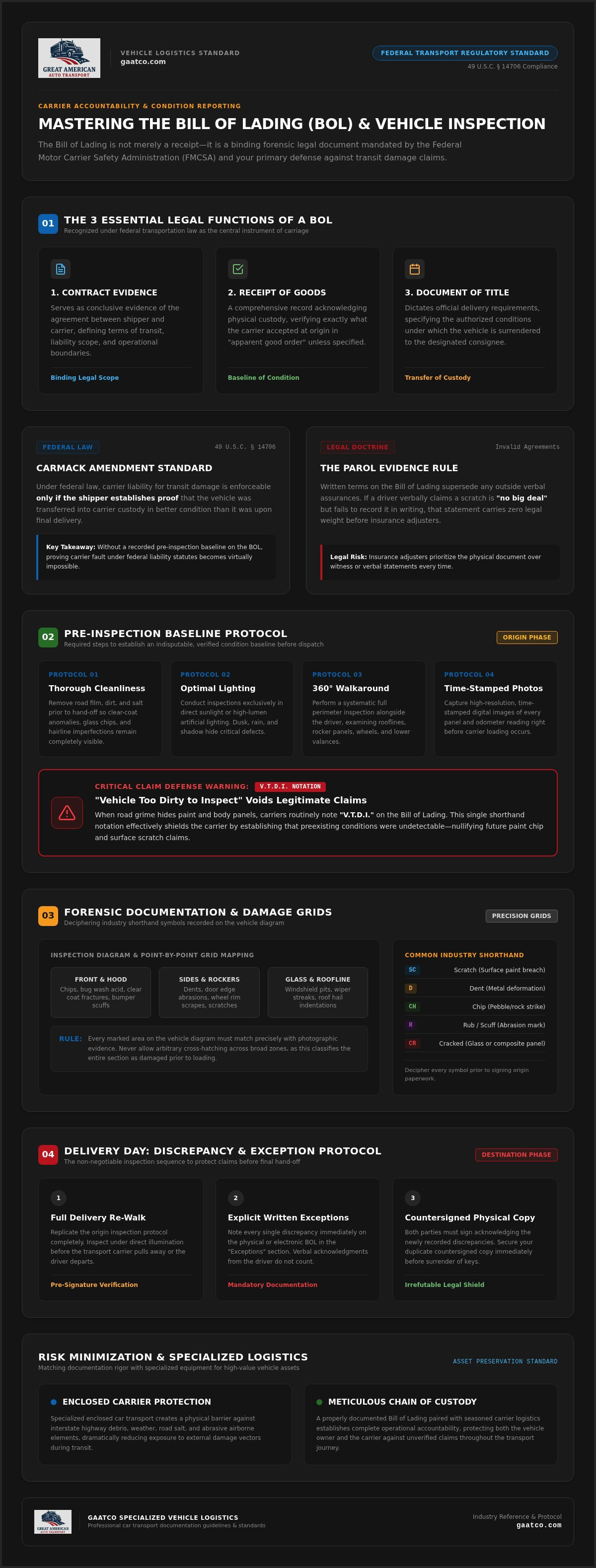
The Bill of Lading (BOL) is the most vital document in the automotive transport industry. It is not merely a piece of paperwork; it's a binding contract of carriage that defines the legal relationship between the vehicle owner and the carrier. The Federal Motor Carrier Safety Administration (FMCSA) mandates specific standards for these documents to ensure transparency and accountability during interstate transit. Understanding its legal weight is the first step in learning how to properly document a car's condition on the BOL for a claim. When a carrier takes possession of your vehicle, they signify it's in "apparent good order" unless specific discrepancies are noted. This origin report establishes the baseline against which all future claims are measured; it's the foundation of your protection.
To visualize the physical process of completing this essential documentation, please observe the following demonstration:
The Three Essential Functions of a BOL
A sophisticated logistics operation relies on the BOL to perform three distinct legal functions of a bill of lading. First, it serves as conclusive evidence of the contract between the shipper and the carrier, detailing the scope of service and liability limits. Second, it acts as a comprehensive receipt, acknowledging exactly what the carrier received at the point of origin. Finally, it functions as a document of title, dictating the terms under which the vehicle is delivered to the consignee. Without a meticulously completed BOL, your legal standing in the event of a dispute is significantly weakened.
Why Verbal Agreements Are Invalid in Auto Transport
Relying on a driver's verbal assurance is a common but costly mistake. The "Parol Evidence Rule" generally dictates that the written terms of a contract supersede any outside verbal agreements. If a driver promises that a small scratch is "no big deal" but fails to record it, that promise holds no weight in a legal or insurance setting. Insurance adjusters prioritize the written report over witness testimony every time. This underscores why knowing how to properly document a car's condition on the BOL for a claim is non-negotiable. You must ensure every detail is captured in writing and that you possess a signed copy before the transport vehicle leaves your sight.
Pre-Inspection Protocol: Establishing an Irreproachable Baseline
The strength of a legal claim relies entirely on the quality of the evidence established at the point of origin. Under the Carmack Amendment under 49 U.S.C. § 14706, carriers are held liable for damage, but only if the shipper can prove the vehicle was handed over in better condition than it was delivered. This is why mastering how to properly document a car's condition on the BOL for a claim begins long before the carrier arrives. You must create an environment where every detail is visible and indisputable. Conduct your inspection in direct sunlight or under high-lumen artificial lighting; shadows and rain are the enemies of precision. If the hand-off occurs at dusk or in a poorly lit area, you're essentially signing away your right to an accurate baseline.
The Cleanliness Requirement
Dirt is a carrier's best defense against a damage claim. When a vehicle is layered in road film, dust, or salt, it's impossible to verify the integrity of the clear coat or identify hairline fractures in the glass. Carriers are trained to protect themselves by noting "Vehicle Too Dirty to Inspect" or "V.T.D.I." on the Bill of Lading. This single notation can effectively void future claims regarding paint chips or surface scratches, as the carrier can argue the damage was simply hidden at pickup. A clean car ensures every scratch is visible to both parties. By presenting a pristine vehicle, you force a detailed inspection rather than a blanket disclaimer.
The 360-Degree Photographic Record
While the BOL is the primary legal document, high-resolution photography serves as its forensic companion. You should capture a minimum of 25 to 30 images, focusing on all four corners, the roof, and the undercarriage. Use your smartphone to capture EXIF metadata, which embeds the exact date, time, and GPS coordinates into the file. This makes it impossible for a carrier to claim the photos were taken at a different time. Don't forget the interior; document the dashboard for warning lights, the condition of the upholstery, and the current odometer reading. Taking these photos in the presence of the driver sends a clear message that you're a meticulous owner who understands the nuances of how to properly document a car's condition on the BOL for a claim.
Finally, identify and point out any non-standard modifications, such as aftermarket spoilers or lowered suspensions, that require specialized handling. Choosing specialized enclosed car transport services provides an additional layer of protection for these high-value assets, ensuring they remain shielded from the elements throughout their journey. Once the vehicle is prepared and the evidence is gathered, you're ready to move to the formal notation process on the Bill of Lading itself.
The Forensic Inspection: Deciphering BOL Notation Symbols
A rigorous physical inspection is only as effective as the notations recorded on the Bill of Lading. To the uninitiated, the vehicle schematic on a BOL can appear as a confusing array of circles and letters. However, for the discerning owner, these symbols represent a precise language of accountability. Learning how to properly document a car's condition on the BOL for a claim requires a forensic eye for detail and an understanding of the Damage Grid. This grid typically features a five or six-view schematic of a vehicle, allowing you to pinpoint the exact location of any imperfection. Adhering to federal claim processing regulations under 49 CFR Part 370 ensures that your notations meet the legal threshold for carrier accountability, creating an indisputable record before the journey begins.
Commonly Used BOL Shorthand Codes
Carriers utilize standardized abbreviations to describe damage types efficiently. It's imperative that you verify the driver's notations match your own observations before signing. Common codes include:
- S (Scratch): Surface marks that haven't penetrated the primer.
- D (Dent): Depressions in the metal without paint loss.
- C (Crease): A sharp, linear dent often found along body lines.
- CR (Cracked): Specifically used for glass, mirrors, or plastic lenses.
- G (Gouge): Deep damage that has removed material or paint.
- MS (Missing): Items like emblems, mirror covers, or fuel caps.
If you disagree with a driver's assessment, use the "Notation of Exceptions" section to clarify. For instance, if a driver marks a "D" for a dent that you believe is a minor scuff, write your specific observation clearly in the text block.
Inspecting High-Risk Areas
Certain areas of a vehicle are frequently overlooked during the rush of a hand-off. The roof and pillars are prone to damage from overhead clearance or debris but are rarely inspected by owners. Similarly, the undercarriage and lower valance on low-clearance luxury vehicles require a dedicated look. For these sensitive assets, choosing specialized enclosed car transport is often the most prudent choice to avoid road-level hazards. Documenting curb rash on wheels versus new scratches is also vital, as alloy rims are expensive to refinish. Finally, inspect convertible tops and weather seals for tension and integrity. By mastering how to properly document a car's condition on the BOL for a claim with this level of granularity, you eliminate the ambiguity that carriers often use to deny liability.
Delivery Day: Identifying Discrepancies and Filing the Exception
The arrival of your vehicle marks the final, most critical phase of the transport process. While the anticipation of receiving your car is significant, this moment requires your most disciplined attention to detail. Your signature on the delivery Bill of Lading is a legally binding acknowledgment that the vehicle has been received in the condition described. Once that document is signed without exceptions, the burden of proof for any subsequent damage claims becomes nearly impossible to meet. Mastering how to properly document a car's condition on the BOL for a claim at this stage is your final safeguard against loss.
One of the most dangerous misconceptions in the industry is the "Subject to Inspection" trap. Many owners believe that writing this phrase on the BOL protects them if they discover damage after the driver has departed. In reality, insurance adjusters and carrier legal teams view a signature with this notation as a "clean" delivery. It suggests that you had the opportunity to inspect the vehicle but chose not to record specific discrepancies. To protect your investment, you must perform a comprehensive walkaround and record specific, descriptive exceptions immediately.
The Comparative Analysis
Begin your delivery inspection by placing the origin BOL side-by-side with the vehicle's current state. This allows for a direct comparison of the notations made at pickup. Beyond cosmetic surface issues, you should verify the following:
- Odometer Readings: Ensure the mileage aligns with the distance required for loading and unloading.
- Mechanical Integrity: Check for new fluid leaks under the chassis or unusual engine sounds.
- Adequate Lighting: Never accept a delivery after sunset or in a poorly lit area. If the driver arrives at night, insist on moving the vehicle to a well-lit location, such as a brightly lit parking lot, to ensure no damage is masked by shadows.
Signing Under Protest
If new damage is identified, you must note the specific location and type of damage on the BOL before the driver leaves. If a driver attempts to rush the process or refuses to allow you to record detailed exceptions, do not sign the document. This is the moment to contact your transport partner immediately. Documenting the driver's refusal through video or photos is essential for your records. You must keep the original copy of the BOL and initiate communication with the carrier or broker within 24 hours to preserve your rights. For those who prioritize the highest level of care and detailed documentation, you can request a quote for specialized transport to ensure your vehicle is handled with the professionalism it deserves.
The GAATCO Standard: Professionalism in Every Detail
Expertise in the automotive logistics industry isn't built overnight; it's forged through decades of managing complex operational realities. With over 20 years of industry experience, we understand that the hand-off of a luxury or classic vehicle is a high-stakes moment that requires absolute precision. Our role as a discreet and dependable partner is to ensure that you have the knowledge and support required to navigate the documentation process with confidence. By teaching our clients how to properly document a car's condition on the BOL for a claim, we provide a sophisticated level of protection that many standard service providers simply cannot match.
Choosing Enclosed Car Transport is one of the most effective ways to minimize condition disputes from the outset. By shielding your vehicle from road debris, inclement weather, and environmental film, we ensure the car arrives at its destination in the same pristine state it left your driveway. This level of protection makes the inspection process significantly more straightforward; there are no "dirty vehicle" disclaimers to mask potential issues. It's a commitment to quality and safety that reflects our understanding of the nuances of high-end service.
A Legacy of Reliability and Safety
Our door-to-door solutions prioritize clear communication at every hub. We work exclusively with a network of licensed and insured carriers who've been rigorously vetted to meet our uncompromising standards. Reliability is the cornerstone of our operations. Our carriers are trained to assist you in how to properly document a car's condition on the BOL for a claim, ensuring that the notation process is handled with the seriousness it requires. This focus on meticulous detail creates a reassuring experience for affluent and corporate audiences who require a trusted advisor to handle their logistics with a calm, seasoned expertise.
Next Steps for a Hassle-Free Move
Preparing your vehicle for its journey across the United States is a systematic process that begins with a thorough cleaning and ends with a forensic BOL notation. We're here to guide you through every step of that journey. If the unthinkable occurs and damage is noted, our team provides the professional mitigation and support needed to resolve the situation efficiently. You don't have to handle complex logistics alone. When you're ready to experience a transport service defined by quiet luxury and operational excellence, you can request a quote for your upcoming needs. Trust the experts at GAATCO to handle your most valuable assets with the seriousness and sophistication they deserve.
Protecting Your Automotive Investment with Precision
Mastering the intricacies of the Bill of Lading is essential for any discerning vehicle owner. It transforms a standard logistics procedure into a robust legal defense. By ensuring your vehicle is clean, utilizing optimal lighting, and deciphering standard industry shorthand, you've learned how to properly document a car's condition on the BOL for a claim. These meticulous steps provide the forensic evidence required to protect your asset throughout its journey across the United States. Your diligence at both pickup and delivery ensures that your rights remain indisputable.
At GAATCO, we bring over 20 years of specialized auto transport expertise to every shipment. Our fully licensed and insured carrier network operates with an A+ commitment to client logistics and safety. We act as your trusted advisor, managing the complexities of specialized transport so you don't have to. You deserve a partner who values precision as much as you do. Our team is dedicated to maintaining the integrity of your vehicle from the moment of hand-off to the final delivery.
Secure your vehicle's journey with a professional GAATCO quote today.
We look forward to delivering the peace of mind and elite service you expect for your most valuable assets.
Frequently Asked Questions
What happens if I sign the BOL and find damage later?
Signing a delivery receipt without noting exceptions creates a legal presumption that the vehicle arrived in the same condition it was received at the origin. Once you've provided a "clean" signature, proving that damage occurred during transit becomes exceptionally difficult. While you should notify the carrier immediately, insurance adjusters often use the lack of delivery notations to deny liability. This is why a meticulous inspection at the point of offloading is non-negotiable.
Does 'Subject to Inspection' protect me if the car is delivered at night?
The phrase "Subject to Inspection" offers no real legal protection and is frequently disregarded by insurance adjusters. It suggests you waived your right to a thorough walkaround at the time of delivery. If your vehicle arrives at night in cities like Seattle or Chicago, you must use high-lumen flashlights or move the car to a well-lit area. You must record specific discrepancies on the document before signing to preserve your rights.
What are the most common BOL symbols used by auto carriers?
Standard industry shorthand includes S for Scratches, D for Dents, CH for Chips, and CR for Cracked glass. Understanding these codes is essential for learning how to properly document a car's condition on the BOL for a claim. Carriers also utilize G for Gouges and MS for Missing parts. Always verify that the driver's marks on the vehicle diagram accurately reflect the physical state of your car before it departs from locations like Houston or Phoenix.
Should I take photos of the car even if the driver is also taking them?
You should always maintain an independent photographic record with timestamped metadata. While drivers use specialized apps, having your own high-resolution images ensures you have control over the angles and clarity of the evidence. Capture all four corners, the roof, and the interior odometer. This secondary layer of protection is vital if the carrier's digital files are incomplete or if a dispute arises regarding the timing of the damage.
How do I document damage on a digital BOL versus a paper one?
Digital BOLs, or eBOLs, allow you to type specific notes into an "Exceptions" or "Remarks" field before providing a signature on a mobile device. Ensure the driver attaches high-resolution photos to the digital report that clearly show the new discrepancies. You should receive an emailed copy of the finalized report immediately. The logic remains the same as paper: don't sign until the digital schematic and text accurately reflect the vehicle's current state.
What should I do if the driver disagrees with my assessment of damage?
If a driver disputes your findings, don't feel pressured to sign a clean document. Write your specific observations in the exceptions section and clearly state that the driver disagrees with the assessment. Take close-up photos of the area in question with the driver or the transport trailer in the background as context. Contact your GAATCO advisor immediately to report the disagreement and ensure the dispute is officially recorded in the shipment's log.
Is the Bill of Lading the same thing as my insurance policy?
The Bill of Lading is a contract of carriage and a receipt of goods, not an insurance policy. It establishes the forensic facts regarding the vehicle's physical condition, which an insurance adjuster then uses to determine liability. GAATCO coordinates with a licensed and insured carrier network, but the BOL is the primary evidence needed to trigger those insurance protections. It bridges the gap between the physical reality of the transport and the financial coverage.
Can I refuse to sign the BOL if the car is damaged?
You shouldn't refuse to sign the BOL entirely, as this can complicate the legal transfer of the vehicle. Instead, you must refuse to sign it "clean." Sign the document only after you have explicitly written a detailed description of the new damage in the exceptions block. By following this protocol for how to properly document a car's condition on the BOL for a claim, you fulfill your contractual obligations while ensuring the carrier is held accountable for the loss.


