
Could a routine toll or weigh-station stop affect your vehicle’s delivery timing or lead to an unexpected charge? It’s a reasonable concern when arranging auto transport, especially when one carrier is moving several vehicles. Understanding how do car carriers handle toll roads and weigh stations starts with recognizing that both are normal parts of commercial route planning, but they serve different purposes.
Tolls are road-use expenses carriers account for when planning a trip. Weigh stations allow officials to assess commercial vehicles and their loads. Requirements vary by state and facility: a loaded carrier may be directed to stop, screened as it approaches, or allowed to bypass a station. These procedures support compliance and safety, but they can affect travel time.
This article explains how carriers plan routes and manage tolls, what may happen when a multi-vehicle carrier reaches a weigh station, and how operational stops can affect delivery estimates. Knowing what to look for in a written quote can also help you distinguish a routine route expense from a separately stated shipping charge. GAATCO arranges open and enclosed auto transport across the United States, including shipments involving Atlanta, Miami, New York, Houston, Dallas, San Diego, San Francisco, Seattle, Orlando, Boston, Nashville, Denver, Austin, Chicago, Las Vegas, and Phoenix.
Key Takeaways
- Learn how do car carriers handle toll roads and weigh stations by considering route access, toll costs, travel time, and vehicle suitability.
- Read the written quote to understand how toll expenses are treated. Billing arrangements can differ.
- Know the basic weigh-station process and why state requirements may determine whether a carrier stops or bypasses a station.
- Allow for traffic, route conditions, and possible inspection stops when planning around a delivery estimate.
- Provide accurate vehicle, pickup, and delivery details to support practical transport planning.
How car carriers use toll roads and weigh stations during a shipment
A car carrier is a commercial vehicle that transports multiple customers’ vehicles on a trailer. Its route may include toll roads, weigh stations, or both. Toll facilities collect road-use charges; weigh stations support oversight of commercial vehicles and their loads. These stops have different purposes, even when they fall along the same route.
So, how do car carriers handle toll roads and weigh stations? The driver follows the planned route while meeting the toll operator’s payment rules and any applicable roadside requirements. The specific process depends on the vehicle combination, road, and jurisdiction. GAATCO arranges open and enclosed vehicle transport and coordinates the logistics around each shipment.
The video below offers a practical look at a procedure a truck driver may encounter at a weigh station:
What happens when a car carrier reaches a toll road?
A toll road is a route option, not an inspection point. The toll is assessed under the road operator’s classification and payment rules, which may apply to the full vehicle combination rather than the tractor alone. Axle count, vehicle dimensions, and local classification rules can affect how a multi-vehicle carrier is categorized, so rates and payment methods vary by facility.
Drivers may pay electronically using a compatible transponder linked to a toll account, or use another method the road operator permits. Some facilities process payment without a cash stop; others use different procedures. When planning a route, the carrier weighs toll access against distance, timing, road suitability, and the rest of the itinerary. Toll collection does not determine whether a vehicle meets weight or safety requirements.
Why loaded car carriers may enter weigh stations
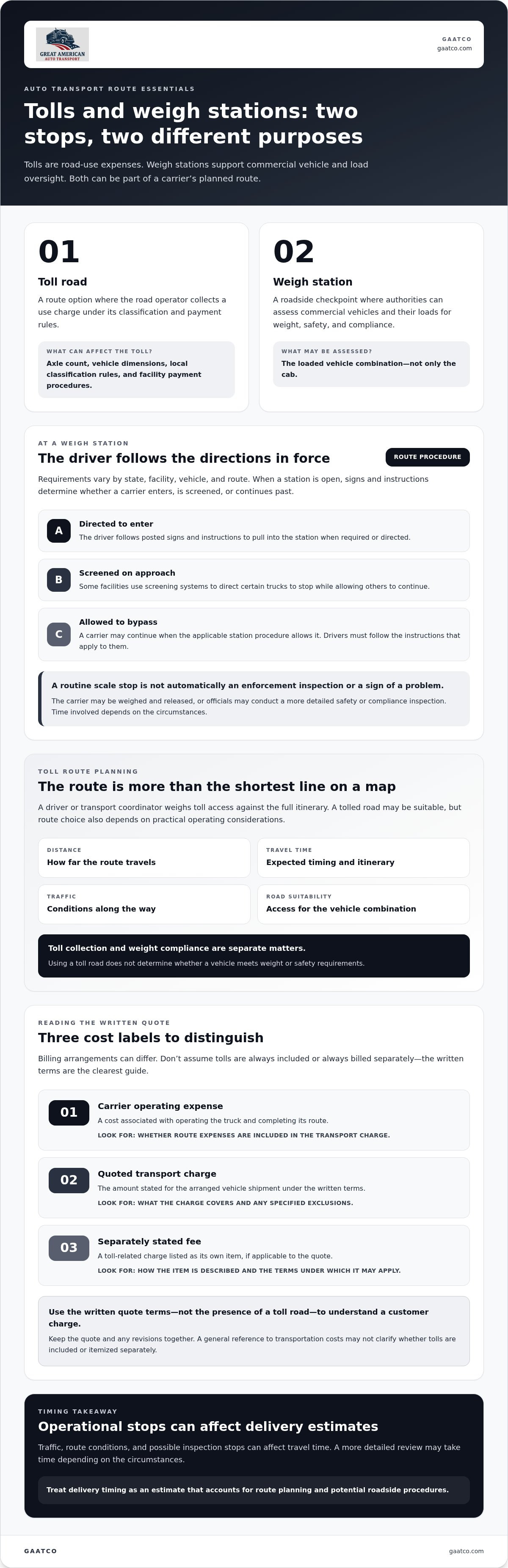
A weigh station is a roadside checkpoint where authorities can assess commercial vehicles and their loads for weight, safety, and compliance. The Weigh station overview describes their role in commercial vehicle oversight. Because a car carrier transports several vehicles, officials may assess the loaded combination, not just the cab.
When a station is open, drivers follow posted signs and instructions, entering when directed or required. Procedures depend on the jurisdiction, vehicle, route, and instructions displayed at the station. Some locations use screening systems that direct certain trucks to pull in while allowing others to continue. Drivers must follow the instructions that apply to them.
A routine scale stop is not automatically an enforcement inspection or a sign of a problem. A carrier may be weighed and released to continue, or officials may conduct a more detailed safety or compliance inspection. That review is separate from ordinary toll processing, and the time involved depends on the circumstances. These controls are part of commercial vehicle operations, not evidence of a separate customer charge.
How toll charges are managed on car-shipping routes
Toll planning is one part of a carrier’s route decision. The driver or transport coordinator considers distance, expected travel time, traffic, road access, and whether the route suits the vehicle combination. A tolled road may make sense for the itinerary, but the shortest route on a map is not always the safest or most workable option for a loaded carrier.
For customers asking how do car carriers handle toll roads and weigh stations, the key distinction is that tolls are a route expense, while their treatment in a shipment quote depends on the written terms. Carriers and pricing structures differ, so do not assume tolls are always included or always billed separately.
Are tolls included in a car-shipping quote?
Review the written quote for the transport charge, any stated toll-related charge, exclusions, and language explaining how route expenses are handled. A general reference to transportation costs may not clarify whether tolls are built into the quoted amount or itemized separately. The written terms are the clearest guide.
Use the written quote terms rather than assuming tolls are always separate. It helps to distinguish a carrier operating expense from a separately stated customer charge:
| Cost category | What it means | What to look for |
|---|---|---|
| Carrier operating expense | A cost associated with operating the truck and completing its route. | Whether the quote describes the transport charge as inclusive of route expenses. |
| Quoted transport charge | The amount stated for the arranged vehicle shipment under the written terms. | What the charge covers and whether any exclusions are specified. |
| Separately stated fee | A toll-related charge listed as its own item, if applicable to the quote. | How the item is described and the terms under which it may apply. |
Keep the quote and any revisions together. Compare the written terms instead of inferring a charge from the fact that the route uses a toll road. This makes it easier to distinguish a carrier expense from a fee expressly presented to the customer.
Why a carrier may choose a tolled route
A toll road may offer a more suitable connection or a more predictable route, depending on traffic and delivery planning. A non-tolled alternative may be shorter on a map but slower in practice, or less appropriate for a large vehicle combination. The route still needs to support safe, lawful operation and comply with applicable vehicle restrictions.
Route planning also considers infrastructure and road safety. The Federal Highway Administration explains the purpose of weigh stations, including protecting bridges and pavement and supporting safe commercial truck operations. Toll decisions and compliance requirements are separate considerations, even when both shape the same itinerary.
For shipment planning, GAATCO’s vehicle transport quote request lets you share the details needed to frame a transport estimate.
What happens at a weigh station, and can a carrier bypass one?
For a loaded car carrier, a weigh station is a checkpoint along the route, not a scheduled customer handoff. Drivers respond to signs, signals, and directions from enforcement personnel. The procedure depends on the state, facility, vehicle, and instructions in effect, so there is no single sequence that applies to every shipment.
Understanding how do car carriers handle toll roads and weigh stations includes recognizing that a possible bypass is conditional. Electronic screening can direct an eligible truck past a participating station, but it does not cancel a required stop or override an officer’s direction. The driver remains responsible for following posted instructions and applicable requirements.
A typical weigh-station stop, step by step
Signs and signals indicate whether commercial drivers should enter, which lane to use, and whether to proceed to a scale or inspection area. A typical sequence may look like this:
- Follow the approach instructions. The driver watches for signs, lane controls, and signals as the carrier nears the facility.
- Enter when directed or required. If a sign, signal, or enforcement officer directs the truck into the station, the driver follows that instruction.
- Complete the requested checks. Depending on the stop, officials may review weight, documents, vehicle condition, or other compliance matters.
- Proceed when released. The driver continues the route once authorized to leave the station.
The stop may be limited to a scale check or extend to a more detailed inspection. A routine weigh-in is different from an enforcement inspection, and neither has a guaranteed duration. Timing depends on what officials request and conditions at the facility. State rules and practices also differ, so a procedure on one route may not describe the requirements in the next state.
When can a car carrier bypass a weigh station?
Some electronic screening programs may give eligible trucks a bypass opportunity at selected participating locations. Drivewyze is one third-party example of a service associated with weigh-station bypass notifications. Eligibility and site participation matter, and a bypass opportunity at one station does not mean a truck can skip every station along its route.
A notification is conditional guidance, not permission to disregard signs. The driver must still follow posted directions, state requirements, and any instruction from enforcement personnel. If the station directs the carrier to enter, or an officer orders an inspection, that instruction takes precedence over a bypass indication.
For customers, a bypass may let an eligible carrier continue without stopping at a particular site, but it cannot be assumed for every vehicle or trip. A required stop may add time, while a bypass may avoid a particular queue. The result depends on the route and conditions, so delivery planning should allow for operational variation rather than rely on a fixed stop time.
How tolls and inspections can affect routing and delivery timing
A car carrier’s itinerary is shaped by more than mileage. A toll road may offer a practical connection, while traffic, vehicle restrictions, road closures, and required inspections can influence the route and travel time. These factors can change together: a route that looks efficient in normal conditions may need adjustment if congestion builds or a commercial vehicle must take a detour.
That is why how do car carriers handle toll roads and weigh stations is also a question about realistic timing. Route planning provides a working schedule, not a promise that the carrier will travel continuously or arrive at an exact hour.
What can cause delays beyond toll plazas and scales?
Conditions can shift after a route is planned. A traffic backup near a toll facility may slow progress before or after the plaza, while weather or a road closure may require a change of itinerary. A restriction affecting the truck or trailer can also make a seemingly direct road unsuitable.
Inspection queues are another variable. A carrier may be directed to stop, and the type of check or the line of vehicles ahead can affect how long it remains at a facility. Safety requirements also shape decisions: a driver may need to slow down, take a compliant alternate route, or pause rather than continue in unsuitable conditions. These circumstances vary by route and can change during a shipment, so they cannot always be anticipated precisely.
What delivery expectations are reasonable?
Use the provided delivery estimate or window as a planning guide rather than assuming a precise arrival hour. A planned route accounts for expected travel, but actual progress can be affected by changing traffic, inspection activity, and other road conditions. A required inspection stop is part of commercial transport, not necessarily a sign that the shipment is mishandled.
Keep pickup and delivery arrangements flexible enough to accommodate normal operational variation. Share accurate location details and make sure the planned access point can accommodate the delivery arrangement. Door-to-door service depends on practical vehicle access, so clear instructions can support smoother coordination when the carrier arrives.
Transport needs also differ by vehicle and owner. GAATCO’s auto transport services include open and enclosed options for different shipping priorities. Route planning accounts for the details of the move. For shipment planning, request a vehicle transport quote with accurate pickup, delivery, and vehicle details. Clear information supports coordination, while a reasonable delivery window leaves room for road conditions a carrier cannot control.
What customers should know before booking car transport
A clear written quote and accurate shipment details help align expectations before a vehicle is assigned to a route. Tolls and inspections are routine parts of commercial transport, but quotes can describe route expenses differently. Review the terms rather than assuming a toll will always be included or billed separately.
As you arrange a shipment, keep these points in view:
- Identify the transport service. Confirm whether the arrangement is for open or enclosed transport and that it suits your vehicle’s needs.
- Read the charge details. Look for the transport charge, stated exclusions, and any toll or route-related fees presented separately.
- Review route language. Note any assumptions or limitations related to the route and access.
- Keep written records together. Save the quote and shipment communications so you can refer to the same terms if questions arise.
Questions to resolve in the written quote
Before booking, make sure the quote describes the service and shipment being arranged, then read any language about route expenses carefully. If tolls or other route-related fees are addressed, note whether they are included, excluded, or itemized. Do not infer a billing rule from the fact that the carrier may use a toll road. Keeping the quote and related communications together makes the agreed terms easier to reference.
How to prepare for a smooth transport arrangement
Good planning starts with precise details. Share complete pickup and delivery locations, including access limitations such as restricted entrances or narrow roads that could affect a large carrier. Provide accurate vehicle information and verify that the selected transport arrangement matches what you intend to ship. These details help with coordination before the vehicle is in transit.
Plan around a delivery window rather than a precise arrival hour. Traffic, route conditions, and required operational stops can affect progress, even when the itinerary is carefully planned. Such stops are part of moving a commercial vehicle responsibly, not necessarily a sign that the shipment is off track.
GAATCO arranges open and enclosed transport with licensed and insured carriers, drawing on more than 20 years of industry experience. This coordination places route and carrier logistics within the broader shipping arrangement. To discuss your vehicle, locations, and preferred transport option, start with a personalized auto transport quote.
Plan your vehicle’s next move with confidence
A well-prepared shipment starts with clear details and a shared understanding of the transport plan. As you consider how do car carriers handle toll roads and weigh stations, remember that these are operational parts of moving a vehicle. They are not, by themselves, a reason to expect an extra charge or an exact arrival time. Reviewing the written quote and providing accurate pickup, delivery, and vehicle information can help set practical expectations.
GAATCO arranges open and enclosed vehicle transport across the United States with licensed and insured carriers, supported by more than 20 years of industry experience. Whether you are coordinating a personal move or a vehicle transfer, outline your shipment needs and preferred arrangement to get started.
Ready to plan your transport? Request a personalized auto transport quote and take the next step toward a well-coordinated vehicle shipment.
Frequently Asked Questions
Do car carriers pay tolls themselves or charge customers separately?
Carriers may pay tolls through their own operating accounts, but the quote determines whether toll expenses are included in the transport charge or listed separately. There is no universal billing arrangement. Review the written terms and any quote revisions before booking. If a trip crosses several toll authorities, keep the relevant documents together so you can see how the quoted amount treats route expenses.
Do car carriers have to stop at every weigh station?
No. Whether a carrier must enter depends on the state, vehicle, and signs or instructions at that location. Some stations screen approaching trucks and direct selected vehicles to enter, while others may use different procedures. Drivers should follow posted directions and instructions from enforcement personnel. What happens at one station does not determine what the carrier must do at the next.
Can a car carrier use a weigh-station bypass service?
Yes, an eligible carrier may receive a bypass opportunity at a participating location through an electronic screening program. Drivewyze is one third-party example. Eligibility and site participation vary, so a bypass should not be assumed for every truck or station. A bypass notification also does not override a sign, state requirement, or officer’s direction to enter or undergo an inspection.
Will weigh stations delay delivery of my car?
A stop can add time, but its effect depends on the route, queue, and type of check. A carrier directed to a scale may be released promptly, while a more detailed inspection can take longer. When considering how do car carriers handle toll roads and weigh stations, treat a delivery estimate as a window rather than a precise arrival hour, and allow for operational stops.
Are toll charges included in an auto transport quote?
They may be included in the quoted transport charge or stated separately. The written quote is the reliable reference. Check the charge description, exclusions, and any language about tolls or route-related expenses instead of inferring billing from the planned route. Whether your shipment involves Atlanta, Miami, New York, Houston, Dallas, San Diego, San Francisco, Seattle, Orlando, Boston, Nashville, Denver, Austin, Chicago, Las Vegas, or Phoenix, make sure the requested pickup and delivery locations are accurate.
Can a car carrier avoid toll roads to save money?
Sometimes a non-tolled alternative is available, but avoiding tolls does not automatically make a route less costly or more practical overall. Traffic, road access, vehicle restrictions, and delivery planning can influence the choice. A carrier must use a route suitable for safe, lawful operation. Review how the written quote treats toll expenses rather than assuming the carrier will avoid every tolled road.
Do toll roads charge car carriers the same as passenger cars?
Not necessarily. Toll operators set their own classifications, and a loaded carrier may be assessed according to the full vehicle combination. Axle count, dimensions, and local rules can affect the classification. A passenger-car toll estimate may not reflect the charge for a commercial carrier using the same road. The toll authority’s vehicle classification rules determine the applicable rate, not the customer’s vehicle alone.


