
Using one car shipper for several vehicles may not produce the lowest quote, but it can make a complex move easier to manage. The benefits of using the same car shipper for multiple vehicles often start with coordination: fewer separate arrangements to track, clearer communication, and one overview of pickup and delivery plans.
One booking does not automatically save time or money. Time savings may come from consolidating logistics, while any price advantage depends on factors such as route, timing, vehicle size, condition, and transport requirements. A shared plan also needs to account for differences between vehicles, including whether open or enclosed transport is appropriate.
This article explains which advantages are practical and which depend on how well the shipment fits together. You’ll learn how to compare coordinated shipping with separate arrangements and what details to prepare for a multi-vehicle quote. GAATCO arranges vehicle transport across the United States, with open transport as the primary option and enclosed transport for vehicles with different protection needs. Preparing the details in advance helps bring the full shipment into focus.
Key Takeaways
- The benefits of using the same car shipper for multiple vehicles often center on coordinated planning and one point of communication.
- Compare quotes using each vehicle’s route, size, timing, and transport needs. One booking does not guarantee a lower per-vehicle cost.
- Shared routes and compatible pickup and delivery windows can make one coordinated shipment easier to manage.
- Prepare an inventory of vehicles, origin and destination details, timing preferences, and any condition or protection requirements before requesting a quote.
- GAATCO coordinates open and enclosed transport for individual owners, dealerships, and military personnel across the United States.
Benefits of Using the Same Car Shipper for Multiple Vehicles
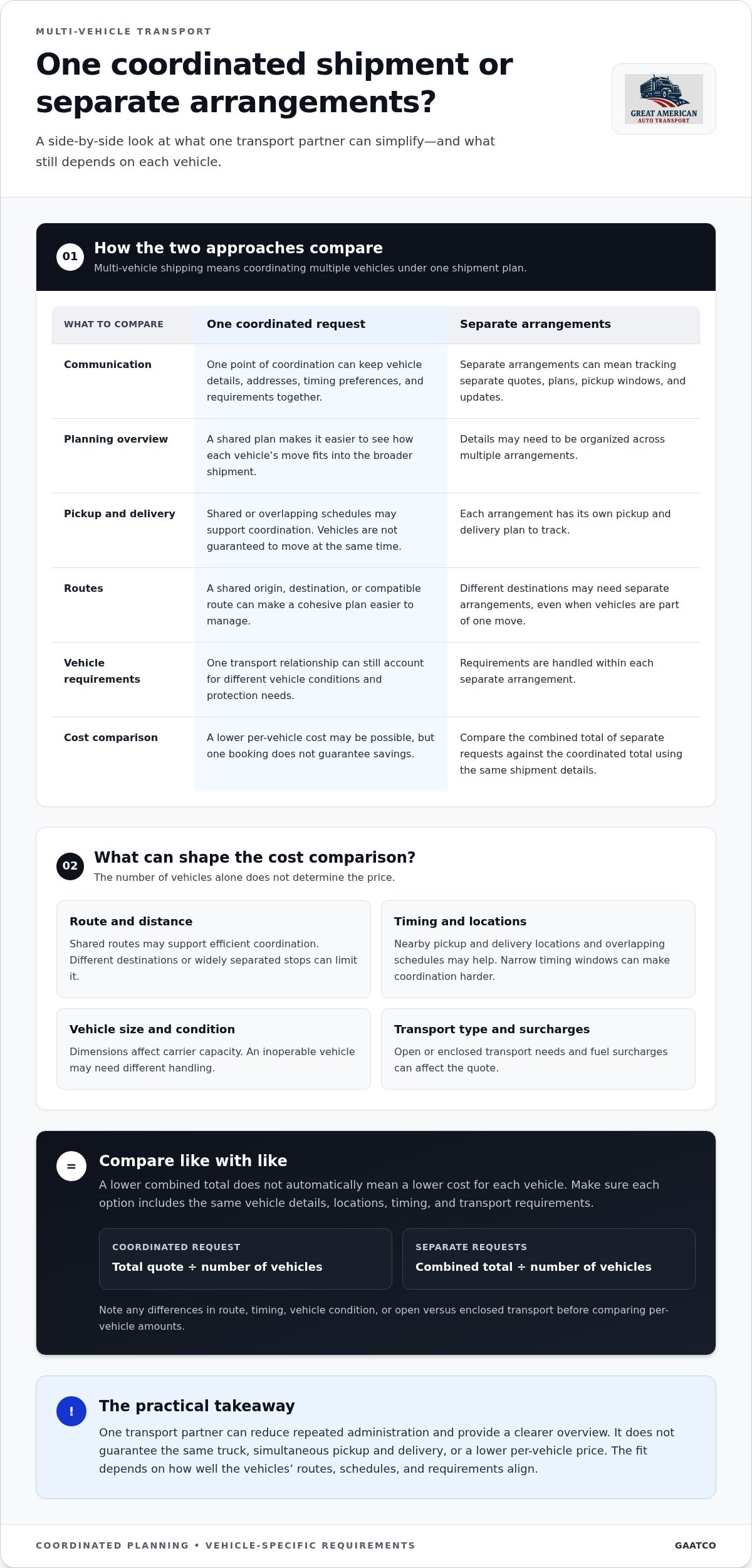
Coordinating several vehicle moves can mean tracking separate quotes, pickup windows, delivery plans, and updates. Using one transport partner brings those details into a shared plan. The benefits of using the same car shipper for multiple vehicles are mainly logistical: one point of coordination, a clearer overview, and simpler communication across the shipment.
Multi-vehicle shipping is the coordinated transport of multiple vehicles under one shipment plan. That plan can make scheduling and communication easier, but it does not guarantee that every vehicle will travel on the same truck or be picked up and delivered at the same time. A lower per-vehicle cost may be possible, but it depends on the route, timing, and requirements for each vehicle.
To see how several vehicles can be transported together, watch this overview of multi-car transport:
How one transport partner can simplify coordination
A shared point of contact can help keep vehicle details, addresses, timing preferences, and transport requirements organized in one place. Instead of repeating the same background across separate arrangements, you can provide the shipment details together and call out where individual vehicles differ. This cuts down on repeated administration and makes it easier to see how each move fits into the broader plan.
Simpler coordination does not mean guaranteed simultaneous service. Pickup and delivery timing still depends on each vehicle’s route and transport arrangements. A coordinated plan can give you a clearer overview without requiring every vehicle to move on an identical schedule.
When multiple vehicles are a natural fit
Several vehicles may be part of a household relocation or a dealership inventory transfer. Coordination can be especially useful when vehicles share an origin, destination, or overlapping schedule. Those common details can help shape a more cohesive plan. The closer the routes and timing align, the easier it may be to manage the shipment as one project.
Not every vehicle will have the same requirements. A standard vehicle may suit open transport, while a classic or high-value car may call for enclosed transport. An inoperable vehicle may also need different handling. One transport relationship can still support tailored arrangements when each vehicle’s condition and protection needs are clearly identified.
The practical advantage is greater oversight of the overall process, not a promise that every vehicle will follow an identical path. GAATCO coordinates open and enclosed vehicle transport across the United States for individual owners, dealerships, and military personnel, with arrangements shaped around vehicle requirements.
When Multi-Vehicle Shipping May Reduce Per-Vehicle Costs
Shipping several vehicles through one coordinated request may improve per-vehicle economics, but the number of vehicles alone does not determine the price. Mileage, vehicle size, fuel surcharges, transport type, and shipment details can all affect a quote. A route that accommodates multiple vehicles efficiently may create opportunities to coordinate. Separate routes or incompatible schedules can limit them.
Multi-vehicle savings depend on shipment-specific factors, not simply the number of vehicles booked. Compare the total for one coordinated request with the combined total of separate requests, then divide each total by the number of vehicles. This helps distinguish a lower overall amount from a lower cost per vehicle.
Shipment factors that influence the comparison
Distance and vehicle dimensions help shape transport arrangements. A larger vehicle may take up more carrier capacity, while cars traveling to different destinations may not fit neatly into the same route. Pickup locations, delivery points, and preferred timing matter as well. Nearby locations and overlapping schedules may support coordination, while widely separated stops or narrow timing windows can make it harder. Fuel surcharges may also affect pricing.
For broader context on multi-car transport options and industry practices, Forbes reviews considerations across the car-shipping market. For your own comparison, make sure each option reflects the same vehicle details, locations, timing, and transport requirements.
Why a lower total does not always mean a lower cost per vehicle
One combined quote may look more manageable than several individual totals, but the total alone does not show whether each vehicle costs less to ship. For example, the coordinated request could include a shared route for some vehicles and a separate arrangement for another. Each vehicle’s portion of the total may therefore differ.
Use a consistent comparison: list the vehicles and requirements included in each quote, note differences in route or timing, and calculate the per-vehicle amount. A fair comparison also accounts for distinct needs, such as enclosed rather than open transport. GAATCO tailors logistics to the shipment rather than applying a fixed multi-vehicle discount. To organize your vehicle details for a multi-vehicle transport quote, include each vehicle’s dimensions, condition, origin, destination, and timing preferences.
| Potential advantage | What may limit it |
|---|---|
| Shared route planning may support more efficient coordination. | Different destinations or pickup windows may require separate arrangements. |
| One request can present the shipment as a whole. | Vehicle size, condition, or transport protection needs may vary. |
| A coordinated plan may lower the per-vehicle amount. | Any savings depend on the complete shipment details, not booking size alone. |
One Car Shipper or Separate Providers: Which Approach Fits?
The right arrangement depends on how closely the vehicles’ routes, timing, and transport needs align. One shipper can provide centralized oversight for related moves, while separate plans may suit vehicles with substantially different logistics. The benefits of using the same car shipper for multiple vehicles are strongest when one coordinated relationship makes the overall shipment easier to manage without forcing every vehicle into the same schedule.
Advantages of coordinating multiple vehicles with one shipper
With one transport partner, shipment details and communication can stay within a single relationship. A household can manage several vehicle moves through one coordinated plan. A dealership coordinator can keep track of multiple units without organizing each move entirely independently. Shared planning may also make it easier to identify overlapping routes or timing preferences.
Centralized oversight does not mean identical transport. Vehicles may travel on different carriers or have distinct pickup and delivery windows, even when one shipper coordinates the arrangements. The value is a unified view of the project and a consistent point of communication, not a guarantee of simultaneous movement.
When separate plans may make more sense
Separate arrangements can be a better fit when vehicles have substantially different origins, destinations, pickup dates, or delivery requirements. For instance, two dealership vehicles headed to different regions on different timelines may have little route or scheduling overlap. A vehicle requiring enclosed transport or special handling may also need a plan distinct from standard open transport.
Compare the options across four practical points:
- Coordination: One shipper centralizes communication; separate arrangements may give each move independent oversight.
- Routes: Shared or nearby routes can support a coordinated plan; distant destinations may call for distinct arrangements.
- Timing: Compatible pickup and delivery windows make coordination more straightforward; conflicting dates can reduce the fit.
- Vehicle needs: Similar transport requirements are easier to plan together; different condition or protection needs may require tailored arrangements.
Operational fit and regulatory compliance are separate considerations. The Federal Motor Carrier Safety Administration (FMCSA) regulations provide authoritative information about the federal agency overseeing commercial motor vehicle safety. For the transport options GAATCO coordinates, review its vehicle transport services and consider how open or enclosed transport aligns with each vehicle’s requirements.
How to Plan a Multi-Vehicle Shipment Without Coordination Surprises
A clear shipment plan starts with complete, consistent information for every vehicle. Preparing the details before requesting a quote helps a transport partner assess the group while accounting for differences in condition, route, and timing. This is where the benefits of using the same car shipper for multiple vehicles become practical: accurate information makes coordination easier to organize.
Information to gather for every vehicle
Create a separate record for each vehicle, then assemble the records into one inventory. Include:
- Vehicle details: Make, model, approximate dimensions, and whether it is operable.
- Route: Full origin and destination details for that specific vehicle.
- Timing: Preferred pickup and delivery timing, including any flexibility.
- Transport requirements: Relevant condition details, special handling needs, and whether open or enclosed transport is preferred.
Be precise about differences. If one vehicle is inoperable or needs enclosed transport while the others are suited to open transport, note that in its individual record rather than treating the group as identical.
Align pickup, delivery, and communication expectations
Identify who can release each vehicle at pickup and receive it at delivery. Make sure each person has the relevant vehicle and location details, then decide who will serve as the primary contact for updates. Consistent information across the coordinated request helps prevent avoidable confusion if addresses or timing preferences change.
Next, review the routes and schedules together. For moves involving Atlanta, Miami, New York, Houston, Dallas, San Diego, San Francisco, Seattle, Orlando, Boston, Nashville, Denver, Austin, Chicago, Las Vegas, or Phoenix, list the city and the specific address for each vehicle. Shared locations or flexible timing may support coordination, but pickup and delivery arrangements depend on the shipment plan and locations. Set realistic preferred dates and communicate any constraints without assuming every vehicle will move on the same schedule.
- Inventory: Record each vehicle’s details and transport needs.
- Map the moves: Match every vehicle to its origin, destination, and timing requirements.
- Set responsibilities: Identify the people available to release and receive each vehicle.
- Review for consistency: Check addresses, condition information, and preferences before submitting the request.
Once the details are organized, request coordinated vehicle transport with the full inventory and route information. A well-prepared request gives the shipment a clearer starting point and makes it easier to account for each vehicle’s individual requirements.
How GAATCO Coordinates Transport for Multiple Vehicles
For a household relocation or dealership transfer, one coordinated relationship can bring vehicle details and route planning into a single process. GAATCO arranges customized transport across the United States and has more than 20 years of industry experience. Its approach is shaped around the shipment rather than a fixed multi-vehicle formula. This makes the benefits of using the same car shipper for multiple vehicles practical while recognizing that each vehicle may have distinct requirements.
Choosing a transport approach for different vehicle needs
Open transport is the primary option for standard vehicle relocation. Enclosed transport can be appropriate when a vehicle’s condition, value, or protection priorities call for additional shielding during transit. In a group shipment, transport choices do not need to be identical: one vehicle may suit open transport while another may warrant an enclosed arrangement. The right mix depends on the vehicles and the customer’s priorities.
Sharing these preferences at the outset helps shape a plan around the shipment as a whole. GAATCO coordinates both open and enclosed transport, allowing vehicle-specific needs to remain part of the planning rather than treating every car as interchangeable.
What to expect when arranging vehicles through GAATCO
For coordinated planning, provide details for each vehicle, including its make and model, condition, origin, destination, preferred timing, and any handling or protection requirements. Clear information helps distinguish shared logistics from individual needs. A common route or overlapping schedule may support coordination, but it does not guarantee that every vehicle will be assigned to the same carrier or move on the same schedule.
GAATCO provides door-to-door delivery solutions and works with licensed and insured carriers. Transparent pricing helps clarify the shipment’s cost considerations, while customized logistics account for differences across vehicles and locations. Pickup and delivery arrangements are planned around the route and shipment details, not assumed to be identical for the entire group.
Before arranging transport, gather the vehicle and location information so the full move can be considered in context. Explore multi-vehicle transport options to understand the available transport approaches, then discuss your vehicle shipment with GAATCO for assistance tailored to your vehicles and routes.
Make Your Multi-Vehicle Move Easier to Coordinate
The benefits of using the same car shipper for multiple vehicles often come down to clearer coordination: one relationship can bring route details, timing preferences, and vehicle requirements into a more unified plan. Any per-vehicle savings depend on how well the routes and schedules align, so compare the complete shipment details rather than assuming a discount.
Before arranging transport, prepare an inventory for each vehicle, including its condition, origin, destination, timing needs, and preferred level of protection. GAATCO brings more than 20 years of industry experience to customized vehicle logistics, with licensed and insured carriers and open, enclosed, and door-to-door transport options.
Whether you are planning a household move or dealership transfer, a well-organized request is a strong place to begin. Explore your multi-vehicle transport options and take the next step toward a plan tailored to your vehicles and routes. With the right details in hand, coordinating your shipment can feel more manageable.
Frequently Asked Questions
Is it cheaper to use the same car shipper for multiple vehicles?
It can be, but a lower per-vehicle cost is not guaranteed. The quote depends on factors such as mileage, vehicle size, fuel surcharges, route overlap, timing, and transport requirements. Compare the total for one coordinated request with the combined total of separate requests, making sure both options cover the same vehicles and services. Then divide each total by the number of vehicles to compare the per-vehicle amounts fairly.
Can multiple vehicles be shipped on the same carrier?
Yes, multiple vehicles may travel on the same carrier when the transport plan, route, timing, and carrier arrangements align. However, using one shipper does not guarantee that every vehicle will be assigned to the same truck or move at the same time. Share each vehicle’s origin, destination, condition, and timing preferences so the shipment can be planned with its individual requirements in view.
What are the benefits of using one car shipping company for several cars?
The benefits of using the same car shipper for multiple vehicles often include centralized communication and a clearer overview of the shipment. Instead of managing separate conversations and records for every car, you can organize vehicle details and route preferences through one transport relationship. This can be useful for household relocations and dealership transfers, though each vehicle may still need a distinct transport arrangement.
Do all vehicles need to travel on the same route to ship together?
No, every vehicle does not need an identical route, but routes that overlap may make coordinated planning more straightforward. If destinations differ, the separate stops and timing can be considered as part of the overall plan. Widely separated locations or incompatible schedules may limit the advantages of combining the request. Provide the origin and destination for each vehicle rather than assuming the group shares one route.
Can I ship different types of vehicles with the same car shipper?
Yes, one transport relationship can cover different vehicle types when each vehicle’s requirements are included in the plan. GAATCO transports cars, motorcycles, classic vehicles, dealer inventory, military vehicles, and inoperable vehicles. Handling and transport choices can vary by vehicle condition, size, and protection needs. Include accurate details for every vehicle so the arrangements can be tailored rather than treating the shipment as a uniform group.
How should I prepare multiple vehicles for transport?
Prepare an inventory with each vehicle’s make, model, approximate dimensions, operability, origin, destination, timing preferences, and transport needs. Identify who will release and receive each vehicle, and keep addresses and contact details consistent. For route planning, specify locations such as Atlanta, Miami, New York, Houston, Dallas, San Diego, San Francisco, Seattle, Orlando, Boston, Nashville, Denver, Austin, Chicago, Las Vegas, or Phoenix, as applicable.
Is open or enclosed transport better when shipping multiple vehicles?
The better choice depends on each vehicle’s condition, value, and protection priorities. Open transport is the primary option for standard vehicle relocation, while enclosed transport can suit vehicles for which additional protection is preferred, such as classic or high-value cars. A multi-vehicle shipment can include different transport choices for different vehicles. Share your preferences and vehicle details so the plan reflects each one’s requirements.


