

What determines whether a vehicle shipment is a business expense: the transport itself, or the reason the vehicle is moving? If you’re asking, “are car shipping costs tax deductible for a business,” the key issue is whether the vehicle’s move serves a genuine business purpose. Shipping a company vehicle to a worksite is different from transporting a personal car during a civilian job relocation, and mixed business and personal use can affect the tax analysis.
It’s reasonable to want a clear answer before recording the expense. In general, business-related shipping costs may warrant a tax deduction review, but eligibility depends on the facts and applicable tax rules. This guide outlines business scenarios to discuss with a tax professional, explains how personal moves differ, and covers the shipment, payment, and vehicle-use records to retain. These details matter especially when a vehicle has mixed business and personal use or an employer reimburses the cost.
We’ll also explain how to describe the shipment accurately in your records and coordinate transport as part of your operations. GAATCO arranges open and enclosed vehicle shipping, including door-to-door and dealer-to-dealer transport, to help businesses manage vehicle moves.
Key Takeaways
- Whether are car shipping costs tax deductible for a business depends on the shipment’s business purpose and the surrounding tax facts.
- Vehicle ownership, business use, and who paid for transport can shape the tax questions to discuss with a professional.
- Compare inventory moves, business-location transfers, mixed-use vehicles, and personal relocations before classifying a shipment.
- Keep shipment details, vehicle identification, invoice, payment evidence, origin, destination, and dates together for your records.
- Arrange transport around operational needs, then assess tax treatment separately with a qualified tax professional.
Are car shipping costs tax deductible for a business? Start with the business purpose
Car shipping costs may qualify for business tax treatment when the vehicle’s transport serves the business, but eligibility depends on the facts and how the expense is treated. The key questions are why the vehicle moved, how it is used, who owns it, and who paid for the shipment. A business invoice alone does not establish that the cost is deductible.
A shipment arranged to move dealership inventory or place a company vehicle at another operating location has a different purpose from transporting an owner’s personal car for convenience. In general, a potentially deductible business transport expense is a substantiated cost incurred to move a vehicle for a genuine business purpose, subject to applicable tax rules. That is a starting point for review, not a guarantee of deductibility. A general explanation of a tax deduction can provide background, but it does not determine how a specific shipment should be reported.
The video below illustrates the distinction between personal and business vehicle use.
What makes a vehicle shipment business-related?
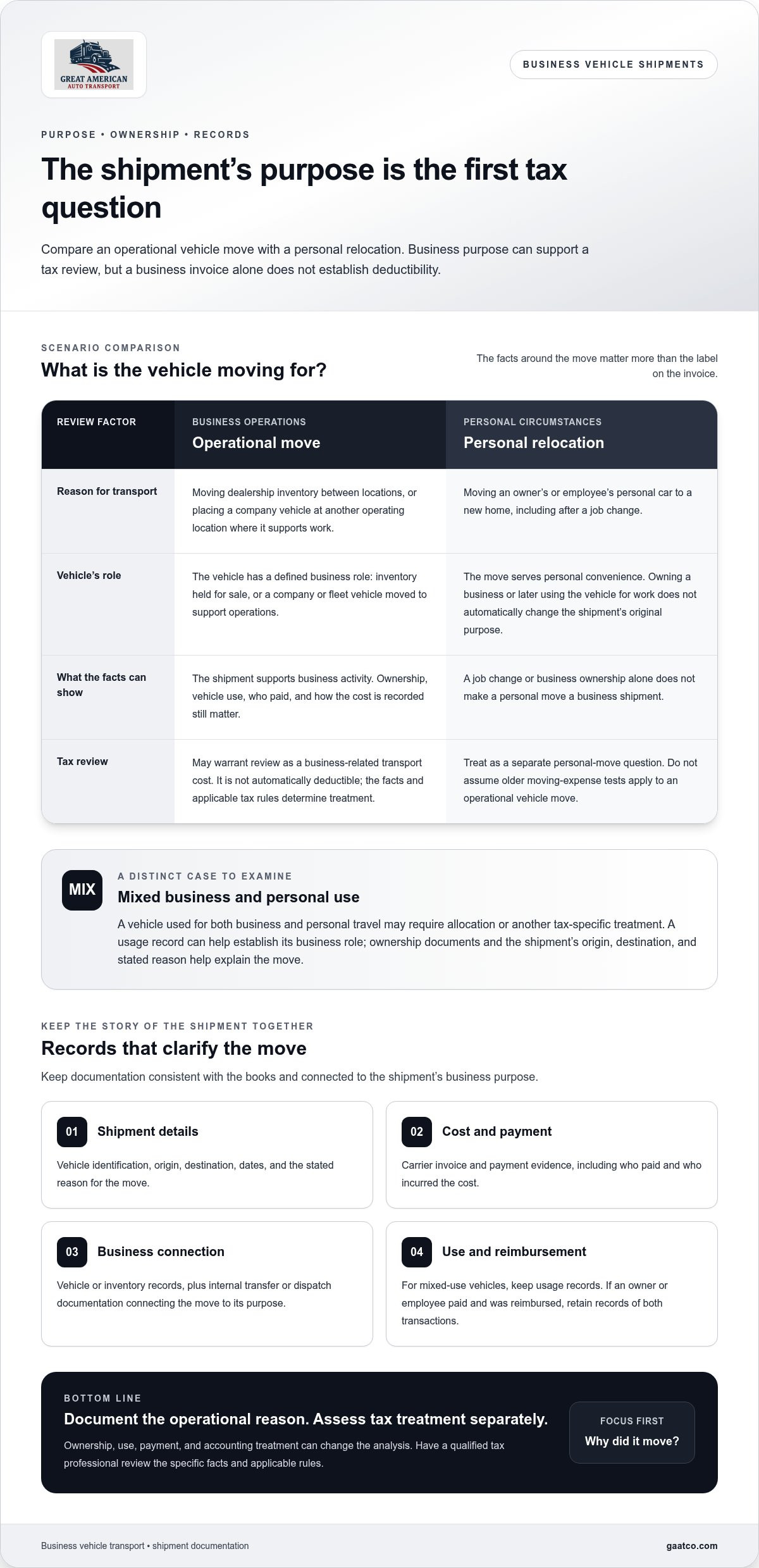
Consider a dealership transferring a vehicle between locations to support inventory operations, or a company moving a fleet vehicle to a branch where employees need it for work. In each case, the vehicle has a defined business role, and the shipment supports that role. By contrast, an owner shipping a personally used car to make a private trip easier does not turn the cost into a business expense simply because the owner also operates a company.
A vehicle’s role and the reason for its transport are related, but not interchangeable. A company-owned vehicle may still have personal use, while a personally owned vehicle may be used for work. The “ordinary and necessary” standard calls for a fact-specific tax review. Business purpose, ownership, use, and payment records help explain the circumstances.
Why personal relocation is a separate tax question
An employee or owner moving a personal vehicle to a new home is not automatically making a business shipment, even if the move follows a job change. Do not apply old distance, time, or moving-expense tests as universal rules for business transport. Those tests address different tax questions and may not fit an operational vehicle move.
For a 2026 filing, verify current federal and state treatment with a tax professional rather than assuming rules from earlier years still apply. The analysis may also differ if an employer reimburses the shipment or if the vehicle has mixed business and personal use. If you’re asking, “are car shipping costs tax deductible for a business,” document the operational reason for the move first, then have the tax treatment assessed separately.
How business use, ownership, and shipment purpose affect the tax analysis
To assess whether are car shipping costs tax deductible for a business applies to a particular move, look beyond the vehicle’s work use. The analysis can depend on who owns the vehicle, which taxpayer paid the carrier, whether the vehicle is inventory or a business asset, how it is used, and how the transport cost is recorded. Business use alone does not determine whether the cost is currently deductible, treated as part of an asset or inventory cost, allocated between business and personal use, or reported by the right taxpayer.
The payer and owner may not be the same. A company could arrange transport for a vehicle titled to an owner, or an employee could pay an invoice and later seek reimbursement. In either case, keep a clear record of who incurred the cost, why the shipment was authorized, and how any reimbursement was handled. The IRS Publication 334, Tax Guide for Small Business offers general federal tax guidance, but a tax professional should assess how its principles apply to the business’s circumstances and accounting method.
Business-owned vehicles, dealership inventory, and fleet moves
A company vehicle sent from one operating location to another may be moved to support business operations. A dealership moving a vehicle held for sale may instead be moving inventory. These are distinct situations, and neither makes a shipment automatically deductible. Tax treatment can depend on the transaction and accounting records. Keep documents connecting the move to its purpose, such as vehicle and inventory records, internal transfer or dispatch documentation, and the shipment invoice.
Compare these situations with a vehicle purchased personally and shipped to a new home. The owner’s business activity does not, by itself, turn a personal purchase or move into a business transaction. If the vehicle is later used for work, that use may matter to other aspects of the tax analysis, but it does not automatically change the original shipment’s purpose or treatment.
Mixed-use vehicles and owner-paid shipping
A vehicle used for both business and personal travel may require allocation or another tax-specific treatment. A usage record can help establish its business role, while ownership documents and the shipment’s origin, destination, and stated reason clarify the move. Keep these details consistent with the books rather than relying on a broad label such as “company car.”
If an owner pays the carrier directly and the business later reimburses the charge, record both the original payment and the reimbursement. Routing the payment through the business does not, by itself, settle its deductibility. Ask a tax professional how the entity’s structure, accounting method, vehicle ownership, and reimbursement policy affect reporting. These facts also help distinguish an operational move arranged by the company from an owner’s personal expense submitted for repayment.
Once you have established the business purpose and transport details, review the vehicle transport options for a move between U.S. locations. The transport arrangement documents the logistics; it does not determine the tax treatment.
Business shipment scenarios compared with personal car shipping
Similar transport arrangements can have different tax implications because the reason for the move, the vehicle’s role, and the supporting records differ. Shipping a car held for sale is not the same tax question as shipping an owner’s vehicle for personal convenience. The comparison below identifies situations for review, not automatic deductions or disallowances.
For each shipment, document its purpose and connect that explanation to relevant business, ownership, and payment records. IRS Publication 463, Travel, Gift, and Car Expenses provides federal guidance on car and travel expenses, but a tax professional can assess whether and how it applies to a specific shipping charge.
| Scenario | Purpose | Typical example | Key records | Tax-review question |
|---|---|---|---|---|
| Inventory transport | Move a vehicle held for sale | A dealership transfers a vehicle between locations | Inventory or sales records, transfer documentation, shipment invoice, payment evidence | How should the transport cost be treated in relation to the inventory and transaction? |
| Business-location transfer | Position a company vehicle for operations | A business sends a vehicle to another operating location | Ownership records, business-use information, transfer approval, origin and destination, invoice | Does the move relate to the business asset, and how should the cost be reported? |
| Mixed-use owner vehicle | Move a personally owned vehicle that also serves work purposes | An owner ships a car used for both business and personal travel | Ownership, business-use records, payment and reimbursement evidence, shipment details | Does the use or payment arrangement require allocation or another treatment? |
| Personal move | Transport a vehicle for private convenience | An individual ships a personal car to a new residence | Personal shipping invoice, payment evidence, move dates and locations | Is any separate current rule relevant to this personal expense? |
Which business shipping situations deserve closer review?
Inventory movement should be traceable to dealership records, while a company vehicle’s operational role and destination help explain its transfer. A personal car does not become business property simply because its owner has a business. If a shipment has both personal and business purposes, or involves unusual ownership or reimbursement, ask a tax professional how the details affect reporting.
Military relocation should be considered separately from ordinary business shipments, and any potentially relevant exception should be verified under current rules. State treatment may also differ, so confirm applicable federal and state guidance rather than assuming one conclusion applies everywhere.
Why shipping method does not decide deductibility
Open or enclosed transport describes how a vehicle is shipped, not whether the expense qualifies for a particular tax treatment. Record the selected method, any specialized handling, and any expedited service as shipment details. Do not assume a premium transport method changes deductibility without tax guidance supporting that conclusion.
In short, whether are car shipping costs tax deductible for a business depends on the facts behind the move, not the carrier type or service label. Keep logistics records clear, then review the tax treatment separately.
What records to keep for a business car shipment
A well-organized shipment file should show what moved, when and where it traveled, who paid, and how the move related to business operations. Build the file as the shipment progresses instead of trying to reconstruct its purpose at tax time. These records support a professional review, but do not establish deductibility on their own.
Create a shipment file that explains the business purpose
Use a consistent file for each vehicle move. Start with the business reason and connect it to transport documents and internal records. For example, a location-transfer file might include the internal request and destination assignment, while an inventory move might include records identifying the vehicle as stock held for sale.
- Document the request. Record who authorized or requested the shipment, the date, and the business need. Describe the purpose specifically, such as transferring a vehicle to an operating location, rather than using a general label like “business transport.”
- Identify the vehicle. Save details that distinguish it from other vehicles, such as the vehicle identification number, make, model, and relevant ownership or inventory information. Match these details across the shipment file and business records.
- Record the route and schedule. Keep the origin, destination, booking confirmation, and planned shipment dates. Add actual pickup and delivery dates when available, and retain delivery documentation connecting the vehicle to its destination.
- Retain the invoice and payment evidence. Save the transport invoice, receipt or other payment record, and any reimbursement documentation. If an employee or owner paid first, preserve evidence of both the initial payment and any repayment by the business.
- Reconcile the file to business activity. Link the shipment to supporting inventory, dispatch, location-transfer, or operational records. Confirm that the vehicle details, route, dates, stated purpose, and recorded payment are consistent.
Prepare the right questions for your tax professional
Bring the complete file to your tax professional and ask how the business entity, vehicle ownership, and accounting method affect reporting. Clarify how to handle owner- or employee-paid charges, reimbursements, personal use, and any business-use allocation. Ask which current IRS forms and state rules apply, and which records and retention periods are appropriate for your circumstances. Requirements depend on current rules and the transaction’s facts.
Clear logistics records support an informed tax review, while the tax conclusion remains a separate professional judgment. GAATCO’s vehicle transport quote form provides a way to outline shipment details; retain the resulting documents with your business records.
Arrange business vehicle shipping with clear records and a sound tax review
A well-coordinated business vehicle move starts with operational details: which vehicle needs to travel, where it must be picked up and delivered, and how the move fits the organization’s schedule. Record those details in the shipment file. They help your team coordinate the transfer and give your tax professional a clearer account of what happened, without implying a particular tax result.
GAATCO arranges vehicle transport across the United States, with open and enclosed carrier options, door-to-door delivery, and dealer-to-dealer transport. With over 20 years of industry experience and licensed and insured carriers, GAATCO helps coordinate vehicle moves around operational requirements. The transport service supports the movement of the vehicle; tax eligibility is a separate question.
Coordinate the shipment around business operations
Before arranging transport, gather the details that keep the move clear: vehicle identification, pickup and delivery locations, intended timing, and the operational reason for the transfer. For example, a dealer coordinating a vehicle between locations may have different handling needs from a business positioning a company vehicle at a branch. Make sure the shipment details are consistent with your internal transfer or inventory records.
Choose a transport arrangement suited to the move. Open or enclosed transport describes the carrier option, while door-to-door delivery and dealer-to-dealer transport support different pickup and delivery arrangements. Review GAATCO’s vehicle shipping services to compare the available transport options and consider which fits the shipment’s logistics.
Separate the transport decision from the tax decision
Arrange transport to meet the business’s vehicle-movement needs, then assess the expense separately. Keep the shipment file with related business documentation, including the reason for the move and records showing the vehicle’s ownership, operational role, or inventory status. Before filing, ask your tax professional how the specific facts should be treated under current federal and state rules.
The question “are car shipping costs tax deductible for a business” cannot be answered by the transport arrangement alone. A shipping method, booking record, or invoice does not promise a deduction; the tax analysis depends on the full circumstances. Keep logistics records accurate and let your tax professional determine the appropriate treatment.
If your business is planning a vehicle move, include the vehicle, pickup and delivery details, and preferred timing when you request a business shipping quote. GAATCO can help coordinate the transport details, while your tax professional advises on reporting.
Make your next vehicle move easier to manage
Turn each business vehicle shipment into a coordinated handoff between operations and accounting. Before arranging a move, decide who will approve it, who will retain supporting documents, and who will review its tax treatment. A consistent internal process helps your team explain the business reason for a shipment and avoid treating the transport booking itself as a tax conclusion.
If you’re still asking, “are car shipping costs tax deductible for a business,” bring the shipment details and your business’s circumstances to a tax professional before filing. The right assessment depends on the facts, while transport planning remains a practical operational decision.
When your team is ready to plan a move, share the vehicle and route details so the transport arrangements can be tailored to your needs. Request a vehicle shipping quote for your business, and move forward with a clear plan for logistics and recordkeeping.
Frequently Asked Questions
Can a business deduct shipping costs when it buys a vehicle online?
Possibly, but shipping tied to acquiring a vehicle may need to be treated as part of the vehicle’s cost rather than as a separate current expense. Whether are car shipping costs tax deductible for a business depends on the purchase, the vehicle’s intended use, and applicable accounting and tax rules. Keep the purchase agreement and transport charge together, and ask your tax professional how to record the acquisition.
Are expedited or enclosed car shipping charges treated differently for tax purposes?
The service method alone does not establish a different tax result. Document the business reason for selecting enclosed shipping for a high-value company vehicle or expedited delivery for an operational need. Retain an itemized invoice or booking details that distinguish the transport choices and charges, then ask your tax professional how those amounts should be classified based on your circumstances.
How should a business handle car shipping costs when a vehicle has mixed personal and business use?
Track the vehicle’s use and ask your tax professional whether the shipping charge should be allocated or handled another way. For example, a business owner might use a vehicle for client visits and personal errands, so a mileage or use log can help show the pattern. Keep the log consistent with the vehicle’s ownership and business records, and avoid claiming the full expense solely because the car sometimes serves work needs.
What if an owner pays the car shipping invoice personally and the business reimburses them?
Keep the original carrier invoice, proof of the owner’s payment, the reimbursement request, and evidence that the business paid the reimbursement. Record the reason for the shipment and who authorized it. Tax and bookkeeping treatment can depend on the business structure and reimbursement arrangement, so ask your tax professional how to report it. Do not record the same charge as both an owner expense and a separate business-paid expense.
Are car shipping costs deductible for a sole proprietorship, LLC, or corporation?
The entity name alone does not settle the answer. A sole proprietorship, an LLC, and a corporation can have different reporting arrangements, and an LLC’s tax classification can also affect how its activity is reported. Identify the vehicle’s legal owner, the taxpayer claiming the expense, and the account that paid the carrier. Then ask your tax professional how the entity’s federal tax treatment affects the specific shipment and supporting records.
Can a business deduct shipping a car to a trade show or temporary work location?
A shipment to a trade show or temporary work site may merit tax review if the vehicle is transported to support a defined business activity. Preserve the event registration or work assignment, the reason the vehicle was needed there, and records showing how it was used at the destination. Personal travel or unrelated use during the same period may affect the analysis, so discuss the full itinerary and vehicle use with your tax professional.
Do state tax rules treat business car shipping costs differently from federal rules?
They can, so confirm the rules for the states relevant to the business and its tax filings. A company coordinating vehicle moves involving Atlanta, Miami, New York, Houston, Dallas, San Diego, San Francisco, Seattle, Orlando, Boston, Nashville, Denver, Austin, Chicago, Las Vegas, or Phoenix should not assume the route itself determines tax treatment. Ask your tax professional which state rules apply to the business, vehicle, and transaction.


