Would you hand the keys to a high-value asset to a logistics provider without first verifying their operational pedigree? For many owners, the transition from a private garage to a transport carrier is fraught with concerns over insurance gaps and the common 72 hour ambiguity of delivery windows. Finding the right partner requires more than a cursory glance at a quote; it demands a rigorous inquiry into their specific protocols. We've curated the essential questions to ask a car shipping company to ensure your vehicle receives the professional precision it deserves in 2026.
We understand that your primary objective is a seamless, damage-free delivery backed by professional-grade insurance. It's a standard of excellence that shouldn't be negotiable. This guide provides a bespoke checklist to help you distinguish between mere brokers and dedicated carriers. You'll learn how to secure clear communication and ironclad protection for your journey. We're providing a 15 point framework designed to transform a complex logistical challenge into a managed, elite experience from pickup to final arrival.
Key Takeaways
- Learn to verify essential credentials, such as the U.S. Department of Transportation number, to clearly distinguish between logistics brokers and actual carriers.
- Master the vetting process by identifying the most critical questions to ask a car shipping company regarding logistical precision and bespoke transport methods.
- Discover how to recognize financial red flags and ensure a comprehensive understanding of all fees to maintain total transparency throughout the transaction.
- Understand the vital role of the Bill of Lading and the necessary documentation required to protect your asset during the door-to-door experience.
- Leverage two decades of industry expertise to secure a seamless, reliable solution tailored to the unique requirements of your vehicle.
Verifying Credentials: Are They Licensed and Insured?
The process of selecting a vehicle transport partner requires the same level of scrutiny one applies to private aviation logistics. Security and legitimacy are the cornerstones of a successful relocation, and the first step involves a rigorous audit of a provider's credentials. One of the most critical questions to ask a car shipping company involves their legal authority to operate within federal guidelines. This verification process ensures that your asset is handled by a professional entity rather than an unregistered operator.
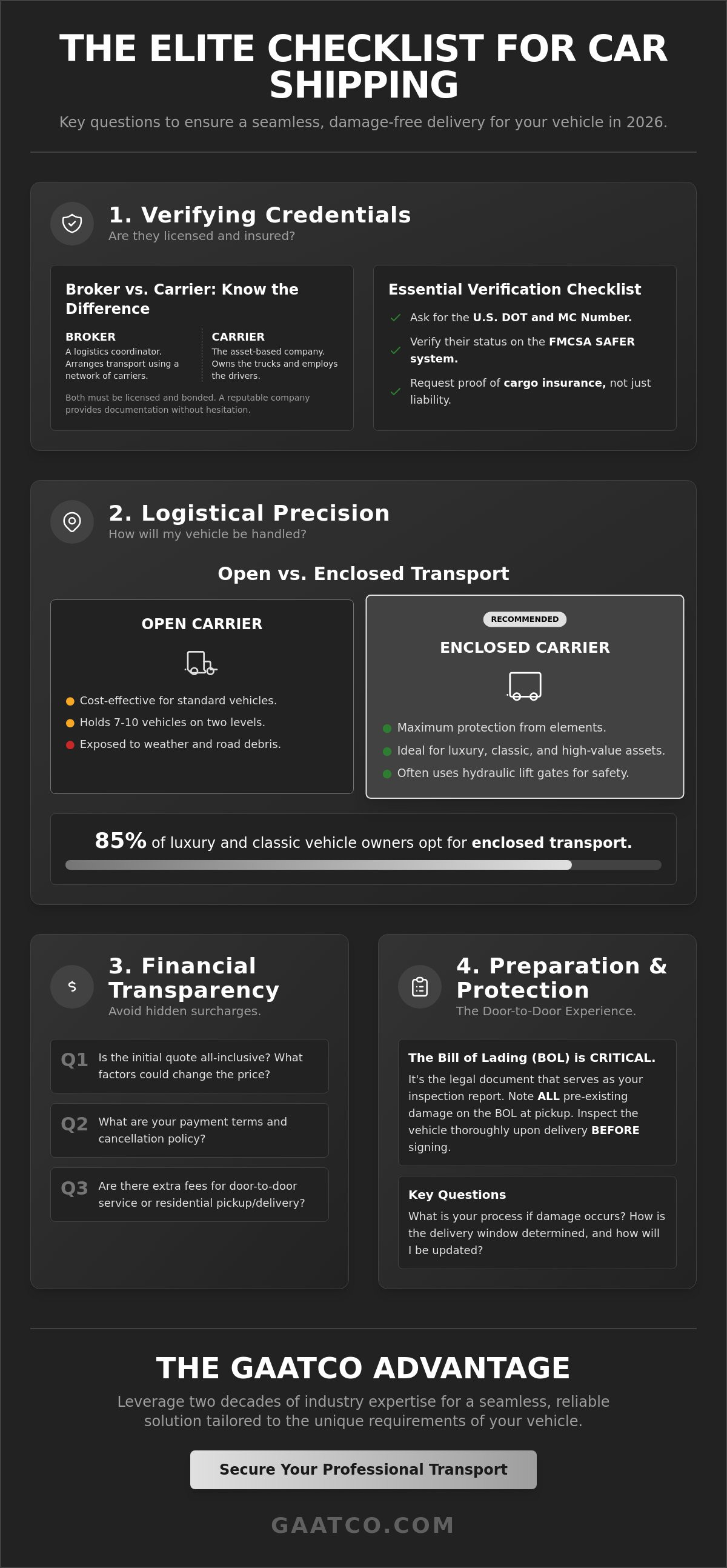
A sophisticated client must be capable of understanding the role of an auto transport broker compared to a direct carrier. A broker serves as a dedicated logistics coordinator, utilizing a global network to find the most efficient route, while a carrier owns the physical fleet. Both entities must maintain specific licensing and bonding requirements to operate legally. A reputable company will provide their insurance documents and operating authority upon request without hesitation, reflecting a culture of transparency and established expertise.
To better understand the fundamental requirements of this industry, watch this helpful video:
The DOT and MC Number Verification
The Federal Motor Carrier Safety Administration (FMCSA) maintains a public database known as the SAFER system, which tracks the safety performance of transport providers. The DOT number is the primary identifier for legal transport operations within the United States. You should use this number on the FMCSA website to verify that the company’s status is active. This portal allows you to review safety records and historical performance data from the past 24 months, providing a clear picture of their operational reliability.
Insurance Coverage Limits and Exclusions
Insurance remains a non-negotiable pillar of elite service, yet many clients overlook the distinction between basic liability and comprehensive cargo insurance. Basic liability typically covers damages caused by the carrier's negligence, while cargo insurance protects the vehicle itself against external factors. When considering questions to ask a car shipping company, inquire about the specific coverage for open versus enclosed transport. Enclosed transport offers a bespoke environment that shields vehicles from road debris, whereas open transport exposes the asset to the elements. You should also ask for a written summary of the claims process to ensure a seamless resolution if an incident occurs. Explore our licensed and insured transport services to see how we prioritize the safety of your cargo through rigorous standards.
Logistical Precision: How Will My Vehicle Be Handled?
The logistical framework of vehicle transport is as intricate as the machinery being moved. When evaluating providers, the most critical questions to ask a car shipping company center on the physical protection and movement of your asset. It's not merely about the destination; it's about the methodology employed to preserve the vehicle's integrity throughout the journey. A professional firm should provide a transparent overview of their equipment and personnel protocols.
Open vs. Enclosed Carrier Selection
Standard sedans often travel on open multi-car carriers. These units typically hold 7 to 10 vehicles on two levels. While efficient, they expose the exterior to environmental elements. Data from recent industry reports indicates that 85% of luxury and classic vehicle owners now opt for enclosed transport to mitigate risks from road debris and weather. You should ask if the company utilizes climate-controlled environments for long-haul routes. At GAATCO, we manage specialized handling protocols for high-value assets, ensuring that bespoke models are protected from the moment they are loaded. It's vital to confirm the use of hydraulic lift gates for low-clearance vehicles, as traditional ramps can cause significant undercarriage damage during the loading process.
Metropolitan Delivery Challenges
Navigating the 12-foot-wide lanes of Boston or the steep inclines of San Francisco requires exceptional precision. Large 80-foot carriers often face legal and physical restrictions in these dense urban centers. One of the essential questions to ask a car shipping company is how they navigate the "final mile" in high-density areas. If a multi-car carrier cannot reach your specific address, the company must have a contingency plan. We often utilize local flatbed trucks or secure regional hubs to facilitate a seamless final delivery. This prevents the logistical friction common in terminal-to-terminal models where vehicles might sit in unsecured lots for 48 hours or longer. Choosing tailored transport services ensures that your delivery is handled with the same care in a busy city as it is on an open highway.
Reliability stems from consistent communication. A dedicated point of contact provides real-time updates and manages the complexities of the transit period on your behalf. This eliminates the uncertainty of automated tracking systems. It's the difference between a standard service and a professional partnership. Your advisor should be able to provide the driver's direct contact information and a precise window for arrival, typically within a 4-hour range. This level of detail reflects a commitment to safety and excellence that is non-negotiable for high-stakes logistics.
Financial Transparency: Avoiding Hidden Surcharges
A quote that appears significantly lower than the industry average often serves as a tactical bait and switch. In the logistics sector, operational costs for fuel and labor remain relatively fixed. If a provider offers a rate 25% lower than established competitors, they're likely excluding essential costs that will appear later as "service fees" or "priority handling." This discrepancy is one of the most vital questions to ask a car shipping company before signing any agreement. A professional partner provides a comprehensive breakdown that reflects the true cost of secure, bespoke transport.
Sophisticated clients understand that a verbal agreement holds little weight without a corresponding written contract. The final document must mirror the initial digital quote precisely. Any ambiguity regarding the total price suggests a lack of operational integrity. Reliable firms utilize non-binding estimates only as a starting point, quickly moving to a fixed-rate contract that protects your capital and your vehicle. We believe that clarity is the foundation of a premium service experience.
Deconstructing the Quote
A transparent quote accounts for every variable of the journey. This includes state taxes, bridge tolls, and comprehensive insurance coverage. In 2025, fuel surcharges fluctuated by as much as 12% in a single quarter; your quote should specify if the price is locked or subject to these market shifts. For those with strict timelines, ask about expedited fees. These costs ensure your vehicle receives priority placement on a dedicated carrier. You may request a transparent auto transport quote to see how a professional logistics breakdown should be structured.
Payment Terms and Deposit Policies
Reliability is built on trust, not large upfront demands. You should be wary of any entity requiring 100% payment before the vehicle is even loaded. Standard industry practice involves a modest deposit only after a carrier is officially assigned, with the remaining balance paid upon successful delivery. This structure ensures the service provider remains committed to your specific timeline and safety requirements. Using a credit card or a secure payment platform provides an additional layer of consumer protection that wire transfers or cash apps simply don't offer. It's a hallmark of a seasoned expert to prioritize the client's financial security throughout the entire transport process.
Preparation and Protection: The Door-to-Door Experience
Transporting a high-value asset requires more than a simple booking; it demands a structured approach to documentation and physical readiness. When researching questions to ask a car shipping company, the owner should focus on the transition from their private residence to the carrier's deck. This phase defines the liability structure for the entire journey. Before the vehicle is loaded, owners must provide a valid vehicle registration, proof of insurance, and a photo ID. For 2026 international exports or specific interstate transfers, a notarized letter from the lienholder may also be required if the vehicle isn't owned outright.
Specialized logistics often involve unique challenges. Inoperable vehicles require a winch and specific loading equipment, which adds a layer of complexity to the scheduling. For military personnel, a Permanent Change of Station (PCS) move involves strict adherence to the Defense Personal Property System (DPS) guidelines. Owners should verify that the carrier is familiar with Form 1797 and the specific requirements for 2026 military transit protocols to ensure a seamless reimbursement process.
The Inspection and Bill of Lading
The inspection process is the most critical moment of the transport cycle. We recommend photographing your vehicle in bright, indirect sunlight to capture the surface detail without harsh glares. Take high-resolution images of all four corners, the roof, and the interior dashboard. If you identify existing wear, you must note it clearly on the official transport document. The Bill of Lading serves as the legal receipt of your vehicle’s condition. It's the primary evidence used by insurance adjusters if a claim arises during transit. Ensure the driver signs this document before the vehicle departs your sight.
Preparing for Major City Deliveries
Logistics in metropolitan hubs like Houston, Dallas, or Miami present unique hurdles. High-traffic volumes and narrow residential streets in these cities often prevent large multi-car carriers from reaching your front door. You might need to coordinate a meeting at a nearby plaza or wide-access parking lot. To meet safety and weight standards set by the Department of Transportation, follow these steps:
- Clean the vehicle: A clean exterior allows for an accurate inspection.
- Remove personal items: The 2024 FMCSA guidelines strictly limit personal belongings in transported vehicles to prevent weight violations.
- Check fluid levels: Ensure there are no active leaks that could damage other vehicles on the trailer.
- Fuel levels: Keep the tank at approximately one-quarter capacity to reduce weight while allowing for loading maneuvers.
- Tire pressure: Maintain standard PSI to ensure the vehicle remains stable during the winching or driving process.
A disciplined approach to these details ensures that the vehicle remains protected and the transport remains on schedule. It's this level of attention that separates standard shipping from a premium logistics experience. If you're ready to secure your vehicle's journey with a team of seasoned experts, you can explore our comprehensive transport services to find a solution tailored to your specific needs.
The GAATCO Advantage: Why Experience Matters
GAATCO has spent 20 years refining the art of vehicle logistics. Since our founding in 2006, we've focused on delivering bespoke shipping solutions that prioritize the safety of your asset above all else. While many individuals focus on the initial questions to ask a car shipping company, the true value lies in the established expertise of the provider handling the transition. Our history in high-stakes aviation transport informs every aspect of our automotive division, bringing a level of precision that is rare in the standard shipping industry.
We manage a diverse portfolio of transport requirements. This includes the delicate relocation of luxury vehicles for private collectors and the high-volume movement of inventory for automotive dealerships. Our team understands the specific protocols required for military personnel during relocation, ensuring that every detail aligns with strict timing and safety standards. We don't view vehicles as simple units of freight. We see them as significant investments that require a dedicated, human-centric approach to logistics. To ensure your move is successful, we provide a final checklist of why we remain the trusted choice:
- Proven Longevity: Two decades of operational experience in complex global and national logistics.
- Vetted Security: A 100% compliance rate with Department of Transportation safety standards across our carrier network.
- Tailored Service: Custom transport plans for high-value assets, including enclosed trailers and climate-controlled options.
- Professional Accountability: A dedicated point of contact who manages the nuances of your shipment from start to finish.
A Legacy of Professionalism
Our operational success is built upon a national network of licensed and rigorously vetted carriers. We maintain a strict 100% compliance rate with federal safety ratings to ensure every partner meets our internal benchmarks for excellence. This commitment allows us to offer a sense of "quiet luxury" in our customer service. We handle the logistical complexities and regulatory paperwork so you don't have to manage the stress of the move. You can learn more about the GAATCO story and see how our background in specialized transport creates a superior experience for every client.
Next Steps for Your Vehicle Transport
Your journey begins with a professional consultation where we assess your specific timeline and requirements. This is a strategic partnership designed to mitigate risk and ensure a seamless delivery from origin to destination. When you consider the final questions to ask a car shipping company, the most important factor is whether they have the infrastructure to support your needs in 2026. Trust your vehicle to the experts in national auto logistics by initiating a conversation with our team today. GAATCO treats every vehicle as a priority, not just cargo.
Securing Your Vehicle's Future with Professional Oversight
Choosing a logistical partner requires more than a cursory search; it demands a rigorous evaluation of operational standards. By prioritizing financial transparency and verifying licensed credentials, you ensure your asset remains protected throughout its journey. Mastering the essential questions to ask a car shipping company allows you to navigate the complexities of 2026 logistics with absolute certainty and poise.
GAATCO brings over 20 years of industry-leading expertise to every transport, providing a seamless bridge between complex requirements and flawless execution. We utilize a network of fully licensed and insured carriers to provide total peace of mind for our most discerning clients. Whether you require specialized solutions for luxury, classic, or military vehicles, our team maintains a meticulous focus on detail that defines the modern gold standard of auto transport. You deserve a partner who handles the complexities of transit so you don't have to. We invite you to experience a service where reliability and elegance intersect.
Request Your Bespoke Auto Transport Quote Today
Frequently Asked Questions
How do I check if a car shipping company is legitimate?
You verify a firm's legitimacy by requesting their USDOT number and checking it against the FMCSA Safety and Fitness Electronic Records system. A valid carrier must possess active operating authority and a minimum of $750,000 in public liability insurance. This verification process is one of the most critical questions to ask a car shipping company to ensure your asset's safety. Our team recommends confirming these credentials before signing any service agreement.
What is the difference between a broker and a carrier in auto transport?
A broker serves as a sophisticated logistics intermediary that identifies the best route and carrier, while a carrier is the entity that owns the physical fleet. Data from the Transportation Intermediaries Association indicates that brokers facilitate approximately 90% of all vehicle shipments in the United States. They provide a seamless bridge between clients and a vast network of vetted drivers. This dual-layered system ensures flexibility and reliability for complex transport needs.
Does my personal car insurance cover my vehicle during shipping?
Your personal insurance policy might provide secondary coverage, but the carrier's cargo insurance acts as the primary protection during transit. Most reputable carriers maintain cargo insurance limits between $100,000 and $250,000 to protect high-value assets. It's essential to review your policy's off-premises coverage clauses. This step ensures a comprehensive safety net is in place before the vehicle leaves your possession.
What should I do if my car is damaged during transport?
You must document any new damage on the Bill of Lading immediately upon delivery before the driver departs. The Carmack Amendment, a 1906 federal law, governs these claims and requires clear documentation for successful resolution. Take high-resolution photographs of the vehicle at both the origin and destination. This evidence supports a bespoke claims process if the vehicle's condition has changed during its journey.
How long does it typically take to ship a car cross-country?
Shipping a vehicle across the United States typically spans a duration of 7 to 10 calendar days. Federal safety regulations limit drivers to 11 hours of operation within a 14-hour period, which dictates the pace of the journey. A 2,800 mile trip from coast to coast requires precise logistics and rest stops to maintain safety standards. We ensure every timeline is communicated with transparency to respect your scheduling requirements.
Can I ship personal items inside my car?
Carriers generally prohibit the inclusion of personal items because federal law restricts them from transporting household goods without specific licensing. The FMCSA strictly regulates weight limits for transport trailers to ensure road safety. Some providers allow up to 100 pounds of soft items in the trunk, but these aren't covered by the carrier's insurance. It's safer to keep your vehicle empty to ensure a seamless inspection process.
What happens if I need to ship an inoperable vehicle?
Transporting an inoperable vehicle requires a trailer equipped with a winch or a specialized loading ramp. Since the vehicle cannot move under its own power, the driver must manually secure it, which adds complexity to the logistics. Industry data shows that roughly 12% of transport orders involve non-running cars. We recommend disclosing the vehicle's condition early so we can provide a tailored, bespoke solution with the correct equipment.
Are there discounts available for military vehicle shipping?
Military personnel often qualify for specialized pricing during PCS moves to alleviate the stress of relocation. These discounts are a standard offering among top-tier logistics firms as a gesture of appreciation for service. While amounts vary, many providers offer a reduction of $50 to $100 per vehicle. It's one of the practical questions to ask a car shipping company when you're coordinating a professional military transition.


