The difference between a seamless transport experience and a costly legal dispute often rests on a single sheet of paper. You likely understand that moving a high-value asset requires more than just a trailer; it requires absolute precision and documented proof of condition. When you ask what is a car shipping bill of lading (BOL), you're seeking more than a simple definition. You're looking for the definitive legal shield that transforms a transport service into a secured logistical event.
It's common to feel a sense of anxiety regarding potential undocumented damage or the complexities of industry jargon. We agree that your vehicle represents a significant investment, and the paperwork surrounding its movement shouldn't be a barrier to your peace of mind. This guide will empower you to master this essential document, ensuring your vehicle is protected and your insurance coverage remains indisputable throughout the journey. We'll examine the legal weight of the BOL in 2026, including the global shift toward electronic records and the critical inspection steps you must take at both pickup and delivery.
Key Takeaways
- Recognize the Bill of Lading as the definitive legal contract of carriage, serving as both a formal receipt and the foundational document for professional accountability.
- Understand exactly what is a car shipping bill of lading (BOL) to ensure your vehicle's condition is recorded with the meticulous detail required for valid insurance protection.
- Implement a disciplined inspection protocol at both origin and destination to safeguard your investment through precise, documented observations.
- Learn to navigate the legal implications of the delivery signature, protecting your right to recourse by avoiding the pitfalls of an undocumented "silent" delivery.
- Gain insights into how sophisticated digital documentation enhances the security of specialized logistics, from classic car transport to door-to-door shipping.
Defining the Bill of Lading (BOL) in Vehicle Logistics
In the sophisticated world of vehicle transport, clarity is the ultimate luxury. Understanding what is a car shipping bill of lading (BOL) serves as your first step toward a secured move. This document acts as the sovereign contract of carriage between the shipper and GAATCO, establishing the legal framework for every mile traveled. While a Bill of lading has historic roots in maritime trade, its role in modern auto transport is more critical than ever. It functions as the definitive proof of the agreement between you and the carrier, ensuring that all expectations are documented with absolute precision.
As of 2026, the industry has fully embraced digital solutions. Electronic Bills of Lading (eBLs) now provide real-time transparency, yet they retain the exact same legal weight as their paper predecessors. This digital evolution ensures that every detail, from the moment our carrier takes possession of your vehicle to the final delivery, is recorded with unalterable precision. It's the primary evidence used by insurance adjusters and legal professionals to resolve any potential liability concerns. Without this document, your ability to file a valid claim for damages is significantly compromised.
To visualize how this document functions within the transport process, please view this brief overview:
The Triple Role of a Professional BOL
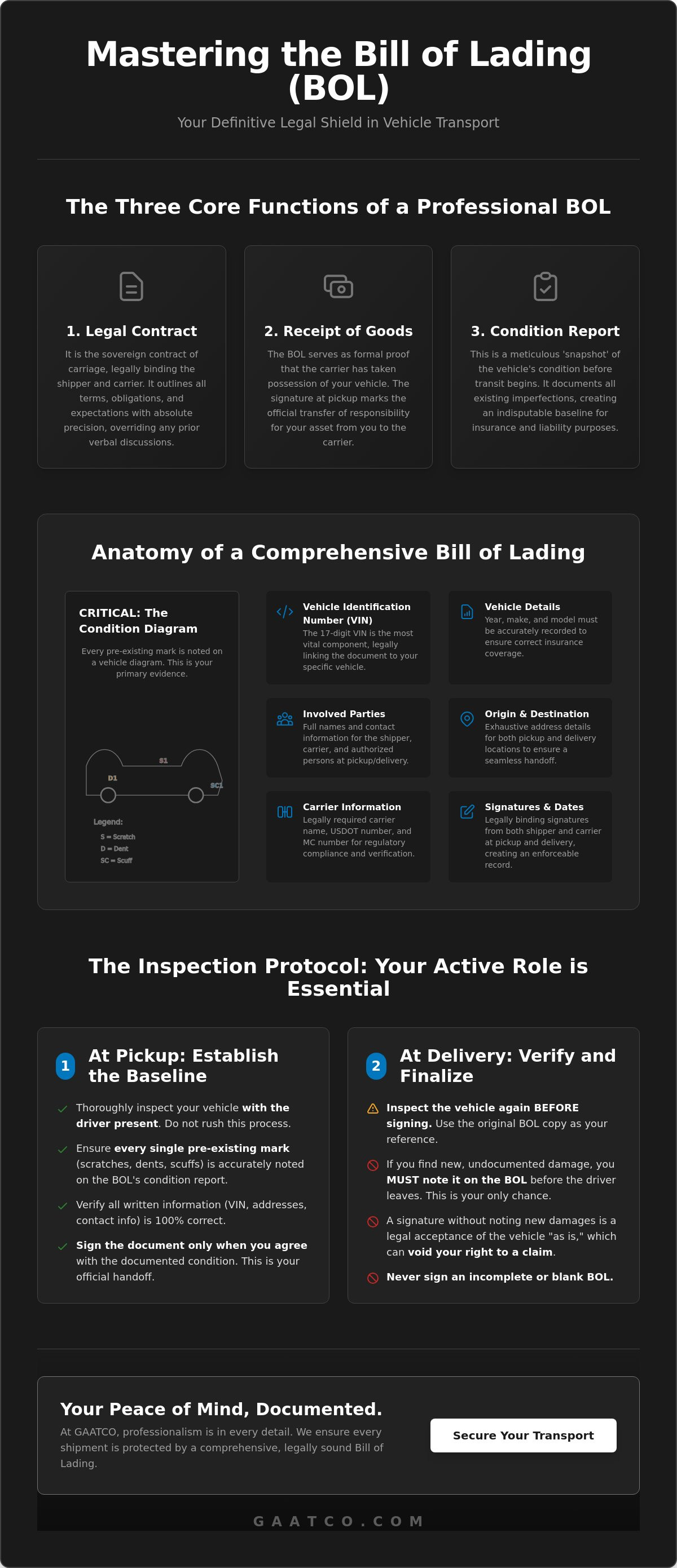
A properly executed BOL fulfills three distinct logistical requirements. First, it's a formal legal contract. It outlines the specific terms of service and the transport obligations we've committed to fulfill. Second, it's a receipt of goods. This confirms the precise moment when the physical responsibility for your asset shifts from your hands to our care. Finally, it's a condition report. This section provides a meticulous 'snapshot' of the vehicle’s state before transit. By documenting existing details, we create a baseline that protects both the shipper and the carrier from disputes regarding the vehicle's integrity during its journey.
Why a Verbal Agreement is Never Sufficient
Relying on a handshake or a phone conversation is a risk no collector or corporate professional should take. Written documentation is a non-negotiable requirement for Federal Motor Carrier Safety Administration (FMCSA) compliance. Following the regulatory updates of October 1, 2026, where the USDOT number became the sole identifier for all carriers, the BOL has become even more vital for verifying carrier legitimacy. Informal promises made during the booking process don't hold weight in a legal setting. The BOL overrides any verbal assurances; it ensures that the shipper, the broker, and the carrier are perfectly aligned on every shipment detail. It's the only way to guarantee that the high standards of safety and reliability you expect are legally enforceable.
The Anatomy of a Comprehensive Bill of Lading
To truly understand what is a car shipping bill of lading (BOL), one must look past the header and analyze the granular data points that constitute its anatomy. It isn't just a list of names; it's a meticulously constructed record designed to protect your asset. A professional BOL acts as a blueprint for the entire logistical event, capturing every detail from the vehicle's mechanical state to the specific terms of its journey.
The core of the document rests on accurate identification. This includes the year, make, and model, but the most vital component is the 17-digit Vehicle Identification Number (VIN). Federal law requires that motor carriers maintain specific records for every shipment, ensuring that the vehicle on the trailer matches the vehicle on the insurance policy. Any discrepancy here can lead to significant delays or the denial of a claim should an incident occur during transit.
Origin and destination details must be exhaustive. This includes contact information for all authorized parties at both ends of the journey to ensure a seamless handoff. Whether you've selected Open Car Transport or a more discreet enclosed option, the transport method should be clearly specified. This ensures that the operational flow aligns with the service level you've commissioned and that the carrier is equipped with the necessary tools for your specific vehicle type.
Vehicle Identification and Shipment Logistics
Verifying the VIN is a non-negotiable step in our professional process. It ensures the correct vehicle is tracked and insured throughout the transit. We also document specific mileage at both the pickup and delivery points to provide a transparent record of the car's stationary status during transport. For those shipping classic or inoperable vehicles, the BOL serves as the primary location to record special handling instructions, ensuring our team treats your vehicle with the specialized care it requires from the moment it's loaded.
Condition Codes and Notations
The condition diagram is a visual map of your vehicle's exterior used to mark existing imperfections. Professionals use standard industry shorthand: 'S' for scratches, 'D' for dents, and 'CH' for chips. It's essential that the vehicle is clean at the time of pickup; a layer of road grime can obscure minor blemishes, leading to potential disputes later. We also meticulously document aftermarket modifications or loose parts, such as custom spoilers or removable tops, to maintain a comprehensive inventory of the vehicle's configuration. If you have questions about specific requirements for your high-value asset, you may request a personalized quote to discuss your logistical needs with our advisors.
The Meticulous Inspection Process: A Step-by-Step Guide
The inspection process is the active realization of your vehicle's protection. Understanding what is a car shipping bill of lading (BOL) requires more than recognizing its fields; it demands your presence and precision during the handoff. In 2026, the transition to digital Bill of Lading systems has streamlined this process, allowing for the seamless integration of high-resolution photo documentation directly into the electronic record. This creates an immutable trail of evidence that safeguards your investment from the first mile to the last. Adhering to Federal Bill of Lading Requirements ensures that the legal protections afforded by the Department of Transportation are fully engaged, providing a foundation of accountability for every shipment.
We advise conducting a thorough walk-around with the driver during daylight hours or under intense artificial light. You shouldn't rush this moment. Compare the driver’s notations on the digital BOL with your own observations. If a scratch or chip is present, ensure it's marked with the correct industry code. Only when you're completely satisfied with the accuracy of the report should you provide your digital signature. This signature confirms that the 'snapshot' taken at pickup is an exact representation of the vehicle's state before it enters our custody.
The Pickup Inspection: Establishing the Baseline
Preparation begins before the carrier arrives. We recommend cleaning the vehicle thoroughly to reveal all surface details; road grime can easily mask minor imperfections that need to be documented. Ensure the driver records the current operational status, particularly for Inoperable Vehicle Transport, as this affects the handling protocols and equipment used. It's a professional best practice to include a single sentence in the comments section confirming that the vehicle was inspected in the presence of both the carrier and the shipper. This small detail reinforces the legal weight of the document in the event of a future dispute.
The Delivery Inspection: Confirming a Successful Arrival
The moment of offloading requires the same level of discipline as the initial pickup. You must re-inspect the vehicle immediately, before the driver departs the scene. Pay close attention to the undercarriage and the roof. These areas are often overlooked but are particularly vulnerable on multi-car open trailers. If the vehicle arrives at night or during inclement weather, don't feel pressured to sign a clean BOL. In these instances, note on the document that the inspection was limited by poor visibility or weather conditions. This notation preserves your right to report damage discovered once the vehicle is dry and viewed in proper light, ensuring your insurance coverage remains valid and your asset remains protected.
Legal Safeguards and Insurance Claims
The Bill of Lading is your most potent legal asset once the transport vehicle departs. While previous sections detailed its role as a receipt, its primary function during a dispute is to serve as an indisputable record for insurance adjusters. Understanding what is a car shipping bill of lading (BOL) in a legal context prevents you from falling into the trap of a 'silent' delivery. This occurs when a shipper signs the document at delivery without noting damage, effectively waiving their right to future claims. In the eyes of an adjuster, a signature on a clean BOL confirms that the vehicle arrived in the exact condition it was received at the origin.
Insurance premiums for carriers continue to rise in 2026, largely due to the increased valuation of electric vehicles and luxury assets. Consequently, adjusters are more meticulous than ever when reviewing claims. They rely on the BOL as the foundational 'source of truth' to determine when and where damage occurred. Beyond damage, the document protects you from billing discrepancies. Any unauthorized surcharges or deviations from the agreed-upon price can be challenged using the BOL, as it contains the official terms of the carriage agreement.
Navigating Damage Disputes with Documentation
If you discover an imperfection during the delivery inspection, you must 'note' it directly on the BOL before the driver leaves. Be specific; rather than writing 'damage on door,' specify 'three-inch scratch on driver-side door panel.' These written notations must be supplemented by clear, timestamped photos. While the BOL is the primary legal record, digital imagery provides the visual context adjusters require to process a claim quickly. Most professional transport agreements require you to file a formal claim within a specific window, often 15 to 30 days, after signing the document under protest.
Carrier Liability and the BOL
The reverse side of the BOL contains the legal terms and conditions that define carrier liability. It's vital to distinguish between carrier negligence and 'Acts of God.' While negligence is covered by the carrier's cargo insurance, events like hail or floods are often excluded under standard transport terms. A properly executed BOL ensures that GAATCO's licensed and insured carriers are held to a rigorous standard of accountability. We recommend keeping a digital copy of your signed BOL for at least one year. This ensures you have the necessary documentation for tax purposes or in case a latent mechanical issue arises that can be traced back to the transport event. For a transport experience backed by professional documentation, view our full suite of specialized services.
The GAATCO Commitment: Professionalism in Every Detail
Precision is the hallmark of our approach to vehicle transport. While this guide has detailed the technicalities of what is a car shipping bill of lading (BOL), the execution of these standards requires a partner with established expertise. Our 20-year legacy is built on meticulous attention to logistical documentation; we understand that for our clients, a vehicle is often more than a machine. It's a significant investment that demands a disciplined, transparent chain of custody. By integrating sophisticated digital systems with a human-centric focus on detail, we ensure that every vehicle in our care is shielded by the highest standards of logistical accountability.
We utilize advanced digital BOL systems to provide real-time transparency and security for every shipment. This technology allows us to capture high-resolution imagery and precise condition notations that are instantly accessible to all authorized parties. Our specialists don't just hand you a document to sign; they guide you through the entire inspection process to ensure total peace of mind. Whether we're managing a single classic car transport or a complex dealer-to-dealer relocation, our documentation standards remain elite and non-negotiable.
Sophisticated Logistics for Discerning Clients
GAATCO manages complex door-to-door deliveries with a level of precision that reflects our deep industry roots. We understand that the nuances of a Bill of Lading can be daunting, which is why our advisors serve as a bridge between your needs and the operational realities of the road. From military vehicle shipping to the specialized handling required for inoperable units, we ensure every detail is captured. GAATCO views the BOL as a promise of quality delivered, acting as a discreet and dependable partner throughout the transit. Our collective team of professionals operates behind a sophisticated infrastructure to ensure your logistical experience is seamless and secure.
Secure Your Shipment with GAATCO
Initiating your transport with GAATCO is a straightforward, transparent process designed for the corporate and affluent traveler. You'll have direct access to professional support for any questions regarding your shipment's paperwork or the specific legal weight of your digital records. We invite you to request a customized transport quote to experience our authoritative service and commitment to safety. By choosing a partner who prioritizes the integrity of the Bill of Lading, you're ensuring that your vehicle is protected by a unified team of experts dedicated to operational excellence. Let our seasoned advisors handle the complexities of your next move so you don't have to.
Securing Your Automotive Legacy through Precise Documentation
Mastering the intricacies of the transport process ensures your vehicle remains protected from pickup to final arrival. We've explored the legal weight of the condition report and the necessity of a disciplined inspection protocol. Understanding what is a car shipping bill of lading (BOL) empowers you to act as your own best advocate, transforming a standard logistical task into a secured event. By adhering to these professional standards, you eliminate the risks associated with undocumented damage and ensure your insurance coverage remains indisputable.
GAATCO brings over 20 years of industry expertise to every shipment, utilizing a licensed and insured carrier network that specializes in high-value and classic vehicle transport. Our team handles the complexities of documentation so you don't have to, providing a discreet partnership built on reliability and safety. We invite you to Request a Sophisticated Auto Transport Quote from GAATCO to begin your journey with total confidence. Your vehicle's safety is our non-negotiable pillar; we look forward to delivering the peace of mind you deserve.
Frequently Asked Questions
Can I ship personal items in my car, and will they be on the BOL?
You may pack up to 100 lbs of personal belongings within the trunk of your vehicle, but these items are not covered by the carrier's cargo insurance. Because the Bill of Lading is a vehicle-specific contract of carriage, these personal effects typically won't be listed on the document. We recommend removing all valuables prior to pickup, as the carrier assumes no liability for items not integral to the vehicle itself.
What should I do if the driver refuses to wait for a thorough inspection?
You should decline to sign the document and contact your GAATCO advisor immediately. A professional driver understands that the inspection is a legal requirement for both parties to establish the vehicle's baseline condition. Signing a document without a proper walk-around waives your right to document existing or new damage, which compromises your protection. Our specialists ensure that every carrier in our network respects the time needed for a meticulous review.
Is a digital Bill of Lading as legally binding as a paper one?
A digital Bill of Lading carries the same legal weight as a traditional paper original in 2026. Regulators and trading nations have updated their legal frameworks to recognize electronic records as legally binding equivalents. This digital shift allows you to easily access and verify what is a car shipping bill of lading (BOL) while ensuring a permanent, unalterable record of your vehicle's condition is stored securely in the cloud for your future reference.
What happens if I find damage after the driver has already left?
Discovering damage after the carrier has departed makes the claims process significantly more difficult. Insurance adjusters rely on the delivery BOL as the final word on the vehicle's condition at the time of handoff. If you sign a clean document and find damage later, the burden of proof falls entirely on you to show the damage occurred during transit. This is why we emphasize the importance of a high-resolution photo record at delivery.
Who is responsible for signing the BOL if I am not present at pickup?
An authorized representative, such as a family member, neighbor, or dealer, may sign the document on your behalf. This individual must be at least 18 years old and capable of performing a detailed inspection alongside the driver. It's vital that your representative understands the importance of the condition report, as their signature is legally binding and dictates the carrier's liability for the remainder of the journey.
Does the BOL include the final price of the transport?
The Bill of Lading typically includes the total cost of the transport service, any remaining balance due upon delivery, and the accepted payment methods. It serves as the official financial receipt for the transaction between the shipper and the carrier. By reviewing these figures before signing, you ensure that the price aligns perfectly with your original quote and that there are no unauthorized surcharges or hidden fees added during transit.
Can the carrier change the terms of the BOL after I have signed it?
No, the carrier cannot unilaterally alter the terms of the Bill of Lading once it has been signed by both parties. As a binding legal contract, any modifications to the transport method, route, or price would require a formal addendum or the issuance of a new document. This stability provides you with the reassurance that the high standards of safety and professionalism agreed upon at the start of the journey remain in effect until delivery.
What is the difference between a BOL and a shipping order?
A shipping order is the initial booking request that outlines your intent to ship, while the Bill of Lading is the finalized legal contract and receipt of goods. The shipping order contains your preferences for services like enclosed car transport or door-to-door shipping, but it doesn't establish the carrier's legal possession. The BOL is only issued once the carrier physically takes the vehicle, serving as the definitive record of the entire logistical event.


