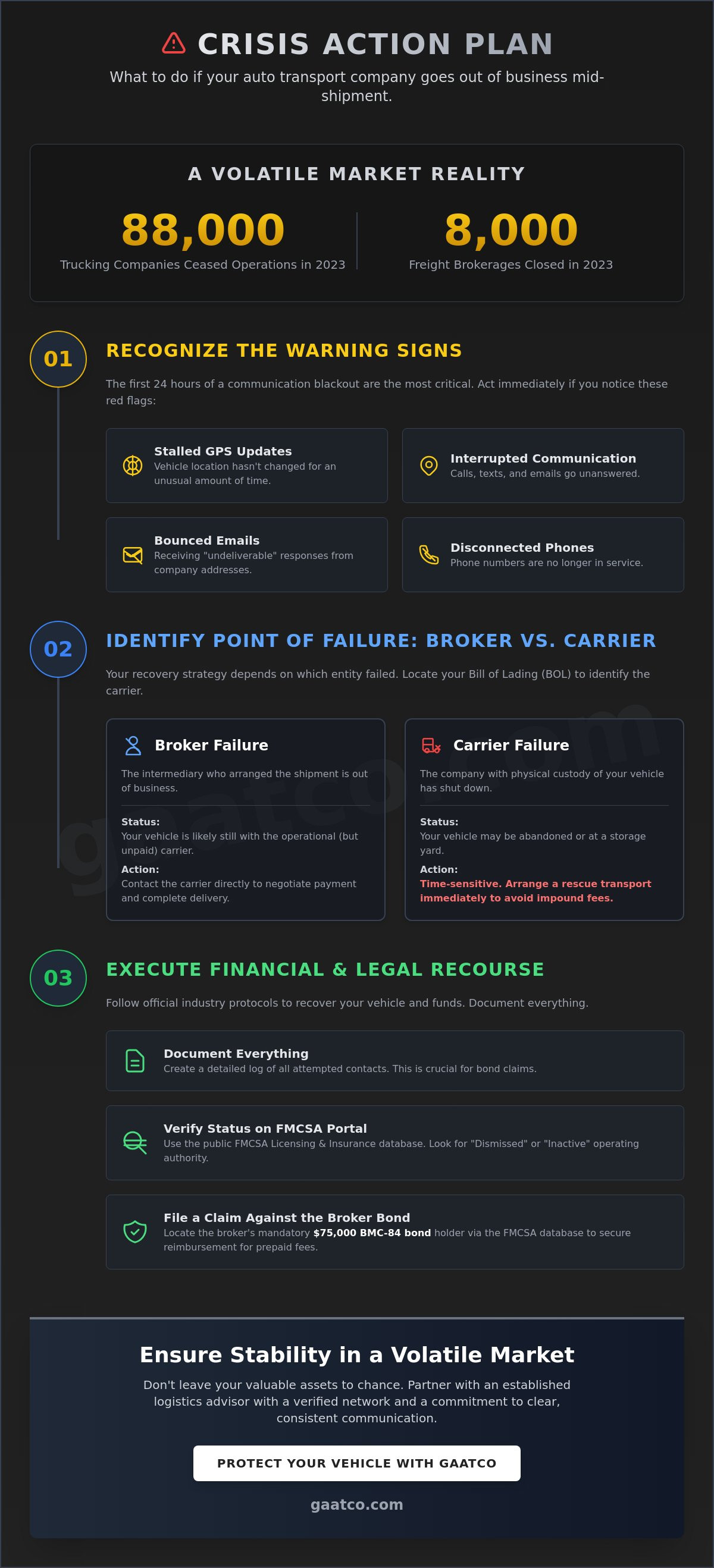
In 2023, nearly 88,000 trucking companies and 8,000 freight brokerages ceased operations, highlighting a volatile shift in the global logistics landscape. While you expect a seamless delivery for your vehicle, the reality of a 25% drop in long-haul demand during the first half of 2025 has left many providers financially vulnerable. It's an understandably distressing situation to ask, what if my auto transport company goes out of business mid-shipment, especially when your high-value assets are already in transit. We recognize that in these moments, clarity and decisive action are your most valuable tools.
This guide serves as a professional resource for recovering your vehicle and securing your financial interests through established industry protocols. You'll learn the precise steps to locate your property, file a claim against the mandatory $75,000 broker bond under the FMCSA's strict January 16, 2026 regulations, and coordinate a bespoke rescue transport. By understanding these technical details, you can transform a logistical crisis into a controlled, successful recovery that prioritizes the safety and integrity of your investment.
Key Takeaways
- Identify the subtle indicators of insolvency, such as interrupted communication or stalled GPS updates, to initiate a recovery plan before a total operational shutdown occurs.
- Learn the specific professional protocols for what if my auto transport company goes out of business mid-shipment by distinguishing between a broker's financial failure and the carrier's physical custody.
- It's vital to utilize the FMCSA public database to identify the $75,000 BMC-84 bond holder and secure financial reimbursement for your prepaid logistics fees.
- Navigate the complexities of carrier negotiations to resolve payment disputes and ensure the seamless release of your assets from a defunct provider's network.
- Discover how partnering with an established logistics advisor provides the stability and verified network required to protect your vehicle in a volatile market.
The Crisis of Mid-Shipment Insolvency: Recognizing the Signs
Mid-shipment insolvency represents a significant logistical failure where a service provider ceases all operations while a client's vehicle is actively in transit. This is not merely a delay; it's a total cessation of the professional obligation to deliver your asset. With nearly 88,000 trucking companies failing in 2023 and another 10,000 closing in the first half of 2024, the risk is a documented reality in the current market. When you're forced to ask, "what if my auto transport company goes out of business mid-shipment," you're dealing with a high-stakes scenario that requires immediate, calculated action. The first 24 hours of a communication blackout are the most critical for locating your vehicle before it becomes entangled in bankruptcy proceedings or legal impounds.
To better understand the common pitfalls in this industry, watch this helpful video:
Distinguishing Between Delays and Business Failure
It's vital to separate legitimate logistical hurdles from a permanent business failure. A 25% drop in long-haul truckload demand in early 2025 has created a volatile environment where some companies simply "ghost" clients when they can't meet financial obligations. You can verify a company's current standing by visiting the FMCSA Licensing and Insurance portal. If their operating authority shows as "Dismissed" or "Inactive," you're likely facing a business cessation. Understanding the role of an auto transport broker is essential here; if the broker fails, the carrier holding your car may still be operational but unpaid. Monitoring industry forums can also reveal if other clients are experiencing identical "red flags" like bounced emails or disconnected phone lines.
Initial Steps to Establish Contact
If you suspect your provider has shuttered, begin documenting every attempted interaction immediately. This log is indispensable for future bond claims or legal recovery efforts. Reach out to every secondary contact provided during your initial booking, including dispatchers or secondary office lines. It's also prudent to contact the original pickup location; drivers often mention logistical issues or company "chatter" during the loading process that could provide a lead on the vehicle's current location. At GAATCO, we prioritize stability through our premium transport services, ensuring that our clients are never left wondering about the status of their high-value assets. Clear, consistent communication is the hallmark of a secure logistics partnership, and its absence is the loudest warning sign of impending insolvency.
Locating Your Vehicle: Broker vs. Carrier Failure
Identifying the specific point of failure within the logistics chain is the first step in a successful recovery strategy. In the auto transport industry, a clear hierarchy exists between the entity that arranges the shipment and the one that performs the physical move. Your primary contract is typically with a broker, who acts as a professional intermediary. However, the physical custody of your vehicle rests with a motor carrier. Understanding the nuances of what if my auto transport company goes out of business mid-shipment requires a precise evaluation of which party has ceased operations, as each scenario demands a different tactical response.
If the broker fails while the carrier is still in transit, your vehicle is likely still moving toward its destination. This is often the more manageable scenario, though it requires immediate financial coordination. The carrier is a separate business entity and may not even be aware of the broker's insolvency until they attempt to collect payment. Conversely, if the carrier fails, your vehicle might be left on an abandoned trailer or at a regional storage yard. In this instance, time is of the essence to prevent the vehicle from being moved to a secondary impound lot where recovery fees can accumulate daily.
The Broker-Carrier Connection
Your most powerful tool for locating your asset is the Bill of Lading (BOL). This document serves as the official "Carrier of Record" and must contain the carrier's legal name and USDOT number. While some brokers may be hesitant to share carrier details during the booking phase to protect their proprietary networks, they are legally required to provide this information once the vehicle is dispatched. If a broker becomes unresponsive, you should immediately check the FMCSA database to verify the status of their mandatory surety bond (Form BMC-84) or Trust Fund Agreement (Form BMC-85). This public record often lists the insurance provider or bond holder who can facilitate contact with the carrier in the event of a broker's total collapse.
Tracking Down the Physical Trailer
Once you have identified the carrier, you can begin the process of tracking the physical trailer. Most interstate carriers utilize Electronic Logging Devices (ELDs) that provide real-time location data to their dispatchers. If the carrier’s main office is unresponsive, contacting regional dispatchers in major transportation hubs like Atlanta, Houston, or Chicago can provide sightings of the specific truck number listed on your BOL. It's also prudent to verify if the vehicle has been offloaded at a terminal or a tow yard. For those who require absolute certainty in their logistics, partnering with a provider that offers bespoke logistics services ensures that you have a dedicated advocate managing every detail of the transit process, from pickup to final delivery. This level of oversight is the most effective safeguard against the chaos of a mid-shipment business failure.
Financial and Legal Recourse: Bonds and Insurance
Securing your financial interests requires an immediate transition from logistical tracking to regulatory recourse. If you're currently facing the uncertainty of what if my auto transport company goes out of business mid-shipment, the Federal Motor Carrier Safety Administration (FMCSA) provides a specific financial safety net. Every licensed broker must maintain a $75,000 surety bond (BMC-84) or trust fund (BMC-85). This bond exists specifically to protect shippers and carriers from financial loss due to a broker's failure to fulfill their contractual obligations. While credit card chargebacks offer a rapid solution for recovering initial deposits, the bond is the primary path for recovering larger sums or unpaid balances owed to the carrier.
Understanding the regulatory environment is essential for a successful claim. Recent FMCSA regulations on carrier shutdowns have strengthened the authority to suspend entities that fail to meet their financial responsibilities. As of January 16, 2026, these rules are strictly enforced, requiring brokers to replenish their bonds within seven calendar days if the balance dips below the $75,000 threshold. This proactive oversight aims to reduce the number of undercapitalized entities operating in the market. Utilizing bespoke logistics services from the outset is the most effective way to avoid these undercapitalized providers.
Filing a Claim Against the Broker Bond
To initiate a recovery, you must first identify the surety provider through the FMCSA public Licensing and Insurance database. The average claim against a broker's bond is approximately $1,900, but data shows that nearly 20% of insolvency cases involve total claims that exceed the $75,000 limit. To ensure your claim is prioritized, you should prepare a comprehensive documentation package including:
- A signed copy of the original transport contract and Bill of Lading.
- Proof of all payments made, such as bank statements or credit card receipts.
- A formal notice of insolvency or documented evidence of the company’s failure to communicate.
Insurance Implications for Your Vehicle
While the broker's bond covers financial disputes, the carrier’s Motor Truck Cargo Insurance is what protects the physical vehicle. Most open carriers maintain between $100,000 and $250,000 in coverage. It's critical to verify that this policy remains active even if the carrier’s parent company is facing insolvency. You may encounter a "hostage" situation where a carrier demands direct payment because the defunct broker failed to pay them. Legally, you're often obligated to pay the carrier for their services to secure your vehicle's release, but you can then add this amount to your bond claim against the broker to minimize your total financial exposure.
The Recovery Process: Securing Your Vehicles Release
Physical recovery of your asset is the most pressing objective once insolvency is confirmed. When you're forced to manage the fallout of what if my auto transport company goes out of business mid-shipment, you must shift your focus toward the motor carrier who holds the physical keys. This stage requires a delicate balance of firm negotiation and professional diplomacy. It's a common misconception that local law enforcement can simply seize the vehicle on your behalf; most police departments view these situations as civil property disputes. Unless there's clear evidence of criminal intent, your resolution will likely come through direct negotiation with the carrier rather than a badge.
The legality of "double payment" often surfaces during these negotiations. While you've likely already paid a deposit or the full fee to a defunct broker, the carrier may not have received a single dollar for their fuel and labor. To minimize your financial exposure, you can negotiate a direct payment to the carrier in exchange for an immediate release. This payment should be documented as a settlement for the specific transport leg completed. While it feels like an additional burden, it's often the fastest way to prevent your vehicle from being offloaded at an insecure terminal or held indefinitely in a legal limbo.
Negotiating with the Carrier of Record
It's helpful to remember that the carrier is often a victim of the broker's failure as well. They're business owners facing their own financial losses. When establishing contact, propose a formal release agreement that protects you from future claims by the defunct broker's estate. Before the vehicle is offloaded from the original trailer, perform a comprehensive inspection. Verify the condition matches the original Bill of Lading to ensure no damage occurred during the period of uncertainty. If you require professional assistance in managing these complex handovers, you can request a consultation for a managed recovery solution.
Arranging Emergency Logistics
Securing a "Rescue Transport" is the final step in a successful recovery. This involves coordinating a seamless trailer-to-trailer transfer at a secure, neutral location. Vetting the new carrier is paramount to avoid a second failure; you should verify their safety rating and active cargo insurance through the FMCSA portal. Ensure that the new insurance policy is active and specifically covers the remaining transit leg before the vehicle is loaded. At GAATCO, we specialize in providing seamless logistics solutions for high-value assets, ensuring that your vehicle's journey is completed with the professionalism and security you originally expected.
Ensuring Long-Term Stability with GAATCO
The current freight market volatility necessitates a partner whose foundation is built on decades of operational excellence. With over 20 years of industry experience, GAATCO provides the stability required to navigate a landscape where nearly 88,000 trucking companies failed in 2023 alone. We understand that for our clients, a vehicle is more than just cargo; it's a significant asset that requires meticulous care. Choosing a provider with a proven history of resilience eliminates the harrowing question of what if my auto transport company goes out of business mid-shipment before the journey even begins. Our commitment to transparent logistics ensures that every phase of the transport process is governed by rigorous safety standards and financial accountability.
Working with an established, licensed, and insured partner is the only definitive way to mitigate the risks discussed in previous sections. While the industry saw a 25% drop in long-haul demand in early 2025, our operations remained steady due to our diversified service lines and conservative financial management. We bridge the gap between complex operational realities and your personal peace of mind. By utilizing sophisticated logistics frameworks usually reserved for private aviation, we provide a level of oversight that smaller, undercapitalized brokers simply cannot match. This authoritative approach ensures your vehicle remains in safe hands, regardless of broader market fluctuations.
The Stability of a Dedicated Network
Our ability to provide a seamless experience stems from a meticulous vetting process that goes far beyond standard FMCSA requirements. We maintain a dedicated network of carriers for both open and enclosed transport; each carrier must pass our proprietary safety and reliability audits. This internal oversight prevents the "ghosting" scenarios that often precede a company's total collapse. We prioritize real-time communication protocols, ensuring that you are never left without a clear status update on your vehicle's location. You can explore our professional transport services to see how we tailor our logistics to meet the specific needs of high-value asset relocation.
Securing Your Next Shipment
In a market defined by fluctuating fuel prices and rising insurance premiums, "cheap" quotes are frequently a harbinger of business instability. These low-cost providers often lack the $1,000,000 liability coverage or the robust $75,000 bond protections that are non-negotiable pillars of our service. At GAATCO, we apply the same precision required for medical evacuations and cargo flight-level logistics to our road transport operations. This ensures that your assets are protected by a partner who understands the nuances of global reach and local expertise. We invite you to request a transparent, reliable quote from GAATCO to experience the confidence that comes from working with a seasoned industry expert.
Securing Your Assets in a Volatile Market
Navigating the complexities of mid-route insolvency requires a blend of regulatory knowledge and swift action. By distinguishing between the broker's financial status and the carrier's physical custody, you gain the leverage needed to secure your vehicle's release. Utilizing the $75,000 bond through the FMCSA provides a documented path for financial recovery, while professional rescue logistics ensure your asset reaches its final destination. It's clear that the best defense against the question of what if my auto transport company goes out of business mid-shipment is a partnership with a proven industry leader.
GAATCO has provided premium transport solutions for over 20 years, remaining licensed and bonded since 2004. Our expertise in both open and enclosed transport ensures your vehicle is handled with the same level of care and sophistication we bring to private aviation logistics. You deserve a partner that offers transparency and unwavering reliability in any market condition. Secure your vehicle with a stable, professional partner—get a GAATCO quote today. Your peace of mind is our priority, and we're here to ensure your vehicle's journey remains seamless and secure.
Frequently Asked Questions
Can I sue an auto transport company that went out of business?
You can legally pursue a defunct company through civil court, but the likelihood of financial recovery is typically low. When a business ceases operations, its remaining assets are usually liquidated to satisfy secured creditors first. Shippers often find themselves at the bottom of the priority list during bankruptcy proceedings. Legal fees can quickly exceed the value of the original shipment, making a claim against the broker's mandatory $75,000 surety bond a much more efficient path for recovery.
Will my personal car insurance cover my vehicle if the carrier fails?
Most standard personal auto insurance policies do not provide coverage for vehicles while they are in the custody of a commercial carrier. Coverage usually resumes only once the vehicle is delivered and back in your physical possession. You should review your specific policy for "gap" coverage or transit riders. In the event of a carrier failure, you must rely on the carrier's Motor Truck Cargo Insurance, which industry standards suggest should provide between $100,000 and $250,000 in coverage.
What is a BMC-84 bond and how does it help me?
A BMC-84 is a $75,000 surety bond that the FMCSA requires all freight brokers to maintain to ensure financial responsibility. If you are wondering what if my auto transport company goes out of business mid-shipment, this bond is your primary mechanism for securing a refund. It acts as a professional guarantee that the broker will fulfill their financial obligations to both shippers and carriers. Claims are filed directly with the surety provider listed in the FMCSA's public database.
Can a carrier legally hold my car hostage for payment?
Carriers cannot legally hold a vehicle "hostage" for unrelated debts, but they do possess a legal right to a "carrier's lien" for the specific cost of your transport. If a defunct broker failed to pay the driver, the carrier may refuse to offload the vehicle until they receive payment for their labor and fuel. Resolving this usually involves paying the carrier directly and then seeking reimbursement through the broker's bond. This prevents the vehicle from being moved to an expensive third-party impound lot.
How do I find out which carrier physically has my car?
The most reliable way to identify your carrier is by examining the Bill of Lading (BOL) provided during the initial pickup. This document is required by law to contain the carrier's legal business name and their unique USDOT number. If the broker has become unresponsive, you can search the FMCSA's Licensing and Insurance system using the broker's MC number. These public records often list the insurance providers who can facilitate contact with the carrier currently holding your asset.
Is it possible to get a refund from a defunct broker?
Obtaining a refund from a defunct broker is possible through a credit card chargeback or a formal claim against their surety bond. If you paid your deposit via credit card, you should initiate a dispute immediately for "service not rendered." For payments made through other methods, you must file a claim with the bond holder. Industry data indicates that 20% of bond claims exceed the $75,000 limit, so filing your paperwork early is essential for a successful recovery.
What should I do if my car is stuck at a terminal and the company is gone?
If your vehicle is stuck at a terminal because the original transport company failed, you must immediately contact the terminal manager to verify the vehicle's status. You will likely need to pay any accumulated storage fees to secure the vehicle's release from the facility. Once you have physical control, you can arrange a rescue transport with an established provider like GAATCO. This ensures your vehicle's journey is completed by a stable partner who understands the urgency of what if my auto transport company goes out of business mid-shipment.
How can I check if an auto transport company is financially stable?
You can evaluate a company's stability by reviewing their "Operating Authority" status on the FMCSA's SAFER website. Look for a history of continuous insurance coverage and a valid BMC-84 bond without recent cancellations. A company that has been licensed and bonded since 2004, such as GAATCO, demonstrates the long-term financial resilience necessary to survive market volatility. Avoid providers with frequent gaps in their insurance history or those that lack a verifiable physical headquarters.


