
If you believe that a premium transport contract guarantees a fixed arrival date, you're mistaking a logistical projection for a certainty. Securing a bespoke contingency plan for a delayed car shipment is not a sign of pessimism; it's the hallmark of a sophisticated traveler who understands that 2026 road logistics are subject to complex variables. With early 2026 price increases of up to 22% on major routes and new driver medical certification requirements that took effect on January 10, the landscape of vehicle transport requires a more rigorous approach to reliability than ever before.
We understand that a lack of communication or the sudden need for a rental vehicle can disrupt your professional and personal commitments. This guide promises to transform your approach to transport delays by providing a structured checklist that protects your schedule and peace of mind. You'll gain a clear protocol for handling disruptions, a deeper understanding of carrier insurance guarantees, and the confidence to choose a partner committed to absolute transparency. We'll examine how to maintain your mobility while navigating the shifting financial responsibility requirements for brokers established on January 16, 2026.
Key Takeaways
- Identify the primary logistical disruptors of 2026, including DOT compliance and mechanical variables, to better anticipate deviations from your estimated delivery window.
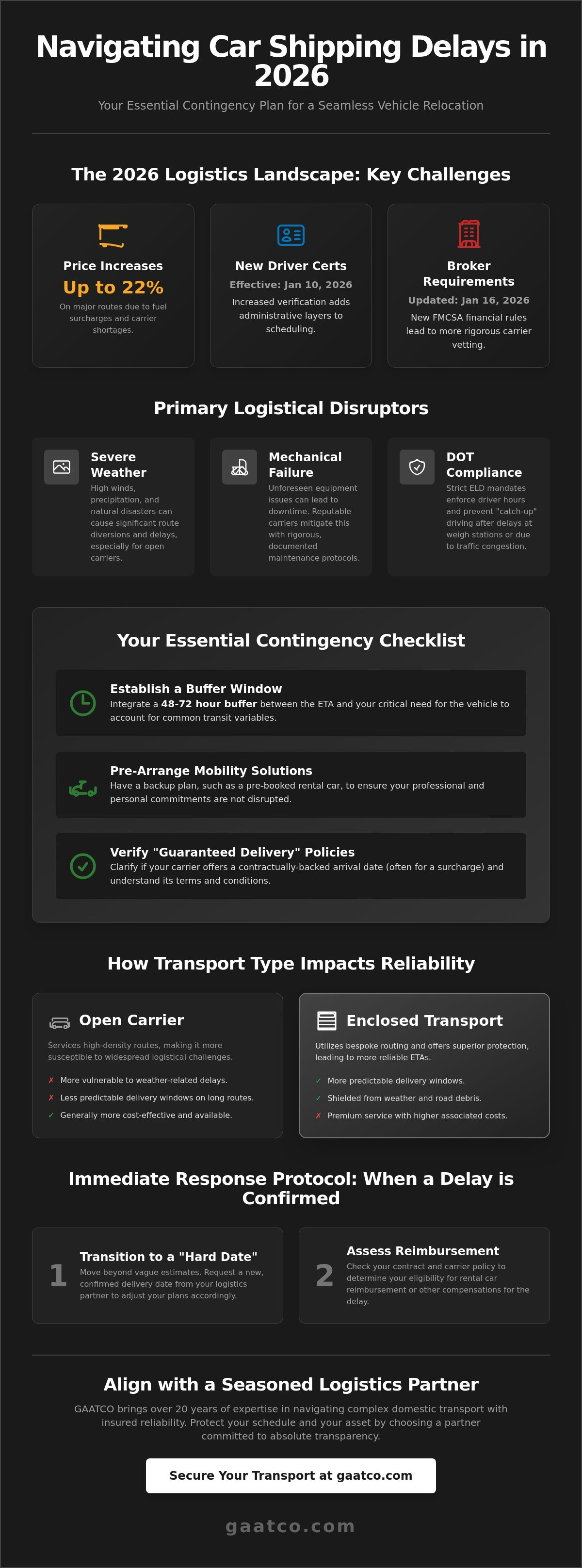
- Formulate a comprehensive contingency plan for a delayed car shipment by integrating a 48-72 hour buffer and pre-arranged mobility solutions into your relocation schedule.
- Evaluate how bespoke routing in enclosed car transport provides more predictable delivery windows than the high-density routes typically serviced by open carriers.
- Master the immediate response protocol to transition from vague delivery estimates to a confirmed hard date while assessing your eligibility for rental reimbursement.
- Align with a seasoned partner like GAATCO to benefit from over 20 years of expertise in navigating complex domestic transport logistics with insured reliability.
Understanding the Variables: Why Car Shipping Delays Occur in 2026
In the specialized world of luxury logistics, a car shipping delay is defined as any deviation from the estimated delivery window provided at the time of booking. While we strive for seamless execution, the reality of 2026 transit involves variables that even the most meticulous planning cannot always bypass. Understanding these factors is the first step in developing a robust contingency plan for a delayed car shipment. The "Big Three" disruptors, which include severe weather, mechanical failure, and Department of Transportation (DOT) compliance, remain the primary catalysts for schedule shifts.
In early 2026, fuel surcharges and a persistent shortage of qualified carriers have tightened scheduling across the United States. Routes through major hubs like Houston, San Diego, and New York face significant density challenges. When demand outstrips carrier availability in these corridors, even confirmed bookings may experience prioritization shifts based on route efficiency. This is particularly evident on long-distance routes over 1,500 miles, where carrier availability is currently at its tightest.
To better understand the structural framework of risk management in complex logistics, watch this expert overview of professional planning:
Regulatory and Infrastructure Factors
Federal ELD mandates now strictly enforce driver hours of service. This prevents "catch-up" driving, meaning a four-hour delay at a weigh station cannot be recovered by extending the drive time. In coastal cities like Miami and Seattle, seasonal traffic patterns and port congestion can add 12 to 24 hours to a local transit window. The Federal Motor Carrier Safety Administration (FMCSA) also updated financial responsibility requirements for brokers on January 16, 2026, which has led to more rigorous, and sometimes slower, carrier vetting processes. Additionally, the inclusion of Inoperable Vehicle Transport on a multi-car carrier often extends loading times, as these vehicles require specialized winching equipment and additional labor.
Environmental and Mechanical Realities
The choice of equipment significantly influences your risk profile. Open carriers are far more susceptible to route diversions caused by high winds or sudden precipitation than enclosed trailers. Reputable carriers mitigate mechanical downtime through rigorous, documented maintenance protocols that exceed federal minimums. Following the expiration of the medical certificate waiver on January 10, 2026, carriers must also perform more frequent verification of driver records, adding a small but necessary administrative layer to the schedule. In these 2026 auto transport contracts, "force majeure" is defined as an extraordinary event beyond the control of the parties, such as a natural disaster, which legally prevents the fulfillment of the delivery obligation.
The Essential Contingency Checklist for Vehicle Relocation
While understanding the variables of the 2026 logistics market is foundational, the practical execution of a contingency plan for a delayed car shipment requires a structured, individual-centric approach. Unlike corporate fleet managers who handle volume, the individual owner must prioritize personal mobility and asset security. We recommend establishing a buffer window of at least 48 to 72 hours between the expected delivery date and your first critical need for the vehicle. This window accounts for the driver medical certification verifications and ELD-enforced rest periods that characterize modern long-haul transport.
Before your vehicle departs, verify the carrier’s specific policy regarding "Guaranteed Delivery." Many premium carriers offer this service for an additional surcharge, providing a contractually backed arrival date. If this is not selected, ensure you have a clear understanding of the "Delay Claims" process. Maintaining a dedicated digital folder is essential. This repository should contain your signed Bill of Lading, insurance certificates, and direct contact information for both the carrier and the broker. For further guidance on your rights during this process, the FMCSA's Protect Your Move program provides authoritative resources on consumer protections in the auto transport industry.
Financial and Logistical Preparation
Logistical readiness extends beyond paperwork. It involves securing a mobility fund specifically for short-term transportation in your destination city. In high-cost hubs like San Francisco or Boston, daily rental rates and rideshare expenses can accumulate rapidly. We suggest reviewing your transport contract for a rental car reimbursement clause; however, many standard agreements exclude this unless explicitly added as a rider. Additionally, verify that your new residence allows for seamless door-to-door auto shipping. Large multi-car carriers often require significant clearance that narrow residential streets in historic coastal districts cannot accommodate. Identifying a nearby staging area, such as a large parking lot, can prevent secondary delays during the final mile of delivery.
Communication Protocols
Effective communication is the most reliable tool for managing expectations. Identify your primary point of contact before the vehicle is loaded. While brokers facilitate the transaction, the carrier or the driver often has the most current information regarding transit status. Establish a preference for milestone-based updates rather than daily check-ins, which can be disruptive to the driver's focus on safety. Many sophisticated clients now expect real-time ship trackers, as these digital solutions provide the transparency necessary to adjust personal schedules without constant phone correspondence. If you require a more tailored approach to your relocation, you might request a bespoke consultation to align your transport with your specific timeline.
Service Levels: How Transport Type Impacts Your Contingency Plan
The structural design of your transport service dictates the complexity of your contingency plan for a delayed car shipment. While price is often the initial focus, the logistical architecture of the chosen service level determines the frequency and predictability of delivery windows. We categorize these into two distinct frameworks: the high-density, multi-stop model of open transport and the bespoke, low-volume model of enclosed trailers. Each carries a unique risk profile that requires a different level of preparation from the client. Choosing a higher tier of service often acts as the first line of defense against logistical volatility.
A priority surcharge functions as a strategic insurance policy against standard transit disruptions. By opting for an expedited tier, you effectively secure a guarantee that your vehicle takes precedence on the next available truck departing from major logistics hubs. This is particularly valuable during the peak summer months of 2026, when shipping prices have historically increased by 20% to 30% due to surging demand. In these high-stakes scenarios, the surcharge ensures your asset isn't sidelined in favor of more profitable route consolidations or higher-volume dealer contracts.
Open Carrier Logistics
Open carriers rely on route density to maintain efficiency. Because these trailers typically accommodate up to ten vehicles, a single delay during a mid-route pickup in Dallas or Chicago can trigger a cascading effect for every other client on that manifest. However, these high-volume corridors offer a degree of flexibility. If a mechanical failure occurs, the sheer number of trucks operating these routes makes it easier to secure a recovery vehicle. We leverage decades of expertise in Open Car Transport to navigate these complexities, ensuring that even within a multi-stop framework, your timeline remains a priority. It's vital to remember that open transport is more susceptible to "weather-hold" delays during winter, as carriers must often divert from northern routes to avoid ice and road salt.
Enclosed and Expedited Solutions
For luxury and classic vehicles, Enclosed Car Transport offers a "white-glove" advantage that simplifies your contingency requirements. These trailers carry fewer vehicles, which naturally reduces the number of potential pickup and delivery disruptions. Bespoke routing allows for more direct transit between hubs like Atlanta and Phoenix, bypassing the frequent stops that characterize open transport. Premium enclosed services carry significantly higher insurance limits, often exceeding $500,000 per vehicle, providing an added layer of financial security if a delay leads to a claim. This service level provides the most predictable windows, as the specialized nature of the cargo demands a more disciplined adherence to schedules and more experienced driver oversight.
Immediate Response Protocol: Steps to Take When a Delay is Confirmed
The moment a carrier confirms a disruption, your contingency plan for a delayed car shipment transitions from a theoretical framework into an active operational protocol. Prompt action is required to mitigate the impact on your schedule and finances. Your first priority is to move beyond the "estimated window" provided at booking. Request a revised hard date for delivery. This specific date allows you to reorganize your arrival logistics with precision rather than relying on vague projections that often shift under the pressure of 2026 road conditions. If your timeline is non-negotiable, you may need to request a quote for expedited recovery services to get your schedule back on track.
Once you have a confirmed delay, follow these four critical steps to protect your interests:
- Step 1: Secure a revised hard date for delivery. Avoid accepting "as soon as possible" as a valid update; insist on a specific calendar day.
- Step 2: Review your original contract for delay claims or rental reimbursement eligibility. Many premium contracts contain specific clauses that trigger after a 24 or 48 hour deviation from the original window.
- Step 3: Document every additional expense immediately. Save all digital receipts for rideshare services, rental car contracts, and even public transit costs incurred due to the lack of your primary vehicle.
- Step 4: Update your destination contacts. Whether you are coordinating with a luxury dealership, a spouse, or a military housing office for Military Vehicle Shipping, early notification prevents secondary logistical friction at the point of arrival.
Administrative Due Diligence
Maintaining a meticulous paper trail is the cornerstone of professional risk management. You should cross-reference the driver’s updated timeline with independent weather and road reports to verify the validity of the delay. The Bill of Lading serves as your primary legal instrument in this scenario. It must clearly document the original delivery date versus the actual arrival time to support any potential claims. Always keep a comprehensive record of all carrier correspondence, including timestamps and the names of representatives you speak with during the process.
Alternative Mobility Solutions
In sprawling metropolitan areas like Las Vegas or Denver, the cost-benefit analysis of mobility shifts quickly. While rideshare services are convenient for short trips, a one-way rental often proves more economical if the delay exceeds three days. In certain high-density scenarios, you might request a terminal drop-off. This allows the carrier to leave the vehicle at a secure, local facility rather than navigating the final mile to your doorstep, which can sometimes shave 24 hours off the delivery time. If you find yourself facing an extended disruption, contact our team to discuss tailored solutions that prioritize your mobility and peace of mind.
Strategic Logistics: Why GAATCO is the Reliable Choice for 2026
GAATCO does not merely facilitate vehicle transport; we manage the sophisticated intersection of logistical precision and personal peace of mind. With over 20 years of experience navigating the complexities of the United States transport infrastructure, our team understands that the most effective contingency plan for a delayed car shipment is a partnership built on transparency. We've refined our operational framework to address the volatility of 2026 road conditions, ensuring that every client benefits from our commitment to utilizing only licensed, insured carriers. Our authoritative presence in the market allows us to maintain a steady, measured communication rhythm that serves as the definitive antidote to transit anxiety.
A primary differentiator in our service model is our focus on Door-to-Door Auto Shipping. Unlike terminal-based shipping, which often introduces secondary middleman delays and additional handling risks, our door-to-door approach streamlines the chain of custody. By removing the terminal as a variable, we eliminate the bottlenecks commonly found at overcrowded storage facilities. This direct logistical path ensures that your vehicle remains on a single trailer from the point of origin to its final destination, significantly reducing the likelihood of the cascading delays discussed in previous sections.
The GAATCO Advantage in Major US Hubs
Our operational capability is anchored by a deep network of vetted carriers in high-growth corridors. In cities such as Nashville, Seattle, and Austin, where demand often outpaces availability during peak seasons, our established relationships ensure prioritized access to equipment. We treat every shipment as a bespoke project, meticulously analyzing route density and driver schedules to minimize the risk of logistical errors before the truck ever arrives for pickup. This quiet luxury approach to professional vehicle relocation reflects our understanding that your time is as valuable as the asset we are transporting.
Finalizing Your Shipping Strategy
Success in 2026 auto transport requires a proactive stance. We recommend booking your service at least three to four weeks in advance to secure the most favorable windows and competitive rates. This lead time is especially critical for Military Vehicle Shipping, where PCS moves often involve rigid timelines and zero margin for error. Military personnel trust our dedicated team because we handle the complexities of their relocation with the same level of seriousness required for high-stakes corporate moves. Whether you are relocating a classic investment or a primary driver, the final step in your logistics plan should be choosing a partner that views safety and excellence as non-negotiable pillars. Partner with GAATCO for a seamless transport experience that prioritizes your schedule and protects your peace of mind.
Mastering Your 2026 Vehicle Relocation
Navigating the evolving transport landscape of 2026 requires more than just a booking; it demands a strategic alignment with experts who anticipate disruptions before they occur. By implementing the 48 to 72 hour buffer window and selecting premium service tiers like enclosed transport, you've already mitigated the most common risks. A robust contingency plan for a delayed car shipment is your most valuable asset when managing the variables of road transit, from ELD compliance to seasonal route shifts. Our team brings over 20 years of logistics expertise to every relocation, backed by a licensed and insured nationwide carrier network that prioritizes the integrity of your vehicle.
Whether you require specialized solutions for classic investments or critical military relocations, we provide the steady, measured oversight necessary for a successful arrival. We handle the complexities of the road so you don't have to, ensuring your transition is as seamless as the luxury you expect. Secure Your Professional Vehicle Transport Quote Today and experience the reliability that comes from decades of dedicated service. Your peace of mind remains our non-negotiable pillar as we bridge the gap between operational realities and your personal schedule.
Frequently Asked Questions
Does the car shipping company pay for a rental car if my delivery is delayed?
Most standard auto transport contracts do not include rental car reimbursement as a default provision. While we understand the inconvenience of a delay, these costs are typically the responsibility of the vehicle owner unless a specific rider was purchased at booking. We recommend reviewing your agreement for "Guaranteed Delivery" clauses which may provide some financial recourse if the carrier fails to meet a contractually backed hard date.
What is considered a "normal" delay in the auto transport industry?
In the 2026 logistics environment, a deviation of 24 to 48 hours is generally considered a standard operational delay. Factors such as the January 16, 2026 updated FMCSA financial responsibility requirements for brokers can occasionally lengthen the administrative phase of a shipment. Transit windows are estimates rather than fixed appointments; however, any delay exceeding 72 hours should prompt the immediate activation of your contingency plan for a delayed car shipment.
Can I track my car shipment in real-time to anticipate delays?
Many premium carriers now utilize integrated GPS and digital logging solutions that allow for milestone-based tracking. While continuous real-time streaming is less common due to driver privacy and safety regulations, clients can typically access status updates through a dedicated portal. This transparency is essential for high-net-worth individuals who require precise coordination for vehicle arrival at private residences or corporate offices.
What should I do if my driver is not answering my calls during a delay?
If your driver is unresponsive, your first step is to contact the carrier's dispatch office or your primary broker representative. Federal law requires drivers to utilize Electronic Logging Devices (ELDs) and strictly prohibits phone use while the vehicle is in motion, which often explains temporary communication gaps. A professional logistics partner maintains secondary contact channels to ensure you receive a status update within a reasonable four-hour business window.
Are there specific seasons when car shipping delays are more common?
Peak summer months typically see a 20% to 30% increase in shipping volume, which can lead to equipment shortages and scheduling friction. Conversely, the winter season introduces route diversions and "weather-holds" that are particularly disruptive for open carriers. Booking during the transitional months of spring or autumn often results in more predictable transit times and fewer environmental disruptions to the logistics chain.
How does enclosed transport reduce the risk of logistical delays?
Enclosed transport reduces logistical risks by carrying fewer vehicles per load, which minimizes the number of potential pickup and delivery interruptions. These trailers are also shielded from the 2026 weather volatility that often forces open carriers into significant route diversions. The bespoke nature of this service allows for more direct transit between major metropolitan hubs, providing a more disciplined adherence to your relocation schedule.
Can I change my delivery address if the shipment is already delayed?
You can request a change to your delivery address, but this often results in additional logistical challenges and potential price adjustments. If the carrier has already finalized their route manifest, a late-stage change may require the vehicle to be offloaded at a local terminal or transferred to a secondary recovery truck. This process almost certainly extends the delivery window by 48 to 96 hours depending on the new location's proximity to the original route.
What documents do I need to file a claim for a significant delay?
To file a claim for a significant disruption, you must provide a copy of the original contract and the Bill of Lading clearly documenting the actual delivery date. You should also include a comprehensive record of all communication with the carrier and digital receipts for any out-of-pocket expenses, such as rideshare or rental costs. These documents form the evidentiary basis of your contingency plan for a delayed car shipment and are vital for a successful resolution.


