A non-running project car is often far more than a mechanical puzzle; it represents a significant investment of time and vision that demands a higher standard of logistical care. You've likely spent months sourcing rare parts or planning a restoration, only to find that the prospect of shipping an inoperable project car introduces a new layer of complexity. It's a common concern that standard carriers might lack the necessary winching equipment or, worse, cause undercarriage damage through improper handling.
We understand that your vehicle requires a discreet and dependable partner who prioritizes safety over speed. This guide clarifies the sophisticated methods and specialized equipment needed to transport your project car safely across the United States. You'll discover how to secure transparent pricing for inoperable surcharges and ensure your vehicle arrives in the exact condition it left your garage. We'll detail the critical differences between open and enclosed transport options and explain how the latest FMCSA regulations, such as the transition to USDOT identifiers, affect your shipping experience. By the end of this article, you'll have the technical knowledge to manage this transition with the calm confidence of a seasoned expert.
Key Takeaways
- Identify the three specific tiers of vehicle inoperability to ensure the logistics team utilizes the correct specialized equipment for your unique mechanical situation.
- Discover how advanced winching systems and roll-back flatbeds facilitate shipping an inoperable project car while maintaining the vehicle's structural integrity.
- Determine whether enclosed or open transport provides the most appropriate level of protection for your vehicle’s current state of restoration.
- Master the preparation protocols, such as securing internal components and verifying tire pressure, to ensure a seamless transition from your garage to the carrier.
- Gain insight into the necessity of transparent pricing for inoperable surcharges and the value of partnering with a seasoned logistics provider.
Defining the Scope of Inoperable Project Car Shipping
Shipping an inoperable project car is a task that requires more than just a trailer and a driver. It involves a deep understanding of the vehicle's current state and a commitment to preserving its future potential. While many high-volume brokers treat every non-runner as a salvage unit, we recognize that a project car is a prized possession. This nuanced approach is a hallmark of sophisticated logistics, where the focus shifts from mere movement to technical precision.
Transparency is paramount during the initial consultation. Providing an accurate assessment of whether the car rolls, steers, or brakes allows us to select the most capable carrier from our curated network. When you're shipping an inoperable project car, the carrier must know exactly which mechanical functions are compromised to avoid equipment failure at the pickup site. Without this clarity, you risk the arrival of a driver with insufficient equipment, leading to unnecessary delays and potential frustration.
To better understand the nuances of vehicle transport, watch this helpful video:
The Three Tiers of Vehicle Inoperability
Vehicle inoperability is rarely a binary state. We categorize these challenges into three distinct tiers to ensure operational flow and safety for our drivers and your asset.
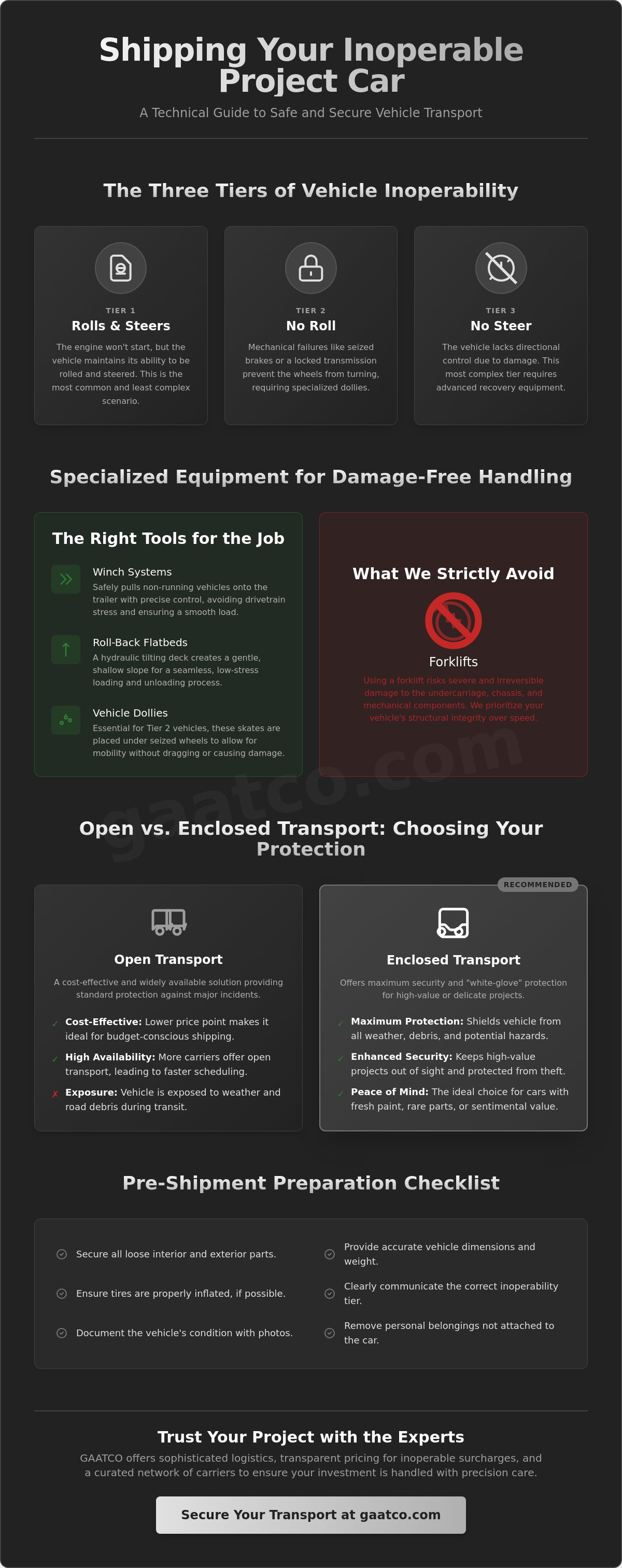
- Tier 1: The engine will not start, yet the vehicle maintains its ability to roll and steer. This is the most common scenario for project cars awaiting mechanical restoration.
- Tier 2: Mechanical failures such as seized brakes or a locked transmission prevent the wheels from rolling. This requires specialized loading techniques to prevent flat-spotting tires or damaging the drivetrain.
- Tier 3: The vehicle lacks directional control due to steering linkage damage or structural issues. These units require the most advanced recovery equipment to ensure a damage-free delivery.
The Financial Reality of Inoperable Surcharges
It's standard practice in the industry to apply a surcharge for non-running vehicles. This fee reflects the additional labor and specialized equipment, such as winches or forklifts, required to load "dead" weight safely. Loading a car that cannot move under its own power is a meticulous process that takes significantly more time than driving a functional vehicle onto a ramp. To ensure a seamless experience, you should provide our team with precise dimensions and weights. This level of detail helps us maintain our commitment to transparent pricing and prevents unexpected costs at the point of pickup. You can explore our full range of Inoperable Vehicle Transport services to find the solution that best fits your project's requirements.
Specialized Equipment: How We Move the Unmovable
The physical act of shipping an inoperable project car demands a level of technical expertise that exceeds standard auto transport. When a vehicle cannot ascend a ramp under its own power, the transition onto the trailer becomes a delicate operation involving physics and specialized hardware. We rely on a suite of professional tools designed to mitigate stress on the chassis and suspension. This approach ensures that your restoration progress remains undisturbed during the relocation. It's this commitment to detail that separates a professional logistics partner from a standard towing service.
For local relocations or the initial leg of a long-distance journey, the roll-back flatbed is a vital asset. Its hydraulic deck tilts to create a shallow angle, allowing for a smooth, linear ascent. In instances where wheels are seized or axles are missing, we utilize heavy-duty vehicle dollies. These specialized skates provide the mobility necessary to maneuver a stationary object without dragging it across the pavement. While some high-volume operations might suggest using forklifts, we strictly avoid them for high-value projects. Forklifts present an unacceptable risk of undercarriage and fluid line damage, which contradicts our core operational values of safety and reliability. If you're seeking a team that treats your asset with this level of care, you can explore our Inoperable Vehicle Transport options.
The Winching Process Explained
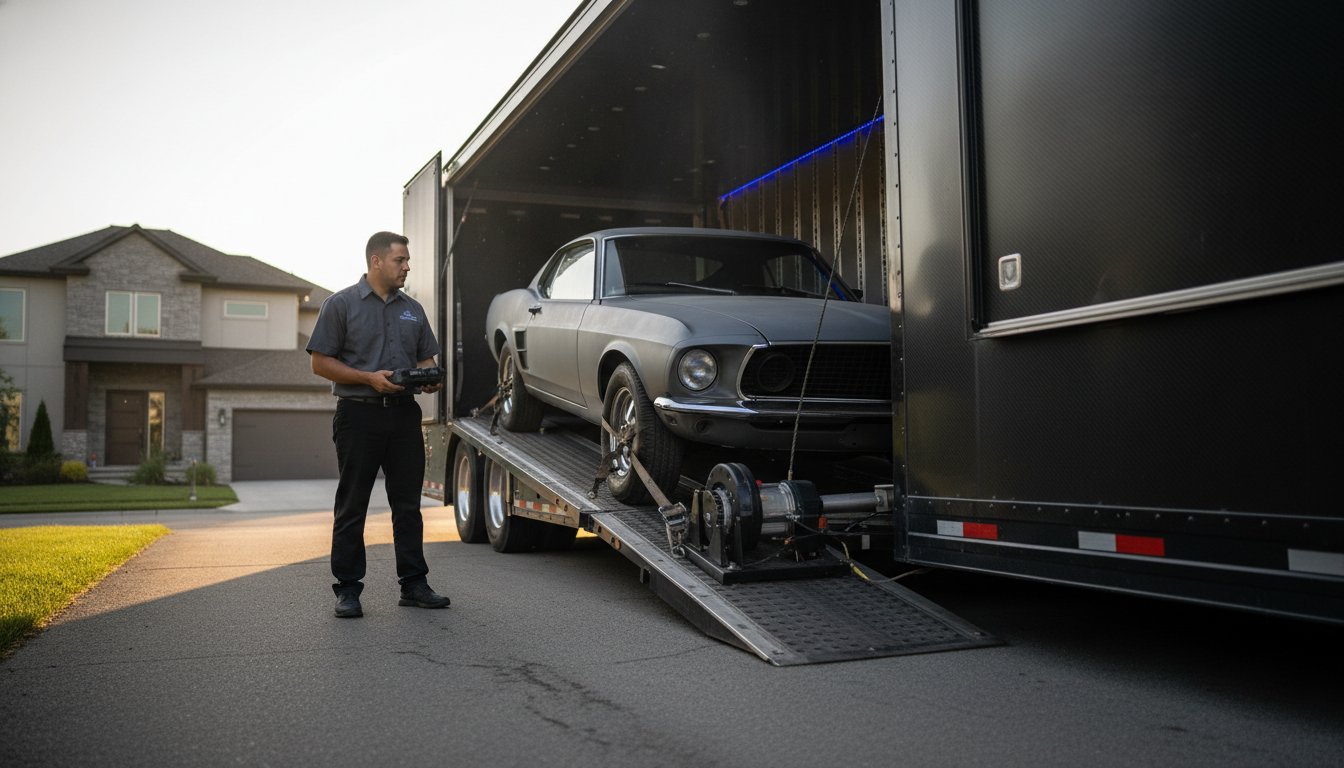
The winching process is a controlled exercise in steady tension. A professional driver first identifies a reinforced chassis point or utilizes a factory-installed tow hook to secure the high-tensile steel cable. This ensures the pull force is distributed through the vehicle's strongest components. Once secured, the driver uses a remote-controlled electric or hydraulic winch to guide the car upward. On inclines, safety protocols dictate the use of secondary chocks and constant tension monitoring to prevent any backward roll. This meticulous method protects both the operator and your investment from the risks of sudden shifts or cable failure.
Advanced Loading: Hydraulic Liftgates
For vehicles with exceptionally low ground clearance or delicate aero components, hydraulic liftgates represent the gold standard. Unlike traditional ramps that require a steep angle of approach, a liftgate remains perfectly horizontal as it rises vertically to the level of the trailer deck. This eliminates the risk of undercarriage scraping and bumper damage entirely. It's the preferred choice for discerning collectors who require absolute precision during the loading phase. If you're ready to discuss the specific equipment needs for your vehicle, you can request a customized logistics plan from our team of specialists.
Open vs. Enclosed Transport for High-Value Projects
Selecting the appropriate transport method requires a clinical evaluation of your vehicle's current condition. While price is always a consideration, the cost-to-value ratio shifts significantly depending on the restoration stage. Shipping an inoperable project car that is merely a rolling chassis involves different risks than transporting a vehicle with a finished, concourse-level paint job. We help you navigate this decision by weighing the physical vulnerability of the asset against the environmental factors it'll encounter during transit. It's a strategic choice that balances protection with budgetary logic.
Our team understands that a project car is often a work in progress, and its needs change as it moves toward completion. By identifying the specific milestones of your build, we can recommend a transport solution that maintains the integrity of the work already performed. Whether you're moving a rough shell or a nearly finished masterpiece, the goal remains the same: a damage-free delivery that respects your investment of time and capital.
The Case for Enclosed Transport
Enclosed transport serves as a mobile vault for your most sensitive investments. This method is the preferred choice for vehicles with freshly applied paint, exposed interiors, or missing windows. Beyond the physical barrier against road debris and inclement weather, enclosed carriers offer a higher tier of financial security. Cargo insurance for these shipments typically ranges from $250,000 to over $1,000,000, providing a reassuring level of protection for owners of high-value assets. It's a discreet service that keeps your project away from prying eyes and the unpredictable elements of the open highway.
When Open Transport Suffices
Open transport remains the most pragmatic solution for many project phases. It accounts for approximately 90% of the vehicle shipping market and is often 30% to 60% more cost-effective than enclosed options. For a "barn find" or a rough shell where cosmetic exposure isn't the primary concern, this method provides excellent value without compromising on safety. Our team ensures that even on a multi-car carrier, your vehicle is positioned strategically to minimize exposure to road grime. You can review our Open Car Transport services to see how this fits your current logistics plan. If your project is in its infancy, the savings from open transport can be reallocated into rare parts or specialized labor, making it a logical choice for the discerning collector.
Essential Preparation: Ensuring a Seamless Transition
Preparation is the bridge between a meticulous restoration plan and a successful delivery. When shipping an inoperable project car, the burden of readiness rests on the owner to ensure the vehicle can withstand the mechanical forces of the loading process. It's not merely about clearing out the cabin; it's about stabilizing the asset so the carrier can execute their duties with precision. A well-prepared vehicle allows our team to maintain a steady professional rhythm, ensuring your project moves from its current location to its destination without avoidable complications.
Documentation serves as your primary safeguard. Before the carrier arrives, capture high-resolution photography from every angle, including the undercarriage and interior. This creates a definitive record of the vehicle's condition at the point of hand-off. Even if the car doesn't run, you should provide the keys to the transporter. This is a standard requirement that facilitates access and ensures the steering column can be unlocked for directional control. If you're ready to begin this process, you can request a quote to discuss your specific timeline with our specialists.
Managing Loose Parts and Spares
Project cars often come with a collection of rare spares, such as extra trim pieces, engines, or transmissions. However, most carriers adhere to a strict "no loose parts" rule for safety reasons. Anything not bolted to the frame must be boxed and secured within the cabin or trunk to prevent shifting during transit. You must also account for the added weight of these components. Overloading the vehicle can affect the winch's capacity and the trailer's balance. For larger items like spare blocks, it's often more efficient to ship them on a separate pallet rather than inside the vehicle shell.
The Logistics of the Pickup Location
The physical environment at the pickup site is just as critical as the vehicle's condition. In sprawling metropolitan areas like Houston or Dallas, residential streets can present significant obstacles for a large transport rig. You must verify that there's ample clearance for a 75-foot carrier to maneuver. Winching operations require a hard, level surface; attempting to pull a non-runner through soft grass or gravel can lead to stuck equipment and increased labor. If your driveway isn't suitable, we recommend coordinating the hand-off at a nearby commercial lot or a local shop with a paved staging area. This foresight ensures the loading phase remains a controlled and elegant operation.
The GAATCO Advantage: Sophisticated Logistics for Discerning Collectors
Entrusting your vision to a logistics partner is a decision based on trust and demonstrated capability. A project car is often more than a mechanical shell; it's a repository of ambition and technical investment. Shipping an inoperable project car shouldn't be a source of anxiety but rather a seamless transition handled by professionals who understand the stakes. We position ourselves as a discreet and dependable partner, bridging the gap between your garage and the next stage of your build through a commitment to core operational values and transparent communication.
Our presence in major logistical hubs like Atlanta and San Diego provides a geographic advantage that translates into smoother pickups and more predictable timelines. This regional expertise, combined with our expansive national reach, ensures that your vehicle is never just another unit in a queue. Instead, it's an asset managed with the meticulous attention to detail that discerning collectors expect. We handle the complex logistics so you can remain focused on the craftsmanship of your restoration.
A Legacy of Reliability
Experience is the most reliable predictor of success in this industry. With over 20 years of expertise in complex relocations, our team has encountered every tier of inoperability mentioned earlier in this guide. We maintain a rigorous vetting process, partnering only with licensed and insured carriers who demonstrate mastery of specialized recovery equipment. For example, we recently managed the transport of a delicate classic shell from Seattle to Miami. The project required a hydraulic liftgate and constant communication between the carrier and the restoration shop. By maintaining a steady, professional rhythm, we ensured the shell arrived without a single scratch to its media-blasted surface.
Your Next Steps in the Restoration Journey
The path to a successful delivery begins with a detailed consultation. When you request a customized quote, you aren't just receiving a price; you're gaining access to a trusted advisor who understands the nuances of high-end service. We'll discuss your vehicle's specific tier of inoperability and match it with the most appropriate equipment and transport method, whether that involves an open carrier for a rough shell or an enclosed trailer for a freshly painted body.
Before your project car hits the road, ensure you've completed this final checklist to guarantee a smooth hand-off:
- Confirm all tires are inflated or "rollers" are securely fitted to the hubs.
- Box and secure all loose restoration parts within the cabin or trunk.
- Finalize your high-resolution photo documentation of the vehicle's current state.
- Verify that the pickup location is accessible for a professional transport rig.
Our unified team of professionals stands ready to manage the sophisticated infrastructure of your next transport. By choosing a partner with established expertise, you ensure that your project car's journey is as refined as the finished product will be.
Secure the Future of Your Automotive Vision
The successful relocation of a project car from a stationary shell to its next restoration milestone requires a partnership rooted in technical precision. By identifying the specific tiers of inoperability and selecting the appropriate specialized equipment, you ensure your investment remains protected throughout the journey. Whether you've chosen the pragmatic path of open transport or the refined security of an enclosed carrier, meticulous preparation remains the cornerstone of a damage-free delivery.
Managing the nuances of shipping an inoperable project car is a task best handled by a trusted advisor who prioritizes safety and reliability. With over 20 years of industry experience and an A+ rated logistics team, we maintain a specialized winch-equipped carrier network dedicated to the needs of discerning collectors. We provide the sophisticated infrastructure necessary to handle complex relocations with calm confidence and understated elegance.
Request a Professional Transport Quote for Your Project Car
Your restoration journey deserves a partner that treats your vehicle with the same level of care and detail you've invested in the build. We look forward to facilitating the next chapter of your automotive story.
Frequently Asked Questions
Can you ship a car that doesn’t have any wheels?
Yes, transporting a vehicle without wheels is possible through the use of specialized recovery equipment. This typically involves a forklift or a roll-back flatbed equipped with industrial vehicle skates. You must disclose this condition during your initial consultation so we can assign a carrier with the necessary heavy-duty hardware. This scenario is often classified as Tier 3 inoperability, requiring the highest level of technical coordination.
How much more does it cost to ship an inoperable vehicle versus a running one?
Shipping an inoperable vehicle incurs a surcharge due to the specialized equipment and additional labor required for a safe loading process. This fee compensates the carrier for the use of winches and the extended time needed to secure "dead" weight. While the exact amount depends on the vehicle's specific mechanical limitations, we prioritize transparent pricing to ensure you understand the value of these specialized services.
Does the car need to have a working emergency brake for transport?
A functional emergency brake is highly recommended for safety but isn't strictly mandatory for the transport process. If the brake is non-functional, the carrier relies entirely on high-tensile winch cables and heavy-duty wheel chocks to secure the vehicle on the trailer deck. Ensuring the vehicle can be held stationary is a non-negotiable pillar of our safety protocols during the entire journey.
What happens if the carrier arrives and the car is in worse condition than described?
If a vehicle's condition differs from the initial description, the carrier may be unable to load it with the equipment on hand. This situation typically leads to a rescheduled pickup and may result in additional fees for the driver's time. Providing an accurate assessment of the steering and rolling capabilities is essential for maintaining the operational flow and avoiding these avoidable logistical complications.
Are project cars covered by the carrier’s insurance during transit?
Yes, your project car is protected by the carrier’s cargo insurance throughout the duration of the transit. Industry standards for open carriers typically provide coverage limits between $100,000 and $250,000 per shipment. Enclosed carriers often offer significantly higher limits, ranging from $250,000 to over $1,000,000. We verify the insurance credentials of every carrier in our network to ensure your investment is fully shielded against risks.
Can I put spare parts inside the car while it is being shipped?
You may include spare parts within the vehicle cabin or trunk provided they are boxed and securely fastened to the chassis. It's vital that these items don't exceed weight limits or obstruct the driver's view if the vehicle needs to be steered. Professional logistics standards dictate that loose components must be stabilized to prevent internal damage during the movement of the transport trailer.
How do I know if my pickup location is accessible for a winch-equipped trailer?
A suitable pickup location must offer sufficient clearance for a 75-foot transport rig and a hard, level surface for winch operations. If your residential street features low-hanging branches or tight cul-de-sacs, it'll likely be inaccessible for a large carrier. In such cases, we recommend coordinating a meeting at a nearby commercial lot to ensure the process of shipping an inoperable project car remains controlled.
Do I need to be present for the pickup of an inoperable vehicle?
You or a designated representative should be present during the pickup to oversee the inspection and sign the Bill of Lading. This document serves as the official record of the vehicle's condition before it enters our professional care. Having a knowledgeable person on-site also facilitates the hand-off of keys and ensures any specific mechanical quirks are communicated directly to the driver for a seamless transition.


