Winning the final bid on a digital platform represents only the beginning of a high-stakes logistical operation. The true complexity of shipping a car bought from an online auction lies in the immediate post-sale period, where every hour of delay translates into escalating overhead. You are likely aware that auction facilities maintain rigorous removal deadlines, often as short as five business days, after which storage fees can reach $75 per day. Such rapid financial penalties require a coordinated and decisive response to protect your investment.
Our team understands the frustration of managing strict gate protocols and the uncertainty regarding a vehicle's mechanical condition at the point of pickup. This professional guide serves as your roadmap to mastering these complexities, ensuring your acquisition arrives safely and without the burden of unnecessary fees. We shall detail the essential documentation required for a seamless release, the specialized equipment necessary for inoperable units, and the precise coordination needed to bridge the gap between global auction houses and your doorstep.
Key Takeaways
- Recognize the critical nature of the auction storage clock to prevent the accumulation of daily fees that begin immediately upon the conclusion of the sale.
- Identify the specific documentation, such as Buyer IDs and Lot Numbers, required to authorize a swift vehicle release from high-volume auction yards.
- Master the "Rolls, Brakes, Steers" assessment to ensure your transport provider arrives with the specialized equipment necessary for inoperable vehicles.
- Evaluate the strategic advantages of open versus enclosed transport when shipping a car bought from an online auction to ensure your investment remains protected.
- Streamline the final logistics phase to achieve a seamless transition from the restricted auction environment to a professional door-to-door delivery.
The Post-Win Reality: Navigating the Auction Storage Clock
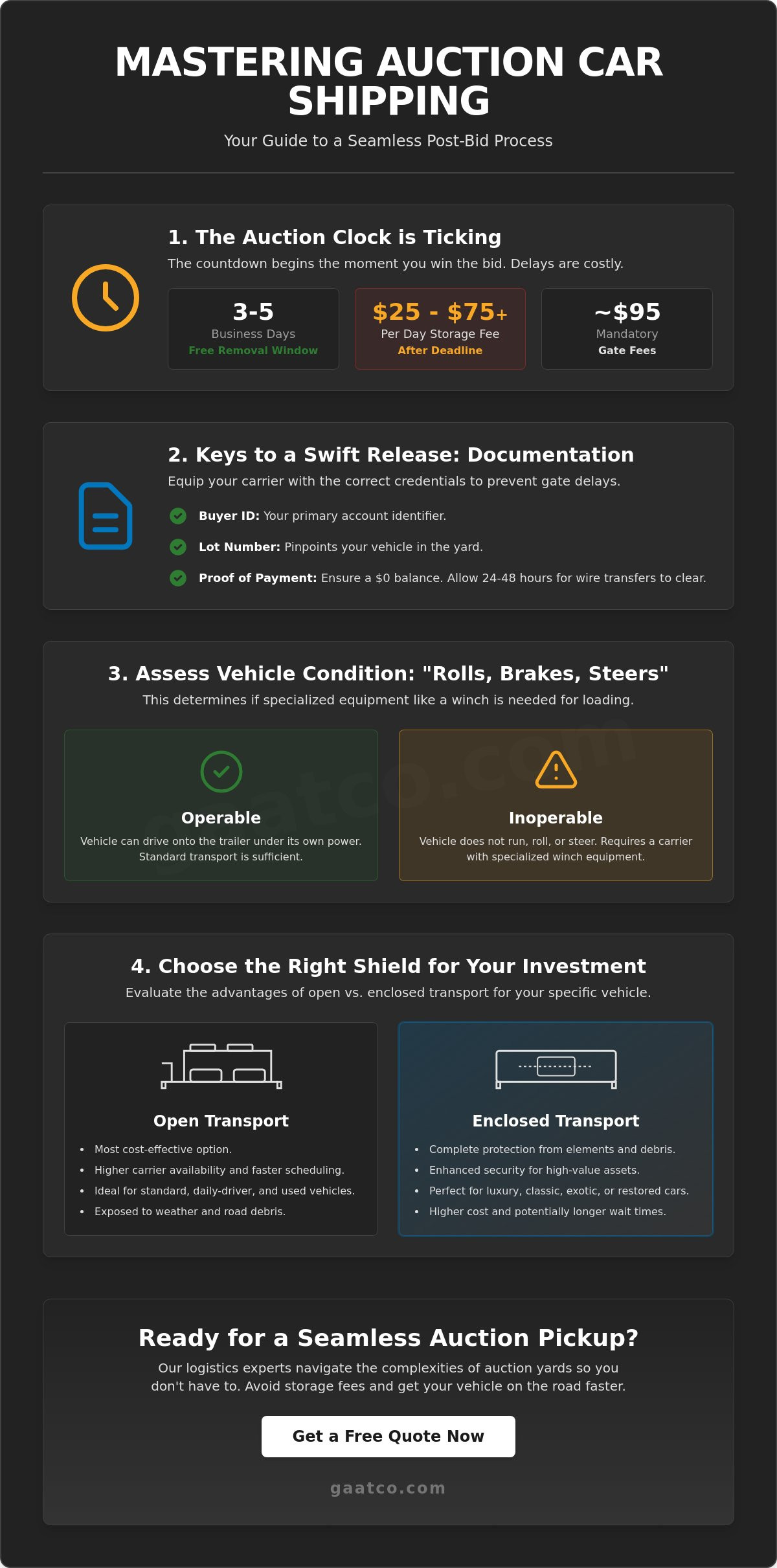
The moment the digital hammer falls at a major auction house like Copart or IAAI, a precise and unforgiving countdown begins. While the excitement of a successful bid is natural, the logistical reality is that the clock starts at the point of sale, not when the invoice is settled. Most national auction platforms provide a narrow window of three to five business days for vehicle removal. Managing the logistics of shipping a car bought from an online auction requires an immediate transition from bidder to project manager to avoid financial penalties.
Delays in this phase are inherently costly. Many buyers mistakenly assume they have a grace period while funds clear, but storage fees often accrue regardless of payment status. A sophisticated approach to logistics involves understanding auto transport brokers and how they coordinate with specialized carriers to bypass these bottlenecks. Professional logistics partners treat the auction lot as a high-priority environment because they recognize that every additional day spent on-site erodes the value of your acquisition. To ensure a seamless transition, it's vital to request a quote and secure a carrier the moment your bid is confirmed.
To better understand the steps involved in this transition, watch this helpful video:
The High Cost of Hesitation
Auction storage fees typically range from $25 to $75 per day once the removal deadline passes. These costs are often accompanied by mandatory gate fees of approximately $95 and smaller environmental assessments. In some instances, fees escalate the longer a vehicle remains on the lot, sometimes increasing by $20 each day. If you don't engage a carrier immediately, these administrative penalties can quickly eclipse any savings secured during the bidding process. Professional carriers prioritize auction pickups to mitigate these specific client costs and ensure a swift exit from the facility.
Regional Logistics Hubs: Atlanta to Houston
The geographic location of the auction significantly influences transport availability and operational flow. Major hubs such as Dallas, Houston, and Atlanta experience high auction density, which can lead to carrier congestion during peak seasons. Between June and August, or during the early January "Snowbird" season, demand for transport capacity often spikes, potentially delaying your vehicle's departure. Utilizing a service with established routes through these major metropolitan yards provides a distinct advantage. Our unified team of professionals maintains a steady presence in these regions, ensuring that seasonal fluctuations don't compromise your shipping timeline or lead to unnecessary storage charges.
The Keys to the Kingdom: Essential Documentation for Auction Release
The administrative phase of shipping a car bought from an online auction is often where the most significant delays occur. It's not enough to simply win the bid; you must equip your carrier with the specific digital credentials required by the facility. The Buyer ID serves as your primary identifier for all auction communications, while the Lot Number acts as the precise coordinate for your vehicle within a yard that may house thousands of units. Without these two identifiers, a driver cannot even begin the check-in process at the security gate.
Payment verification remains the most frequent point of failure in the release process. Carriers cannot pick up a vehicle if there is any outstanding balance, including late fees, taxes, or gate charges. Auctions generally require 24 to 48 hours for wire transfers to clear their internal systems before they will issue a release. We recommend ensuring all financial obligations are satisfied well before the carrier's scheduled arrival. For those conducting due diligence on their transport partners, verifying carrier credentials through the Department of Transportation ensures that your chosen team is properly licensed and insured to handle such specialized pickups.
The "Gate Pass" Protocol
The Gate Pass is the digital "key" that allows your vehicle to leave the lot. Most facilities now issue these via email or through their mobile applications once payment is fully processed. You must transfer these documents to your transport coordinator immediately to prevent a driver from being turned away. Common reasons for gate rejection include expired passes or a mismatch between the Buyer ID on the pass and the one provided to the driver. Our unified team verifies document validity before dispatching a driver to ensure every arrival leads to a successful release without a secondary trip.
Third-Party Authorization Requirements
National auction platforms often require a specific Letter of Authorization if someone other than the registered buyer is retrieving the vehicle. This document must clearly state the carrier's name and the specific Lot Number being released. Ensuring your carrier is already registered with major auction platforms leads to faster entry and fewer administrative hurdles during the check-in phase. We manage this complex document flow as a standard part of our professional transport services, acting as a discreet bridge between the auction's requirements and your delivery needs. This meticulous attention to detail ensures a seamless handoff at the gate, allowing you to focus on the eventual arrival of your new acquisition.
Assessing Vehicle Condition: Operable vs. Inoperable Logistics
The mechanical state of your acquisition dictates the technical requirements of the transport vessel. When shipping a car bought from an online auction, the term "inoperable" encompasses far more than a simple refusal to start. It refers to any mechanical or structural deficiency that prevents the vehicle from being driven onto a trailer under its own power. Accuracy in this assessment is the cornerstone of a successful pickup, as it determines the specific equipment the carrier must bring to the auction lot.
Logistics professionals utilize the "Rolls, Brakes, Steers" (RBS) standard to determine if a standard open carrier is sufficient. For a vehicle to meet this baseline, it must be able to roll on its own tires; the braking system must be functional to stop the vehicle during loading; and the steering rack must allow for precise positioning. If a vehicle fails any of these criteria, it requires specialized intervention. Total salvage vehicles or those with seized drivetrains often require heavy-duty recovery trailers that are not part of a standard transport fleet.
Misrepresenting a vehicle's condition leads to significant operational friction and avoidable expenses. If a carrier arrives expecting an operable unit but finds a seized engine or locked wheels, they'll likely be unable to load the vehicle. This often results in a "dry run" fee to compensate the driver for the lost time and fuel. We recommend verifying the vehicle's status through the auction lot's condition report or a third-party inspection before finalizing your transport arrangements.
The Winch Requirement and Specialized Equipment
Winching is the mechanical loading process for non-running vehicles using a heavy-duty cable and hydraulic motor. Winch-equipped trailers differ from standard multi-car carriers by including reinforced anchor points and specialized recovery gear. This type of transport requires a higher level of driver expertise and strict safety protocols to manage the tension and weight distribution during the ascent. Our seasoned experts are meticulously attentive to these details, ensuring that even non-running acquisitions are handled with the same care as a showroom-ready vehicle.
Salvage Title Considerations
Vehicles with salvage titles often present unique challenges, such as structural damage or compromised body panels. It's critical to ensure all loose parts are secured or removed before the vehicle enters the open-air stream to prevent road hazards. You can explore our specialized transport services for complex vehicle conditions to ensure even the most delicate salvage projects are managed with professional precision. The sophisticated infrastructure of our operations ensures that these technical specifications are never left to chance, providing a discreet and dependable solution for your most complex auction wins.
Choosing the Right Shield: Open vs. Enclosed for Auction Wins
Selecting the appropriate transport method for shipping a car bought from an online auction requires a nuanced understanding of risk management. It's more than a simple choice between two price points. You're selecting a level of protection that aligns with the vehicle's current condition and your long-term aspirations for the asset. A restoration project destined for a workshop has different logistical needs than a limited-edition exotic heading to a climate-controlled gallery. The decision should be a strategic one, reflecting the high-stakes nature of the specialized vehicle market.
Distance plays a critical role in this calculation. Longer routes increase the probability of exposure to road debris and inclement weather. You should also consider the insurance valuation limits. Open carriers typically provide cargo insurance capped between $100,000 and $250,000 per shipment. For high-value acquisitions, the enhanced limits of enclosed transport, which often range from $250,000 to over $1,000,000, provide the necessary financial security for discerning collectors. Industry standards generally recommend enclosed transport for any vehicle with a valuation exceeding $75,000 to ensure the asset's integrity is maintained during transit.
Open Carrier: The Efficient Standard
Open transport remains the industry standard for daily drivers and many project vehicles. Approximately 90% of vehicles in the U.S. move via open trailers, typically carrying seven to ten units at once. It's a reliable, cost-effective solution for those who prioritize efficiency. However, you must manage expectations regarding the "open-air" environment. Vehicles coming from dusty auction lots will remain exposed to the elements and road film during transit. Even on our multi-car open trailers, the GAATCO commitment to safety ensures that every vehicle is secured with professional-grade equipment and monitored with meticulous care.
Enclosed Carrier: The Elite Choice for Collectors
For those who have acquired a rare classic or a modern supercar, enclosed transport is the only logical choice. This method provides a total shield against road salt, seasonal weather, and stray debris. Sophisticated collectors often prefer hard-side enclosed trailers over soft-side options for the maximum level of structural protection. This elite service includes white-glove handling and a level of discretion that mirrors the prestige of the auction world. You'll find that the peace of mind provided by premium insurance and a climate-protected environment is an essential component of a successful high-end acquisition. If you're ready to secure a protected transport solution for your newest asset, you can request a quote today to receive a customized logistics plan.
Seamless Delivery: From the Auction Lot to Your Doorstep
The final phase of shipping a car bought from an online auction represents the culmination of a high-stakes investment. Transitioning from the restricted, industrial environment of an auction yard to the personalized convenience of Door-to-Door Auto Shipping requires a sophisticated logistical touch. Our team manages this transition by coordinating precise delivery windows in major metropolitan hubs such as Seattle, San Diego, and Boston. We recognize that your time is a premium asset, so we prioritize clear communication to ensure the arrival fits seamlessly into your professional schedule.
Upon the vehicle's arrival, the final inspection serves as the definitive verification of the asset's integrity. It's essential to meticulously compare the vehicle's current state against the initial auction condition report. This verification is anchored by the Bill of Lading (BOL), a critical document that records the vehicle's condition at both ends of the journey. Our drivers facilitate this process with an authoritative attention to detail, ensuring that the transition from the carrier to your possession is documented with absolute transparency. This level of oversight is why a professional partner is indispensable for complex auction-to-door movements.
Managing the Delivery Interface
Preparing your location for the arrival of a large multi-car carrier is a vital step in the delivery process. In dense urban environments like New York or Chicago, 75-foot trailers often face significant maneuverability challenges and local weight restrictions. If your specific doorstep is inaccessible to such a vessel, we coordinate a convenient and secure meet-point nearby. This proactive approach ensures that the final mile of shipping a car bought from an online auction remains a controlled and elegant experience, free from the stress of local traffic or municipal hurdles.
The GAATCO Advantage in Auction Logistics
Our unified team of professionals brings over 20 years of experience to every transport, navigating the specific bureaucracies and gate protocols that define national auction houses. We act as a discreet and dependable partner, handling the complex paperwork and timing requirements so you don't have to. This seasoning allows us to anticipate bottlenecks before they manifest, ensuring a steady and measured rhythm from the auction hammer to your private drive. To secure your newest acquisition with the elite service it requires, you may request a bespoke auction shipping quote to finalize your logistics plan today.
Securing Your Investment for the Long Term
Successfully navigating the final stages of a digital purchase requires a sophisticated logistical strategy that extends well beyond the falling hammer. By prioritizing documentation precision and understanding the mechanical nuances of your vehicle, you effectively eliminate the risk of accruing unnecessary storage fees. Selecting the appropriate transport shield ensures that your asset remains protected from the moment it leaves the auction lot until it arrives at your doorstep. The process of shipping a car bought from an online auction is a high-stakes endeavor that benefits from a partner who understands the critical urgency of removal deadlines.
With over 20 years of industry expertise, our unified team of professionals specializes in navigating the complex gate protocols of national auction houses. We utilize only licensed and insured carriers to provide the reliability and safety your acquisitions deserve. Our commitment to operational excellence acts as a bridge between complex auction realities and your specific delivery needs. Request a Professional Auction Shipping Quote to ensure your vehicle is handled with the discreet authority and meticulous care it requires. We look forward to facilitating a seamless transition for your next successful bid.
Frequently Asked Questions
How soon after winning an auction should I book my shipping?
You should secure your transport provider immediately after the auction hammer falls. Most national facilities provide a narrow window of three to five business days for vehicle removal before daily storage fees begin to accrue. Initiating the process for shipping a car bought from an online auction early ensures that your carrier can be dispatched in time to meet these rigorous deadlines.
Can I ship a car from an auction if it does not run?
Yes, we provide specialized inoperable vehicle transport for units that cannot move under their own power. These shipments require trailers equipped with heavy-duty winches and drivers trained in recovery loading protocols. It's essential to disclose if the vehicle fails the "Rolls, Brakes, Steers" standard so our team can arrive with the correct specialized equipment for a successful pickup.
What specific information does GAATCO need to pick up my auction car?
Our team requires your unique Buyer ID, the specific Lot Number, and a digital copy of the Gate Pass or Release Form. These credentials serve as the formal authorization required by yard security to release the asset. Additionally, you must confirm that all financial balances are settled, as carriers cannot retrieve vehicles with outstanding auction invoices.
Are auction cars insured during transport?
Every vehicle is protected by comprehensive cargo insurance throughout the entire transit duration. Open transport typically provides coverage limits between $100,000 and $250,000, while our enclosed offerings provide enhanced protection up to $1,000,000 or more. This creates a reassuring layer of safety for high-value acquisitions and exotic investments alike.
What happens if the auction car has loose parts or is a total salvage?
Loose components must be secured within the cabin or trunk to prevent road hazards during the journey. If the vehicle is a total salvage with structural damage, we utilize specialized loading techniques to maintain safety and integrity. Our professionals are meticulously attentive to these details, ensuring that even complex projects are handled with the same care as a showroom-ready vehicle.
How do I avoid paying storage fees at the auction lot?
The most effective way to avoid penalties is to satisfy your invoice within 24 hours and immediately transfer all release documents to your logistics partner. Since storage fees can reach $75 per day at national hubs, prompt administrative action is vital. We prioritize auction pickups within our operational flow to help you bypass these unnecessary overhead costs.
Does GAATCO pick up from Copart and IAAI locations?
Our unified team of professionals maintains a consistent presence at all major Copart and IAAI locations across the country. We possess a deep understanding of their specific gate protocols and regional nuances, which allows for a discreet and dependable transition. This established expertise ensures that shipping a car bought from an online auction remains a seamless experience regardless of the yard's location.
Can I put personal items in a car I bought at an auction before shipping?
No, vehicles must be free of personal effects and household goods during transport. Carriers are licensed specifically for vehicle logistics and are prohibited by federal regulations from moving secondary cargo. Furthermore, items left inside the vehicle are not covered by cargo insurance and can lead to complications at Department of Transportation weigh stations.


