If you received a quote for $1,020 to move your vehicle 1,000 miles, would you trust that figure to remain unchanged upon delivery? For many owners of luxury or classic vehicles, the initial estimate is often a mere starting point for a series of unexpected surcharges. You likely believe that a professional agreement should be final, yet the hidden costs of vehicle transport frequently emerge as delivery fees or broker markups. It's a frustrating reality that can turn a premium logistics experience into a source of unnecessary anxiety.
This guide provides the clarity you need to secure a bespoke, all-inclusive quote that honors your budget and protects your investment. We'll show you how to identify specific fees often omitted from standard estimates, such as the 30% to 60% surcharge for enclosed transport or costs associated with inoperable vehicles. You'll also learn how to verify insurance coverage and understand the impact of the 2025 FMCSA regulatory changes on your shipping experience. Our goal is to ensure you have the expertise required for a seamless, door-to-door transport process with total confidence in your vehicle's safety.
Key Takeaways
- Identify technical surcharges associated with vehicle modifications and inoperable status to ensure your quote accounts for specialized equipment like winches.
- Demystify the broker-carrier relationship to recognize how transparent margins lead to reliable scheduling and prevent unexpected carrier cancellations.
- Navigate the complexities of cargo insurance by distinguishing between primary and secondary coverage to safeguard high-value assets from contract exclusions.
- Learn the essential questions to ask when reviewing a logistics contract to effectively eliminate the hidden costs of vehicle transport from your final invoice.
- Establish a protocol for securing all-inclusive, door-to-door shipping that prioritizes the safety and integrity of your classic or luxury vehicle.
What Are the Hidden Costs of Vehicle Transport?
In the sophisticated world of high-value logistics, a quote should be a commitment, not a negotiation. Many clients encounter the hidden costs of vehicle transport because they rely on automated quote engines that oversimplify the complexities of the freight transport industry. These algorithms often ignore real-time variables like driver availability or regional demand. This leads to a "Bait-and-Switch" scenario where a low-tier broker lures you with an impossible price only to demand more once your vehicle is scheduled for pickup. The road doesn't lie. Integrity is our standard.
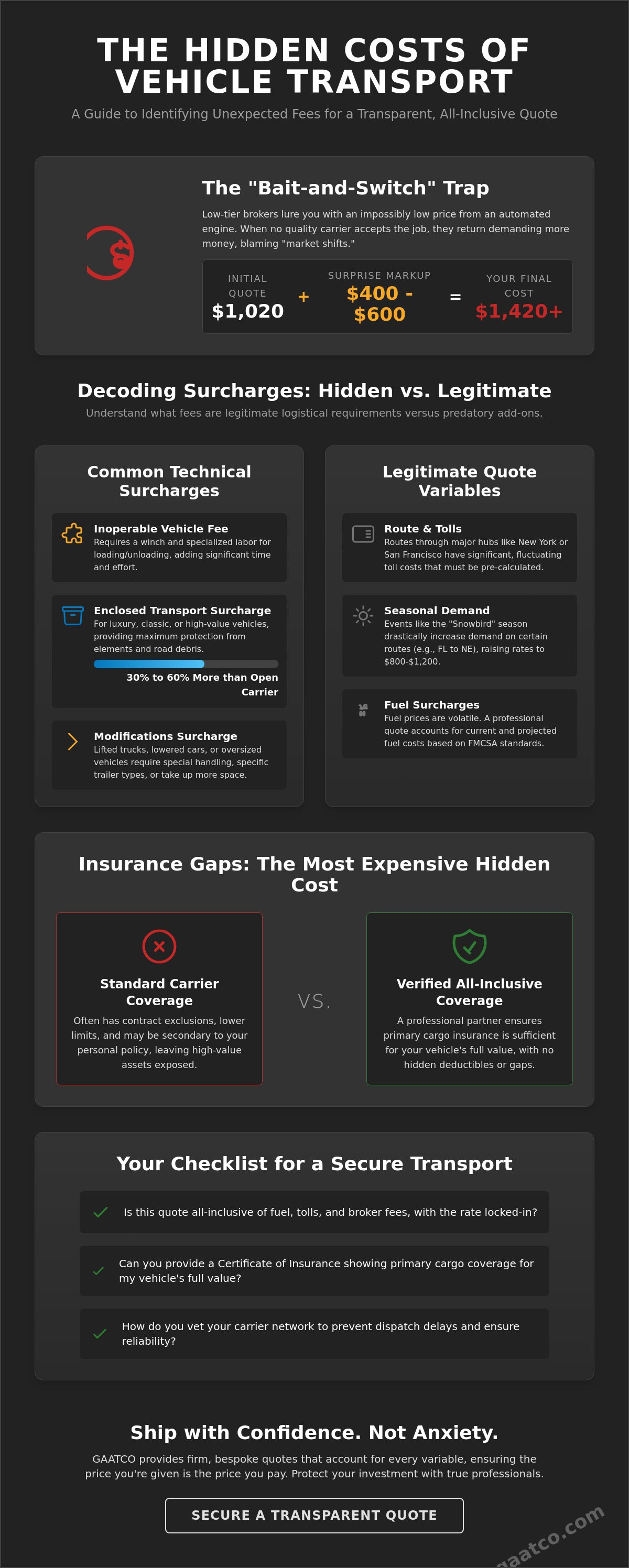
The "Bait-and-Switch" is particularly prevalent in 2026 as operating costs for carriers rise due to stricter FMCSA enforcement and new fuel efficiency standards. A broker might offer a price that seems attractive, but they often lack a dedicated carrier to fulfill it. When no professional driver accepts the low-paying load, the broker returns to you, claiming market shifts require an additional $400 to $600 to move the car. This isn't a market shift; it's a failure of transparency. Transparent pricing is a quote that includes all terminal, insurance, and fuel fees.
To better understand how professional logistics providers distinguish themselves from low-tier options, watch this helpful video:
The Anatomy of a Low-Ball Quote
Automated engines frequently fail to account for the market volatility seen in 2026. When a quote is set too low to attract a quality carrier, your asset sits in limbo. This is known as a dispatch delay. These delays aren't just inconvenient; they're a symptom of a broker who hasn't properly assessed the market. We utilize our 20 years of experience to provide firm, bespoke estimates. Our rates reflect the actual cost of securing premium carriers who prioritize safety over volume. Market rates are firm. Quality is non-negotiable.
Legitimate Variables vs. Hidden Traps
It's essential to distinguish between predatory fees and legitimate logistical expenses. Transporting a vehicle through hubs like New York or San Francisco involves significant toll fluctuations that must be factored in from the start. Seasonal shifts also play a critical role. During the 2026 "Snowbird" season, routes from Florida to the Northeast typically range between $800 and $1,200 for open carriers. A professional request for a quote should account for these spikes and the current 2026 fuel surcharges. Our projected average fuel economy for model year 2026 vehicles is 40.4 miles per gallon, a factor that influences long-haul logistics. By understanding these dynamics, you can avoid the hidden costs of vehicle transport and ensure a seamless experience for your asset.
Technical Surcharges: Vehicle Condition and Modifications
Precision is the hallmark of professional logistics. When you initiate the request-quote process, the technical specifications of your vehicle dictate the operational requirements of the transport. Many clients are unaware that physical modifications or the mechanical state of an asset can trigger legitimate surcharges. These aren't arbitrary fees. They reflect the specialized equipment and additional labor required to ensure a safe transition. Unfortunately, some brokers omit these details initially to present a lower price, a tactic often associated with unscrupulous business practices within the broader logistics sector. True transparency requires a comprehensive understanding of these technical variables to avoid the hidden costs of vehicle transport.
The Cost of Inoperable Vehicle Transport
Shipping a non-running vehicle is a complex logistical task. Standard car carriers rely on the vehicle's own power to navigate ramps. If a vehicle cannot move under its own power, the carrier must utilize specialized winch equipment. This process demands significantly more time and physical labor during both loading and unloading. It's common for carriers to charge a dedicated fee for this service because it limits their efficiency and requires specific trailer configurations. Additionally, if an inoperable vehicle cannot be moved promptly at a terminal, it may incur storage fees. We ensure these contingencies are managed within your bespoke quote to prevent any surprises at the destination.
Modified Vehicles and Specialized Equipment
Vehicle modifications often alter the spatial requirements of a transport trailer. For instance, lift kits and roof racks increase the total height of a vehicle, which may prevent it from fitting on a standard multi-car carrier. This requires the dispatcher to secure a specific spot on the trailer or use a different trailer type entirely, affecting the final price. Managing these technical surcharges effectively is the only way to eliminate the hidden costs of vehicle transport from your logistical planning.
Conversely, performance cars with low ground clearance present a different challenge. These vehicles require specialized lift-gate enclosed trailers or extended ramps to avoid undercarriage damage. While enclosed transport typically costs 30% to 60% more than open carriers, this premium ensures the safety of low-profile assets. The weight of modern Electric Vehicles (EVs) is also a critical factor in 2026. Because EVs are substantially heavier than their internal combustion counterparts, they reduce the total number of vehicles a carrier can legally transport. Disclosing these details early allows us to provide a seamless experience. You can explore our tailored transport services to see how we handle these specialized requirements with the care your asset deserves.
The Broker Spread and Market Dynamics
Reliability in vehicle shipping depends on a delicate balance between the client, the broker, and the carrier. While many clients view a quote as a fixed price, it's often a starting bid in a digital auction. The "broker spread" represents the difference between the total amount you pay and the fee the actual driver receives. When this margin is too wide, the driver's compensation falls below market standards. This often results in carrier cancellations as drivers prioritize higher-paying loads. These delays are the true hidden costs of vehicle transport. They cost you time, peace of mind, and logistical certainty.
Choosing a licensed and insured logistics partner is essential for high-stakes transport. We operate as a bridge between your needs and a vetted network of elite carriers. Unlike low-tier brokers who prioritize volume, we focus on securing drivers who maintain premium equipment and impeccable safety records. The cheapest quote often carries the highest indirect costs. A low price may lead to your vehicle sitting at a terminal for weeks while more profitable freight takes priority. In the 2026 market, quality handling requires fair compensation for the professionals behind the wheel. We don't compromise on the integrity of the transit.
Understanding the Broker Markup
Traditional brokers often auction your shipment to the lowest bidder to maximize their own profit. This creates a direct correlation between carrier pay and the quality of vehicle handling. If a driver is underpaid, they may be forced to cut corners on safety or maintenance to remain profitable. We maintain a commitment to transparent carrier relations and fair pricing. By ensuring our carriers are compensated appropriately, we secure priority scheduling and meticulous care for every asset. It's a partnership built on mutual respect and operational excellence. This ensures your vehicle is never treated as mere commodity cargo.
Market Fluctuations and Guaranteed Windows
Market realities in 2026 dictate that geography and timing significantly influence pricing. Route density is a primary factor. For instance, shipping from Illinois to California, a journey of approximately 2,100 miles, typically costs between $1,200 and $1,550 for open transport as of January 2026. However, shipping to a less dense hub like Seattle may require a premium compared to a high-volume destination like Dallas. We balance bespoke logistics with these market fluctuations to offer realistic, guaranteed windows. If you require expedited shipping with a guaranteed pickup date, it will involve a higher initial investment. This transparency prevents the "bait-and-switch" tactics common in the industry and ensures your vehicle arrives exactly when expected.
Insurance Gaps: The Most Expensive Hidden Cost
Financial exposure often remains invisible until an incident occurs. While a transport quote covers the logistics of movement, the quality of the underlying insurance policy is what truly defines the value of the service. Many owners discover the hidden costs of vehicle transport only after a claim is denied due to "secondary" coverage limitations or common contract exclusions. Standard carrier policies frequently exclude damage from "Acts of God," such as hail or wind. They also typically won't cover loose parts or the 100-pound limit of personal items allowed in the vehicle. Understanding these nuances is essential for protecting a high-value asset.
The distinction between primary and secondary cargo insurance is critical. Primary coverage pays out first, whereas secondary coverage only applies after your personal auto insurance is exhausted. This can lead to increased premiums and out-of-pocket deductibles that weren't part of your initial financial planning. We mitigate these risks by implementing high-limit insurance protocols. Our vetted network ensures that every transport is backed by comprehensive primary coverage, acting as a definitive safety net for your investment. You can secure your vehicle's journey with our professional oversight.
Evaluating Carrier Insurance Limits
Verification is a non-negotiable step. In 2026, the FMCSA has shifted toward data-driven oversight, making it easier to verify a carrier's active insurance status. It's vital to request a Certificate of Insurance (COI) and check it against the carrier's DOT number. Standard open-carrier limits are often capped at $100,000. This is frequently insufficient for modern luxury SUVs or classic performance cars. We maintain a rigorous vetting process to ensure our partners carry limits that reflect the actual market value of the cargo they transport. Peace of mind isn't an add-on. It's a requirement.
The "Door-to-Door" Liability Chain
The Bill of Lading (BOL) serves as the legal foundation for any insurance claim. It records the precise condition of your vehicle at both pickup and delivery. A meticulous pre-transport inspection is necessary to ensure that minor imperfections aren't used to dismiss legitimate transit damage as "pre-existing." By utilizing door-to-door shipping, we minimize the number of times your vehicle is handled. This direct chain of custody reduces the risk of damage compared to terminal-to-terminal models. It's a seamless approach that prioritizes the integrity of the asset from start to finish.
Securing a Transparent Vehicle Transport Solution
Transparency in logistics isn't a matter of chance; it's the result of meticulous operational planning and professional integrity. To effectively eliminate the hidden costs of vehicle transport, you must look beyond the simplified figures provided by automated quote engines. A truly professional estimate functions as a binding commitment that accounts for every variable, from the specific technical requirements of your vehicle to the current 2026 market dynamics. Before you authorize a deposit, it's essential to secure a comprehensive contract that details every aspect of the transit. This document serves as your definitive protection against the volatility often found in lower-tier brokerage models.
How to Compare Quotes Like a Professional
Evaluating multiple shipping options requires a disciplined approach to data. A professional doesn't just compare the total cost; they dissect the components of the quote. When reviewing your options, you should insist on a clear breakdown of the carrier's pay versus the service fees. This transparency ensures that the driver is fairly compensated, which is the primary factor in securing a reliable and safe transit. You should also verify that the following elements are included in the final figure:
- Fuel Surcharges and Tolls: Fuel costs are a primary variable in 2026. With the projected average fuel economy for model year 2026 vehicles reaching 40.4 miles per gallon, carriers are adjusting their long-haul rates. Ensure these surcharges are fixed within your quote.
- Accessorial Charges: Confirm that residential pickup, delivery, and any necessary lift-gate services for low-clearance vehicles are accounted for in the initial price.
- Insurance Verification: Verify that the quote includes primary cargo insurance with limits that reflect the actual market value of your asset.
The GAATCO Advantage: Seamless Reliability
Navigating the complexities of United States logistics requires more than just a network of drivers; it demands the seasoned expertise that only 20 years of industry experience can provide. We've built our reputation on a foundation of reliability and quiet luxury, offering a service that prioritizes the client's peace of mind above all else. Whether you're coordinating the transport of a single classic motorcycle or managing the movement of complex military fleets, our team provides a bespoke solution tailored to your specific operational needs. We handle the intricacies of the road so you don't have to. It's a premium experience designed for those who value excellence and discretion. Experience the difference of a dedicated logistics partner and request your transparent, professional transport quote today.
Elevating Your Logistical Standards
Achieving a seamless transport experience requires a commitment to transparency that many providers simply cannot match. By identifying the technical variables and insurance nuances discussed, you've moved beyond the uncertainty of automated quotes. You now possess the insight to recognize the hidden costs of vehicle transport before they impact your final invoice. True value is found in the meticulous vetting of carriers and the assurance of comprehensive primary coverage for your high-value assets. Professionalism is not an option; it's the foundation of a safe arrival.
Our team leverages over 20 years of industry expertise to provide a service defined by reliability and quiet luxury. As specialists in high-value and classic vehicle logistics, we maintain a licensed and fully insured carrier network that prioritizes the safety of every asset. We invite you to experience a logistics partnership where every detail is managed with sophisticated precision. Secure Your Professional, Transparent Transport Quote today. We look forward to providing the dedicated support and peace of mind your vehicle deserves.
Frequently Asked Questions
Are fuel surcharges always included in my initial transport quote?
Reputable logistics providers provide all-inclusive quotes that incorporate current fuel surcharges as a standard practice. In 2026, market volatility and the SAFE Vehicles Rule have made fuel costs a significant variable in long-haul transport. If a quote seems unusually low, it may lack these essential fees, leading to a higher final bill. These omissions are among the most common hidden costs of vehicle transport found in low-tier brokerage models.
What happens if my car is considered "inoperable" at the time of pickup?
An inoperable vehicle requires specialized equipment, such as a winch or forklift, to facilitate loading and unloading. You should disclose this status during the initial consultation to ensure the carrier arrives with the necessary machinery. Failure to do so often results in a "non-running" fee or a refusal of service at the point of pickup. Transparency regarding the vehicle's mechanical state ensures a seamless experience for all parties.
Does the transport price change if I have personal items in the car?
Most carriers allow up to 100 pounds of personal items within the trunk of the vehicle at no additional cost. However, excessive weight can impact the carrier's legal load capacity and fuel efficiency. It's important to remember that these items are not covered by cargo insurance policies. We recommend removing all valuable belongings prior to transport to avoid potential loss or damage that falls outside of standard coverage.
Is there an extra fee for door-to-door delivery in major cities like New York or Miami?
Door-to-door delivery in high-density areas like New York or Miami often involves supplemental charges due to regional tolls and restricted commercial access. Large transport trailers cannot navigate narrow residential streets or low-clearance bridges. In such cases, the carrier may coordinate a meeting at a nearby accessible location to ensure a safe delivery. A professional quote will account for these regional nuances before the transit begins.
How much extra does enclosed car transport cost compared to an open carrier?
Enclosed vehicle transport typically costs between 30% and 60% more than standard open carrier services. This premium covers the added protection from road debris and weather elements, which is essential for luxury or classic assets. While the investment is higher, it provides the highest level of security for vehicles with significant market value. The choice between open and enclosed transport should reflect the specific needs of your vehicle and your expectations for safety.
Can a carrier charge me more after they have already picked up my vehicle?
A professional logistics partner will honor the agreed-upon price once the contract is signed and the vehicle is in transit. However, unscrupulous brokers may attempt to add surcharges after pickup, a practice that highlights the hidden costs of vehicle transport. You should always verify your contract terms and ensure your provider is a licensed and reputable firm. A guaranteed price that doesn't fluctuate is the hallmark of a premium service provider.
What is a "Bait-and-Switch" quote, and how can I spot one early?
A "Bait-and-Switch" quote is an artificially low estimate designed to secure a deposit before a carrier is actually assigned. You can spot this if the price is significantly lower than the 2026 industry average of $1.02 per mile for a 1,000-mile trip. If a broker cannot name a specific carrier or provide a firm, all-inclusive contract, the price will likely increase once a driver is finally located. Professionalism requires honesty from the first interaction.
Does my personal auto insurance cover my car while it is on a transport trailer?
Most personal auto insurance policies don't provide comprehensive coverage for vehicles while they are on a commercial transport trailer. You must rely on the carrier's primary cargo insurance for protection against transit-related damage. We recommend requesting a Certificate of Insurance (COI) to verify that the policy limits are sufficient for your vehicle's current value. Understanding the liability chain is a critical step in securing a transparent and safe transport solution.


