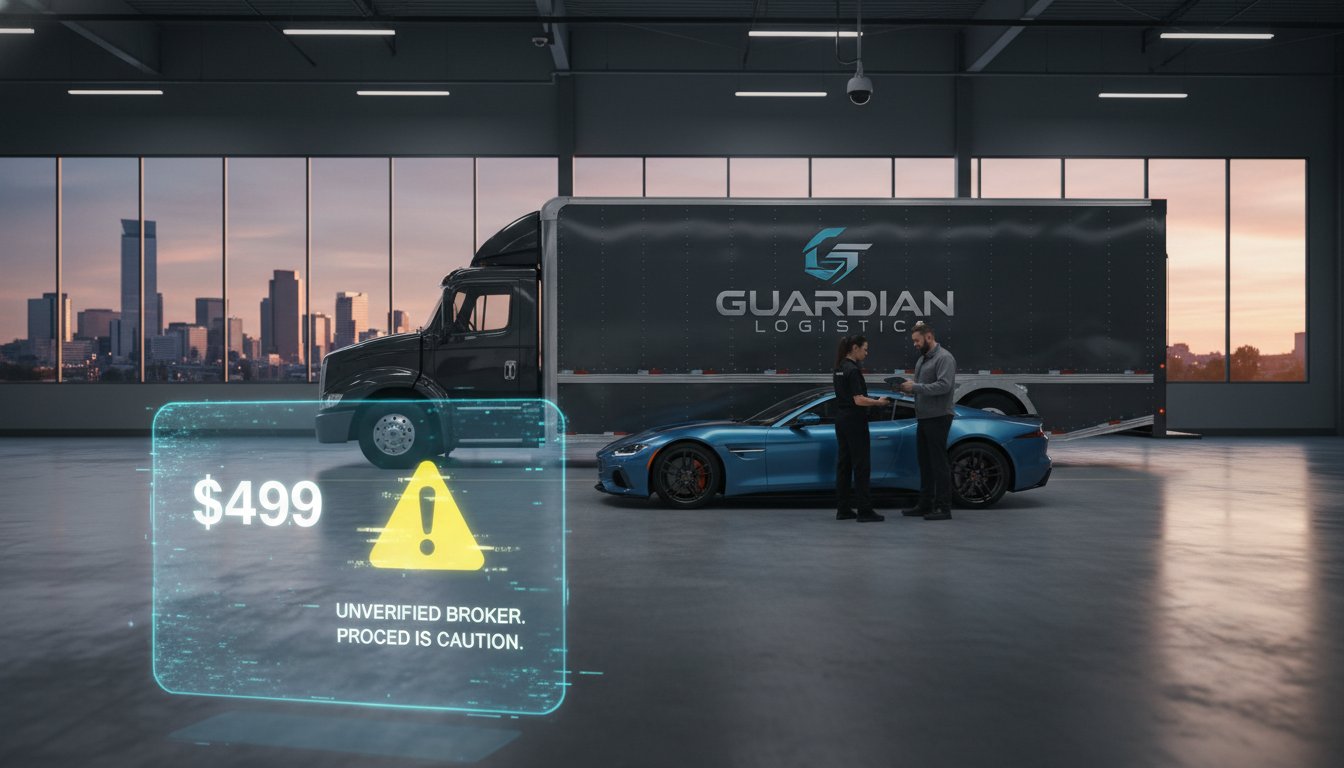
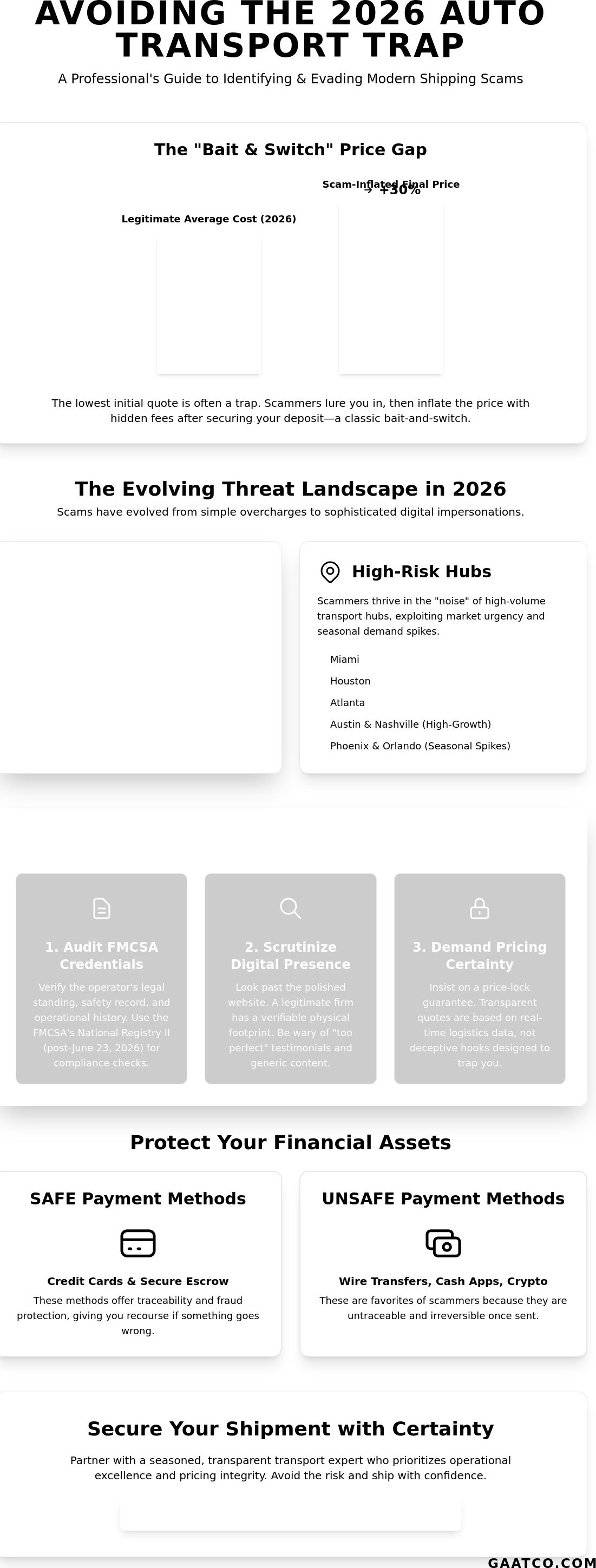
What if the most professional-looking quote in your inbox is actually a sophisticated digital facade designed to bypass modern security protocols? While the average car shipping cost is approximately $1,150 in 2026, many clients find themselves trapped by bait-and-switch tactics that drive prices 30% higher after the contract is signed. Identifying common car shipping scams to avoid 2026 requires more than a casual glance at a website; it demands an understanding of the FMCSA's latest digital compliance standards and a commitment to rigorous verification.
You likely agree that transporting a vehicle should be a discreet, reliable process defined by certainty rather than hidden fees or digital payment risks. We've developed this guide to provide you with the professional clarity needed to secure a seamless logistics experience. We'll examine the operational impact of the National Registry II implementation on June 23, 2026, and provide the specific verification steps required to ensure your chosen carrier is both legally compliant and operationally sound.
Key Takeaways
- Identify the digital signatures of "Ghost Brokers" who use AI-generated platforms to impersonate legitimate logistics firms.
- Recognize why the lowest initial quote often signals a "bait-and-switch" tactic designed to secure deposits before demanding additional fees.
- Master a professional framework for auditing FMCSA credentials to verify an operator's legal standing and safety record.
- Protect your financial assets by avoiding untraceable payment methods when navigating common car shipping scams to avoid 2026.
- Discover the value of a transparent, seasoned transport partner who prioritizes operational excellence and pricing certainty.
The Evolution of Auto Transport Deception in 2026
The landscape of vehicle logistics has shifted. In previous years, scams were often crude attempts at overcharging or simple clerical errors. By May 2026, these threats have evolved into high-tech digital impersonations that target even the most discerning clients. Scammers now leverage advanced automation and sophisticated site builders to create "Ghost Brokers." These entities appear as elite firms with decades of history, yet they possess no actual fleet or operational capacity. They often mimic the visual identity of established providers, making common car shipping scams to avoid 2026 significantly harder to detect than in the past.
This evolution mirrors trends seen among reputable moving companies, where digital trust is the primary currency. Scammers don't just want your deposit; they often seek to harvest sensitive data through the identity theft of legitimate carriers. This sophisticated approach allows them to operate in the shadows of the industry's busiest corridors, using the complexity of modern logistics as a shield for their deceptive activities.
To better understand the mechanics of these modern deceptions, watch this helpful video:
Digital Impersonation and AI-Generated Logistics Sites
Scammers in 2026 use artificial intelligence to generate deepfake customer testimonials that look and sound entirely authentic. These "too perfect" digital presences often lack a verifiable physical footprint or a history with the FMCSA. While a professional firm like GAATCO maintains a transparent, long-standing record, these digital clones can vanish in minutes once a client's funds are secured. It's vital to look for a consistent operational history rather than just a polished web interface. If a company's social proof seems too uniform or lacks specific regional nuances, it's likely a synthetic facade.
Why Major Hubs Like Miami and Houston are Targeted
Major logistics hubs like Miami, Houston, and Atlanta are primary targets for these activities. The sheer volume of transport requests creates a "noise" that allows fringe brokers to hide. In cities like Phoenix or Orlando, seasonal demand spikes during the summer can increase shipping costs by $200 to $300. Scammers exploit this urgency by offering "guaranteed" lower rates that simply don't exist in the current market. For those seeking bespoke logistics services, verifying the local operational reality of a carrier is the only way to avoid these high-volume traps. A legitimate partner won't hide behind a digital screen; they'll provide clear, verifiable data regarding their presence in these major hubs.
Myth vs. Reality: Debunking the 'Lowest Quote' Guarantee
Many clients view vehicle logistics as a simple commodity where the lowest price represents the highest value. This is a dangerous fallacy. In May 2026, the economic reality of transport makes "guaranteed" low rates nearly impossible for legitimate carriers to sustain. For instance, a 3,000-mile journey from Seattle to Boston requires a precise balance of fuel surcharges, driver wages, and equipment maintenance. Professional firms understand that cutting corners on these costs compromises safety. Understanding common car shipping scams to avoid 2026 starts with recognizing that an artificially low quote is rarely a bargain. It's usually the first step in a predatory cycle that ends with significant financial loss.
The 'Bait and Switch' Pricing Trap in High-Traffic Corridors
In high-growth cities like Austin and Nashville, the demand for relocation services has reached record levels. Scammers exploit this urgency by providing a low-ball quote to secure a deposit. Once the vehicle is scheduled for pickup, they claim an "emergency surcharge" is necessary due to carrier availability or fuel price fluctuations. The U.S. Department of Transportation has identified several red flags of moving fraud that specifically highlight these last-minute price hikes. A premium service provider offers a price lock because their logistics network is stable. Their pricing is based on real-time data, not deceptive hooks meant to trap the unwary.
Understanding the Logistics Costs from Houston to San Diego
Shipping a vehicle across the 1,500-mile corridor from Houston to San Diego involves complex variables that a simple algorithm cannot always predict. These factors dictate the final cost of a secure shipment:
- Vehicle Dimensions: Larger SUVs or modified trucks occupy more "slot" space on a trailer, which naturally increases the per-mile rate.
- Fuel Indices: As of May 2026, fuel remains a volatile component. Legitimate quotes must account for these fluctuations to ensure the carrier is fairly compensated.
- Transport Type: Choosing enclosed car transport typically costs 30% to 60% more than open transport. This premium reflects the added security and protection provided for luxury or classic assets.
Flat rates often signal a lack of professional logistics planning. They fail to account for the $150 to $300 surcharge typically required for inoperable vehicles. They also ignore the seasonal shifts that can add $200 to $300 to a summer trip. If you require certainty for your next relocation, it's best to start with transparent pricing from a verified expert who understands these nuances.
Sophisticated Payment Scams and Escrow Fraud in 2026
Security in financial transactions is the cornerstone of professional logistics. As of May 2026, the rise of untraceable digital payment platforms has provided new avenues for deception. Identifying common car shipping scams to avoid 2026 requires a critical look at how a company requests funds. Scammers often employ "Fake Escrow" services. These are websites designed to mimic official financial intermediaries. They promise to hold funds until delivery but are actually controlled by the fraudulent entity. This creates a false sense of security for the client while the scammer prepares to vanish with the capital. Professional firms never use third-party sites that lack a verifiable corporate history or banking affiliation.
The Danger of 'Instant' Wire Transfers and Cryptocurrency
Scammers frequently pressure clients in high-demand markets like Las Vegas or Phoenix into making "urgent" payments. They often insist on cryptocurrency, Zelle, or other peer-to-peer wire apps. These methods offer zero fraud protection. Once the transaction is finalized, the funds are essentially unrecoverable. There is no recourse through a bank or a central authority. Professional logistics standards dictate the use of secure corporate portals and major credit cards. These offer the consumer protection necessary for high-value asset transport. GAATCO maintains a commitment to financial transparency, ensuring every transaction is traceable and secure. We believe that financial peace of mind is just as important as the physical safety of the vehicle.
Deposit Myths: When is an Upfront Fee Legitimate?
A common misconception is that any upfront fee indicates a scam. In reality, a legitimate booking fee is often required to secure carrier space within a professional network. This deposit secures a specific slot on a trailer, ensuring your timeline is met. However, this transaction should only occur after a formal contract is signed and the company's credentials have been verified. Scammers often demand full payment before providing a DOT or MC number for verification. This is a significant red flag. Always verify that the payment portal's security certificates align with the company's corporate identity. A transparent partner will always provide a clear breakdown of costs and a secure environment for the transaction. They ensure your bespoke logistics needs are met with the highest level of financial integrity. If you're unsure about a quote's validity, you can request a secure quote through our verified channels to ensure a protected experience.
Vetting Your Carrier: A Professional Verification Framework
Verification is the ultimate safeguard against asset loss. Identifying common car shipping scams to avoid 2026 requires a rigorous, multi-layered audit of a provider's legal and physical standing. A professional firm doesn't just provide a Motor Carrier (MC) number; they welcome the scrutiny of their operational history. As of February 2026, the FMCSA significantly increased civil penalties for falsifying records, with maximum fines reaching up to $19,000 per violation. This regulatory shift makes it easier to spot legitimate operators who adhere to the highest safety standards. Your vetting process should move beyond surface-level aesthetics to confirm the reality behind the digital facade.
Beyond Google Reviews: Verifying FMCSA and MC Credentials
The first step in any professional audit is utilizing the Safety and Fitness Electronic Records (SAFER) system. You must verify that a carrier's insurance is not only active but sufficient for the total value of your vehicle. Be particularly wary of "reincarnated carriers." These entities close their doors following safety violations and reopen under a new name to hide a poor track record. A reliable partner will show a consistent history of compliance, including the use of Electronic Driver Vehicle Inspection Reports (DVIRs), which the FMCSA formally clarified as legally unambiguous on February 19, 2026. Furthermore, you should cross-reference the company's registered address in hubs like Atlanta or Chicago. If the location is a residential home or a virtual mailbox service, it's a clear red flag that the company lacks the infrastructure to manage complex logistics.
Local Logistics Check: Vetting Companies in Dallas or San Francisco
Local expertise is a critical pillar of safe transport. A firm operating in San Francisco or Dallas must understand the specific regional challenges, from strict port regulations in Seattle to the high-volume traffic corridors of Southern California. When vetting a provider, ask for local references or established dealer partners within your specific metropolitan area. A seasoned expert will have a deep understanding of regional carrier lanes and the nuances of local delivery. They won't rely on AI-inflated ratings or "review bombing" tactics to build trust. Instead, they rely on a documented history of successful deliveries. This level of transparency is what differentiates a premium logistics partner from a fly-by-night operation. If you require a partner who prioritizes safety and legal compliance, you can explore our comprehensive logistics services to see how we maintain these non-negotiable standards.
Confirming a carrier's medical compliance is also essential. As of June 23, 2026, the FMCSA’s National Registry II is fully operational. Legitimate carriers must now verify a driver's medical status through their Motor Vehicle Record (MVR) rather than relying on paper certificates. If a provider cannot confirm their drivers' medical standing through this digital system, they're likely operating outside of current federal mandates. This attention to detail ensures that your vehicle is in the hands of a professional who respects both the law and your property.
Securing Your Vehicle Shipment with GAATCO
Choosing a transport partner in an era of digital deception requires a commitment to established expertise. GAATCO stands as the professional antithesis to the common car shipping scams to avoid 2026 that currently proliferate across major logistics hubs. With over 20 years of dedicated industry experience, we've built a reputation for reliability that fly-by-night operations simply cannot replicate. We provide a seamless, bespoke logistics solution that prioritizes the safety of your asset, whether you're transporting a daily sedan or a rare luxury classic. Our approach is defined by a calm confidence that comes from mastering the complexities of vehicle movement so you don't have to.
The GAATCO Approach: Transparent Logistics and Verified Networks
Our commitment to excellence begins with a meticulous vetting process for every carrier within our network. We don't just verify a DOT number; we conduct a comprehensive audit of insurance coverage and safety records. While many entities struggle with the FMCSA's February 19, 2026, mandate regarding Electronic DVIRs, we've already integrated these digital standards into our operational core. This focus on transparency ensures that your vehicle remains in a secure, professional environment from the moment of pickup to its final destination. We maintain a physical presence and a dedicated team of experts who understand that logistics is a human-centric service operating behind sophisticated machinery. Our global network allows us to provide local expertise in high-volume corridors like Miami and Houston, ensuring your vehicle is never lost in the "noise" of busy ports.
Requesting a Bespoke Quote for Secure Transport
When you contact our team, you'll find a discreet environment focused on professional advice rather than high-pressure sales tactics. We understand that the needs of military personnel, private collectors, and corporate clients are inherently different. We tailor our services to meet those specific requirements, providing certainty in pricing that eliminates the risk of common car shipping scams to avoid 2026. You'll receive a clear breakdown of costs that reflects the current economic reality of May 2026 without hidden surcharges or vague fees. Whether you require enclosed transport for a high-value asset or standard open shipping for a corporate relocation, we ensure the process is handled with the same level of seriousness and attention to detail. Secure your peace of mind and protect your investment by requesting a professional transport quote from a partner you can trust.
Ensuring Excellence in Your Next Vehicle Transport
Identifying common car shipping scams to avoid 2026 is a critical prerequisite for any successful relocation or asset transfer. By prioritizing verified FMCSA credentials and rejecting the lure of untraceable payment methods, you effectively insulate yourself from the digital deceptions of "Ghost Brokers." The shift toward high-tech compliance, such as the National Registry II fully implemented on June 23, 2026, underscores the necessity of choosing a partner that remains ahead of regulatory curves. Real-world operational history and a physical presence in major hubs will always outweigh a polished, AI-generated digital facade.
GAATCO provides the stability of over 20 years of logistics expertise and an A+ rated professional service across the United States. Our fully licensed and insured carrier network is built on the non-negotiable pillars of safety and transparency. We manage every intricate detail of the transport process so you don't have to navigate the complexities alone. You deserve a seamless experience defined by elite care and pricing certainty. Request a Bespoke Auto Transport Quote from GAATCO today and secure your vehicle with a trusted advisor who values your property as much as you do.
Frequently Asked Questions
What are the most common car shipping scams to avoid in 2026?
The most prevalent common car shipping scams to avoid 2026 involve sophisticated "Ghost Brokers" who use AI to clone the digital identities of licensed carriers. These entities present a polished facade to lure clients into non-traceable payment schemes. Additionally, "bait-and-switch" pricing remains a significant threat, where a low initial quote is followed by a mandatory surcharge at the time of pickup once the vehicle is already in the carrier's possession.
Is it normal for an auto transport company to ask for a deposit?
It is a standard industry practice for a legitimate broker to request a booking fee to secure a slot in a carrier's schedule. However, this payment should only occur after you've received and signed a formal contract. A reputable firm won't demand full payment upfront or require funds before providing their FMCSA registration details for your independent verification. Always ensure the deposit is processed through a secure corporate portal rather than a peer-to-peer app.
How can I verify if an auto transport broker is legitimate?
You can verify a broker's legitimacy by cross-referencing their Motor Carrier (MC) and DOT numbers through the FMCSA’s SAFER system. A professional provider will also have a verifiable physical office address rather than a residential location or a virtual mailbox. Check that their registration status is "Active" and that their bond filings are current. Legitimate firms are transparent about their operational history and welcome scrutiny from their clients.
Why is my car shipping quote so much lower than other companies?
An exceptionally low quote often signals a lack of professional logistics planning or a planned "bait-and-switch" tactic. Legitimate transport costs are dictated by current fuel indices and carrier availability, which rarely allow for extreme price variations. If a quote is significantly below the $1.50 to $2.50 per mile average for short trips seen in May 2026, it's likely a deceptive hook meant to secure your deposit before the price is increased later.
Can I track my vehicle during transport to ensure it hasn't been hijacked?
Most premium carriers now provide real-time tracking through Electronic Logging Devices (ELDs) and dedicated digital portals. This technology ensures that you can monitor your vehicle's progress across major hubs like Dallas or Atlanta. While constant GPS access isn't universal for all open-carrier shipments, a professional logistics partner will provide regular status updates and a direct line of communication with the dispatcher. This transparency is a hallmark of a secure, professional service.
What should I do if I suspect I've been scammed by a car shipper?
If you suspect a scam, you should immediately file a formal complaint through the FMCSA’s National Consumer Complaint Database. You should also contact your financial institution to dispute any unauthorized charges, especially if the transaction occurred via a credit card. Reporting the incident to the Better Business Bureau and local law enforcement in the company's registered city can help prevent future fraudulent activity. Acting quickly is essential to recovering funds and protecting other consumers.
How do I check a carrier's insurance and FMCSA license?
You can check these credentials by visiting the FMCSA’s "Company Snapshot" portal online. This database provides a public record of a carrier's safety rating and their insurance coverage levels. It's essential to verify that the policy is active and matches the corporate name on your contract. Legitimate firms are required by federal law to maintain these filings to operate legally within the United States, and they'll never hesitate to provide proof of coverage.
Are there specific scams targeting car shipping in New York or Miami?
Scammers in New York and Miami often exploit port congestion and high-volume routes to justify fake "priority loading" fees. They may claim that an additional $400 is required to bypass a non-existent backlog at the terminal. These regional tactics are common car shipping scams to avoid 2026, particularly during the peak summer months when demand for transport between the Northeast and Florida reaches its highest point. Always verify terminal status independently before paying any "expedited" surcharges.


